

Matt Singleton
10 posts


@OfficialXYO This is the reaction to a comment. Just sold my 300k coins. Im out of this hype fugazi

English

Decentralization isn’t just a buzzword—it’s the foundation of the future. 🌐
Start today 👉 xyo.network
Here is why 👇🏻
At $XYO, we’re tackling real-world challenges, from data ownership to location verification, using blockchain technology. Join the project that’s building a better, more transparent world.
English

From:
Scott P. Scheper
Rancho Santa Margarita, Calif.
Thursday, 2:22 p.m.
Dear XYO Spatial Miners,[1]
The tl;dr of this update is this: it's happening.
I've assembled a team that is integrating XYO into Teslas.
Quite frankly, I'm not concerned with the type of people who want tl;dr news. I'm writing to those of you who are creators, futurists, and participants—in other words, builders—meaning people who want to build a future where Teslas can pay for themselves with crypto.
If that's you, read on. Otherwise, I wish you nothing but the absolute best. (Seriously. I'm just not for you.)
In this announcement we are going to cover more details of what I've hinted at previously. Furthermore, this will act as a roadmap for the months ahead.
The overall vision is this...
We are building an army of Teslas that mine spatial data for DOGE. The backend of the platform will be powered by the XYO protocol and secured by the XYO token.
There is a lot to unpack in the above statement, and I'm going to spend the rest of this update doing just that—while also sharing several other exciting pieces of news.
First, let's start with what I mean by "we." As I've said previously, I've assembled a team independent of XY Labs, Inc., which remains the largest contributor to the open XYO protocol (which is managed and maintained by the XYO Foundation).
Just as the independent company Consensys develops for the open Ethereum protocol, my independent company is developing for the open XYO protocol. For some reason, this seems to befuddle some people—yet, this is quite common within the blockchain ecosystem.
Crypto assets and blockchain protocols rely on independent developers to build on their platforms. One need only spend a few seconds on XYO Foundation's website to see their desire to attract developers to build on their network.
As the Co-Founder of XYO, it holds a special place in my heart. In addition, I'm very familiar with its technical principles (given that I co-authored and helped conceive its white paper). This is why I've chosen to develop on the XYO protocol instead of other blockchain projects.
Like the company Conensys, the brand of the platform we're building will not include the underlying technology we're focused on. That is, the name of my company and platform will not contain "XYO" in its brand.
The brand, website, and domain have been chosen, and they will be unveiled in a future product update.
Now, let's talk about the architecture of what we're building here. If you have not yet read the white paper that Arie, Markus, and I wrote, then this may be a bit foreign to you. In brief, there are four primary components of the XYO Network.[2] Here is how they will look in the Tesla integration:
1. Sentinels
In our network, Teslas act as a native sentinel (not a phone or an app that you must leave open). Once integrated, your Tesla will mine spatial data from its environment.
Spatial data includes geolocation data, trip data, external temperature, internal temperature, battery data, visual data (dashcam data), air quality indicators, humidity, noise, radiation, and many other types of spatial data.
If you've seen the recent movie Twisters, then picture the trucks in the movie—rigged up with all types of sensor data. Our goal, however, is to collect the same type of data—without having to turn your Tesla into a Frankenstein.
This brings me to the next important point:
There are two layers of spatial data:
Layer One: Spatial Data via Tesla API
As mentioned previously, we were granted access to Tesla's API, which enables us to assemble spatial data. This includes geolocation data, weather data, trip data, battery data, directional data, and more.
Layer Two: Spatial Data via Hardware Integrated Into Tesla
In addition to Tesla's API, there are other ways to mine spatial data from the environment.
In my green cybertruck (aka, the "XYO Cybertruck"), there sits a device that integrates directly into the Tesla dashcam. (This is an open hardware device that you can purchase from any vendor.) In addition to this, there is an entire world of IoT hardware sensors that can also be attached—like modules—to mine even more data from the environment (air quality data, humidity, noise, and more).
This brings me to another important point—the hardware needed for our network is NOT proprietary. The network is built on open hardware that follows the "maker" philosophy. It can be purchased cheaply from any vendor for $40 - $100.
This brings us to the second component of our XYO Network:
2. Bridges
With all the spatial data being mined from the environment, the next question is how to transport that data back to the network (i.e., the "bridge").
There are two ways data is bridged:
Layer One: With the Tesla API, it's trivial. Tesla handles the transport of the vehicle's spatial data back to our server (Archivist, the next component) via their API.
Layer Two: Within the Tesla, connected via USB, is the open hardware device, which—once connected to WiFi—transports the spatial data back to the server (the Archivist).
If you are driving a Model S3XY, then you need to wait until you're home to connect to WiFi (to bridge the data back to the network). However, if you have a Cybertruck, you can integrate a Starlink in order to constantly upload the data without waiting.
Right now, in my green XYO Cybertruck, there sits a Starlink Standard Kit hooked up and connected to a network of Starlink satellites. (We're currently testing the Starlink Standard, which has a higher reported upload speed than the Starlink Mini). From my Cybertruck, Dashcam data and other spatial data is broadcasted from the Starlink up to the Starlink satellites and into the Archivist (next component).
This brings me to today's visit at the Tesla hardware installation center. The question is—how do we seamlessly integrate this hardware, the IoT sensors, and the Starlink Standard onto the XYO Cybertruck—without (a) it looking like a Frankenstein, and (b) being cost-effective and maker-friendly.
After today's meeting, I will say this: First off, my contact (who runs the team) is extremely excited about this integration, and second—they have agreed to do a test run and create something to make this more seamless. (i.e., so that your Cybertruck doesn't have a Starlink constantly sticking out its back, but can be tucked away—same with IoT sensors).
That's all I can disclose for now. The bottom line: They're pumped and I have another meeting scheduled soon.
This brings us to the next component:
3. Archivists
The Archivist acts as the data warehouse of all spatial data. Picture it kinda like Archive.org—except, instead of storing snapshots of websites over time, it stores snapshots of the world over time.
This data is stored in the network and becomes increasingly valuable with scale. (Think about having the spatial data of all 6.7 million Teslas in the world.)
This brings us to the final component of the XYO Network:
4. Diviners
The purpose of the diviner component is to fetch data from the Archivist based on a given query. (See page 5 of the white paper.)
In our network, there are two main Diviner interfaces:
I. End User Web3 App
For our users, they will be able to login to our Web3 app using their Tesla login credentials. From there, they can manage and view the spatial data they mine by each vehicle they own.
In order to opt a Tesla vehicle into the network, you are required to stake XYO. This will be done by connecting a Web3 wallet (e.g. Metamask).
Staking XYO is where the magic starts to come into play. As I announced in my keynote speech at the Spatial Summit, the XYO token acts as an incentive mechanism to provide valid data to the network.
Roughly $500 worth of XYO tokens are required to stake your Tesla vehicle into the network. Once staked, your Tesla will begin earning DOGE for mining spatial data.
One important thing to note—you can unstake your XYO at any time and get 100% of it back. Once staked, your XYO will be locked into an Ethereum smart contract. It is held as collateral to ensure you only provide valid, unspoofed data. Unless you're trying to deliberately hack the protocol and provide false data, you need not worry about losing your stake.
Once you unstake your XYO, you will stop generating DOGE from your Tesla and your XYO balance will be returned to your wallet address in ~23 days.
Before moving on, let's talk briefly about what this does.
First, my team is focused on three milestones:
Milestone 1: 1,000 Tesla vehicles opted into the network mining spatial data.
Milestone 2: 10,000 Tesla vehicles opted into the network mining spatial data.
Milestone 3: 100,000 Tesla vehicles opted into the network mining spatial data.
There are roughly 6.7 million Teslas in the world right now. I believe these milestones are attainable. Once achieved, we will craft three new milestones. Until then, here's the most important point:
With the requirement of $500 XYO per vehicle to stake, that means $500,000, $5 million, and—eventually—$50 million+ XYO will be staked into the network. This is the short-to-medium-term goal.
What this will do will be invaluable to the XYO token economy. It will lock up more XYO and reward those who are committed to building in the long haul. Furthermore, with the 29 day unstaking period, it ensures the XYO token economy will be less subjugated to the wild swings caused by short-term speculators.
With that understood, let's move on to the second Diviner interface——that is, the second portal by which one can query spatial data from the Archivist.
II. Data Partner Diviner API
One of the most critical factors of this undertaking circulates around the following question:
Who will pay for the spatial data being mined by Teslas?
The answer to that is quite simple——and that is——data partners.
Believe it or not, there are many parties who pay for spatial data. To certain parties, specific types of data are extremely valuable. These buyers stem from many industries. For instance, agriculture, insurance, energy, environment, construction, mining, real estate, and government.
Another key buyer avatar is that of hedge funds and commodity traders. With commodity traders, their specific use cases are typically held close to the vest (because their use case serves as their competitive trading edge).
The bottom line is this——there is a robust marketplace of spatial data buyers. However, at this point, I realize it's all talk. That's why I'm delighted to share the following news with you:
On Tuesday, I entered into an agreement with one of the largest geospatial data providers out there. They have agreed to integrate our data into their robust ecosystem of spatial data buyers. They will be white-labeling our platform and providing their buyers with a new stream of valuable data. (There will be a tab in their app that reads "IoT", as well as another integration).
This new data partner will be given access to our Diviner API, enabling them to query and purchase spatial data from our Archivist.
This transitions nicely into the topic of earnings. Let's talk about that now:
Earnings:
Our data partners will be buying the spatial data you mine with your Tesla, and you will be paid in DOGE.
100% of what our data partners pay will be passed onto our spatial miners. There is no "rent fee" or cut that we take. We are incentivized by the healthy growth of the XYO token economy. The more our spatial miners make, the better the XYO token economy. It's that simple.
The next question you may be wondering is—
Why earn DOGE and why not XYO?
Listen—I've been involved in Bitcoin and blockchain since 2011. I've seen a lot of projects come and go. I've been at the forefront of shaping blockchain ecosystems for some time. I recruited the most incredible developer I've met (unsuccessfully several times)—before he finally agreed to join XY (he's the reason COIN exists). I was there in the very beginning drawing up COIN on the whiteboard—heck, I even named it COIN because we wanted to show up at the top spot in the app store when people began typing in "Coinbase" (it worked). Anyway—I'm telling you this to let you know I've been thinking through this stuff for many years. In the beginning, COIN geomined XYO, but eventually, we switched to redeeming ETH and BTC as well. One reason I think it's wise that we switched is because it's harder to get unindoctrinated users to get excited about earning some token they've never heard of (XYO) compared to one they have heard of (DOGE).
The reason we're leading with earning DOGE on the front end is because (1) it will make user acquisition easier, and (2) the favorite coin of Elon Musk is DOGE (which is an important factor for something that will be outlined later).
Now that you understand the strategy behind DOGE as the frontend currency, let's talk about the all-important question:
How much DOGE can you expect to earn per month?
Here are the milestone earnings we're focused on:
Milestone 1: You will earn $9 in DOGE per Tesla per month.
Milestone 2: You will earn $90 in DOGE per Tesla per month.
Milestone 3: You will earn $900 in DOGE per Tesla per month.
The key centers on starting small. We're laser-focused on the first milestone. When people start hearing about their friend earning $9/month+ in DOGE from their Tesla, the network will experience a cascading waterfall of growth.
The third milestone is $900/month, which—I admit—is ambitious. It will involve not only spatial data but also several other mechanisms.
The bottom line: In the beginning, your Tesla will pay for your Apple Music account. In the future, your Tesla will pay for its lease payment (thanks to the spatial data it mines). That is our goal.
As a final note, let's talk about what this will cost you:
First, spatial mining happens in the background—without causing undue drainage of your battery. Your Tesla is already mining spatial data. The only difference is—you can now send it back home to the network where you can earn crypto from it.
Once you set up your vehicle within the Web3 app, and plug in the open hardware device (and optionally, more IoT sensors and a Starlink), there's nothing else you need to do. You don't need to keep a phone app open; your DOGE balance will accumulate in the Web3 app and you can withdraw anytime.
As mentioned, the $500 of staked XYO can be unstaked anytime (and you will receive 100% of it back——unless there was tampering or spoofed data).
Those are the costs. The rewards? Not only DOGE, but—like Shackleton's crew—honor and recognition, as well.
Whew! We've covered a lot.
I will leave off on this—there is a great book called "So Good They Can't Ignore You." Our philosophy going forward is to be so good they can't ignore us.
This means, we need to create an army of Teslas mining spatial data for DOGE. If you're a paperhand speculator, I have no use for you. I'm for those who are builders—those who are creators, futurists, and participants in building an army of spatial mining Teslas.
Let's put it this way...
Actually, I thought about not sharing this part with you (because I can already hear the negative FUDsters decrying I'm some marketer—even though I'm a geek who writes Python half my day, and writes by hand the other half). Anyway, here's the reality—Once our network has proven itself (with at least 1,000+ Tesla spatial miners), I have a direct line of communication that will ensure not only the head of Tesla will know about us, but so will the most crypto-friendly president in history who is about to re-take office.
That's all.
Peace.
And always remember,
To stay crispy, my friend.
Scott P. Scheper
XYO Co-Founder and Spatial Miner
P.S. Going forward, my team and I will be in build mode. I have two more Tesla visits before the end of December, however, I will be moving to a cadence where you will hear one major product announcement from me on the 7th of each month going into 2025. That means, you should not expect to hear another major update until January 7th.
P.S. #2: The next few years should be incredible for innovation within the cryptocurrency and blockchain world. Altcoin season hasn't even started. It's only been memecoin and asscoin season. Get ready for a fun ride ahead. We're just getting started.
P.S. #3: If you want to be part of my army, then listen up—I will be opening 1,000 spots in the beginning (to begin mining DOGE from your Tesla). If you would like to be the very first notified when these spots open up, please join the early enlistment list:
api.greenlamp.com/widget/form/z7…
(Greenlamp is the software platform the form is hosted on.)
Peace.
Footnotes:
[1]: You may have noticed a new salutation ("XYO Spatial Miners"). This was chosen deliberately. I cointed the terms "Geominer" and "Geohacker." They have become synonymous with providing GPS data via the COIN app. This is different from the types of data mining we'll be focusing on. Therefore, I've decided to refer to my people as "Spatial Miners." If you're a creative, futurist, and builder—and—you want your Tesla to mine spatial data for DOGE, then I welcome you aboard.
[2]: XYO Network White Paper. docs.xyo.network/XYO-White-Pape…

English
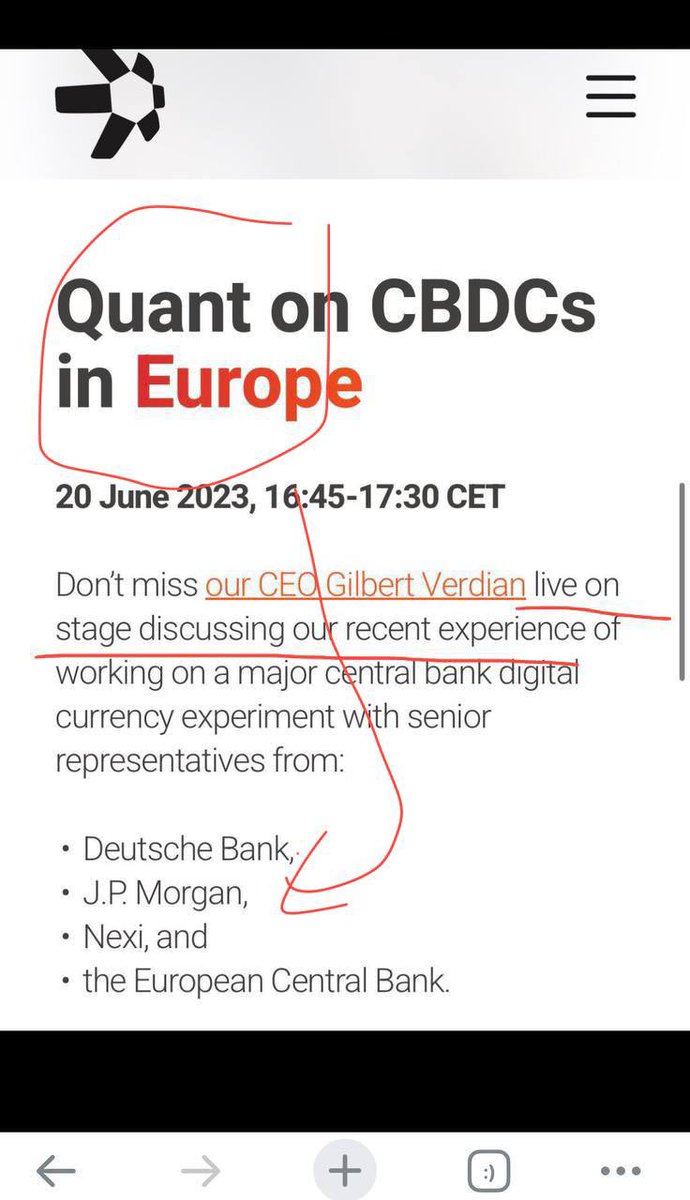
@SanNL11 JPM is bleeding and wont be around in a few years
English




English

Yesterday, @SECGov adopted amendments to certain rules that govern money market funds under the Investment Company Act of 1940. I was pleased to support this adoption because it will enhance these funds’ resiliency and ability to protect against dilution.
My statement:
English
@CobraAlfred @Cobratate @ReachTWR @hu4_global @HU_TheRealWorld @therealworld_hq 9 visitors and 88 orders. Absolute bullshit
English

I don’t know how this is real/possible! @Cobratate @ReachTWR I’m 14 fu**ing years old and I made $17,157.65 profit today! I cant show my gratitude enough if there is anyone who wants to do an interview I’m willing to do so. Please get this to Andrew. @hu4_global

English

The Internet Computer is taking over
3,000,000 Identities soon 📈
⏳
Crypto.Girl@DeFiWizards
Update on #ICP Internet Identities! Up to 200,000 new identities since my last post. World Computer is taking over!
English
#ICPeople what's your favorite part about the Internet Computer? ♾🤔
English

I am writing an email.
It will be the first email I’ve sent since being released from incarceration.
Sign up to the email list for free at cobratate.com

English