Matthew Arcus
2.2K posts


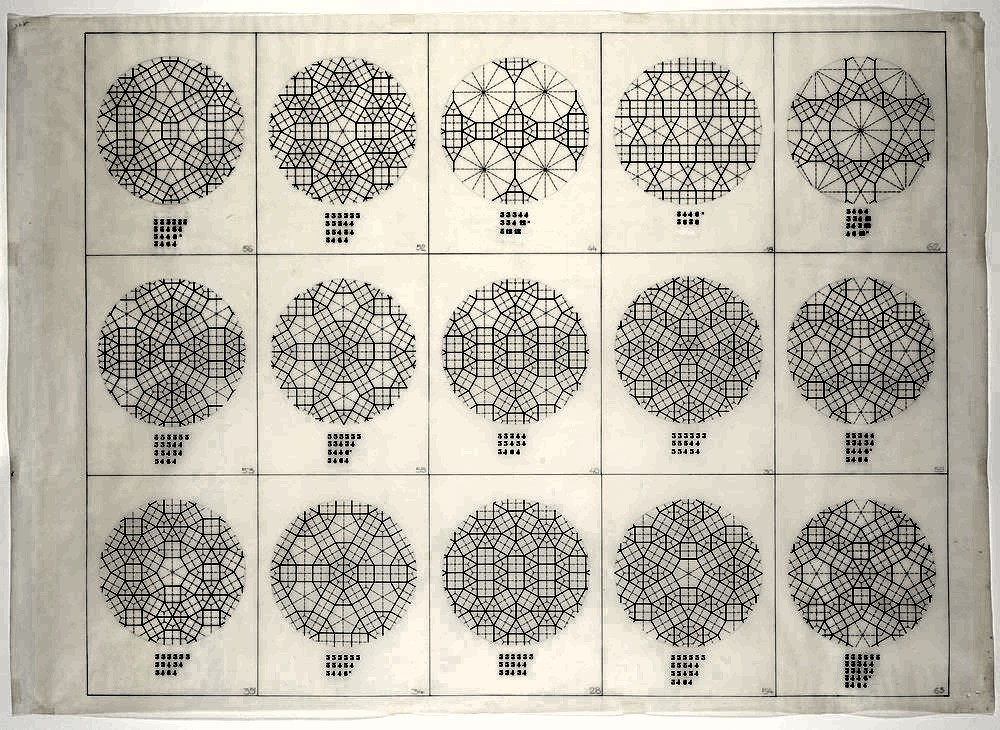
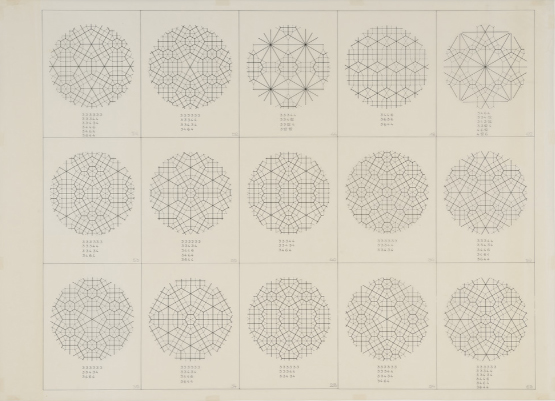
@tessellationfan They look like k-uniform tilings, with the duals superimposed (see Grunbaum & Shephard 2.2).
English

@tessellationfan Aha, thanks for the link. Not the friendliest website, as you say. Grabbed some of the images & stretched the contrast, which makes things a little easier.


English

@neozhaoliang I had a play with WebXR & Shadertoy shaders a while ago, if you are interested. I haven't done anything on it for a while, but it seems to still work with browser VR emulation: matthewarcus.github.io/xrshader/
English

I've been wanting for about 5 years to do relativistic simulation in Shadertoy, inspired by
captaineinstein.org
Since Shadertoy supports VR, we could make the scene even crazier—but I kept procrastinating over scene design. Anyone want to battle me on this idea?
English

@manujarvinen @tdhooper If there's any of my code involved, no problem!
English

@MatthewArcus @tdhooper Hi @tdhooper and @MatthewArcus - I got your Möbius Warp code working for a Godot game engine shader. Would you allow me to use the code for the upcoming Assembly Summer '25 Demo Competition in my Demo? I shall credit you straight in the Demo itself, of course. What do you think?
English
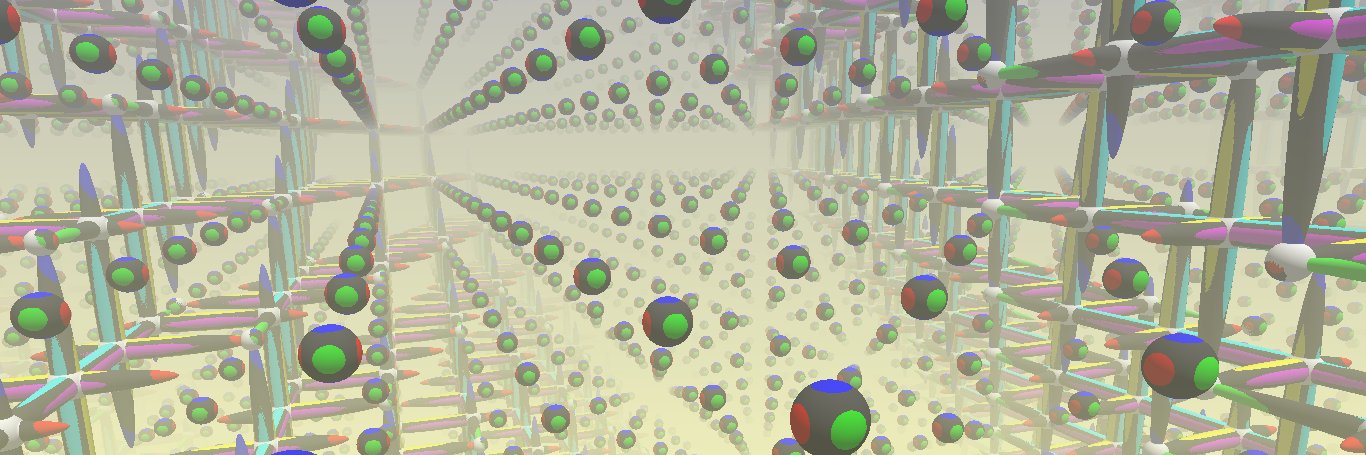
Inside, the new Outside!
For the @revision_party animated gif competition
(better video quality over at instagram.com/p/CNQCz5YH9PH/)
English

@technolapin @iquilezles My code is doing the same thing, but reducing to a 2x3 problem by mapping three points to the reference triangle so only three coefficients are needed and we can just use cross product to get the 3 minors.
English

@MatthewArcus @iquilezles If you also allow the use of 5x6 matrices, you can just build a matrice with lines of the form [x^2 , y^2 , xy , x , y ,1] with (x,y) the coordinate of the points, and its 6 max-size minors will be the coefficients of the conic. It also works for any algebraic curve
English

// Any three (non colinear) points define a circle
// { .xy=center, .z=radius }
vec3 getCircle( vec2 a, vec2 b, vec2 c )
{
vec2 ba = b-a, cb = c-b, ac = a-c;
float de = ba.x*cb.y-ba.y*cb.x; // zero if colinear
vec2 ce = 0.5*(a+b+vec2(ba.y,-ba.x)*dot(ac,cb)/de);
return vec3( ce, length(a-ce) );
}
Français

@iquilezles Conic through 5 points:
mat3 conic(vec3 p, vec3 q, vec3 r, vec3 s, vec3 t) {
mat3 a = mat3(cross(q,r),cross(r,p),cross(p,q));
s *= a; t *= a;
vec4 m = vec4(cross(s*s.yzx,t*t.yzx),0);
mat3 x = mat3(m.wxz,m.xwy,m.zyw);
return a*x*transpose(a);
}
x.com/shawn_halayka/…
Shawn Halayka@shawn_halayka
@iquilezles Do you have a similar function called getEllipse? Thank you for your time and guidance.
Français

@shawn_halayka @iquilezles Well, my code is intended to be GLSL, but for C++, looks like glm doesn't like *= for matrices, but s = s*a seems to work (note order, this is same as s = transpose(a)*s). Swizzling might cause problems too, but you can use eg. yzx(s) instead of s.yzx etc.).
English

@MatthewArcus @iquilezles Hi Matthew, I'm having trouble compiling the code. I'm using MSVC and C++20. It has to do with the statements s *= a; t *= a. Basically, it's telling me that it's having problems casting. I am using glm as the matrix/vector library.
English

@neozhaoliang Nice. My C++ code takes about 2 minutes, but I'm impressed that the slowdown from using Python isn't more.
English

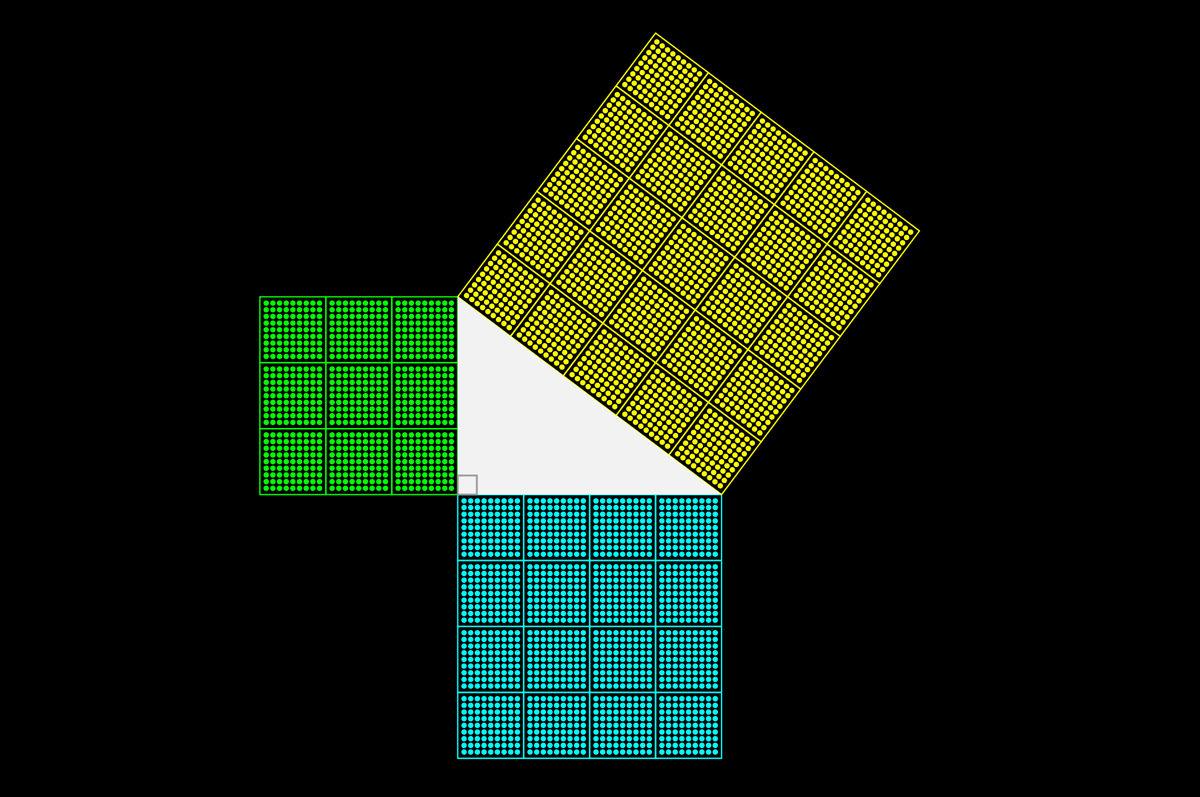
2025 = (1+2+3+4+5+6+7+8+9)²
= 1³+2³+3³+4³+5³+6³+7³+8³+9³
#MathGIF
GIF

@panlepan Nice. That seems to be the only way to make 2025 as the sum of two squares (so in fact it's the sum of a 4th power and a 6th power).
English

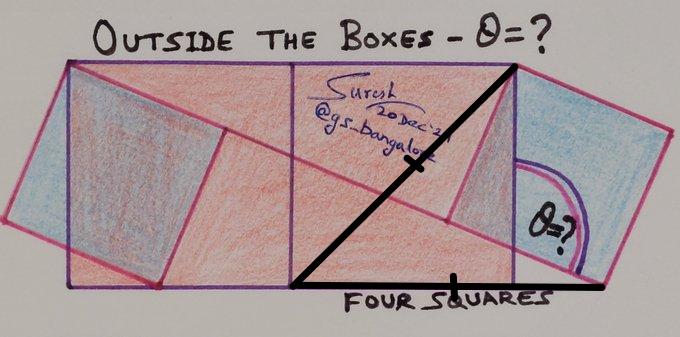
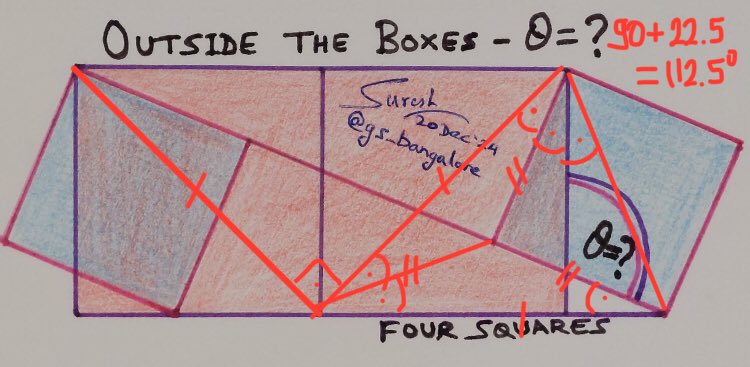
Outside the Boxes.
Four squares, having extended sides. Theta = ?
#geometrique #angle #similarity #trigonometry #puzzle #thinking #logic #reasoning #square #circle #math #teacher #algebra #mathteachers #geometrydash #mathematics #geometrynodes #highschool #students #learning

English

@OkanAtalay1970 @gs_bangalore Aha! Thanks for the explanation, very nice...
English

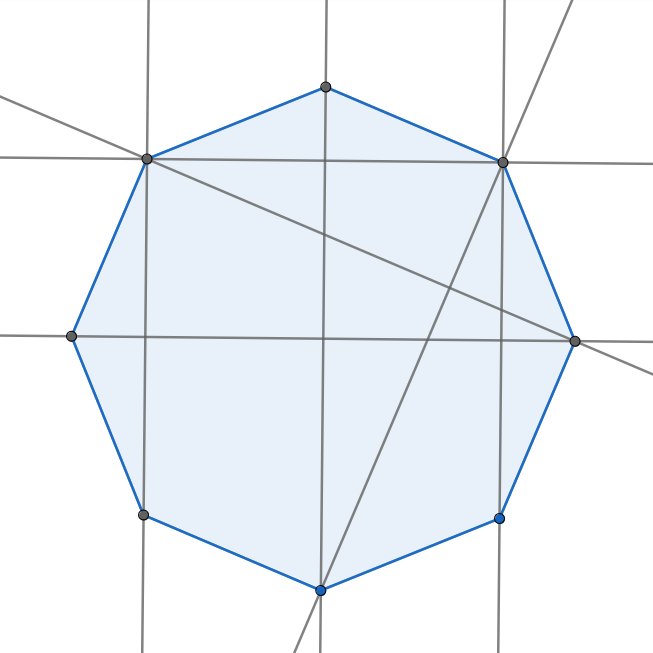
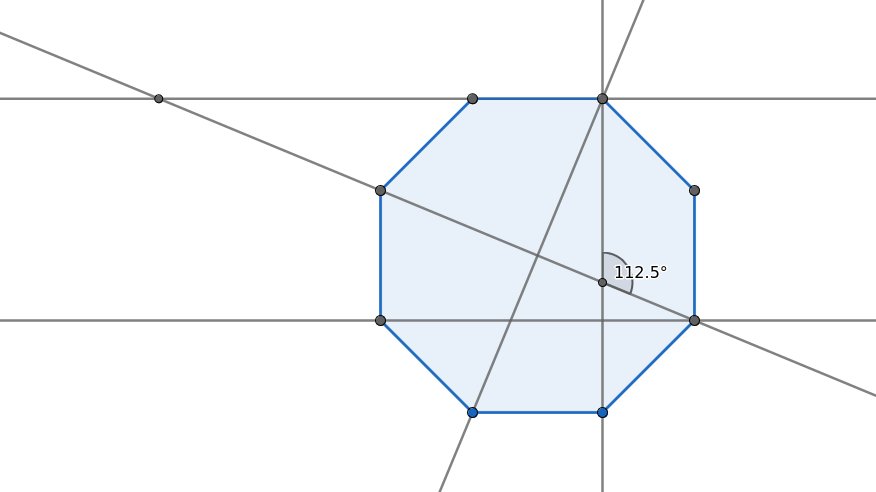
@MatthewArcus @gs_bangalore I hope this helps. Notice the central angle of 90 degrees and the inscribed angle of 45 degrees, both having the same arc of the circle.

English

@OkanAtalay1970 @gs_bangalore Nice, but I can't see how to show that these two lengths are equal (I'm a bit out of practise with these puzzles, so I'm probably missing something obvious):

English


@panlepan Nice. Can you do something with 2025 = 1³+2³+3³+4³+5³+6³+7³+8³+9³ ( = (1+2+3+4+5+6+7+8+9)²) ?
English

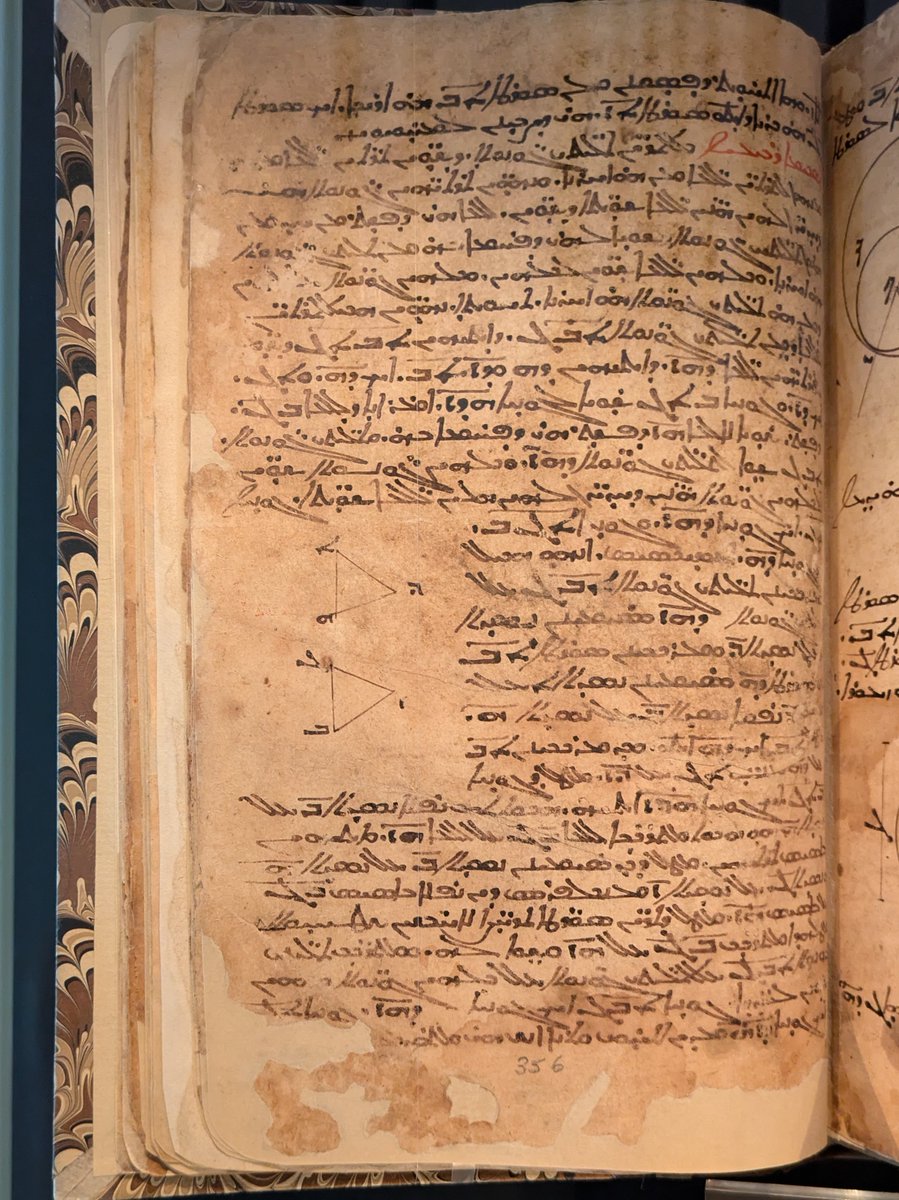
Euclid in Syriac, from the new exhibition at @theUL. x.com/theUL/status/1…


Cambridge University Library@theUL
Endless Stories, opens on 28 Sep at Cambridge University Library. It showcases the extraordinary manuscripts collected by 17th-century visionary, Thomas Van Erpe. The exhibition includes works in Arabic, Hebrew, Persian, and Malay. Book your free ticket: lib.cam.ac.uk/endlessstories
English

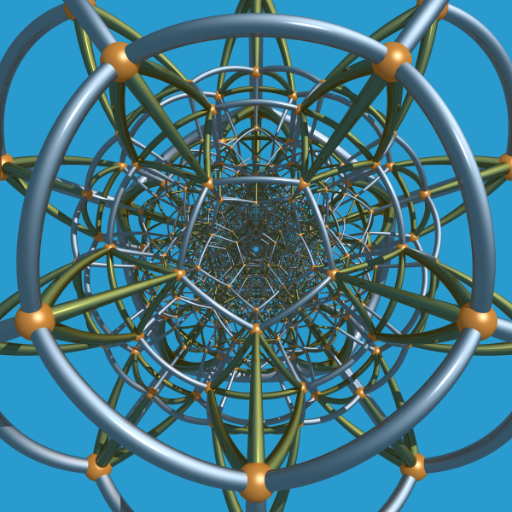
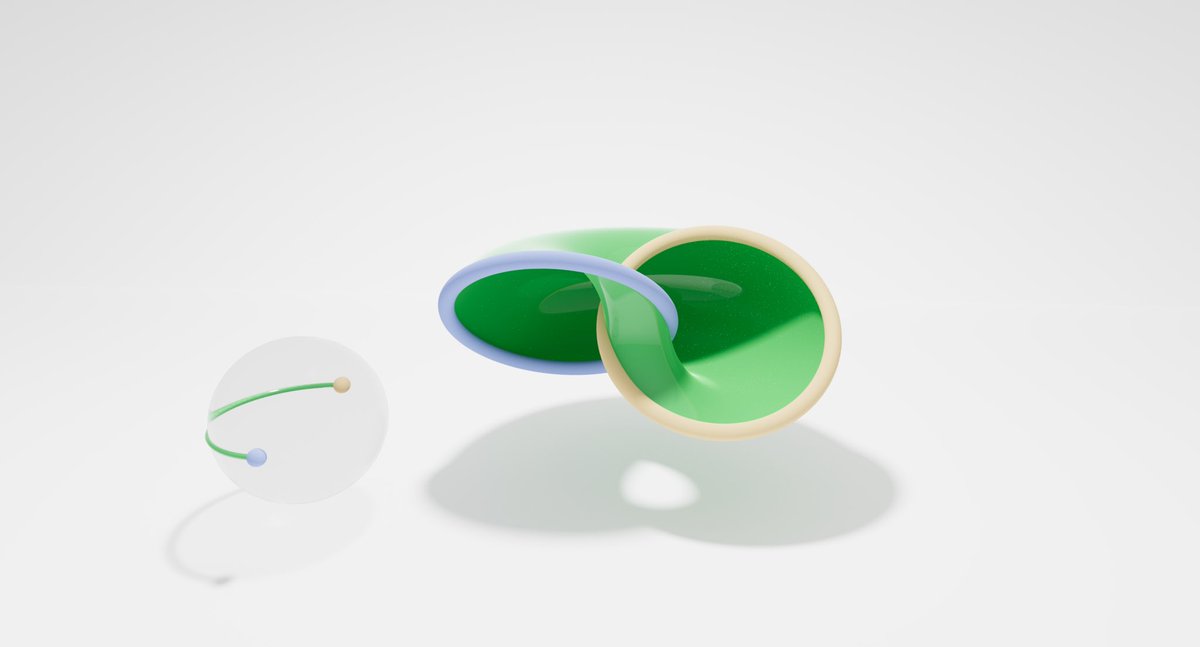
@stevejtrettel So it would seem - I only realized this after looking at this excellent volumetric Hopf shader by "tmst'": shadertoy.com/view/ttVXWt

English

@MatthewArcus Cool! That’s what I was imagining! Measure distance to points in S2 (after the hopf map) gives distance to fibers in S3 👍👍
English