Matthew Siper

152 posts

Matthew Siper

Matthew Siper

@MatthewSiper

Co-Founder & CTO @the_nof1, AI Research Scientist, Ex-Citadel, ML PhD Candidate @nyu

Manhattan, NY Katılım Şubat 2022
1K Takip Edilen1.6K Takipçiler
Sabitlenmiş Tweet
Matthew Siper
Matthew Siper@MatthewSiper·
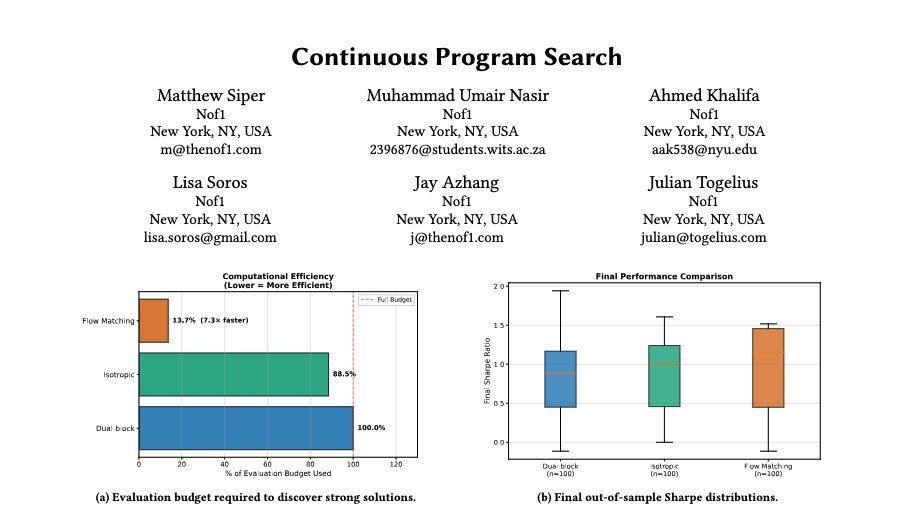
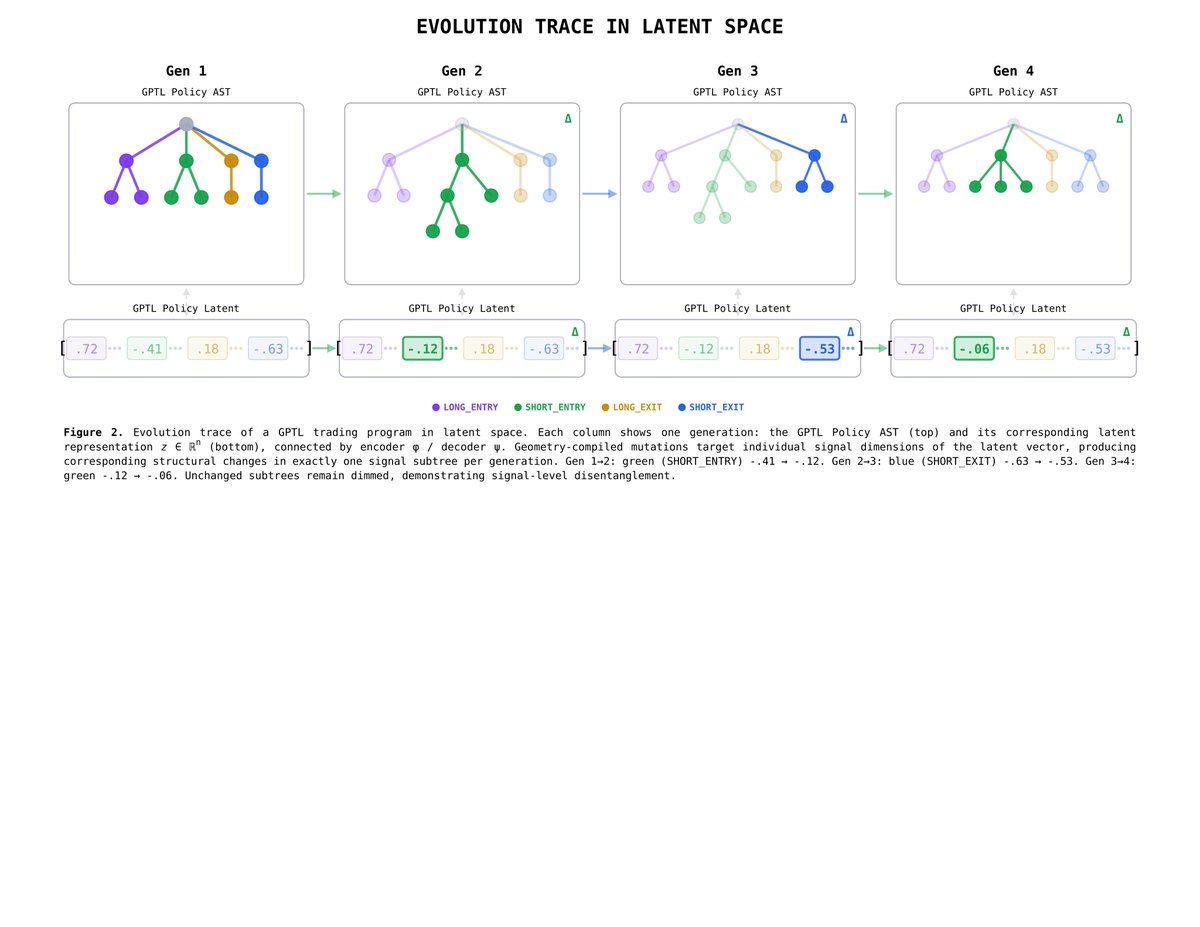
We’re excited to share our latest work Continuous Program Search (CPS) - a new approach to evolving executable trading programs by operating in a continuous latent space, rather than directly mutating syntax trees. Key ideas: 👉 GPTL (Genetic Programming Trading Language) - a DSL purpose-built for latent evolution, enabling behaviorally local edits and signal disentanglement. 👉A learned geometrically-compiled mutation operator that constrains latent updates to semantically aligned subspaces, while learning high-quality mutation proposals within those regions. 1/2
Matthew Siper tweet media
English
6
4
66
131.8K
Matthew Siper retweetledi
Jesus
Jesus@TheCreatorAbove·
New in Horizon SDK: Genetic strategy optimization for prediction markets. 6 selection methods. UCB1 bandit selection from the ProFiT paper from @the_nof1 . NSGA-II multi-objective Pareto fronts. Island model with migration. Adaptive mutation via Rechenberg's 1/5 rule. All in Rust.
Jesus tweet media
English
3
3
13
387
Jesus
Jesus@TheCreatorAbove·
New in Horizon SDK: hedge prediction market positions with stocks. Trade "Will Fed cut rates?" on Polymarket, hedge with TLT on Alpaca. Rolling hedge ratio, rebalancing, scenario analysis. All in Rust.
Jesus tweet media
English
4
2
5
1.6K
Matthew Siper
Matthew Siper@MatthewSiper·
A new paradigm for self-improving systematic trading agents (LLM = agent): Inspired by @steipete’s artifact-driven design - give the agent two durable files: TRADE_PLAN.md (setups, research routine, entry/exit triggers, risk + management rules) TRADE_JOURNAL.md (every trade, notes, results, lessons) Then make improvement mechanical: On a cadence → audit Journal → detect edge leaks → patch the Plan (or skills, prompts). Example conclusion from a journal audit: “Every trade after 3pm loses.” → New rule: no entries after 3pm. The improvement loop: Trade → Journal → Analyze → Update Plan → Trade better. More to come soon.
English
3
2
25
209.8K
Matthew Siper retweetledi
Rosinality
Rosinality@rosinality·
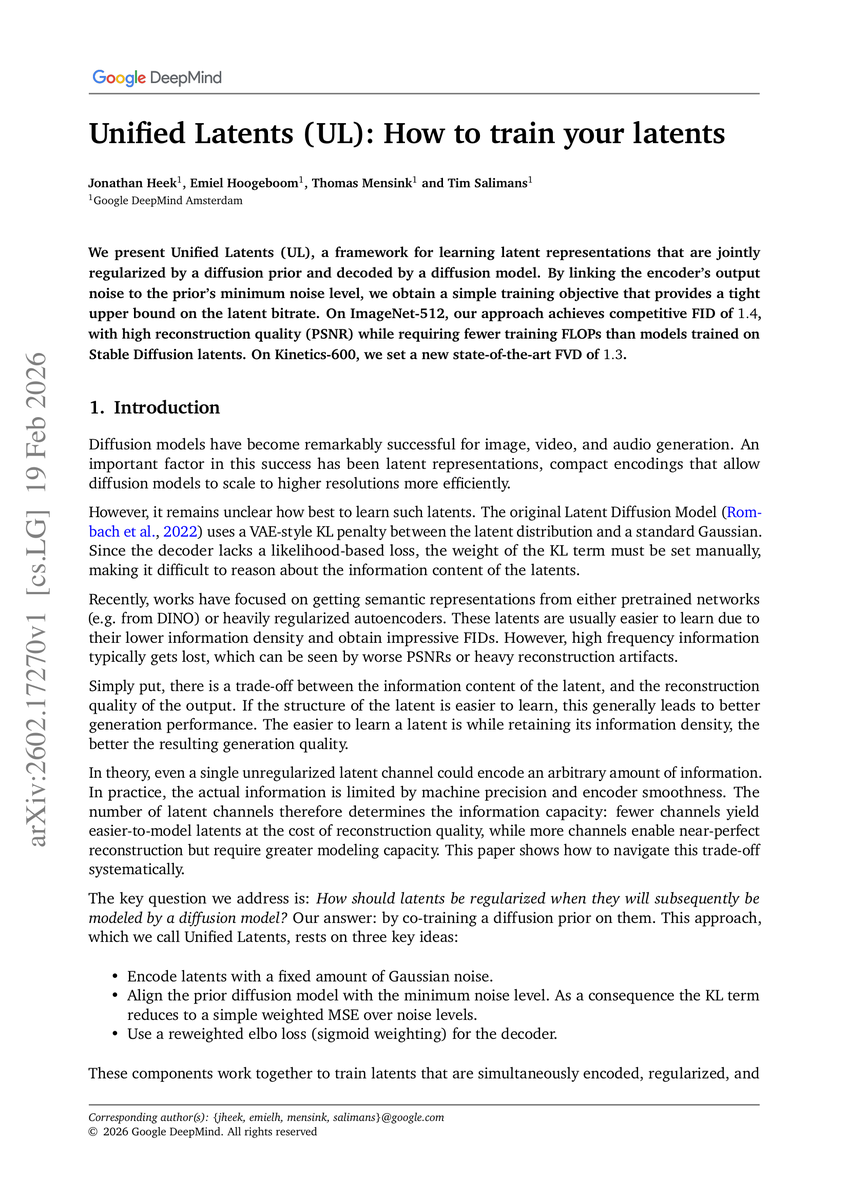
VAE with diffusion as both a decoder and prior. Diffusion prior diffuses to slightly noised latent.
Rosinality tweet media
English
2
23
195
10.2K
Matthew Siper
Matthew Siper@MatthewSiper·
Are you saying surface area as in attack surface? Attack surface is about how many places the system can be probed or broken. Search surface (the surface I was taking about) is about how much solution space the system can explore. It’s true a swarm increases both. The way I think about it is Fewer large models → smaller orchestration complexity, but higher per-unit capability. Many small models → lower per-unit capability, but larger combinatorial (search) surface.
English
0
0
0
6
0x_Vivek
0x_Vivek@0x_Vivek·
@MatthewSiper but weaker models are easier to jailbreak, right? lowers the surface area
English
1
0
0
14
Matthew Siper
Matthew Siper@MatthewSiper·
This is definitely true. Even though local models are weaker vs. Opus 4.6 a huge swarm of them means larger surface and more efficient, which makes any degraded local quality irrelevant.
Alex Finn@AlexFinn

I'm sick and tired of the people who don't understand why I spent $20,000 on this set up, and plan on spending another $100,000 by the end of the year IT DOES NOT MATTER THAT LOCAL MODELS AREN'T AS GOOD AS OPUS 4.6 That is not the point. The point is me being able to run a swarm of local AI agents powered by local AI models unlocks a world you can't imagine A world never discovered by humanity before Right now, as you read this post, I have multiple local AI models reading thousands of posts on X and Reddit Hunting for challenges to solve Those local AI models are feeding hundreds of challenges a day to a manager model The manager model (Henry) decides what the company (Alex Finn Global Enterprises) will build. The company is constantly working. Constantly researching. Constantly building. Constantly shipping If I did this with local models I'd be spending $20,000 a month on API calls. With my set up, it's free. I have an army on my desk. Never resting. Never eating. Never complaining. Always conquering. Here is your problem: it's not that you don't understand this. You don't want to understand this. You don't want to think this is possible. Your brain doesn't want to believe this is the world we now live in. It is. And the faster you can accept this and get on board, the faster you can enter the new society. Otherwise, you will forever be doomed to the permanent underclass. Make your choice.

English
2
0
6
725
Matthew Siper retweetledi
Tim Rocktäschel
Tim Rocktäschel@_rockt·
Congrats @PaglieriDavide! Great application of Alpha evolve to get more diverse behavior out of LLMs!
Davide Paglieri@PaglieriDavide

🧬 New paper from my internship at @GoogleDeepMind We introduce Persona Generators: functions that generate diverse synthetic populations for arbitrary contexts. We use AlphaEvolve to optimize the generator code, hill-climbing on diversity metrics — not just likelihood — counteracting the mode-seeking behavior of LLM sampling for agent-based simulations. 🧵👇1/

English
0
5
46
7.5K
Paul Zimmons
Paul Zimmons@PZigggy·
@MatthewSiper Could this be applied to AI Math using Lean say? It seems like in math you want to preserve certain properties in your proof (program) while exploring other sub-goals which Continuous Program Search seems to do?
English
1
0
0
82
Matthew Siper
Matthew Siper@MatthewSiper·
We’re excited to share our latest work Continuous Program Search (CPS) - a new approach to evolving executable trading programs by operating in a continuous latent space, rather than directly mutating syntax trees. Key ideas: 👉 GPTL (Genetic Programming Trading Language) - a DSL purpose-built for latent evolution, enabling behaviorally local edits and signal disentanglement. 👉A learned geometrically-compiled mutation operator that constrains latent updates to semantically aligned subspaces, while learning high-quality mutation proposals within those regions. 1/2
Matthew Siper tweet media
English
6
4
66
131.8K
Matthew Siper
Matthew Siper@MatthewSiper·
@TheCreatorAbove Thanks @TheCreatorAbove we didn’t go this route because you end up collapsing out degrees of freedom in Iatent space (small latent deltas snap to same discrete policy which muddles semantic deltas transference).
English
0
0
1
148
Jesus
Jesus@TheCreatorAbove·
@MatthewSiper Amazing work, the paper it’s incredible. Have you guys tried adding grammar constraint decoding?
English
1
0
0
157
Matthew Siper
Matthew Siper@MatthewSiper·
In finance we model market states as inputs. We should be modeling financial manifolds instead. Instead of discrete regimes --> continuous geometry of behaviors, transitions, and constraints. This means learning happens on the manifold, not the snapshot.
English
1
1
12
1.5K
ilaikit
ilaikit@ilaikit2010·
@MatthewSiper Exactly. Markets don’t reward conviction, they reward efficient exploration. Edge is about structuring the search: pruning bad paths early, sizing uncertainty, and letting asymmetric payoffs do the work. In a non-stationary game, survival is alpha - adaptation compounds.
English
1
0
2
102
Matthew Siper
Matthew Siper@MatthewSiper·
Trading is fundamentally a search problem. Policy search. Action search. Risk / loss search. You are hunting needles in a massively heuristic, non-stationary haystack. Edge means better search bias + faster exploration.
English
1
2
11
1K
Matthew Siper
Matthew Siper@MatthewSiper·
@aimihat Thank you @aimihat, the seed strategies in ProFit were somewhat canonical so LLMs as seed-strategy generators will definitely work here
English
0
0
2
74
aimilios
aimilios@aimihat·
@MatthewSiper Great research @MatthewSiper! I'm curious if you also tried using the LLM to generate seed strategies & broaden the search space? (vs using handful of fixed seed strategies as described in the paper)
English
1
0
1
90
Matthew Siper
Matthew Siper@MatthewSiper·
What if LLMs created financial trading strategies that adaptively improve over time? We built ProFiT: a framework where LLMs generate, mutate, and evolve strategy source code 1/3
Matthew Siper tweet media
English
11
4
37
17.4K
Matthew Siper
Matthew Siper@MatthewSiper·
Incredibly on point per usual
Julian Togelius@togelius

I was at an event on AI for science yesterday, a panel discussion here at NeurIPS. The panelists discussed how they plan to replace humans at all levels in the scientific process. So I stood up and protested that what they are doing is evil. Look around you, I said. The room is filled with researchers of various kinds, most of them young. They are here because they love research and want to contribute to advancing human knowledge. If you take the human out of the loop, meaning that humans no longer have any role in scientific research, you're depriving them of the activity they love and a key source of meaning in their lives. And we all want to do something meaningful. Why, I asked, do you want to take the opportunity to contribute to science away from us? My question changed the course of the panel, and set the tone for the rest of the discussion. Afterwards, a number of attendees came up to me, either to thank me for putting what they felt into words, or to ask if I really meant what I said. So I thought I would return to the question here. One of the panelists asked whether I would really prefer the joy of doing science to finding a cure for cancer and enabling immortality. I answered that we will eventually cure cancer and at some point probably be able to choose immortality. Science is already making great progress with humans at the helm. We'll get fusion power and space travel some day as well. Maybe cutting humans out of the loop could speed up this process, but I don't think it would be worth it. I think it is of crucial importance that we humans are in charge of our own progress. Expanding humanity's collective knowledge is, I think, the most meaningful thing we can do. If humans could not usefully contribute to science anymore, this would be a disaster. So, no. I do not think it worth it to find a cure for cancer faster if that means we can never do science again. Many of those who came up to talk to me last night, those who asked me whether I was being serious or just trolling, thought that the premise was absurd. Of course there would always be room for humans in science. There will always be tasks only humans can do, insight only humans have, and so on. Therefore, we should welcome AI. Research is hard, and we need all the help we can get. I responded that I hoped they were right. That is, I truly hope there will always be parts of the research process which humans will be essential for. But what I was arguing against was not what we might call "weak science automation", where humans stay in the loop in important roles, but "strong science automation", where humans are redundant. Others thought it was immature to argue about this, because full science automation is not on the horizon. Again, I hope they are right. But I see no harm in discussing it now. And I certainly don't think we need research on science automation to go any further. Yet others remarked that this was a pointless argument. Science automation is coming whether we want it or not, and we'd better get used to it. The train is coming, and we can get on it or stand in its way. I think that is a remarkably cowardly argument. It is up to us as a society to decide how we use the technology we develop. It's not a train, it's a truck, and we'd better grab the steering wheel. One of the panelists made a chess analogy, arguing that lots of people play chess even though computers are now much better than humans at chess. So we might engage in science as a kind of hobby, even though the real science is done by computers. We would be playing around far from the frontier, perhaps filling in the blanks that AI systems don't care about. That was, to put it mildly, not a satisfying answer. While I love games, I certainly do not consider game-playing as meaningful as advancing human knowledge. Thanks, but no thanks. Overall, though, it was striking that most of those I talked to thanked me for raising the point, as I articulated worries that they already had. One of them remarked that if you work on automating science and are not even a little bit worried about the end goal, you are a psychopath. I would add that another possibility is that you don't really believe in what you are doing. Some might ask why I make this argument about science and not, for example, about visual art, music, or game design. That's because yesterday's event was about AI for science. But I think the same argument applies to all domains of human creative and intellectual expression. Making human intellectual or creative work redundant is something we should avoid when we can, and we should absolutely avoid it if there are no equally meaningful new roles for humans to transition into. You could further argue that working on cutting humans out of meaningful creative work such as scientific research is incredibly egoistic. You get the intellectual satisfaction of inventing new AI methods, but the next generation don't get a chance to contribute. Why do you want to rob your children (academic and biological) of the chance to engage in the most meaningful activity in the world? So what do I believe in, given that I am an AI researcher who actively works on the kind of AI methods used for automating science? I believe that AI tools that help us be more productive and creative are great, but that AI tools that replace us are bad. I love science, and I am afraid of a future where we are pushed back into the dark ages because we can no longer contribute to science. Human agency, including in creative processes, is vital and must be safeguarded at almost any cost. I don't exactly know how to steer AI development and AI usage so that we get new tools but are not replaced. But I know that it is of paramount importance.

English
0
0
6
1.6K
Matthew Siper
Matthew Siper@MatthewSiper·
@zinnresearch We have a few homegrown models in the eval pipe. We’ll have more to say about this soon
English
1
0
2
242
Zinn
Zinn@zinnresearch·
@MatthewSiper Wow thought it may have been your guys tweaked with the ProFiT adjustments as per your paper, but to hear its grok is very interesting!
English
1
0
1
256