
Sabitlenmiş Tweet
Max
2.3K posts

@LeonardoJaquez El ceo de JetBlue no dijo eso, mencionó que según predicciones de JPM podría enfrentarse dependiendo de si la subida del precio del petróleo alcanza los 140 usd que es casi imposible actualmente. Basura si vas a comunicar algo hágalo bien .
Español

AHORA: Reportan que la aerolínea norteamericana Jet Blue se podría declarar en quiebra debido al impacto negativo que está teniendo en sus finanzas operativas el incremento de los combustibles. CEO de la empresa dice que deuda de Jet Blue se podria incrementar unos US$1,300 millones mas, lo que la elevaria a mas de US$10,300 MM, un nivel insostenible, afirmó.
#JaqueMate

Español
@Juanilda @CualMejia Nada que ver de como ese la economía! 💀💀💀 desde 2022 no conseguir inversores que compres sus bonos, mala administración, empleado no muy educados, y en bancarrota 2 veces además de que han sido subsidiados por el gobierno, ya se veía venir.
Español

Esto es más peligroso de lo que ustedes creen. Eto ta fuerte
Pop Base@PopBase
Spirit Airlines has shut down after 34 years.
Español

Iran is exporting its Oil to China
By Train
Trump got played again.
English
@solarpaulo307 @lacontraria1844 Marica y estúpido hasta cuando una AI lo refuta
Español

@lacontraria1844 Y el 5% ya no existe para ti :p
Español
Los haitianos son multiraciales también. Ridiculos
Juan@JuanIsidro
Pongámoslo claro: Dominicano = Multiracial Haitiano = Negro Listo. No hay que darle tantas vueltas.
Español
@crypto_lucario @DEVOLUCIONARIOS Eres retrasado o que ? Si estado unidos es el mayor exportador de petróleo crees que lo hace a un precio de 40usd por barril ? 💀
Español


Récord histórico de exportación de petróleo y derivados. Estados Unidos ya exporta más de 6 millones de barriles por día. Va ganando sobrado en la rama energética. Además las petromonarquías pagan la protección ante Iran, en inversiones dentro de Estados Unidos. Esta guerra solo tiene un ganador.

Español
@artdec000 @AlertaNews24 Pero si de 6700 aviones solo cayeron como 6 cuántos crees que eso en porcentaje? Marica deja de ver anime marica
Español


🇺🇸 | AHORA: EE.UU. anuncia que retirará del Medio Oriente al portaaviones más grande del mundo, el USS Gerald R. Ford.

Español
@MemoriasPez Sabes por qué están cayendo porque la mayoría de ellos son préstamos invertidos y a diferencia de aquí las casas son una parte fija del plan de jubilación y la mayoría se declarará en bancarrota porque China tiene más de 10 millones de casas sin usar y sin terminar. Eres estúpido
Español

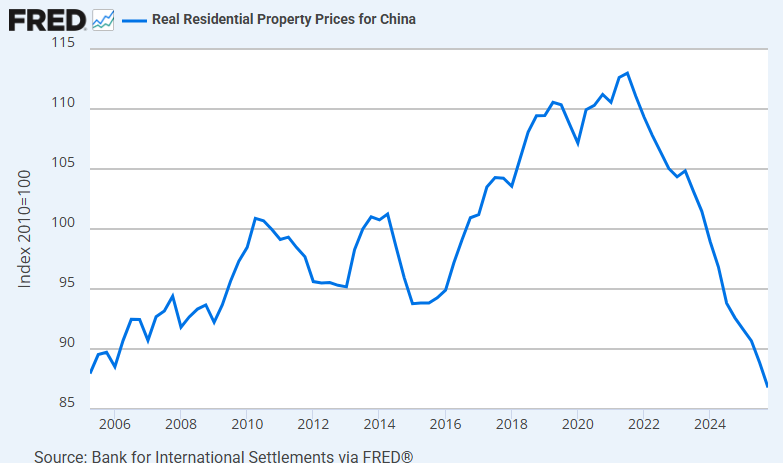
Para el que diga que construyendo no se puede bajar el precio de la vivienda.
Si China ha hecho una cosa, esa es construir. Levantaron ciudades enteras, millones de apartamentos y barrios modernos en tiempo récord.
¿El resultado?
Un exceso de oferta tan brutal que el mercado ha implosionado. China saturó la demanda y ahora los precios reales están por debajo de niveles de 2010.
Eso sí, si te pasas construyendo puedes crear un problema, cargarte a toda la industria de la construcción. No obstante, en España estamos muy lejos de eso aún.
Español

@gofowler3 This is obviously idiotic and has been demonstrated countless times
English
“Oh no, Chinese people can afford to buy homes”
US propaganda is so dumb. The Chinese economy is designed to serve its citizens. The US economy is designed to serve the rich. This is why China is winning and will win.
Hedgeye@Hedgeye
🚨 China's Real Estate Market has erased all gains from the last 20 years
English

@Elkstone14879 So properties being far cheaper is a bad thing?
Would you be unhappy if you could purchase a property 50% cheaper?
English
It is the exact opposite. China has rightly taken the heat out of its real estate market. This was an asset bubble that needed deflating. They have managed to do this without crashing their real estate market.
The Western real estate market is going to have to do the same thing only in our case that will involve it crashing and burning.
Wimar.X@DefiWimar
🚨 BREAKING CHINA’S REAL ESTATE MARKET JUST CRASHED TO A 20-YEAR LOW, LOSING A 1/4 OF ITS VALUE. SOMETHING EXTREMELY BAD IS HAPPENING…
English

Ok, señora. Enfóquese en su país, combustible caro, comida por las nubes, drogas, violencia, etc.
LISTÍN DIARIO@ListinDiario
Embajadora de EEUU reacciona tras participación de RD en cumbre progresista en España 🔗listindiario.com/la-republica/g… #ListínDiario
Español
@terrykk85 @Unveiled_ChinaX Como explicas que más de 13 mil ricos han sacado su dinero del mercado chino marica
Español

@Unveiled_ChinaX Wishful thinking, smart monies are loading up in China because it’s stable and UNDERVALUED. Bubble do not last forever, you will see how dumb your post is not too long from now
English

China's economy is nearly the size of the US economy. Its stock market tells a completely different story.
In 2021, China's GDP was 78% of America's. By 2024 that had fallen to roughly 64%, back to 2017 levels. The gap between the world's two largest economies didn't just stop closing. It doubled in just a few years. That alone is remarkable. But the GDP gap is actually not the most revealing number.
Angle 1: GDP vs. Market Cap. Size isn't the same as strength.
China's GDP sits at roughly $20.5 trillion. Its total stock market capitalization is approximately $15.4 trillion. The US GDP is $28.3 trillion. Its market cap exceeds $58.9 trillion.
Do the math. In the US, every $1 of economic output generates roughly $2.08 in equity value. In China, every $1 of GDP generates only about $0.75 in equity value. That divergence is not a rounding error. It is a structural signal. Investors are telling you that they trust the quality and durability of US growth at more than twice the rate they trust China's.
Why? Because a significant portion of China's GDP is driven by state-directed spending, infrastructure investment, and debt-fuelled construction. These are activities that generate output on paper but do not compound in value the way that intellectual property, platforms, and technology ecosystems do. The US economy is built around businesses that generate high margins at scale and reinvest into innovation. China's economy is largely built around physical output that depreciates.
Angle 2: Taiwan vs. China. Quality destroys quantity.
Taiwan's GDP is roughly $977 billion. Less than one twentieth of China's. Yet Taiwan's stock market is worth $4.14 trillion, which means Taiwan's equity market is 4.2 times its GDP.
China's is 0.75 times its GDP.
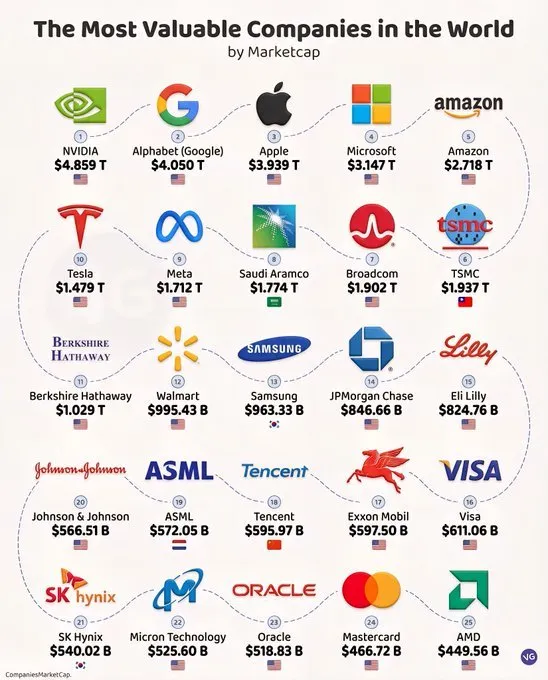
Taiwan, a self-governing island of 23 million people under constant geopolitical pressure, just surpassed the United Kingdom to become the world's 7th largest stock market. And it got there not through size but through chokepoint power. TSMC alone, ranked 6th in the global market cap chart above, manufactures chips that every AI company, every data center, and every advanced semiconductor product in the world depends on. That single company is worth nearly $2 trillion.
Global capital has made a clear decision. Technological irreplaceability is worth more than sheer output. One strategically indispensable island is worth roughly one quarter of all of China, a country of 1.4 billion people.
Angle 3: The Tencent Paradox. One company. That's it.
Look at the top 25 most valuable companies in the world. Eighteen are American. One is Chinese. Tencent, ranked 18th at $596 billion.
This wasn't always the case. In 2021, Chinese tech was ascendant. Tencent was briefly the world's 5th most valuable company. Alibaba was a global force. Ant Group was preparing what would have been the largest IPO in history, implying a valuation north of $300 billion. Chinese tech giants collectively commanded trillions in market value and were beginning to rival Silicon Valley.
Then the CCP moved. Between late 2020 and 2022, Beijing launched an 18-month regulatory crackdown on its own most successful private companies. Alibaba was fined $2.8 billion. Ant Group's IPO was cancelled overnight. Didi was forced to delist from the US days after going public. ByteDance was pressured to restructure. State-owned entities quietly acquired "golden shares" and board seats across the sector.
The result: Chinese tech giants lost $2 trillion in value in roughly 18 months. Alibaba's share price fell 80% from its peak. Tencent lost 44% of its market cap. Meituan dropped 86%. None have fully recovered. And crucially, global investors stopped betting on the next Chinese tech giant, because the CCP had made clear that any company that grew too large, too influential, or too independent would be brought to heel.
The CCP called it "Common Prosperity." What it actually produced was corporate stagnation. Beijing spent years building national champions and then, when those champions became powerful enough to matter globally, it systematically capped their growth.
You cannot surpass the US economically when you are regulating your own most innovative companies into irrelevance. You cannot attract global capital when investors have watched Beijing destroy $2 trillion in private value in 18 months on political grounds.
China's GDP is large. Its market cap is underweight. Its companies are politically constrained. And the only island Beijing can't stop is the one generating more equity value per dollar of output than any economy on earth.
The dream of China overtaking the US was always about quantity. The data says the future belongs to quality.
#China #US #Economy #GDP #Geopolitics #Taiwan #TSMC #CCP #Investing #GlobalMarkets
Terence Shen@Terenceshen
The dream of China surpassing the U.S. as the world’s largest economy is fading. In 2021, China’s GDP was about 78% of the U.S.; by 2024, that share had fallen to roughly 64%, back to around 2017 levels, with the gap between the two economies doubling in just a few years.
English

@Terenceshen Are you retard or what? First in 2025 the trend is reversed again with China growing in USD term faster than US secondly no shit China find problem along the way since US is trying everything in their power to stop China. Can you imagine the effect if US allow china EVs in US?
English

In a previous tweet, I pointed out that China will have a harder time catching up with the United States. China’s GDP was about 78% of the U.S. level in 2021, but by 2024 that share had fallen to roughly 64%.
Some argued this was simply an exchange-rate effect, while others questioned the metric itself and suggested that purchasing-power parity, or PPP, tells a different story.
It is true that the renminbi has weakened from around 6.3 to roughly 7.2 per dollar, a depreciation of about 13%. That does reduce China’s GDP in dollar terms. But the divergence between China and the United States is visible in underlying growth.
In nominal terms, the U.S. economy has expanded more rapidly. American GDP rose from about 23 trillion dollars in 2021 to roughly 28 to 29 trillion in 2024, an increase of around 25%. China’s grew from approximately 114 trillion yuan to around 130 trillion yuan, closer to 15%. Even allowing for differences in measurement, the gap is widening, not narrowing.
The same pattern appears in capital markets. U.S. equities, represented by the S&P 500, increased from roughly $45 trillion in 2021 to around $55–60 trillion more recently. Chinese markets have moved in the opposite direction. Indices such as the CSI 300 and the Hang Seng have seen their combined market value fall from around $13 trillion at their peak to closer to $10 trillion. If this were primarily a currency story, it would be difficult to explain why U.S. markets have surged while China’s have contracted in absolute terms.
This points to a deeper structural shift. China’s growth model, long driven by investment, construction and credit expansion, is running into constraints, including diminishing returns and rising debt burdens. The United States, by contrast, continues to benefit from stronger consumption and more resilient capital markets.
There is also a historical lesson. During the Cold War, Nobel economist Paul Samuelson projected that the Soviet economy would eventually catch up with or even surpass that of the United States in late 20 century . Those forecasts extrapolated from USSR’s strong growth trends but underestimated geopolitical realities.
As for PPP, it serves a specific purpose but has clear limitations. It is useful for comparing domestic purchasing power, yet far less informative when assessing global economic weight, financial influence or technological leadership.
For instance, India’s economy already appears significantly larger than Japan’s. Few would argue that India offers a higher level of development.
Finally, headline GDP figures themselves have limits. Investment can boost output and employment in the short term while generating little long-term return, especially when financed by rising debt. This concern has long been raised in discussions of China’s infrastructure and construction-led model. Questions around data transparency add another layer of uncertainty.
For policymakers, the implication is straightforward. Treating this as a currency-driven fluctuation, or relying on PPP-based comparisons, risks misreading China’s trajectory. The evidence points to a more durable divergence, shaped by structural factors rather than short-term financial movements. This is not simply a cyclical slowdown. It marks a shift in relative economic momentum.
Terence Shen@Terenceshen
The dream of China surpassing the U.S. as the world’s largest economy is fading. In 2021, China’s GDP was about 78% of the U.S.; by 2024, that share had fallen to roughly 64%, back to around 2017 levels, with the gap between the two economies doubling in just a few years.
English
@HenryWilt76 @jdoedoe101101 No es china son una pequeña cantidad y btw china tiene un problema más grave que la inflación y es la deflación investiga
Español

@jdoedoe101101 Ahora pon la inflación.
Y, de paso, busca quién compra la deuda de EEUU para mantener su economía en pie.
Español

El sueño de los zurdos que China supere a Estados Unidos como la economía más grande del mundo se está desvaneciendo.
En 2021, el PBI de China estaba al 78% del de EEUU; para 2026, esa proporción ya está abajo del 60%, gracias a Trump.
La brecha entre las dos economías se duplicó en solo unos pocos años.
El modelo chino de "comunismo hacia adentro libre mercado hacia afuera" sigue quedándose corto contra el modelo full capitalista de Estados Unidos.

Español

Just spoke to 2,000 Wall Street Bankers
They all told me that tomorrow will be a BLACK MONDAY Crash of epic proportions
There is nothing that can be done to reverse this
English
Max retweetledi

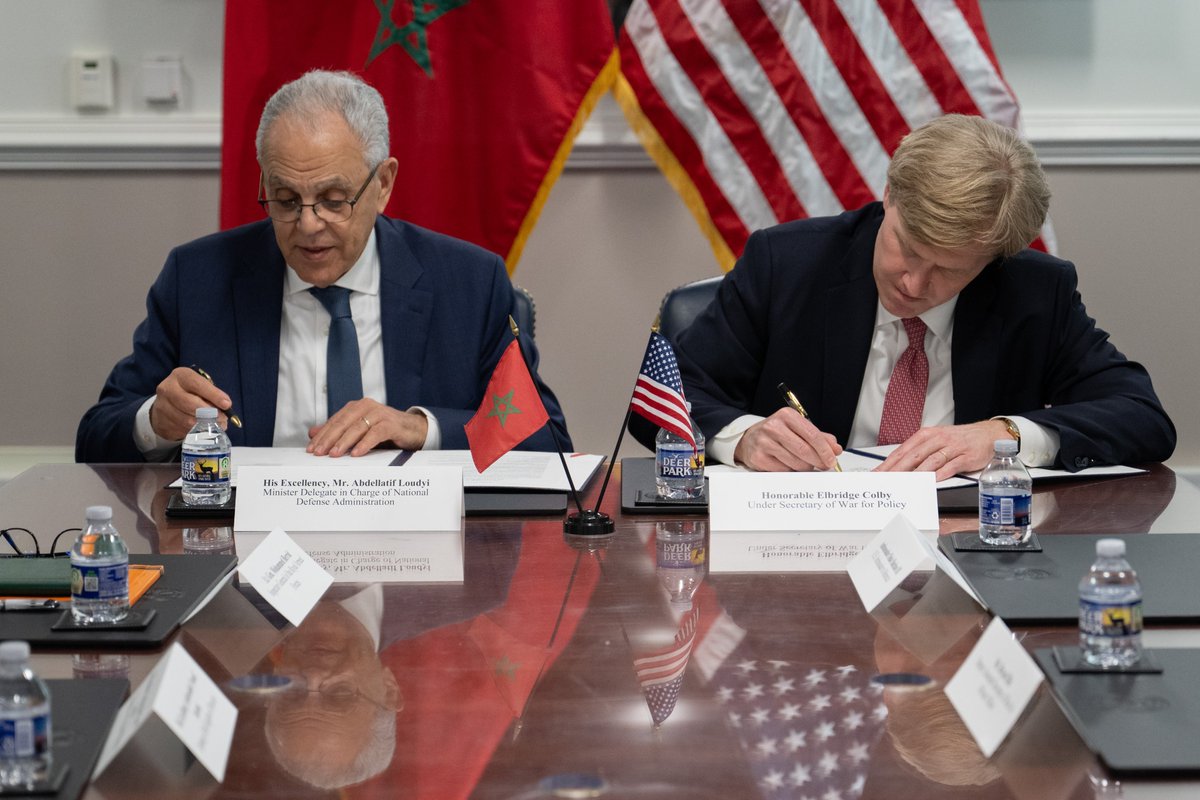
美国昨天与摩洛哥签署国防协议,这关乎着直布罗陀海峡 (地中海与太平洋的进出口)。
至此,美国在一年多一点的时间里,完全控制了全球四大海运关卡:
直布罗陀
马六甲
霍尔木兹
巴拿马
我不用说,大家也看得出这是在精心布局,感觉比一带一路要靠谱一点。
中文

@DustinWalper They are more focused on Robots. And I’m not sure if any American company can match the level of Chinese robotics companies
English

Two independent American companies can now do something China’s entire aerospace industry can’t.
Bullish on America.
Jeff Bezos@JeffBezos
English

La gente en comentarios que dice “pues los ricos se irán a vivir a otro lado y listo” se os olvida una cosa: el ego del rico. ¿Tan poco rico eres que no puedes vivir en NYC porque te han puesto un impuesto del 1%? Compran mansiones donde no viven solo para decir que la tienen…
Mayor Zohran Kwame Mamdani@NYCMayor
Happy Tax Day, New York. We’re taxing the rich.
Español