Ricardo Prado@ricklock99
The situation on Neo is simple: Forget the theoretical stuff and the fantasies. There is no "Neo Council." What exists is: two founders with enormous funds at their disposal, a group playing house and getting paid for it, a class of outcasts, and the holders. There are also core developers and NSPCC.
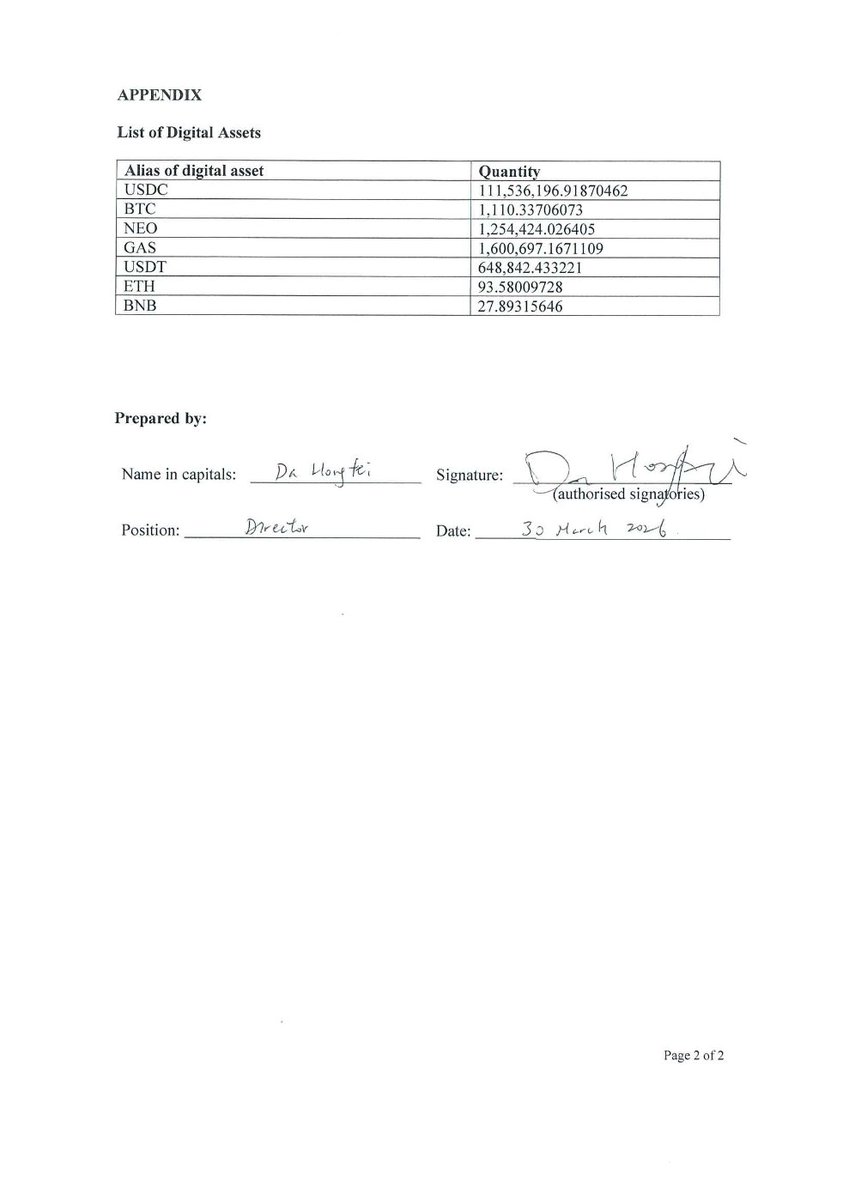
Erik controls the addresses holding NEO. Da Hongfei controls non-NEO assets, NGD, and its investments. Each side is sitting on over $200 million.
The group playing house, private groups, receives tens of thousands of dollars per month from contracts and consensus nodes. "Community" initiatives received over $430000 per month in 2025 alone.
Not all groups are dead weight. Some, like NeoSPCC and the core developers, are genuinely competent and deliver real work. But they're the exception, not the rule, and there's nothing in between.
You either have teams doing excellent work or teams delivering virtually nothing. The most competent ones often have to compensate for those who don't deliver, and even with their skill, it's still not enough to carry an entire ecosystem.
The rest show up once in a while, work on mostly pointless projects (if they even deliver anything), derail discussions, and disappear. Behind the scenes, they also actively work to sabotage competitors (when they rarely appear).
Then there are the outcasts. Community members with no contracts, no node, no seat at the table. People who try to build or contribute but don't see results. When they need funding, they have to beg and humiliate themselves for $300, $500. Many have probably sensed they belong to a different caste, but the arrangement is so absurd that they may not have fully processed it.
On one side, people collect five figures a month to deliver nothing. On the other hand, people scrape for pocket change to keep contributing.
And this isn't accidental. The first group created the second. The contracted insiders use their influence, amplified by the network's centralization, to ensure that no outside group or project can rise.
They gatekeep funding, visibility, and access through their influence over NGD. That's why the outcasts are outcasts. Not because they lack competence, but because allowing them to grow would threaten the arrangement.
Now, the founders are pissed at each other and have decided to split, not the network, but the management and funds. DHF has invested in his own preferences without accountability, even to his co-founder and director, Erik Zhang.
What changed is that Erik will likely stop directing NEO toward DHF's chosen investments. But that barely matters, since DHF still controls over $200 million in assets, even if you exclude the Binance stake, which nobody knows the size or worth of.
The difference is that Erik will now start deploying funds on his side. Before, DHF decided alone. Now, both will. Even if Erik stops sending to the multisig, DHF still has more resources under his control.
What happens next?
The near-impossible scenario is DHF and Erik reaching an agreement and consolidating funds. What will happen is simpler: if DHF refuses to disclose where and how the money went, Erik stops transferring funds, and each side invests in whatever they want, independently. The conflict doesn't resolve; it just becomes less relevant as both parties shift focus to their own goals.
Will DHF use non-NEO assets to cover project expenses? Will Erik start hiring on his own? Very likely. The change is that both founders now have greater autonomy to manage funds. Could that solve Neo's problems?
The problem on Neo is the existing cartel. We won't see improvement if the same groups that have failed for a decade continue to do so.
Keeping them in place removes all accountability for the current state of things: the lack of adoption, the lack of activity, the lack of everything on this network. The platform is technically capable of far more than what's being built on it today.
The failure is not technical; it is the total absence of consequences when these groups steer the network toward expensive and useless projects. Imagine giving nearly 500k per month to grow your project, only to end up smaller year after year.
Let's be honest about what's left: a handful of people operating as a cartel, a group that exists to protect itself. The network is in disarray, and some people are earning a lot while delivering very little.
Some are proposing that we let the people getting paid handsomely for producing nothing choose who controls the network. Let's give more power to the same caste that has drained the treasury while the outcasts beg for scraps. What do you think happens next? It's not hard to predict.
And there's another problem, maybe the worst one. NEO holders will barely show up to any vote. Governance participation is already low, not for the reasons many imagine, but simply because nobody wants to read a wall of text explaining candidate A versus candidate B.
Handing decision-making power to a process where almost no one participates is just another dead end.
In short, the situation is very problematic. But the fragmentation might actually be an improvement: real decentralization, born out of anger and distrust. One side literally does not trust the other. And that mutual distrust might be exactly the catalyst for building blockchain-based mechanisms that are actually realistic and enforceable, rather than governance theater.
As for the future, there are only two paths: one with the same groups, and one without them. We already know where one of those leads: one transaction per minute, on a good day.