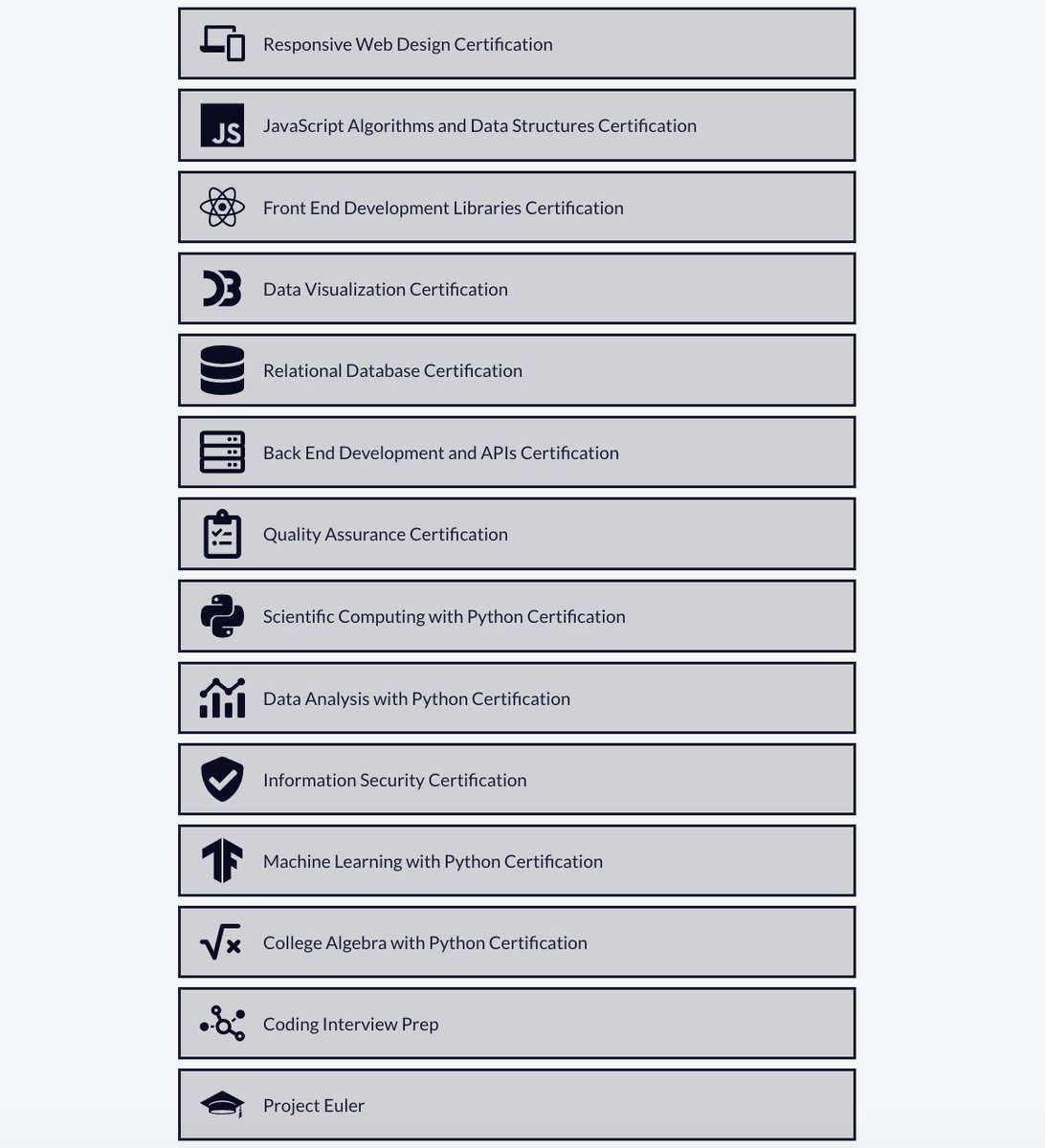
--
49 posts

Buscamos 4 chicos para que nos den a las 2 al mismo tiempo ...
Quien se anima?

Español
-- retweetledi



-- retweetledi

¡Cursos con certificado GRATIS! Aprende de cero a avanzado SQL, Python, Machine Learning y Ciencia de Datos
→ kaggle․com/learn

Español
-- retweetledi

Los mejores sitios web para leer y/o descargar libros gratis.
Guárdalos o te arrepentirás.

Español
-- retweetledi
¡Entiende cualquier código de programación!
Esta página te explica el paso a paso de su ejecución.
Compatible con Python, JavaScript, C, C++ y Java ↓
Español
-- retweetledi

-- retweetledi

¿Sabes que existe un "juego" para aprender a trabajar con las ramas de GIT de manera interactiva?
Trabajarás con 8 comandos, junto a sus variantes, a través de 34 niveles. Y está en español.
learngitbranching.js.org

Español
-- retweetledi


-- retweetledi
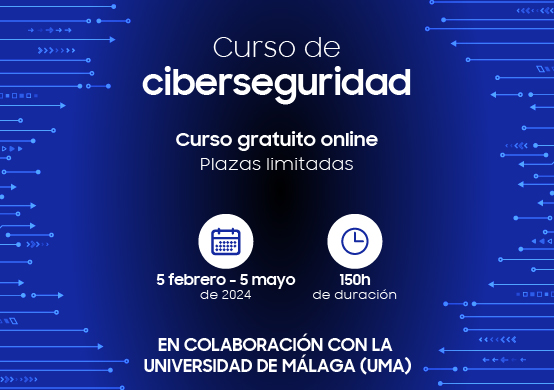
Curso de CIBERSEGURIDAD creado por Samsung y la Universidad de Málaga!
→ GRATIS
→ 100% Online
→ Con certificado
→ 150h de duración (3 meses)
→ 5 Módulos
→ Plazas limitadas
mouredev.link/cursociber
Español
-- retweetledi

Free Google IT Certification Courses in 2023:
(Bookmark For Later )
1. Data Science with Python
simplilearn.com/getting-starte…
2. Create Image Captioning Models
cloudskillsboost.google/course_templat…
3. Encoder-Decoder Architecture
cloudskillsboost.google/course_templat…
4. Google Cloud Computing Foundations: Cloud Computing Fundamentals
cloudskillsboost.google/course_templat…
5. Introduction to Baseline: Data, ML, AI
cloudskillsboost.google/course_templat…
6. Introduction to Google Cloud Essentials
cloudskillsboost.google/course_templat…
7. Google IT Automation with Python
coursera.org/professional-c…
8. Introduction to Large Language Models
cloudskillsboost.google/course_templat…
9. Introduction to Generative AI
cloudskillsboost.google/course_templat…
10. Generative AI Fundamentals
cloudskillsboost.google/course_templat…
11. Introduction to Responsible AI
cloudskillsboost.google/course_templat…
12. Introduction to Image Generation
cloudskillsboost.google/course_templat…
13. Attention Mechanism
cloudskillsboost.google/course_templat…
14. Transformer Models and BERT Model
cloudskillsboost.google/course_templat…
15. Introduction to Generative AI Studio
cloudskillsboost.google/course_templat…
16. Google Cloud Computing Foundations
classcentral.com/course/google-…
17. Google IT Support Professional Certificate
coursera.org/professional-c…
18. Google UX Design Professional Certificate
coursera.org/professional-c…
19. Build apps with Flutter
developers.google.com/learn/pathways…
& Many More over there.
Just comment what certification you're looking for, I'll share the link for it.
Follow @TheMsterDoctor1 For Amazing Tweets Like These.
#Google #Cloud #AI #DataScience #Coding



English
-- retweetledi
-- retweetledi

-- retweetledi

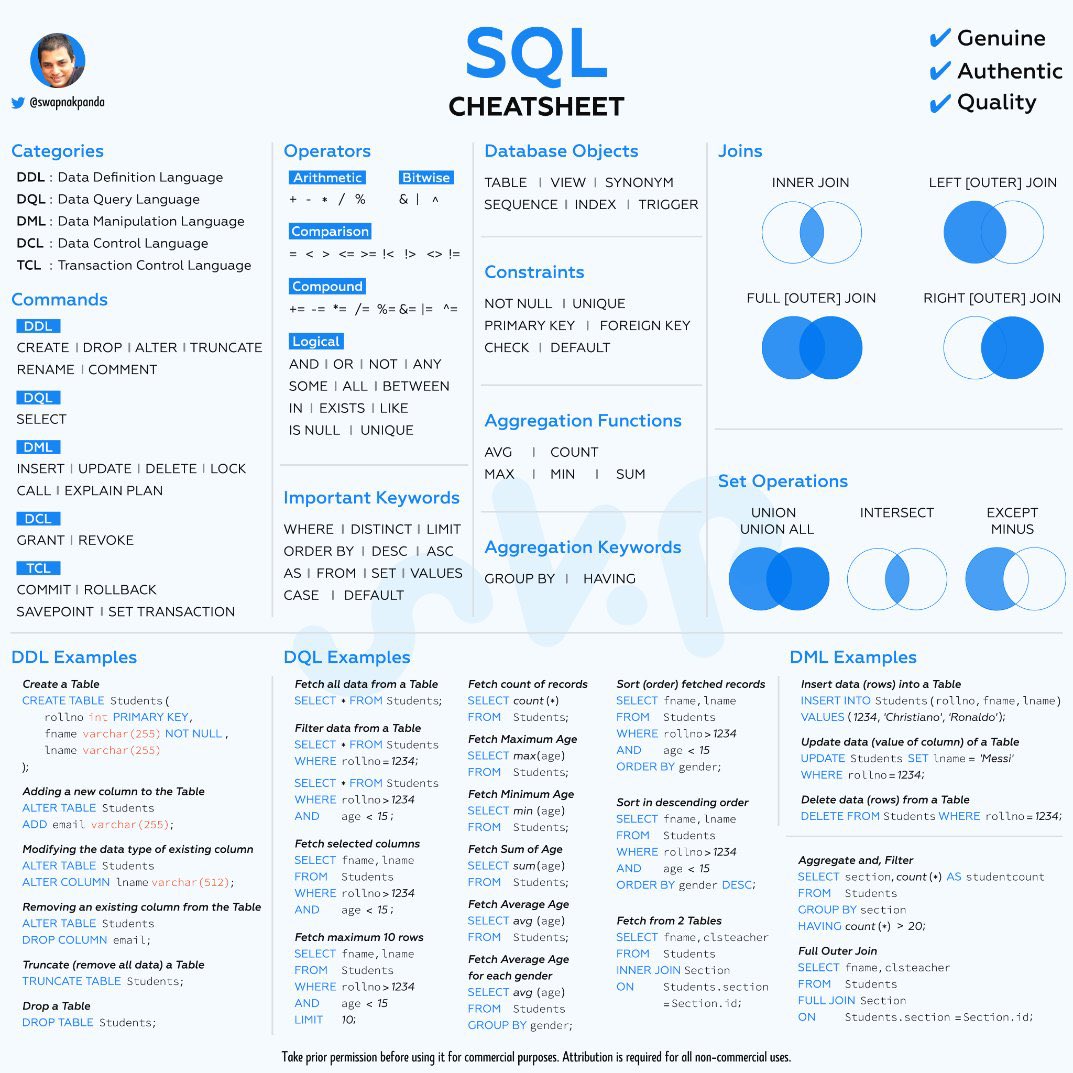
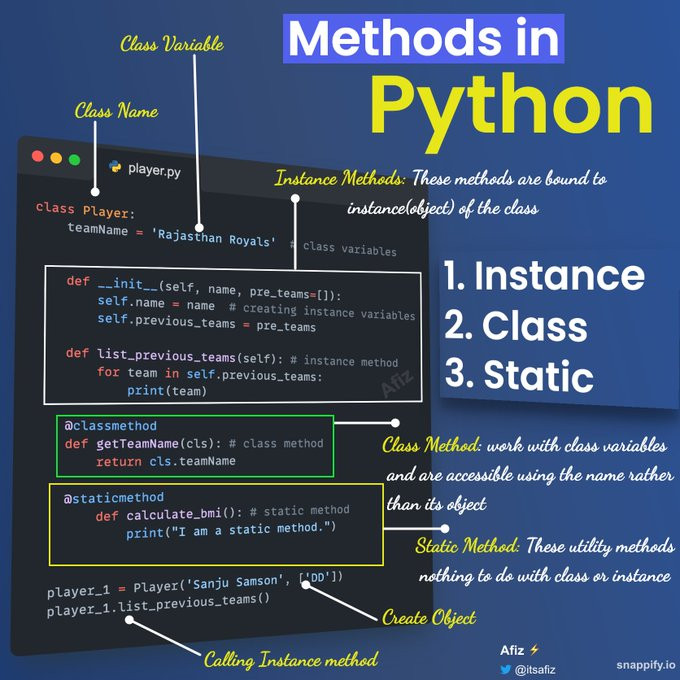
Life is short, I use Python.
Today I'm sharing a Cheat Sheet with everyone who's interested

English
-- retweetledi

Linear algebra, deep learning, and GPU architectures are fundamentally interconnected
Linear algebra deals with matrices & tensors and is the branch of math that is applied in deep learning (DL). GPUs are used for training DL models.
Tensors and GPUs are a marriage made in heaven!
GPUs were first designed for graphics processing but they are remarkably well-suited to perform linear algebra operations
Tensors are multidimensional arrays that can represent anything from simple scalars to complex n-dimensional matrices. They're a unifying framework to represent data, weights, biases, and essentially all the numerical aspects of a neural network.
0th-Order Tensor: A scalar, a single real or complex number.
1st-Order Tensor: A vector, an ordered set of numbers. It's an n-tuple.
2nd-Order Tensor: A matrix, a grid of numbers arranged in rows and columns.
Higher-Order Tensor: Tensors of three or more dimensions, generalizing vectors, and matrices.
You can represent text, images, and videos as tensors and operate on these tensors to train the weights and biases of a neural network
Tensors support operations like addition, matrix multiplication, transposing, contraction, reshaping, and slicing
Each of the layers of the NN can be formulated as tensor operations and the fundamental algorithms like backpropagation and gradient descent apply these tensor operations
The cool thing about these tensors is that you enable parallelization of computations, and the cool thing about GPUs is that they are incredibly good at parrallelism. Unlike CPUs, which might have a few powerful cores optimized for sequential processing, GPUs have thousands of smaller, less powerful cores designed to execute operations simultaneously.
Tensors and GPUs work really well together
Parallelism: The operations on tensors, especially those of higher orders, can be broken down into many smaller, independent tasks. This suits the architecture of a GPU, where thousands of these tasks can be run in parallel.
Memory Hierarchy: GPUs have a hierarchical memory structure, including global, shared, and local memory. Effective use of this hierarchy while working with tensors can lead to substantial efficiency gains.
Optimized Libraries: Libraries like cuBLAS, cuDNN, and others offer GPU-accelerated implementations specifically designed for tensor operations. Frameworks like TensorFlow and PyTorch are built on top of these, abstracting away the complexity.
Batch Processing: Deep learning models often process data in batches, which means performing the same operations on a whole set of data points simultaneously. This again plays into the parallelism that GPUs provide. You can think of it as applying the same transformation to every element in a grid simultaneously.
Over time there have been a lot of software libraries and frameworks built to make building AI really simple and fast. You can iterate and experiment with your favorite NN using a couple of lines of code. In the background, the GPUs will crunch the tensor operations and extract patterns in your data magically.
Further reading and pic credit -
towardsai.net/p/deep-learnin…
Why GPUs for ML - weka.io/learn/ai-ml/gp…

English
-- retweetledi

Anyone with an Internet connection can learn Data Analysis for free:
Excel - Microsoft Training Videos
tinyurl.com/sxyuyd3m
SQL - Mode
tinyurl.com/mry3vsrz
PowerBI - Udemy Course
tinyurl.com/8ejmwjcb
Python - Google Classes
tinyurl.com/4nb2encb
No more excuses.
English
-- retweetledi