Danny

2.5K posts

Danny banner
Danny

Danny

@Metalgrem1in

MBA l Bundelkhand University l Pro Democracy Forums | Paradox Precept

Nairobi Katılım Ağustos 2016
1.9K Takip Edilen201 Takipçiler
Danny retweetledi
Market Rebellion
Market Rebellion@RebellioMarket·
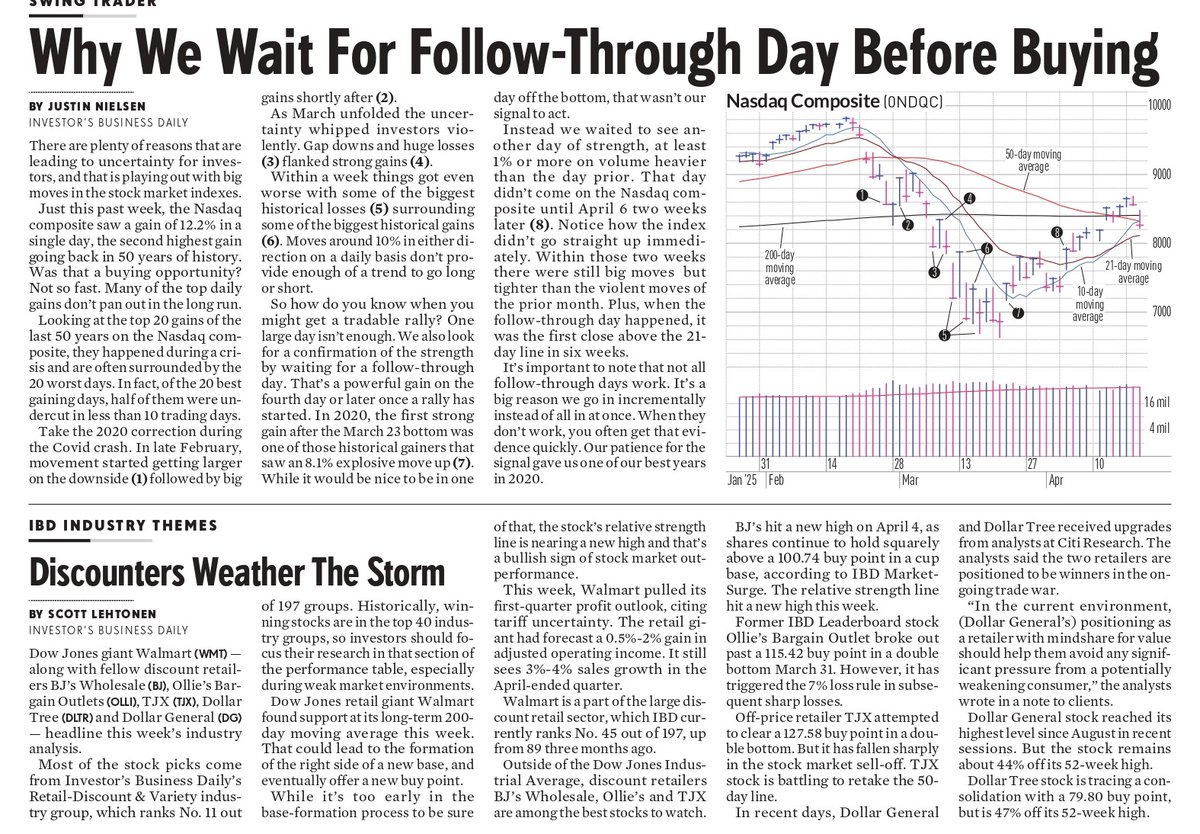
Why We Wait For Follow--Through Day Before Buying.
Market Rebellion tweet media
English
9
23
120
10.5K
Danny retweetledi
Ankur Patel
Ankur Patel@AnkurPatel59·
My Chart Layout Video Language ( Hindi )
English
3
21
128
10.9K
Danny retweetledi
mon
mon@moninvestor·
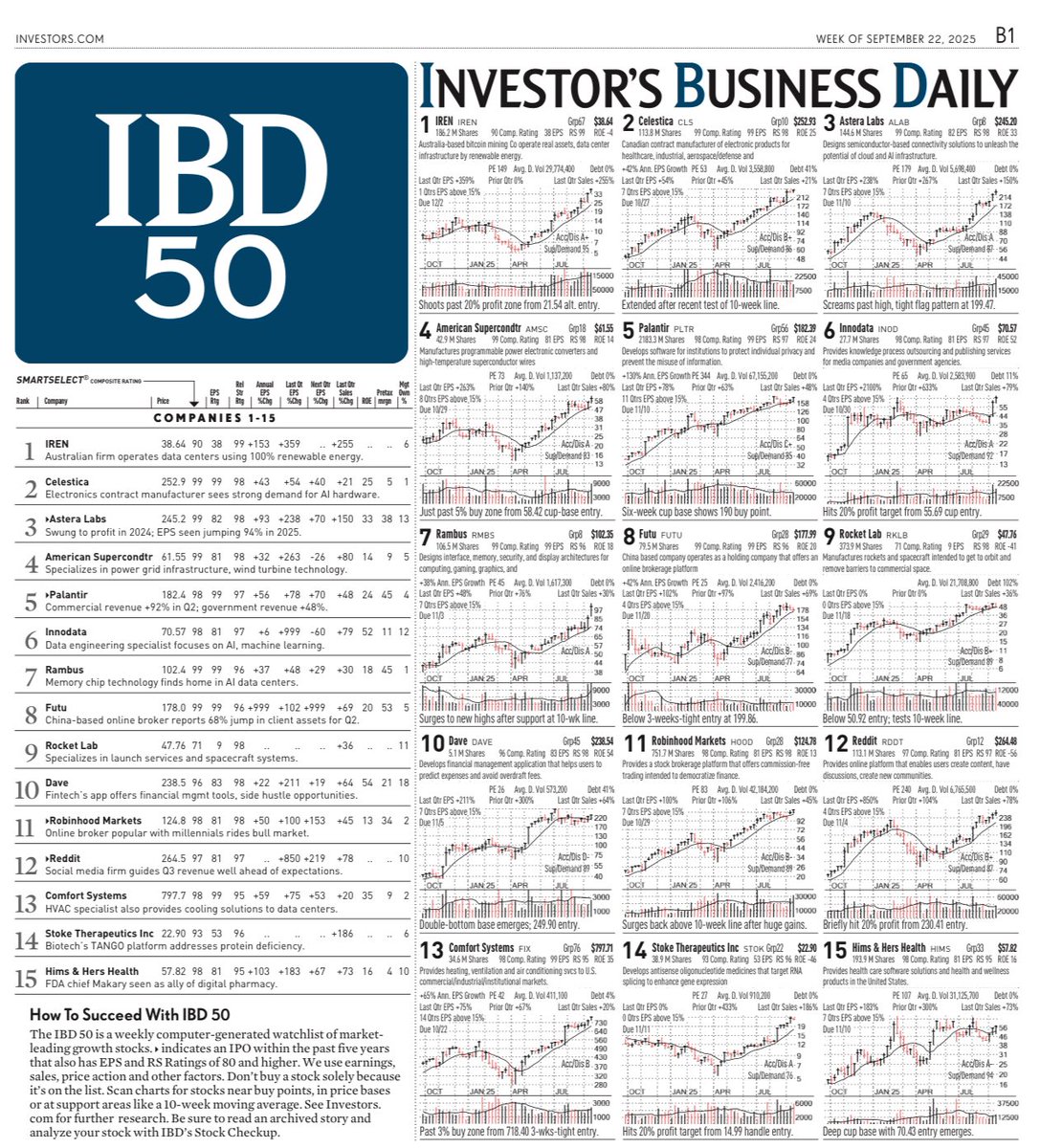
IBD 50 List. Week of September 22, 2025. 1) $IREN stays on top, holding the number 1 spot for the second week in a row. 🧐 Other notable top 15 stocks: 5. $PLTR 9. $RKLB 10. $DAVE 15. $HIMS
mon tweet media
English
20
145
904
108.6K
Danny retweetledi
Equity investor
Equity investor@equitydd·
Here is the IBD 50 complete list: $IREN $CLS $ALAB $AMSC $PLTR $INOD $RMBS $FUTU $RKLB $DAVE $HOOD $RDDT $FIX $STOK $HIMS $SOUN $GFI $RIGL $OUST $APH $WLDN $ANET $RYTM $MIRM $APP $LIF $AVDL $RIOT $TVTX $WGS $AFRM $BZ $TEM $AEM $STNE $SOFI $KGC $NVMI $ONC $TFPM $MU $AU $ANIP $GOOGL $ATAT $PAHC $SITM $CCJ $EGO $EME
English
0
5
25
1.9K
Danny retweetledi
TraderLion
TraderLion@TraderLion·
What improved your trading so much you wish you'd done it sooner?
English
156
16
236
81.9K
Danny retweetledi
The_Chartist 📈
The_Chartist 📈@thechartist26·
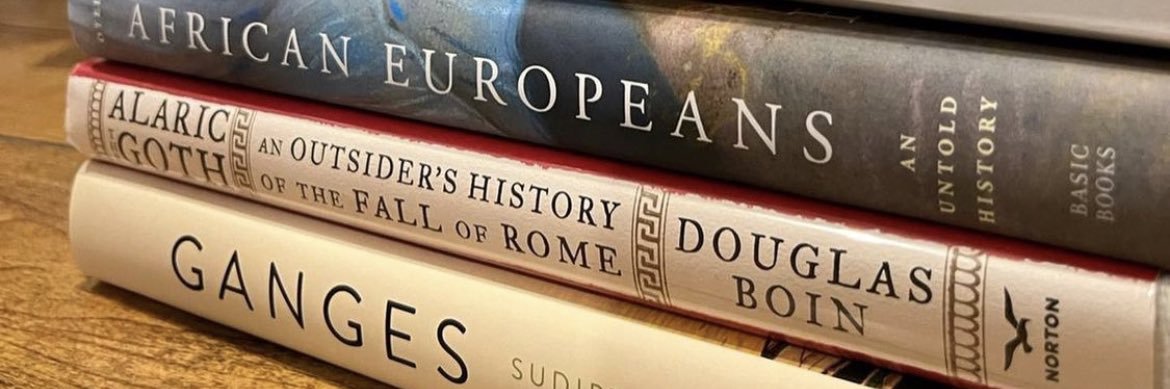
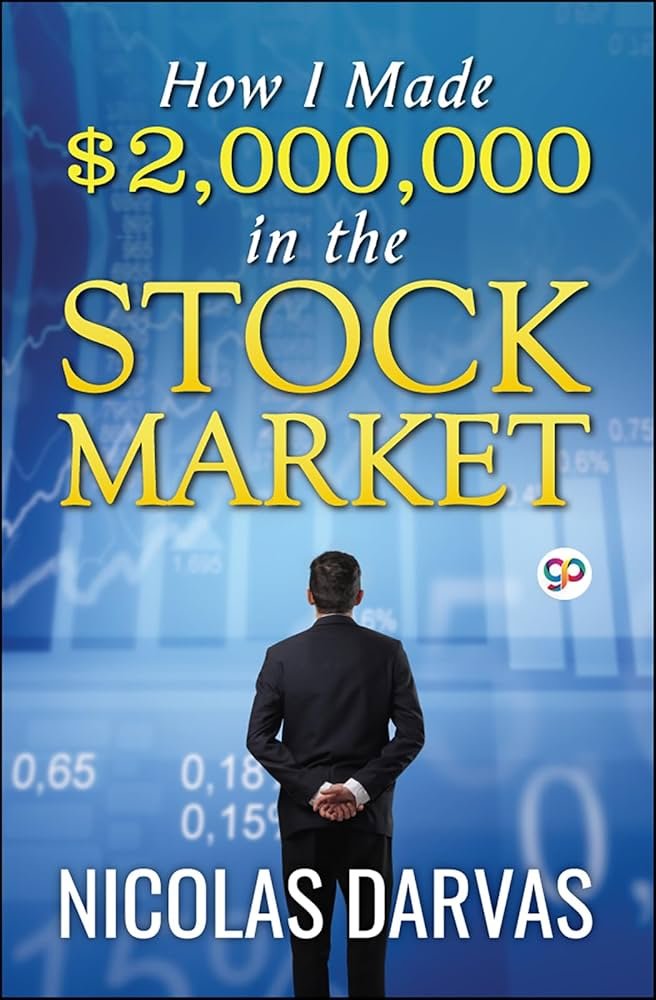
Original account @_chartitude is hacked. I am writing again the list of books that one should read as a beginner in trading/investing. @InvestmentBook1 might share the link with you for them. 1. How I made 2,000,000$ in the Market by Nicolas Darvas - any cover you find on Amazon is ok. This book covers the basics, so you'll need to read it multiple times. 2. You can still make it in the market by Nicolas Darvas - here, he will explain in detail his concepts.
The_Chartist 📈 tweet mediaThe_Chartist 📈 tweet media
English
14
67
446
54.8K
Danny retweetledi
Ankur Patel
Ankur Patel@AnkurPatel59·
This took me 5 years to learn. Cost me over 100R in losses. If you're cutting trades early to "save money," you're making the same expensive mistake I did. Stop before it's too late. [A thread] 🧵
Ankur Patel tweet media
English
6
44
266
36.8K
Danny retweetledi
Equity investor
Equity investor@equitydd·
Big gainers today $MIND $SMCI $AMD $BAND $ANF $CRDO $ACMR $BELFB $COHN $MRC $ZBIO $SKYW $MSB $TRML
English
0
2
18
1.1K
Danny retweetledi
TraderLion
TraderLion@TraderLion·
Oliver Kell doesn’t wait for perfect bases. He looks for wedge pops — tight price action after capitulation — and EMA crossbacks for low-risk entries early in the trend. Big moves start before the chart looks clean.
English
14
36
407
31K
Danny retweetledi
Ankur Patel
Ankur Patel@AnkurPatel59·
Setups keep repeating. They were there 10 years ago, they are here now, and they will be there 10 years later too. Market conditions may change, but patterns don’t. So instead of jumping from one setup to another, just stick to one. Learn it inside out. Especially when the market is slow or not offering much that’s the best time to sharpen your skills. Because when the market heats up again, it’s not the “new setup” that will help you, it’s your old one practiced and perfected. #Trading
Ankur Patel tweet mediaAnkur Patel tweet mediaAnkur Patel tweet media
English
12
73
563
37.1K
Danny retweetledi
Manas Arora
Manas Arora@iManasArora·
These three videos, spaced about three years apart, show just one thing , I keep doing the same setup again and again to make money. No fancy tricks, no constant new reinvention. 2023: tr.ee/xPwartb2Py 2025: tr.ee/9gUj2lIy7g 2025: tr.ee/HbGph9NUFS If you're serious about learning, take out time to watch them before placing any real trade. #BroTip
English
31
388
1.5K
209.7K
Danny retweetledi
Jeff Sun, CFTe
Jeff Sun, CFTe@jfsrev·
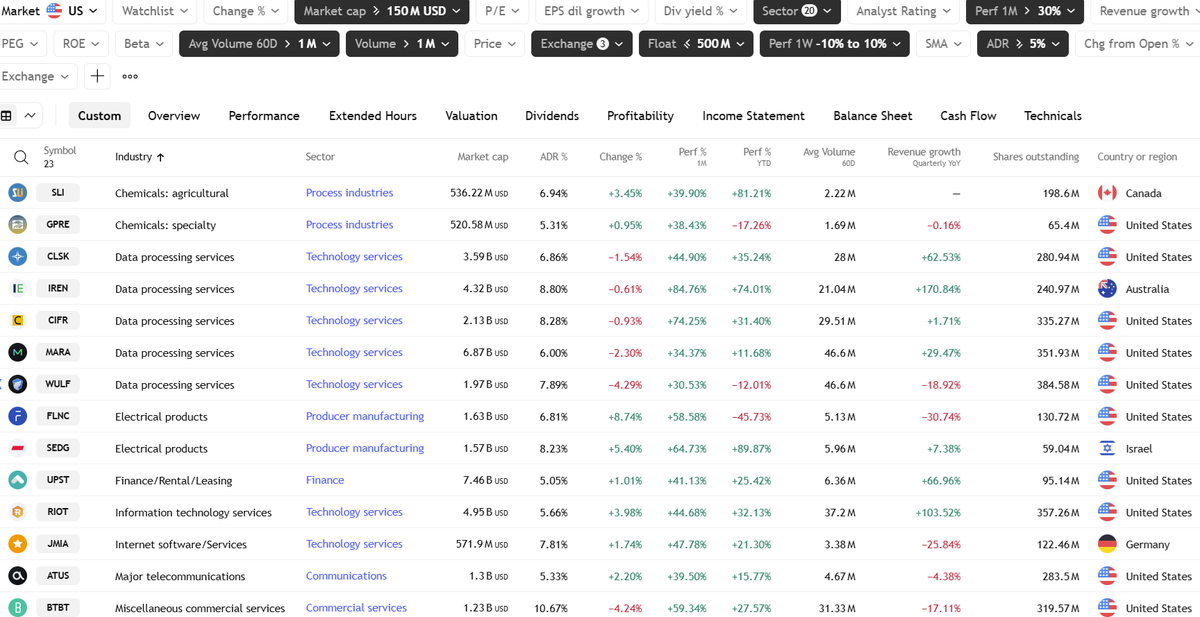
23 Hot/Theme Stocks in Contraction Phase to Add to Your Watchlist, Categorized by Industry Group. (ADR 5%>, Last 1M +30%>, Last 1W +/- 10% Contraction/Tightening) $SLI $GPRE $CLSK $IREN $CIFR $MARA $WULF $FLNC $SEDG $UPST $RIOT $JMIA $ATUS $BTBT $BKSY $SOUN $PL $RZLV $POET $AAOI $RUN $ONDS $COMM
Jeff Sun, CFTe tweet media
Jeff Sun, CFTe@jfsrev

I've just build a quick screen called "Hottest Stock" off @tradingview v2 tailored for individuals seeking stocks akin to $POET chart. This scan sifts through stocks that have exhibited significant momentum over the past month of trading, while also consolidating within a defined range over the past week. Parameters can be further loosen or tighten to your liking (eg. market cap, share float, avg volume). I need to highlight that the initial substantial movement is prioritized in this screening process. A first huge move has to be made. Some other similar names worth mentioning $DJT $ELYM $INDO $RILY $TMDX $WGS $ZURA To catch the initial surge of $POET, you'll require either a pre-market gap-up screener for April 22nd or a post-gap-up continuation base screener for April 23rd. Your approach to capturing stocks like this hinges entirely on your trading strategy and lifestyle preferences. No right or wrong, as long as it is sustainable on the long run for yourself. Pre-market screener example x.com/jfsrevg/status… Post gap up continuation screener example x.com/jfsrevg/status…

English
2
20
122
36K
Danny retweetledi
Lone
Lone@lonextrades·
Qullamaggie shows difference between Choppy and Linear stocks "CCO, uh, this thing is all over the place. It's not good, man; it's not good at all; it's bad. This is not a momentum stock. Very choppy, very choppy all over the place. Look at the recent moves it made. Is this is a momentum stock? Like, it’s all over the place versus something like LEDS right. Right, look at this move it made look at how clean it was, look at this orderly the pullback was. Look at what explosivity it had, and then it had this clean breakout out of a tight range. Then it’s the same thing with this one. IHT - look at how clean it is; look at the move it made look at how big the move was. Right, and then you have the CCO - is it clean? It’s all over the place. Up down up down up down up down. You see the clean trend. Is it surfing the 10 or the 20? It’s a micro cap, so you shouldn’t even be looking at the 50 on this thing; it’s not good. You want to be in explosive stocks."
English
2
15
192
10K
Danny retweetledi
breakout stocks
breakout stocks@gbstocks·
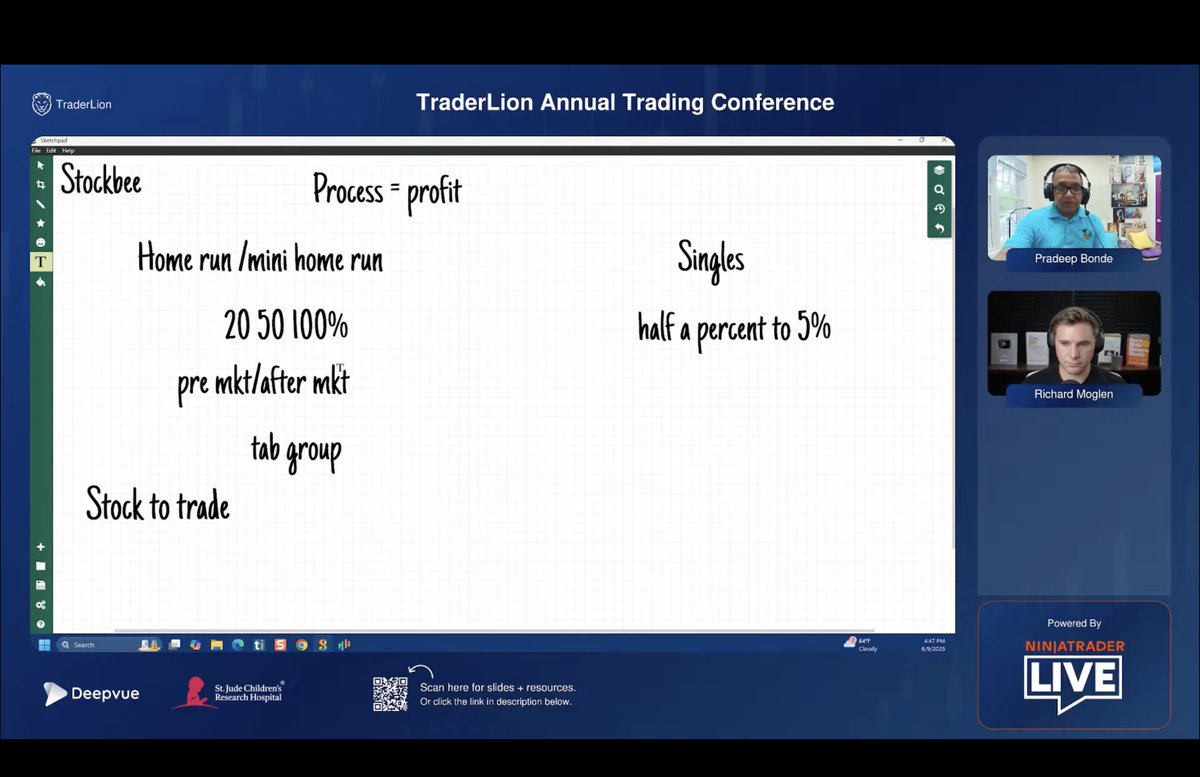
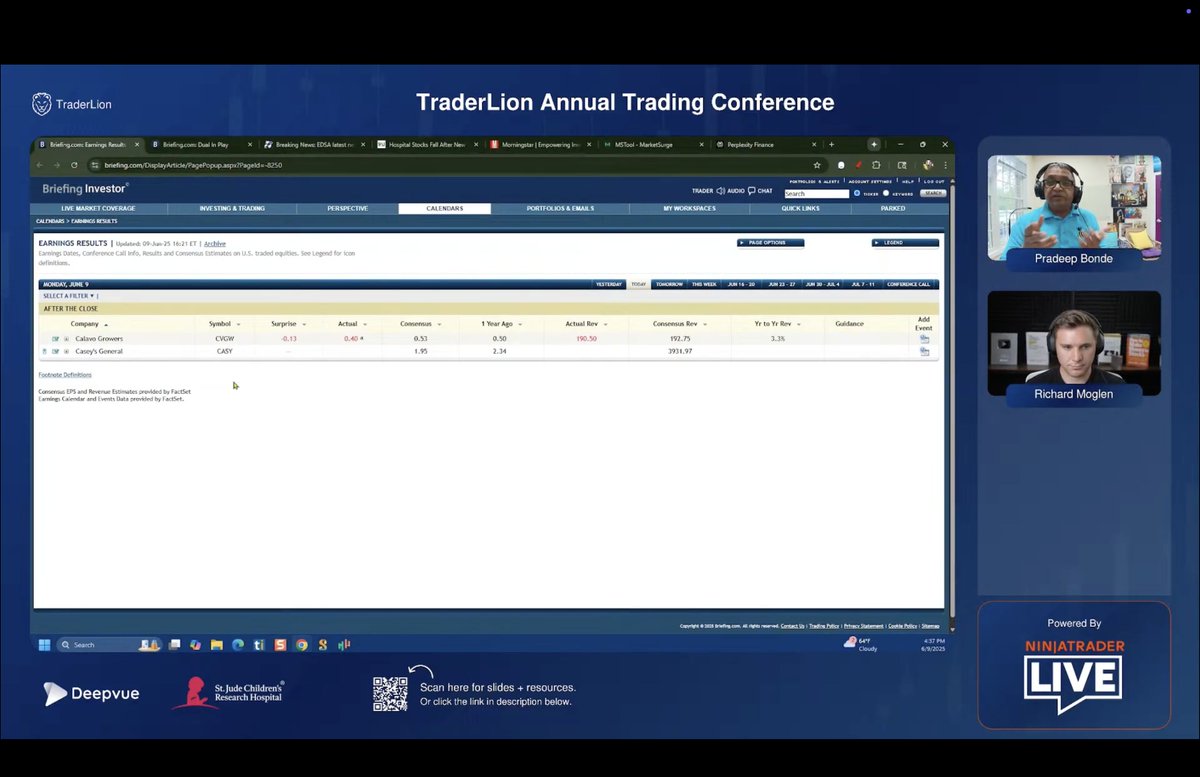
Notes from @PradeepBonde's recent @traderlion presentation in which he goes over his daily process to find trades: "If you follow a process, profit is just an outcome of following a process. In order to have a process, you need to have setups. Two categories of setups: 1. Home runs: one trade will move your account by 20%, 50%, 100%+ (example: EP) 2. Mini home runs: one trade that will move your account 0.5-5% In order to do this successfully, there is a process flow that is required... the most important part of this process starts in premarket or aftermarket. In order to finds stocks which have earnings as a catalyst, sales as a catalyst, news as a catalyst, or game changing news, will be after hours or before the market opens (when companies announce)... Websites he uses to find earnings/news catalysts: - Briefing.com - TheFly.com - WSJ.com - Morningstar.com - MarketSurge.com - Perplexity.com The starting point is always earnings. When I'm looking at earnings, I'm looking for a surprise or year to year revenue/sales to be higher than 39%... I only look for a surprise if the stock is neglected because the move becomes explosive if the stock is neglected. So, this is one thing I do for a process to find a trade. And this process runs before the market opens. By 8:30am, I've looked at everything." Presentation found here: youtube.com/live/c1ncNqbni…
YouTube video
YouTube
breakout stocks tweet mediabreakout stocks tweet media
English
7
65
362
39.3K
Danny retweetledi
Chhirag Kedia
Chhirag Kedia@swing_ka_sultan·
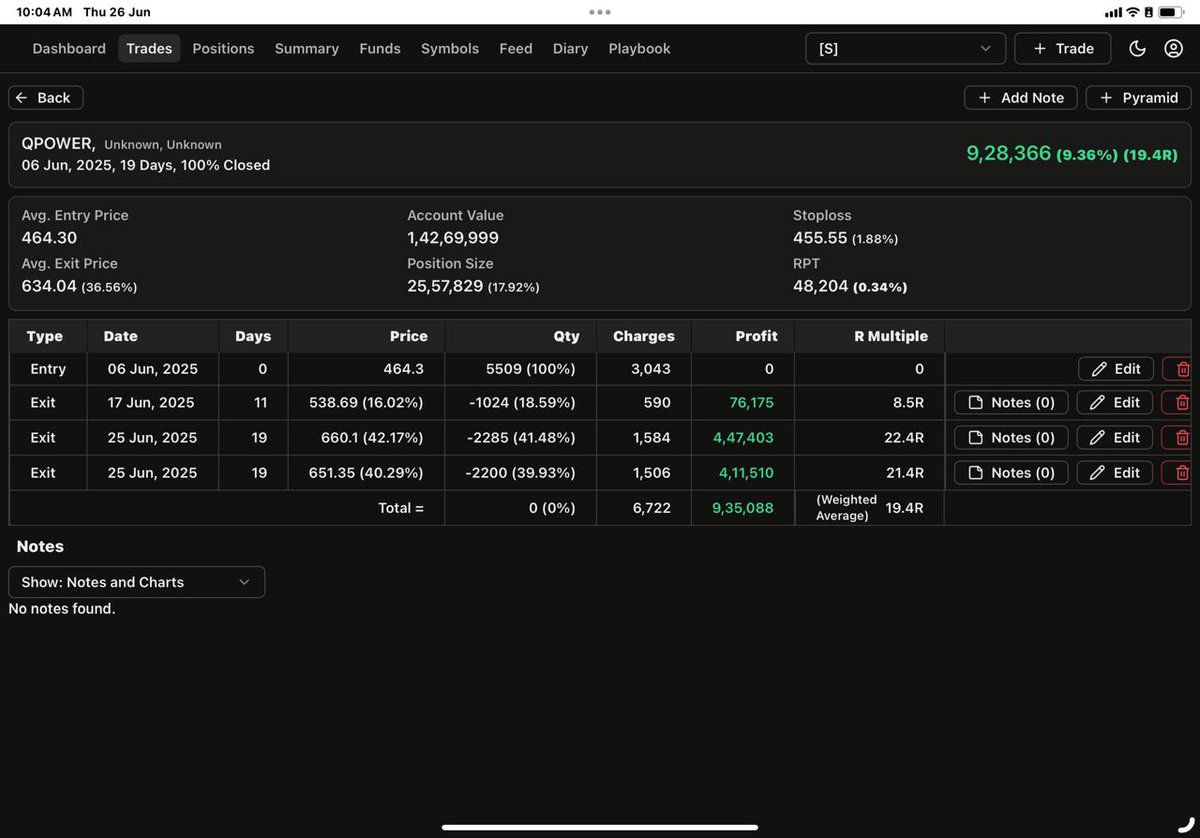
A SUCCESS STORY AND AN APPRECIATION POST A few days ago, I shared the following framework as an equation for wealth. This story highlights how a student implemented the top three principles from that framework—and the impact it created. A] Just Another Trade The student entered #QPOWER on June 6, 2025, at an average price of ₹464.30. The stop-loss was set 1.9% below the entry, with a position size of approximately 18% of the portfolio, based on 0.35% risk on portfolio. B] The Skin in the Game A key moment in the trade came when he pyramided the position with an additional 0.5% risk and a 2.13% deep stop-loss. The second entry was made on June 16 at ₹499.64 with a stop-loss at ₹489. This added 23.46% exposure to the portfolio, bringing the total position size to 40% of the portfolio. I usually avoid sharing the rupee value of a trade, as it tends to spark greed and creates the illusion that trading is a shortcut to quick riches—something that has ruined many careers, lives, and families. However, in this case, I’ll make an exception—because we’re talking about wealth. And at the end of the day, it’s the rupee value that puts food on the table, not the percentages. And having skin in the game is also the first and most vital component of our wealth equation. Without it, the rest holds little meaning. The total position size in this trade, after the second entry, was approximately ₹60 lakhs on a ₹1.4 crore portfolio. The first leg accounted for ₹25.5 lakhs, while the second added ₹34.5 lakhs. At no point did the risk exceed 0.5% of the portfolio which comes around ₹73,500. C] A Key Moment The most crucial decision in this entire journey came on June 19, 2025, when the market produced a shakeout. Since the trade was already risk-free and the stock showed strong potential, he chose to apply O'Neil's eight-week hold rule—but with a twist. He extended it to a nine-week rule, simply because nine is his favorite number. As per this rule, he committed not to sell the stock for the next 45 trading sessions, no matter what, unless it hit the stop-loss. One key modification—something I follow in my own trading and advised him to adopt—was to avoid taking a loss in a high-potential trade. Instead, he set the stop-loss at his breakeven level, which was around ₹484. The only exception I make to this rule is when the price turns parabolic and a sharp decline appears imminent—in such cases, it's wise to lock in partial or full profits based on the situation. This approach allows you to combine all three components of the wealth equation—Portfolio Value × Position Size × Magnitude of Move—while keeping risk to a minimum. I consider this the most pivotal moment in the trade because many traders tend to exit strong positions out of fear when other trades aren’t working and the market produces a shakeout. This often happens even when the probability of loss is minimal, and the only action required is to defend the entry price. However, had the position been sold that day, re-entering would’ve been extremely difficult once the move began the very next day—and the stock hasn’t looked back since. It would have meant a complete loss of opportunity. This also highlights the importance of getting the entry right, as we discussed in our evening session. If his initial entry had been slightly higher, he would’ve been shaken out during the shakeout phase. D] And Then The Wind Comes ... A quote I keep on my trading desk is from @nntaleb: "Wind extinguishes a candle and energizes fire. Likewise with randomness, uncertainty, chaos: you want to use them, not hide from them. You want to be the fire and wish for the wind." The wind of fortune turned in his favor over the next few days, as the stock began accelerating rapidly—rallying 45% in a short span. This, I believe, is the hardest part of the entire journey. Most other aspects can be handled through a rule-based approach, but watching a large sum of unrealized gains builds an inflated perception of risk, often pushing traders to exit too early. It’s not that #QPOWER was an extraordinary mover we’ve never seen before—trades like these show up every now and then in our careers. But what we often miss is one of the key elements in the wealth equation—and that’s what stops us from making life-changing gains. Some don’t fund their portfolios properly because they still see trading as “khelna” (gambling), not as a serious business. Others hesitate to size their positions meaningfully—40% feels too aggressive even with a 0.5% HRE. And most will fail to ride the move, simply out of fear of giving back a part of the gains to the market. Many times, we do have the right size—but we offload a major portion as soon as we see initial gains, cutting off the potential for a meaningful impact. However, this doesn’t mean we should blindly risk all our unrealized gains by sticking rigidly to the eight- or nine-week rule, especially when the situation calls for flexibility. As the stock accelerated and turned parabolic, he began trailing it bar-by-bar—locking in most of his gains while maintaining full capital exposure to ride the move. This is the phase where money comes easiest, but holding becomes the hardest. E] Exits and the Final Stats During our conversation on Wednesday, I advised him to take some profits into strength—at least a quarter or a third of the position—which he was already considering. He booked partial gains between ₹650–₹660, as the upside appeared limited. The final exit was made yesterday around ₹690–₹700, once the stock began losing momentum. (I also noticed a minor 20% reduction in the first position around 17th June, just before the second entry. This would have resulted in roughly a 3.6% reduction in overall position size. However, I’m not factoring it in, as it’s too minor and doesn’t impact things significantly.) For the final stats, I’m sharing the details he provided. But the most important takeaway from this entire story isn’t the numbers or the rupee amount—it’s the decision-making that led to the best trade of his career. He graciously credited me, but the real credit goes to him. He held firm through the pressure and was rightfully rewarded by the market. I did tell him one important thing though—he’s been rewarded this time, but in 80 out of 100 cases, even after doing everything right, he won’t be. That’s the part we can’t control. The magic isn’t in the tactics I taught him—no tactic is failproof. It was simply that the market was kind this time. All we can really do is prepare for every possible scenario, favorable or not, and respond with the best of our ability. Trading isn’t a tactic- or strategy-driven game where knowing something automatically means making money. It’s a decision-making game. And the real goal should be this: Are your decisions aligned with the kind of trader you envision yourself becoming in the next 10 years—or over your lifetime? I hope this trade inspires him to aim even higher in his journey. The market shapes a trader through fire, and I truly wish it forges him into one of the finest traders the world has ever seen. That would be an incredibly proud moment for me. I hope it also inspires each one of you. I’d love to hear the takeaways you draw from this trade—and more importantly, how you plan to implement them in your own trading journey.
Chhirag Kedia tweet mediaChhirag Kedia tweet mediaChhirag Kedia tweet mediaChhirag Kedia tweet media
Chhirag Kedia@swing_ka_sultan

If you want to build real wealth, focus on four key principles: 1) Skin in the Game – You must have capital invested. If your portfolio isn’t well-funded yet, put every rupee you can save early in your career. Without skin in the game, you won’t develop conviction—and without conviction, success is unlikely. 2) Get Size – Size matters. Whether you use tight stop-losses, pyramiding, or gradually increase your risk appetite, growing your position size is essential. No size, no meaningful gains. 3) Catch Big Moves – Don’t keep switching for small wins. You'll only end up collecting pennies and missing the real opportunity. Holding size through volatility is uncomfortable—but that’s what separates those who get rich from those who don’t. 4) Repeat – Do all of the above. Again, and again. Wealth Equation: Portfolio Value × Position Size × Magnitude of Move × Frequency of Execution.

English
45
56
393
85K
Danny retweetledi
Lone
Lone@lonextrades·
Qullamaggie’s 100 Year Market Study Takeaways: "So out of the 102 years, there were 56 down quarters excluding sideways and excluding bars that went up - so 14 percent of the time market went lower over the past 102 years. That means the market has gone up or sideways 86% percent of the time, and I did a more recent study of Nasdaq from the 1970s and marked periods good for swing trading and periods tough for swing trading. It’s not an exact science but my conclusion was 62 percent of the time Nasdaq has been in a favorable condition, 62 percent means up and 38 percent of the time it's been going down or sideways over the past 40 years. The average bull run lasted 9.4 months and the average unfavorable period lasted for 7.2 months and we are like six months in a very good period and the median good period lasts for only seven months. So if someone tells you the market only goes up or if someone on Twitter tells you market only stocks only go up it’s not really true stocks go up and down.”
English
3
44
336
24.2K
Danny retweetledi
Lone
Lone@lonextrades·
Qullamaggie Breakout Setups Compilation Watch videos like this over and over again until you can’t unsee the setups.
English
5
62
373
24.9K