
T-Money Ⓥ
3.5K posts

T-Money Ⓥ
@MiceliCapital
✦ 6 Years Trader ✦ +80% 2024 | +381% 2023 ✦ @ZCTraders
Katılım Nisan 2020
287 Takip Edilen2K Takipçiler
T-Money Ⓥ retweetledi
Most traders try to change their behavior by trying to increase willpower.
They try to push harder. Focus more. Be more disciplined.
But it often doesn't work.
If you look at Ohm's Law (from electrical engineering), behavior doesn’t come from force alone.
It comes from the interaction between force and resistance.
Ohm's law says voltage drives current.
And it also says resistance determines how much actually flows.
Let me translate that into trading:
Your willpower is the voltage.
Your execution is the current.
Your internal conditioning is the resistance.
And here's why trading is inherently difficult:
If resistance is high, increasing willpower doesn’t create smooth execution.
It creates internal pressure.
That pressure shows up as:
> Overtrading
> Hesitation
> Forcing trades
> Deviating from your plan
> Emotional exhaustion
You feel like you’re trying harder… but getting worse results.
Why?
Because resistance isn’t simply a mindset problem.
It’s also a nervous system problem.
It’s built from:
** Fear of loss or not enough
** Need to prove something
** Past emotional experiences around money
** Dopamine-driven habit loops
** Stress physiology (cortisol, adrenaline)
When those are active, your system is not optimized for execution.
It’s optimized for protection.
So you push harder.
And the nervous system pushes back.
That’s why willpower alone doesn’t create sustainable change.
It increases voltage in a system full of resistance.
The real work is different, and this where skilled coaching comes in:
You don’t force better behavior.
You reduce resistance.
That means:
- Building awareness of your Inner Market in real time
- Regulating your nervous system under pressure
- Unwinding unconscious emotional drivers
- Creating structural risk management so you’re not relying on discipline in the moment
When resistance drops, something shifts.
Execution starts to flow.
Not because you’re trying harder…
but because there’s less in the way.
That’s the paradox...
Sustainable discipline isn’t about pushing more.
It’s about removing what’s blocking you.
#tradingmindset #tradingpsychology $ES_F $NQ_F
$QQQ $SPY
English
@KoroushAK So many traders I have worked with went from unprofitable to profitable just by fixing their routine.
This is such an underrated edge!
English
T-Money Ⓥ retweetledi

I've traded for 9 years and this is the best trading routine I've ever found
- Step by Step Daily Routine
- Works for full and part time traders
• Journal download (free)
I've included a cheatsheet too
Enjoy.
↓
x.com/KoroushAK/stat…

Koroush AK@KoroushAK
English
T-Money Ⓥ retweetledi
I've traded for 9 years and this is everything I know about Price Action ↓
x.com/KoroushAK/stat…
Koroush AK@KoroushAK
English
This is huge for strategy development! Building indicators, running backtests, etc. just got so much easier.
The time it takes to find edge is drastically reducing if you are implementing Claude into your trading workflow.
Koroush AK@KoroushAK
English
T-Money Ⓥ retweetledi

T-Money Ⓥ retweetledi
I built you a free trading journal.
The video shows you what it looks like.
I cut all the complciated BS you don't need and made it as easy as possible to use.
Here's how to get it and a starting guide.
↓
Step 1: Get Your Journal
Get a free copy of my trading journal from my telegram.
Link to telegram in my profile --> @KoroushAK
*There's also an in-depth video tutorial there too
**If you can't find it just reply below and I'll give you the link
Step 2: Key Inputs
These are the key pieces of data we track.
Entry Date
Market (coin)
Strategy
Set Up Grade
Long/Short
Position Size ($)
Entry Price ($)
Exit Price ($)
Trade Screenshot
Reason for Cutting the Trade & Cut Result
P/L, Win/Loss & Cumulative P/L
I'll break down how you can use these to build profitable strategies in part 4.
Step 3: The Most Important Statistics
Expected Value: This tells you if your strategy is profitable.
Trade Frequency: This tells you if your strategy gives you enough opportunity.
To improve expected value we need to draw alpha from our journal (this is explained in part 4).
To improve trade frequency, you can do:
Horizontal expansion: Test and iterate your same strategy in different markets. Trade new assets and markets.
Vertical expansion: Build new strategies to trade the same assets.
Step 4: Finding Alpha
-Market
You will often find a select few assets responsible for most of your gains or losses. Trade those more.
-Strategy
Focus on the ONE strategy that makes you the most money and ignore everything else until you have mastered that. Without a journal, you'll never know what that one strategy is.
-Set Up Grade
Grade every trade at entry. Over time, you'll see which grades are actually profitable. Stop taking the low-grade setups that are costing you money.
-Position Size
Pay close attention to this. It's where most emotional mistakes show up. 90% of the time an emotional mistake equals too large a position.
- Daily Report Card
Find and eliminate your weak points. Look for repeat patterns and behaviours.
e.g When I lose 3 trades in a row my execution goes down the drain, new trading rule I stop trading after 3 losses.
- Reason for Cutting The Trade & Cut Result
Find ways to cut your losers quicker and keep them smaller than your winners. Track why you exited and whether it was the right call (over time the patterns become obvious)
- P/L & Cumulative P/L
Don't just look at individual trades, keep an eye on how the cumulative picture is evolving.
- Trade Screenshot
Look for patterns in your screenshots. The journal links directly to your TradingView charts so you can review the price action, not just the numbers.
I could go on for a while but that should give you plenty to work with.
Made this more than a generic guide.
Something that can motivate you to start journaling and get value from it.
Please share for others.
Link to telegram and free journal in my bio --> @koroushak
***Remember if you can't find it just reply below and I'll give you the link
English
This really hits home.
I lost my mother to terminal cancer as well two years ago. If I had been more serious and didn’t give away all my profits in the past I could have afforded better care for her. Now I am consistently profitable but unfortunately it took that loss for me to prioritize it.
English

Once you realize time is all we have..
Things start to become very clear.
I hope it doesn’t take you long to realize this…
Unfortunately for me, I learned it very early in life. I lost both my parents to terminal cancer. If I had taken my trading more seriously, maybe I could have afforded better care for my father. Just one more month.. one more day… one more hour… would be worth any price tag.
Your journey as a trader has a BIGGER purpose.
Every time you click that button.. you have the ability to buy time. More flexibility to spend that time with loved ones. More money to afford proper insurance, better options for a healthier lifestyle, etc.
You have a duty to them.
If you are on this journey.. treat it with the seriousness it deserves.
I guarantee if you do.. you’ll turn into an unrecognizable savage when it comes to pursuing your goals.
English
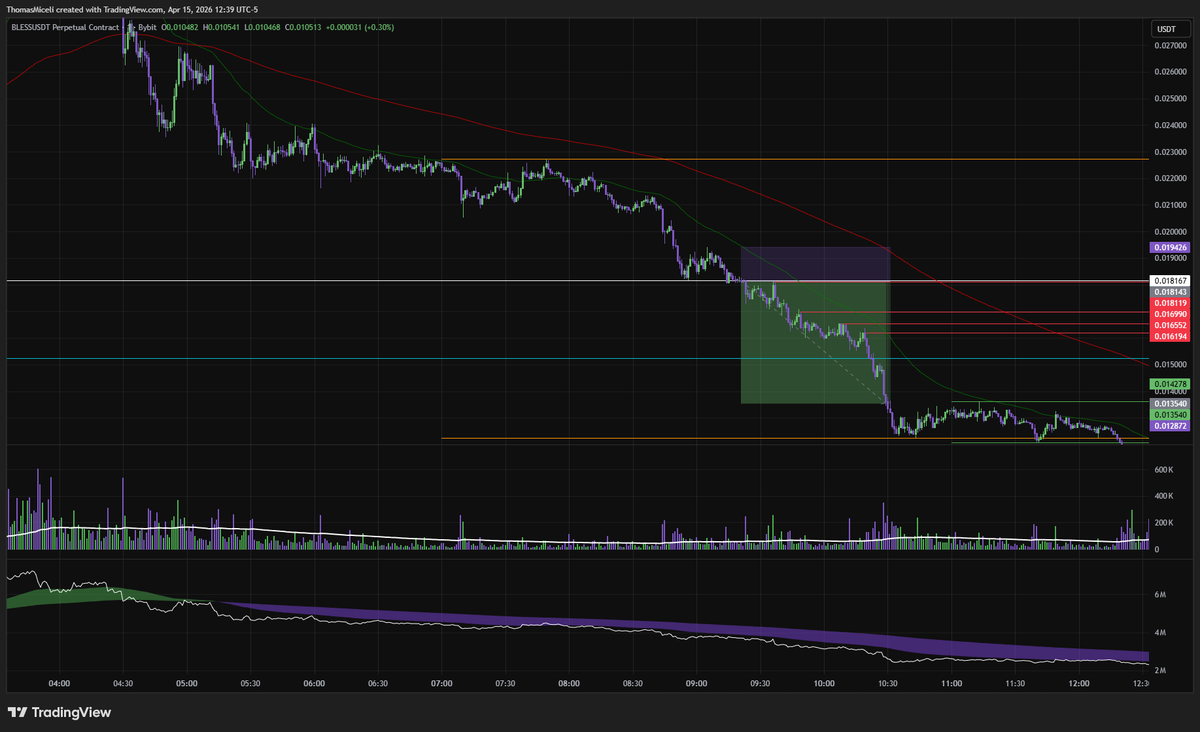
Short $BLESS
There's a very clear pattern playing out in altcoins right now. A majority of the low cap coins that see fast gains of +100% or more in a day or two are quickly giving back the entire move.
It's important however not to be too early and try to predict the top as some of these coins see second waves higher. Waiting for a break of structure on the 15min or 1hr is helpful to ensure the top is in.
This has been my main focus to start the year and will continue to be while we trade in this current market regime. It
English
@KoroushAK Risk management is often the missing piece to a trader’s profitability. This article is worth spending serious time on
English
5am analyzing my journal, doing a quarterly review, and improving my system.
The analysis is the boring side of trading but it’s where the edge comes from. Our execution is simply a byproduct of our journal analysis. It’s not always fun but it’s essential.
Most people say they want it, but few are willing to put the work in for it.
English
Weekly Recap:
Closing out the week early as US markets will be closed tomorrow.
I traded 3 days this week and ended with a profit of +7.3%. The key to my trading this week was passive aggression. The crypto market has lacked synchronicity which has caused a lot of noise.
My goal lately has been to sit on my hands until the stars align and then act aggressively. That happened today with two shorts on $STO and $SOLV.
Here is a video that I shared in the @ZCTRADERS group detailing my thesis, analysis, and execution.
English
T-Money Ⓥ retweetledi
I think this is a useful teaching moment, so I’ll try to expand on it a bit.
Over the last few weeks, I’ve heard a lot of statements like “most participants are short,” “everyone is hedged,” and “the pain trade is up.” But when you hear things like that, you really have to step back and ask: who exactly is doing what, and what evidence do I actually have to support it?
At a high level, markets can be broken down into a few key groups of participants:
Large tactical end users;
These are primarily hedge funds and active managers. They are trading to generate returns, and their flows are large, fast-moving, and opportunistic. Like the hedge funds listed in the original post below.
Small tactical end users;
This includes smaller RIAs and retail traders. The flows are smaller, but still active and reactive, often moving quickly in and out of positions.
Large passive end users;
These are large RIAs, retirement programs, insurance-linked mandates, and ETF issuers. They represent massive pools of capital, but their activity is slower and typically rules-based.
Small passive end users;
Your typical buy-and-hold retail accounts. Smaller in size individually, but collectively meaningful. Their behavior is generally steady and long-term oriented.
Non-tactical end users;
Sovereign wealth funds and very slow-moving pension or retirement programs that require 5 year long approval cycles. These are enormous in size but extremely slow to adjust positioning.
Now, if you think about how markets actually move, most short-term price action is driven by large and small tactical players, along with large passive flows. That is where the velocity comes from.
So if “everyone is short” and “the pain trade is up,” you have to reconcile that with reality. If that were true, why did so many of those players (like the hedge funds in the original post) lose money during a market decline? Why did large RIAs wealth programs lose money? Why did a broad set of passive products also take losses?
Once you look at actual performance across the street, the list of possible explanations narrows quickly.
Are pensions broadly positioned for equities to fall? No.
Are sovereign wealth funds leaning short equities? Also no.
Are buy-and-hold retail investors positioned for downside? Definitely not.
What people usually mean when they say “the pain trade” is that large and small tactical players are positioned in a way that would lose money if a certain outcome occurs. But when data objectively shows us the opposite, we have to accept that information.
It might sound elegant to frame things as some kind of 4D chess, but in reality, markets are often much simpler. Most of the time, when it comes to U.S. equities and larger drawdowns, the real pain trade is lower. It continues to seem like that is the case at this moment.
Nishant Kumar@nishantkumar07
March was BRUTAL: Some of the world’s biggest hedge funds known for delivering steady returns lost money as the war in the Middle East roiled markets across energy, bonds and equities and forced traders to unwind crowded positions. Here are some confirmed initial estimates:
English
@KoroushAK Love this! Going into your trading session with intention and an understanding of the environment you are in is super important
English
T-Money Ⓥ retweetledi
T-Money Ⓥ retweetledi