Sabitlenmiş Tweet

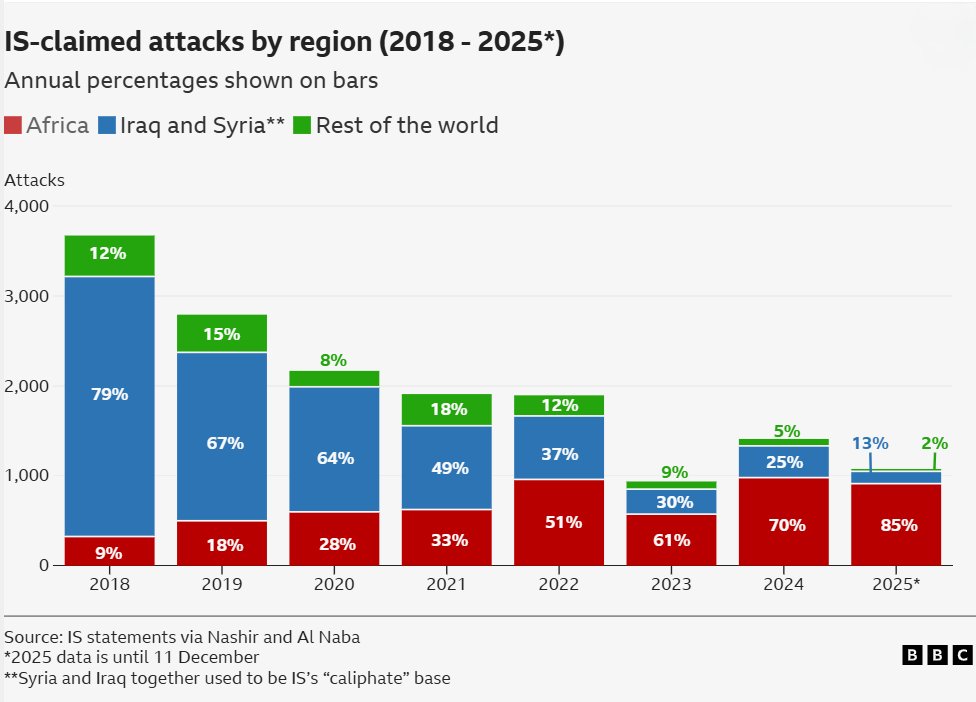
@Andrew_Zammit Hope this latest updated chart helps (these charts/data are based on IS's own claims, but collected and analysed by BBC Monitoring)
English
Mina Al-Lami
4.8K posts
@Minalami
Chief jihadist media specialist at @BBC/ BBC Monitoring (https://t.co/YOO1pNdHh2)
I don't know for sure, but we've written analyses on both cases. In the New Orleans case, IS's unexpected decision not to claim responsibility for the attack, despite the perpetrator's professed/reported support for the group, may suggest he was considered too unstable for IS to claim direct association (we explain in detail why). In its al-Naba editorial on the subject, where it took credit for inspiring the attack but not directing it, IS said that specific conditions must be met - without specifying these - for the group to claim affiliation with an attack or its perpetrator. My analysis at the time, if you're subscribed: monitoring.bbc.co.uk/product/b00034… In the case of Bondi Beach, IS rarely claims attacks in cases where the perpetrator is caught/in custody, and one of the two accused attackers, Naveed Akram, is in custody. Overall, in the past two years, IS has repeatedly argued that it no longer needs to rush to claim every attack, asserting that IS-inspired attacks "speak for themselves" and that authorities now recognise "whether or not an attack has the hallmarks" of the group. It has also claimed that it sometimes deliberately withholds information about its involvement in certain attacks. Together, these claims may be intended to create the impression that IS's influence extends beyond the attacks it formally claims and that its threat is everywhere

Oh my goodness - Yassin with quite a scoop from Germany in @zeitonline
High-profile ISIS/IS supporters online have celebrated the #BerlinPrideAttack, esp after the suspect, Abdul Ballout, was killed, calling him a “martyr” and a “lion”. They clearly believe he was inspired by IS ideology and messaging, particularly following mainstream reporting about his background. Worth noting that IS itself has not claimed any affiliation with the attack or the attacker. Many IS supporters posted the phrase “one of us”, referencing IS’s Al-Naba editorial from July 2024, where the group claimed responsibility for inspiring a series of attacks in the West, under that title, “One of us”. That editorial stated that even if IS doesn’t claim responsibility for an attack, and even if the perpetrators aren’t operationally linked to the group, “they are [nevertheless] one of us, and we are them”. IS’s argument at the time seemed designed to lower the threshold for affiliation, suggesting that ideological alignment alone connects these individuals to the group. This approach also allows IS to claim credit for even more attacks, even if only by inspiring them. IS made a similar argument in the case of the New Orleans attack (Jan 2025) writing “We were there”, taking credit for inspiring the attack but not directly orchestrating it. Same for Bondi Beach attack. In essence, in their reactions to the latest 25 July Berlin Pride attack, IS supporters seem to be saying that regardless of whether IS claims responsibility or not, the attacker is still considered “one of us [IS]”.

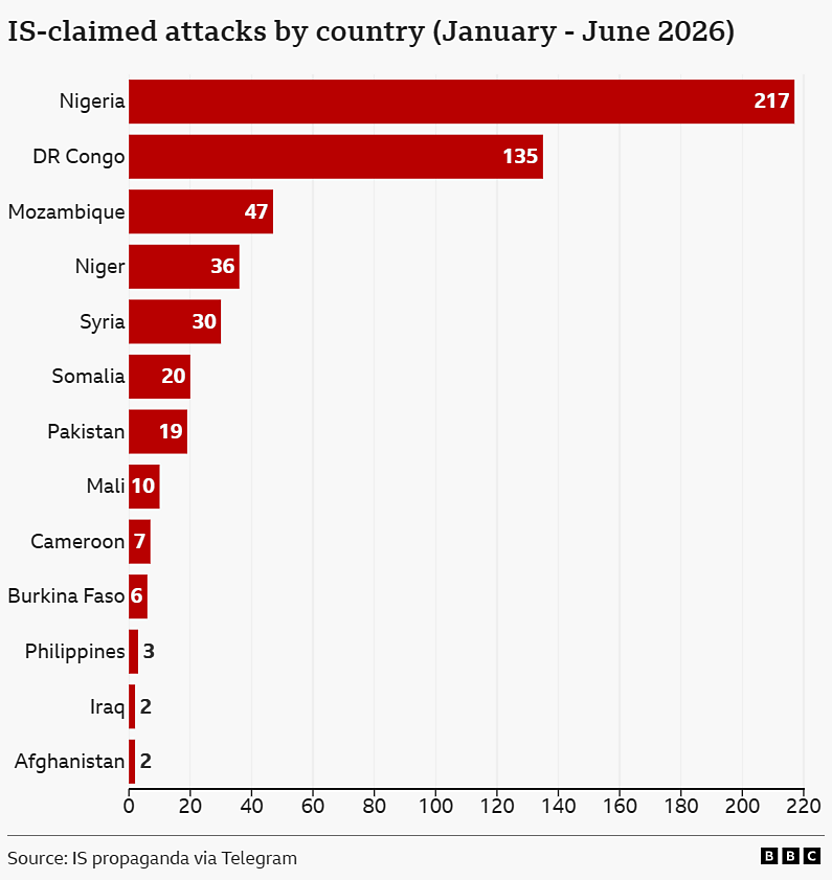
The high-profile pro-al-Qaeda media group al-Yaqin has shared the first issue of a new weekly newspaper, al-Bayan, which closely mimics IS’s weekly newspaper al-Naba in its design, layout, length and content. Even its name, al-Bayan, echoes that of IS’s now-defunct flagship radio station. The nine-page publication was released on 3 July by al-Yaqin's online outlets. It was presented as “a weekly newspaper issued every Friday by [al-Qaeda] supporters from the Arabian Peninsula”, which often refers to al-Qaeda’s Yemen branch (AQAP). Like al-Naba, al-Bayan offers a roundup of key militant attacks and propaganda from al-Qaeda’s global affiliates, although the first issue focuses primarily on the activities of al-Qaeda’s most active branches: JNIM in the Sahel and al-Shabab in Somalia. Interestingly, the publication refers to these groups not by their commonly known names - Jamaat Nusrat al-Islam wal-Muslimin (JNIM) and al-Shabab - but as al-Qaeda in West Africa and al-Qaeda in East Africa, respectively. Almost identical to al-Naba’s layout, the publication opens with a front page highlighting key stories. The second page features an infographic summarising attack statistics from the previous week, while the third page carries an editorial. The editorial in the first issue, which focuses on the conflict in Gaza, appeared somewhat dated and generic.