🚨 OFFICIAL: Mind Chill AI | Department of Human Defence is now live.
I started Mind Chill to showcase the best of humanity. What reality taught me is this: it does not just need celebrating anymore. It needs defending.
Good Proof™ is now live.
Official statement:
mindchill.ai/intel/official…
Best, Jamie (Mind Chill) A Real Human

Absolutely. youtube.com/watch?v=dguz0I…
This feels like the message for today.
To anyone struggling right now: it’s time to bring the chill.
Mind Chill.
You are not alone.
Whatever today feels like, it will not be the same tomorrow.
Our world will start to care again.
@Srini_Pa The irony is almost perfect. AI is being sold as the end of human inefficiency, yet the most effective distribution channel is still a human face, a bit of trust, and a badly lit bedroom.
Authenticity may become the rarest technology of all.
“CNBC just reported that Google, Microsoft, OpenAI, Anthropic, and Meta are paying influencers between $400,000 and $600,000 EACH to promote AI products on Instagram and YouTube.”
So much for revolutionary AI.
Revolutions don’t need promo codes.
🚨 BREAKING: Sean Strickland’s UFC win kind of just exposed the ugliest business model in modern media. After winning, Sean Strickland apologised for inciting and amplifying prejudice during the build-up to his fight with Khamzat Chimaev. But, the real story is not just the apology. It is the explanation.
He had to sell the fight!
That sentence should make every brand, platform, AI company, media executive and political strategist pause.
Because this is the modern attention economy in one ugly little receipt.
Say the extreme thing.
Get the clips.
Trigger the outrage.
Drive the numbers.
Win the market.
Then apologise afterwards and hope everyone treats the apology like a mop.
But the apology does not clean up the incentive system that rewarded the behaviour in the first place.
And this build-up was not just normal fight hype.
BBC Sport reported that Strickland’s comments about Chimaev included derogatory and racist attacks on his religion and heritage. Chimaev then kicked Strickland during a chaotic press conference face-off before security stepped in.
Combat sports has always had theatre.
Villains.
Trash talk.
Ego.
Chaos.
A bit of circus smoke before the cage door shuts.
But there is a line where promotion stops being theatre and starts becoming social damage dressed up as marketing.
UFC is no longer just cage-side entertainment, they are culture..
A UFC event on the White House South Lawn has reportedly been promoted as “Freedom Fights 250”, with coverage describing a planned June 14, 2026 card tied to the White House and President Trump’s birthday.
So this is bigger than one fighter.
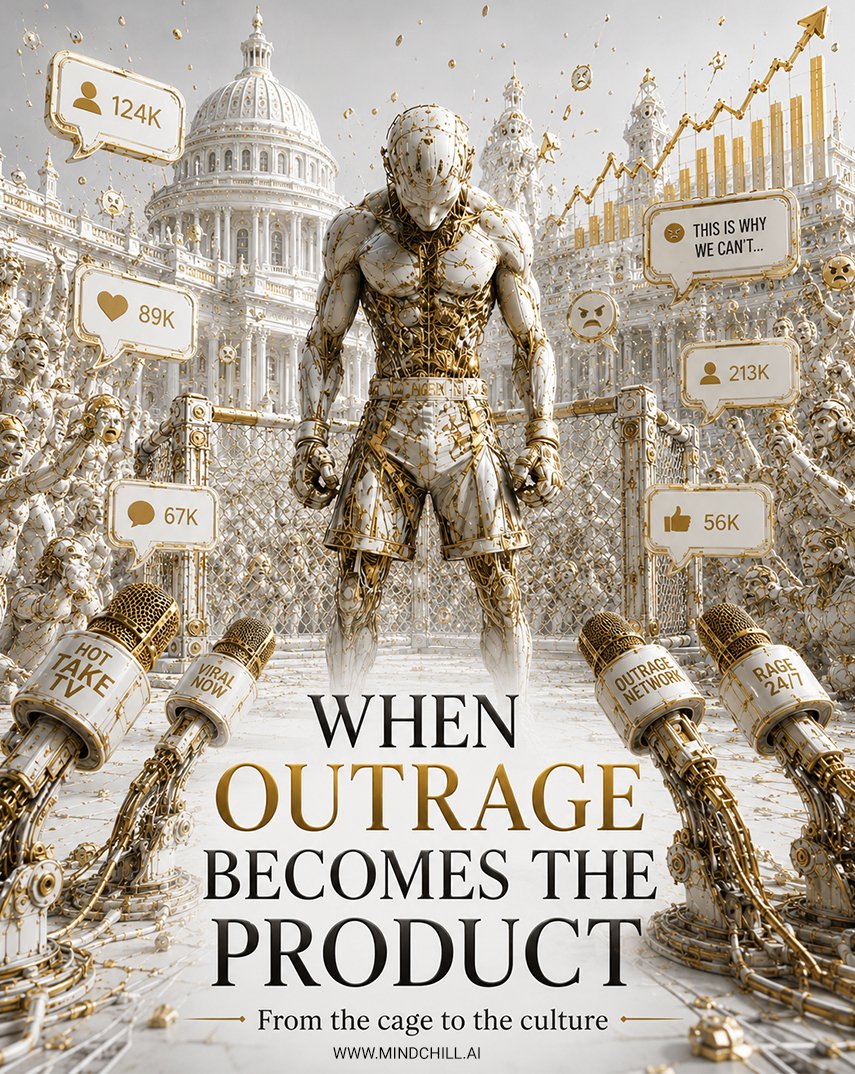
It is about what happens when outrage becomes not just entertainment, but a public-stage business model.
The algorithm does not ask whether something is fair, harmful, racist, strategic, funny, performative or sincere.
It asks one thing:
Did people react?
That is the danger.
Because once reaction becomes the currency, escalation becomes the strategy.
This is not just happening in UFC.
It is happening in politics.
Media.
Influencer culture.
Corporate content.
AI-generated outrage.
Public discourse.
Everyone is learning the same lesson:
Be louder. Be uglier. Be more extreme. Then explain it later.
And the worst part?
The culture we reward becomes the data we train.
The data we train becomes the systems that judge, recommend, moderate, promote and exclude people at scale.
So the real question is not only whether Sean Strickland crossed the line.
The real question is:
Why does “too far” keep becoming the place where the money starts?
That is the ugly receipt.
And sooner or later, every attention market has to pay it.
Trust does not need better apologies.
It needs better proof of what we reward.
#UFC#SeanStrickland#KhamzatChimaev#WhiteHouse#AttentionEconomy#AI#Media#Marketing#Leadership#DigitalCulture#Trust#GoodProof#HumanJudgement#ArtificialIntelligence#SocialMedia
Elon Musk just told a story that should terrify every AI company on Earth.
His son Saxon is autistic.
Saxon couldn’t understand why the family went to restaurants.
You can get the same food delivered.
You can call your friends over.
You can eat better at home for half the price.
So why go?
Musk: “He had an epiphany and said, ‘Oh, the reason people go to restaurants is to hang out with strangers.’”
A kid who takes the world literally just decoded something the rest of us never thought to question.
We like being around people we’ll never know.
Look at what we already built.
Delivery apps so you never wait in line.
Remote work so you never share an office.
Self-checkout so you never talk to a cashier.
Every innovation of the last 20 years was a bet against human proximity.
Every one paid off.
Until it didn’t.
Loneliness is now a public health emergency.
Depression has doubled since the smartphone.
The average American has fewer close friends than any generation in history.
We didn’t remove friction.
We removed the thing friction was hiding.
Now look at what’s coming.
AI agents that handle your emails.
AI companions that replace your conversations.
AI assistants that make every human interaction optional.
Same playbook. Same bet.
Except this time we’re not engineering out strangers.
We’re engineering out humans entirely.
The coffee shop where nobody knows your name.
The subway where no one speaks.
The restaurant where you’ll never see that couple again.
Those aren’t failed connections.
They’re the background radiation of belonging.
We don’t just need people who know us.
We need to exist in rooms full of people who don’t.
That’s what a kid understood at a dinner table that billion-dollar companies still can’t grasp in a boardroom.
We spent 20 years building a world you never have to show up to.
AI is about to finish the job.
And nothing it builds will ever replicate sitting in a room full of strangers and not feeling alone.
And that's still very important, but now people who just really deeply understand their users and can't code at all. I want to fund those people." "it's a big turnaround" from where even he used to be, which is when Silicon Valley used to laugh the "idea guys" out of the room. "I think to do anything at this point on a 10-year time horizon requires a real suspension of disbelief, and yet that's probably the right way to live your life," he said. " I don't think it works to say there's this singularity in three years or five years, whatever, we can't see past it."
People have not stopped wanting love, children, dancing, connection or family. They have become terrified, exhausted, priced out, watched, judged, recorded and algorithmically managed.