Mind Network

1.4K posts

Mind Network banner
Mind Network

Mind Network

@mindnetwork_xyz

A pioneer in quantum-resistant FHE infrastructure | Backed by @BinanceLabs | BUILD Program @chainlink | @ethereum Fellowship Grant | @deepseek_ai Contributor

https://agent.mindnetwork.xyz/ Katılım Ekim 2022
181 Takip Edilen424K Takipçiler
Mind Network
Mind Network@mindnetwork_xyz·
The Agentic Economy is here. But public blockchains completely expose your AI Agent's commercial intent. In this DealFlow interview, our CEO Christian explains how Mind Network solves the machine to machine payment deadlock. With x402z, FHE, and the ERC7984 standard, we provide the Zero Trust Layer and establish HTTPZ to secure autonomous A2A payments. Watch the full breakdown below! 👇
Dealflow@dealflowpodcast

[EP #39] The Future of Privacy & AI Agents Feat. @TheTAOofData (CEO @mindnetwork_xyz) hosted by @RealMissAI AI agents transact openly. Mind Network’s Christian explains homomorphic encryption for private computation. Data sovereignty: foundation for agent economy.

English
18
218
156
11.9K
Mind Network
Mind Network@mindnetwork_xyz·
Mind Network is advancing the privacy first AI economy alongside @BNBCHAIN. As we prepare for the rollout of #x402z, our confidential A2A payment solution, BNB Chain is positioned to be among the very first networks to unlock this infrastructure. x402z leverages Fully Homomorphic Encryption and the ERC7984 standard to enable autonomous machine to machine payments for AI Agents. This infrastructure strictly protects commercial intent, allowing Agents to operate strategically on public blockchains with completely secure transaction histories and balances. Acting as the Zero Trust Layer, we ensure that data and AI computations remain fully encrypted. Extending this vision, our AgenticWorld and the FHE Bridge already fully support BNB Chain, facilitating secure cross chain asset transfers and privacy preserving AI interactions. Network performance is critical for FHE infrastructure requiring continuous computation and settlement of encrypted data. Since AI Agents depend on frequent and autonomous micro transactions, BNB Chain perfectly meets this demand by offering sub second block times and processing millions of transactions daily at exceptionally low costs. This high throughput and cost efficiency create an ideal environment for our privacy solutions.
Mind Network tweet media
English
31
21
89
9.7K
Mind Network
Mind Network@mindnetwork_xyz·
Excited to dive into the ai x web3 frontier with phemex and partners. see you there!
Phemex@Phemex_official

AMA Alert! 📢 This week, join us to discuss the true convergence of AI agents and Web3. 📌 Set a reminder here: x.com/i/spaces/1nxnR… ⏰ When: Mar 19, 1:00 PM UTC 🎁 Giveaways: ▫️ 5 winners from X comments × $10 each ▫️ 5 winners from random live airdrops × $10 each 🎙️ Speakers: ▫️ @Federico0x (Phemex CEO) ▫️ Rolland, CEO of @UXLINKofficial ▫️ Jay, CMO of @UnifaiNetwork ▫️ Christian, CEO of @mindnetwork_xyz ▫️ Anita, GTM APAC Lead of @SentientAGI #AMA #PHEMEX


English
13
8
52
8.2K
Mind Network
Mind Network@mindnetwork_xyz·
Most people don't know this. Apple has been quietly running FHE (Fully Homomorphic Encryption) as core infrastructure since iOS 18. Features like Live Caller ID process your queries directly while the data stays strictly encrypted. This privacy-first technology is powering millions of iPhones right now.
Mind Network tweet media
English
20
21
100
10.1K
Mind Network
Mind Network@mindnetwork_xyz·
AI NEEDS PRIVACY
Mind Network tweet media
English
27
16
79
6.3K
Mind Network retweetledi
Mind Network
Mind Network@mindnetwork_xyz·
In the era of Autonomous Agents, visibility equals vulnerability. Exposure is Risk.
Mind Network tweet media
English
37
9
56
7K
Mind Network retweetledi
Christian
Christian@TheTAOofData·
Right now, the only LLM alternative is to use @AskVenice The privacy in AI market is incredibly underdeveloped and underserved
Guri Singh@heygurisingh

🚨 Stanford just analyzed the privacy policies of the six biggest AI companies in America. Amazon. Anthropic. Google. Meta. Microsoft. OpenAI. All six use your conversations to train their models. By default. Without meaningfully asking. Here's what the paper actually found. The researchers at Stanford HAI examined 28 privacy documents across these six companies not just the main privacy policy, but every linked subpolicy, FAQ, and guidance page accessible from the chat interfaces. They evaluated all of them against the California Consumer Privacy Act, the most comprehensive privacy law in the United States. The results are worse than you think. Every single company collects your chat data and feeds it back into model training by default. Some retain your conversations indefinitely. There is no expiration. No auto-delete. Your data just sits there, forever, feeding future versions of the model. Some of these companies let human employees read your chat transcripts as part of the training process. Not anonymized summaries. Your actual conversations. But here's where it gets genuinely dangerous. For companies like Google, Meta, Microsoft, and Amazon companies that also run search engines, social media platforms, e-commerce sites, and cloud services your AI conversations don't stay inside the chatbot. They get merged with everything else those companies already know about you. Your search history. Your purchase data. Your social media activity. Your uploaded files. The researchers describe a realistic scenario that should make you pause: You ask an AI chatbot for heart-healthy dinner recipes. The model infers you may have a cardiovascular condition. That classification flows through the company's broader ecosystem. You start seeing ads for medications. The information reaches insurance databases. The effects compound over time. You shared a dinner question. The system built a health profile. It gets worse when you look at children's data. Four of the six companies appear to include children's chat data in their model training. Google announced it would train on teenager data with opt-in consent. Anthropic says it doesn't collect children's data but doesn't verify ages. Microsoft says it collects data from users under 18 but claims not to use it for training. Children cannot legally consent to this. Most parents don't know it's happening. The opt-out mechanisms are a maze. Some companies offer opt-outs. Some don't. The ones that do bury the option deep inside settings pages that most users will never find. The privacy policies themselves are written in dense legal language that researchers people whose job is reading these documents found difficult to interpret. And here's the structural problem nobody is addressing. There is no comprehensive federal privacy law in the United States governing how AI companies handle chat data. The patchwork of state laws leaves massive gaps. The researchers specifically call for three things: mandatory federal regulation, affirmative opt-in (not opt-out) for model training, and automatic filtering of personal information from chat inputs before they ever reach a training pipeline. None of those exist today. The uncomfortable truth is this: every time you type something into ChatGPT, Gemini, Claude, Meta AI, Copilot, or Alexa, you are contributing to a training dataset. Your medical questions. Your relationship problems. Your financial details. Your uploaded documents. You are not the customer. You are the curriculum. And the companies doing this have made it as hard as possible for you to stop.

English
3
6
20
6.4K
Mind Network retweetledi
vitalik.eth
vitalik.eth@VitalikButerin·
"AI becomes the government" is dystopian: it leads to slop when AI is weak, and is doom-maximizing once AI becomes strong. But AI used well can be empowering, and push the frontier of democratic / decentralized modes of governance. The core problem with democratic / decentralized modes of governance (including DAOs on ethereum) is limits to human attention: there are many thousands of decisions to make, involving many domains of expertise, and most people don't have the time or skill to be experts in even one, let alone all of them. The usual solution, delegation, is disempowering: it leads to a small group of delegates controlling decision-making while their supporters, after they hit the "delegate" button, have no influence at all. So what can we do? We use personal LLMs to solve the attention problem! Here are a few ideas: ## Personal governance agents If a governance mechanism depends on you to make a large number of decisions, a personal agent can perform all the necessary votes for you, based on preferences that it infers from your personal writing, conversation history, direct statements, etc. If the agent is (i) unsure how you would vote on an issue, and (ii) convinced the issue is important, then it should ask you directly, and give you all relevant context. ## Public conversation agents Making good decisions often cannot come from a linear process of taking people's views that are based only on their own information, and averaging them (even quadratically). There is a need for processes that aggregate many people's information, and then give each person (or their LLM) a chance to respond *based on that*. This includes: * Inferring and summarizing your own views and converting them into a format that can be shared publicly (and does not expose your private info) * Summarizing commonalities between people's inputs (expressed as words), similar to the various LLM+pol.is ideas ## Suggestion markets If a governance mechanism values "high-quality inputs" of any type (this could be proposals, or it could even be arguments), then you can have a prediction market, where anyone can submit an input, AIs can bet on a token representing that input, and if the mechanism "accepts" the input (either accepting the proposal, or accepting it as a "unit" of conversation that it then passes along to its participant), it pays out $X to the holders of the token. Note that this is basically the same as firefly.social/post/x/2017956… ## Decentralized governance with private information One of the biggest weaknesses of highly decentralized / democratic governance is that it does not work well when important decisions need to be made with secret information. Common situations: (i) the org engaging in adversarial conflicts or negotiations (ii) internal dispute resolution (iii) compensation / funding decisions. Typically, orgs solve this by appointing individuals who have great power to take on those tasks. But with multi-party computation (currently I've seen this done with TEEs; I would love to see at least the two-party case solved with garbled circuits vitalik.eth.limo/general/2020/0… so we can get pure-cryptographic security guarantees for it), we could actually take many people's inputs into account to deal with these situations, without compromising privacy. Basically: you submit your personal LLM into a black box, the LLM sees private info, it makes a judgement based on that, and it outputs only that judgement. You don't see the private info, and no one else sees the contents of your personal LLM. ## The importance of privacy All of these approaches involve each participant making use of much more information about themselves, and potentially submitting much larger-sized inputs. Hence, it becomes all the more important to protect privacy. There are two kinds of privacy that matter: * Anonymity of the participant: this can be accomplished with ZK. In general, I think all governance tools should come with ZK built in * Privacy of the contents: this has two parts. First, the personal LLM should do what it can to avoid divulging private info about you that it does not need to divulge. Second, when you have computation that combines multiple LLMs or multiple people's info, you need multi-party techniques to compute it privately. Both are important.
English
575
275
1.9K
297.2K
Mind Network retweetledi
Mind Network
Mind Network@mindnetwork_xyz·
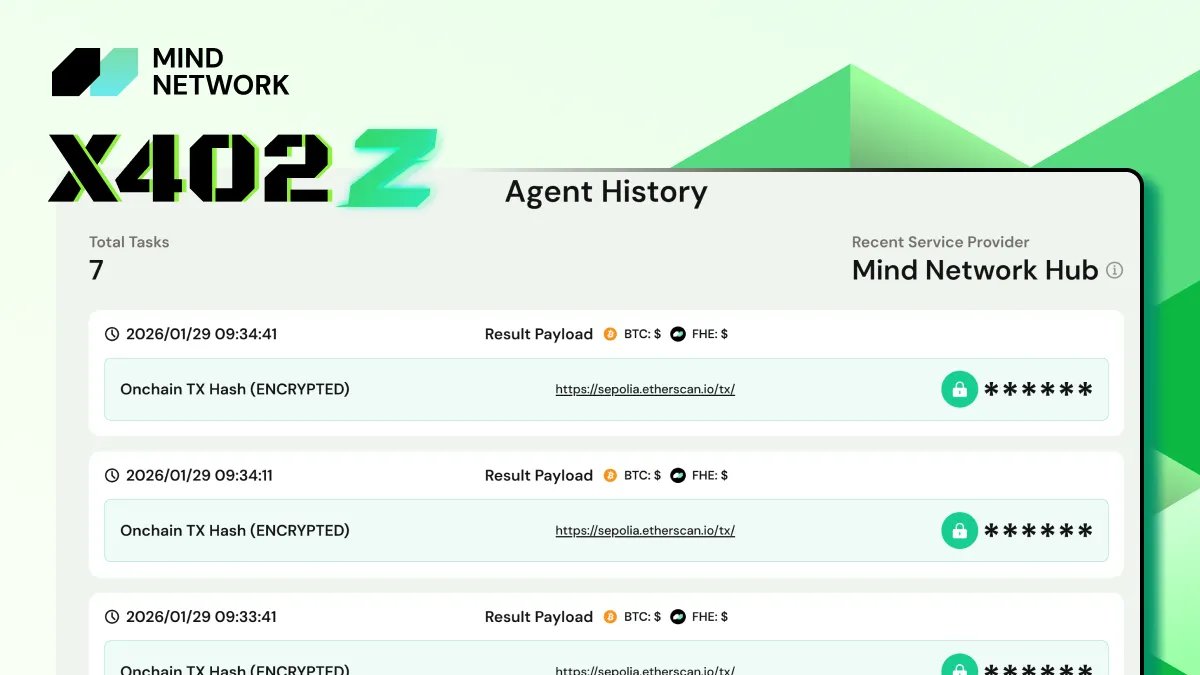
Your Agents are leaking their alpha on public chains. x402z fixes this. We built a confidential payment solution for the Agent to Agent economy. Secure commercial intent is the new standard. Experience it now. ⬇️ x402z.mindnetwork.xyz
Mind Network tweet media
English
17
21
68
9.9K
Mind Network
Mind Network@mindnetwork_xyz·
Legacy payments = real-time human authorization. Agentic payments = pre-defined rules, autonomous execution within them. Same outcome. Completely different trust model.
Mind Network tweet media
English
27
13
59
5.4K
Mind Network
Mind Network@mindnetwork_xyz·
For agents executing complex economic tasks, transparency functions as a liability. Fully visible markets compel agents to adopt simple strategies to evade copy-trading. Integrating x402z with PayAI establishes a market structure that supports informational asymmetry. This enables agents to leverage PayAI for seamless resource acquisition while Mind Network’s FHE strictly guards their proprietary algorithms.
English
0
7
40
3.8K
Mind Network
Mind Network@mindnetwork_xyz·
This architecture effectively decouples the validity of the transfer from the visibility of the transfer. 1/ PayAI manages the execution layer (routing, marketplace indexing), while Mind Network handles the verification layer via x402z. 2/ Validators verify the validity of the input (balance > amount) without decrypting the specific recipient or metadata associated with the service request. 3/ It enables a new class of "Confidential Agents" that can interact with public markets without exposing their internal logic or data sources to competitors.
English
2
6
38
4.5K
Mind Network
Mind Network@mindnetwork_xyz·
We are collaborating with @PayAINetwork to address a fundamental friction in the agentic economy: the trade-off between payment execution and strategy concealment. PayAI implements x402 to enable autonomous agent handling of 402 codes on Solana/Base, resolving the coordination problem of machine payments. However, public settlement transparency conflicts with proprietary alpha. Visible payment graphs expose an agent’s resource acquisition, making its strategy easily copyable. We are embedding FHE-based #x402z directly into the settlement flow, treating confidentiality as a protocol-level requirement.
Mind Network tweet media
English
25
42
122
14.2K