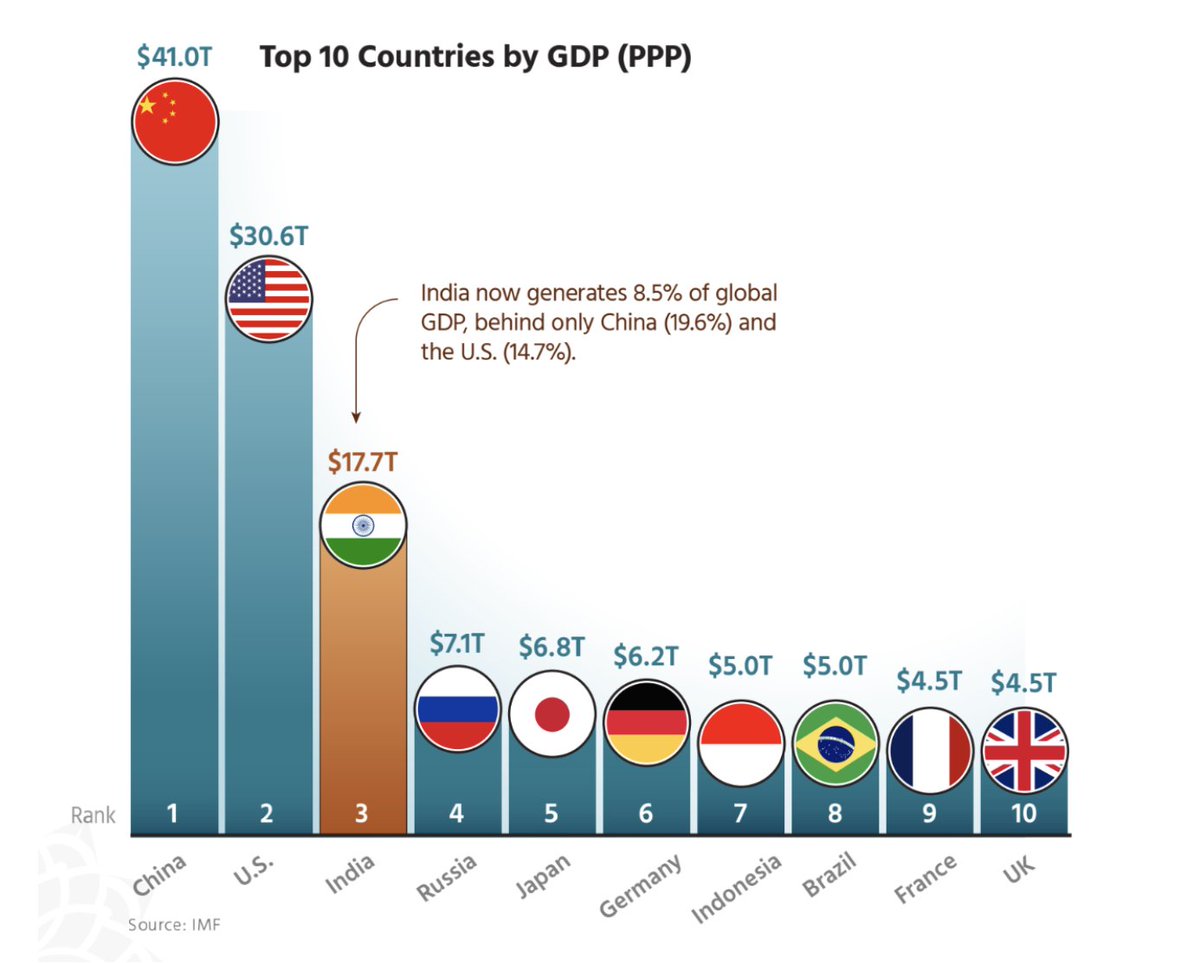
#IndiaWatch🇮🇳: When measured on a Purchasing Power Parity basis, India is the world’s 3rd largest economy. But, on a per capita basis, India remains poor. INDIA = SIZE WITHOUT PROSPERITY.
Sanj
47.2K posts

@Mindzatwork
From sub-sea cables to sugar reduction innovation in India.

#IndiaWatch🇮🇳: When measured on a Purchasing Power Parity basis, India is the world’s 3rd largest economy. But, on a per capita basis, India remains poor. INDIA = SIZE WITHOUT PROSPERITY.


Farzapedia, personal wikipedia of Farza, good example following my Wiki LLM tweet. I really like this approach to personalization in a number of ways, compared to "status quo" of an AI that allegedly gets better the more you use it or something: 1. Explicit. The memory artifact is explicit and navigable (the wiki), you can see exactly what the AI does and does not know and you can inspect and manage this artifact, even if you don't do the direct text writing (the LLM does). The knowledge of you is not implicit and unknown, it's explicit and viewable. 2. Yours. Your data is yours, on your local computer, it's not in some particular AI provider's system without the ability to extract it. You're in control of your information. 3. File over app. The memory here is a simple collection of files in universal formats (images, markdown). This means the data is interoperable: you can use a very large collection of tools/CLIs or whatever you want over this information because it's just files. The agents can apply the entire Unix toolkit over them. They can natively read and understand them. Any kind of data can be imported into files as input, and any kind of interface can be used to view them as the output. E.g. you can use Obsidian to view them or vibe code something of your own. Search "File over app" for an article on this philosophy. 4. BYOAI. You can use whatever AI you want to "plug into" this information - Claude, Codex, OpenCode, whatever. You can even think about taking an open source AI and finetuning it on your wiki - in principle, this AI could "know" you in its weights, not just attend over your data. So this approach to personalization puts *you* in full control. The data is yours. In Universal formats. Explicit and inspectable. Use whatever AI you want over it, keep the AI companies on their toes! :) Certainly this is not the simplest way to get an AI to know you - it does require you to manage file directories and so on, but agents also make it quite simple and they can help you a lot. I imagine a number of products might come out to make this all easier, but imo "agent proficiency" is a CORE SKILL of the 21st century. These are extremely powerful tools - they speak English and they do all the computer stuff for you. Try this opportunity to play with one.


India 🇮🇳 is converting sanctions-driven discounts into billions in refining profits and strategic leverage 😉 India 🇮🇳 is locking in Venezuelan 🇻🇪 crude at ~$55–60 per barrel, refining it at ~$8–10 cost, and selling finished fuels at $85–95. That’s a clean $15–25 profit per barrel. At scale (~300,000 barrels/day), this translates to $4.5M–$7.5M daily and up to $2.7B annually in margin capture. China 🇨🇳 , which once capitalized on these discounted Venezuelan 🇻🇪 barrels, is now ceding that advantage. Imports have fallen to roughly 150,000–170,000 bpd in early 2026, a steep drop from earlier peaks. This effectively cuts off access to some of the cheapest heavy crude available, forcing a shift to relatively higher-cost alternatives and putting pressure on refining margins, especially for plants optimized for heavy sour grades. Containment of China policy of Americans is favouring India directly or indirectly in various ways. 😁 #OilGames

If you want to build an AI automation business serving small Indian firms, do not start by asking "what can AI do?" Start by asking "what does the office boy do?" Sit in any small CA firm, law office, or trading company for one day. Watch what the least skilled person spends their time on. That is where you start automating. The same 3 things break every small firm. Industry does not matter. 1. Nobody follows up with clients. The CA chases 40 clients for documents before filing deadline. The lawyer needs signed vakalatnamas. The trader needs PO confirmations. What happens: someone sends a WhatsApp message. Client does not reply. Nobody follows up. Deadline passes. Chaos. Automate this first. A system that sends a reminder, waits 2 days, sends another, escalates if no response. WhatsApp or SMS. No app. No portal. This alone is worth Rs 2,000/month. Because the alternative is the owner remembering to follow up with 40 people manually. 15 get missed. 2. Deadlines live in someone's head. Ask any small firm owner: where are your upcoming deadlines? The answer is always a diary, a wall calendar, someone's memory, and panic. GST dates. ITR deadlines. Hearing dates. Lease renewals. Compliance filings. None of this is complicated. All of it is catastrophic when missed. A deadline tracker that sends alerts 7 days before, 3 days before, and morning of. That is it. This is not AI. This is a Google Sheet and a script. But the firm will never build it themselves. They will pay you to run it because when the reminder fails, they want a person to call. Not a dashboard to check. 3. The same documents get typed from scratch every time. Every law firm drafts the same 10 notices. Every CA firm writes the same 8 letters. Every trader sends the same PO format. They fill up templates, but worry because juniors made avoidable mistakes even in filling up templates. Set up templates with variable fields. Create a form that can be filled up to generate a document. Client name, date, amounts, clauses. Or even better, send a WhatsApp message with details and voila, document generated. This is where AI shines. Not replacing judgment, but turning "draft a standard rent agreement" from a 45-minute task into 2 minutes. None of these require advanced AI. The first two are barely AI at all. That is exactly the point. Small Indian businesses do not care if it is AI, automation, or magic. They care that the problem is solved and someone is accountable. Start with these three. Rs 15,000 to set up. Rs 2,000/month to maintain. Once you are inside the firm and they trust you, they will ask you to solve the next problem. And the next. That is how you build a business. Not by selling AI. By solving the 3 problems every small firm has and nobody is fixing.


India's courts produce more data than most SaaS companies. It's public and Free. Still, nobody is using it. Every district court publishes cause lists daily. Every High Court puts orders online. Case status, hearing dates, adjournments, judge assignments. All public. All free. eCourts alone has data on over 20 crore cases. And what are funded legal tech startups doing? Building contract review tools for the 200 large firms that already have budgets. Classic. Meanwhile the most valuable dataset in Indian legal is sitting on government servers. Updated daily. Ignored completely. Every judge has patterns. I have seen judges in Saket who dispose of cheque bounce matters in 4 hearings flat. And judges two courtrooms away who take 14 for the same case type. Some adjourn freely on first ask. Some will chew you out for wasting court time. When a lawyer faces an unfamiliar judge, they call a senior. Ask the clerk. Walk in and hope for the best. But that judge's last 500 orders are on eCourts. How many NI Act cases did he dispose of last year? Average time to disposal? Does he grant interim relief without hearing the other side? All answerable. Nobody is answering. A client asks: how long will my case take? Every lawyer makes something up. Not because they are dishonest. Because they genuinely do not know. But 5 years of data from that court, that case type, under that judge, gives you a real answer. "14-18 months. Under Judge Sharma, closer to 12." Now here is the part that changes everything. You do not need a SaaS company to build this anymore. You do not need funding or a tech team. A single lawyer with a laptop can scrape a judge's last 200 orders, feed them into an AI, and build a personality model of that judge. How does he reason? What arguments does he find persuasive? What makes him dismiss an application on the first hearing? Then do the same for opposing counsel. Do they seek adjournments early? File bulky replies? Bluff on interim applications or actually follow through? Now your draft is not generic. Your arguments are written for the specific judge who will read them. Structured to counter the specific lawyer on the other side. Do this for an arbitrator before your statement of claim. For a tribunal member before your next hearing. Even for your own senior, so the draft you hand them already matches how they think and argue. At LawSikho, we are now teaching our learners to build exactly this. Not a product. A personal tool on their own laptop for the matters they are actually working on. The lawyer who walks into court with a personality model of the judge and a pattern analysis of opposing counsel is not just better prepared. They are playing a different game. The data is public. The tools are free. The skill takes weeks, not years. The only question is whether you learn it before the lawyer on the other side does. Would you like us to make a youtube video and put out on our channel?

I met a D2C founder last month. Massive top line revenue. Beautiful branding. But he looked completely burnt out. "We did 2 Crores in sales last year," he said proudly. "I want to raise 1 Cr to hit 6 Crores next year." I looked at his P&L statement. Net profit: Zero. Every single rupee was burning in the performance marketing furnace. With his growth chart, I could have introduced him to my investor friend that afternoon. No, I said. Stop scaling. He looked offended. "But scale is everything, right?" "Scaling a broken machine just means you crash faster," I told him. I took his notepad and wrote down one simple equation: Contribution Margin - CAC = Profit per order. "Right now, yours is negative," I said. "You aren't acquiring customers. you are subsidizing their lifestyle. Stop scaling unprofitable growth." I mapped out the exact turnaround for him: 1. Don't cut ads blindly; cut the fat. Kill the unprofitable campaigns and bad creatives today. Double down only on high-ROAS channels. 2. Shift to Hybrid Growth. Stop relying 100% on paid ads. Build a retention fortress using WhatsApp, email and community. 3. Renegotiate Supply. Fix your bleeding gross margins at the source so you actually have money left over to market with. 4. Build Two Engines. A "Cash Engine" (profitable base of repeat customers) and a "Growth Engine" (highly targeted ads). Both must coexist. If you do this, I said, You won't just be a spreadsheet with high revenue. You'll be sitting on a cash printing machine. He hesitated. But my current investors want month on month growth. Won't I look like I'm failing? "Who are you building this business for?" I asked. For a VC's dopamine hit, or for your own financial freedom? Today, he sent me a voice note. We trimmed the fat. Top line dropped slightly. But for the first time in two years, our Contribution Margin is positive. We actually made a 15% net margin. I can finally breathe. He could have raised funds to burn them. But I stopped a founder from building a bigger house of cards. Don't scale unprofitable growth. Fix your unit economics, then scale aggressively. It's not about the top line. It's about the bottom line.