Mineto Ota

78 posts

Mineto Ota

Mineto Ota

@MinetoOta

MD/PhD. Rheumatologist. Lecturer, Department of Allergy and Rheumatology, University of Tokyo Hospital. Into complex trait genetics and all things immunology.

Katılım Ocak 2022
165 Takip Edilen229 Takipçiler
Mineto Ota retweetledi
Ronghui (Ron) Zhu
Ronghui (Ron) Zhu@RonZhu2015·
Together with Emma Dann, we are thrilled to present a massive new Perturb-seq atlas of 22M primary CD4+ T cells, from 4 donors, across 3 timepoints – the result of a decade-long collaboration between the Marson (@MarsonLab) and Pritchard (@jkpritch) labs. 🧵👇
Ronghui (Ron) Zhu tweet media
English
4
52
241
38.9K
Mineto Ota retweetledi
Nikhil Milind
Nikhil Milind@TheNikhilMilind·
How well does TWAS estimate a gene’s direction of effect on a trait? We think of this as an important stress-test for the accuracy of TWAS. In a new pre-print with @PGerlach98341, Jeff Spence, and @jkpritch, we find that TWAS gets the sign wrong around 20-30% of the time! 1/n
English
2
21
44
17.3K
Mineto Ota retweetledi
Stacie Dodgson, PhD
Stacie Dodgson, PhD@StacieDodgson·
Another exciting paper from @GladstoneInst Genomic Immunology - check out our latest preprint on myeloid cell editing: Virus-like particles enable targeted gene engineering and pooled CRISPR screening in primary human myeloid cells, led by @HyuncheolJung and @pascal_devant
English
1
9
14
6.2K
Mineto Ota
Mineto Ota@MinetoOta·
I believe that understanding the genetic architecture of complex traits can transform clinical practice. We’ve built—and are still growing—a patient-derived immune cell dataset (see previous work below). If you’re looking for a postdoc, feel free to DM me! pubmed.ncbi.nlm.nih.gov/33930287/
English
0
0
5
336
Mineto Ota
Mineto Ota@MinetoOta·
After time in the Bay Area, I’ve started a new role as Lecturer in the Department of Allergy and Rheumatology @UTokyo_News_en . We’re the group of clinicians who see patients with autoimmune diseases, while researching new treatments, patient stratification, etc.
English
0
1
3
295
Mineto Ota
Mineto Ota@MinetoOta·
Excited to see our paper published in @Nature ! Huge thanks to Jeff, @tkyzeng, Emma, @TheNikhilMilind, Alex, @jkpritch, and everyone who helped make it happen--and to the editors and reviewers for their thoughtful feedback! Article link: rdcu.be/eT5sL
Jonathan Pritchard@jkpritch

Modern GWAS can identify 1000s of significant hits but it can be hard to turn this into biological insight. I'm excited to share our new work combining genetic associations and Perturb-seq to build interpretable causal graphs, out today in @Nature:

English
2
5
58
7.1K
Mineto Ota retweetledi
Hakhamanesh Mostafavi
Hakhamanesh Mostafavi@Hakha_Most·
How do GWAS and rare variant burden tests rank gene signals? In new work @Nature with Jeff Spence, @jkpritch, and our wonderful coauthors we find the key factors are what we call Specificity, Length, and Luck! 🧬🧪🧵 nature.com/articles/s4158…
English
4
39
138
39.5K
Mineto Ota
Mineto Ota@MinetoOta·
Thank you Jonathan for the elegant explanation of our recent work! We dove into how we can model the gene regulatory architecture of complex traits with 1) gene effects from LoF burden tests and 2) Perturb-seq. It’s been an incredibly exciting and thought-provoking journey!
Jonathan Pritchard@jkpritch

Modern GWAS can identify 1000s of hits but it can be hard to turn this into biological insight. What key cellular functions link genetic variation to disease? I'm excited to present our new work combining associations + Perturb-seq to build interpretable causal graphs! A🧵

English
1
9
34
8K
Mineto Ota retweetledi
Carlos E Alvarez
Carlos E Alvarez@CarlosEAlvare17·
New approach to discovering the biology of GWAS signals “by combining quantitative estimates of gene-trait relationships from loss-of-function burden tests with gene-regulatory connections inferred from Perturb-seq experiments in relevant cell types.”
Jonathan Pritchard@jkpritch

Modern GWAS can identify 1000s of hits but it can be hard to turn this into biological insight. What key cellular functions link genetic variation to disease? I'm excited to present our new work combining associations + Perturb-seq to build interpretable causal graphs! A🧵

English
1
2
9
3.4K
Mineto Ota retweetledi
Hakhamanesh Mostafavi
Hakhamanesh Mostafavi@Hakha_Most·
In a country where women's voices are silenced, a young Iranian woman, Parastoo Ahmadi, held an 'imaginary' concert. Fearless of the punishment that awaits, she sang and inspired the dream of a free Iran. A true symbol of resistance. Full video here: youtu.be/oYcaDHEnhbU?si…
YouTube video
YouTube
English
1
2
24
1.8K
Mineto Ota retweetledi
Maya Arce
Maya Arce@maya_m_arce·
Excited to share the latest from the @MarsonLab! An investigation of context-specific gene regulation in T cells, which led to dynamic mechanisms required to control T cell rest and activation. Published today in @Nature thanks to the work of many! nature.com/articles/s4158…
English
4
31
115
21.2K
Mineto Ota retweetledi
Jonathan Pritchard
Jonathan Pritchard@jkpritch·
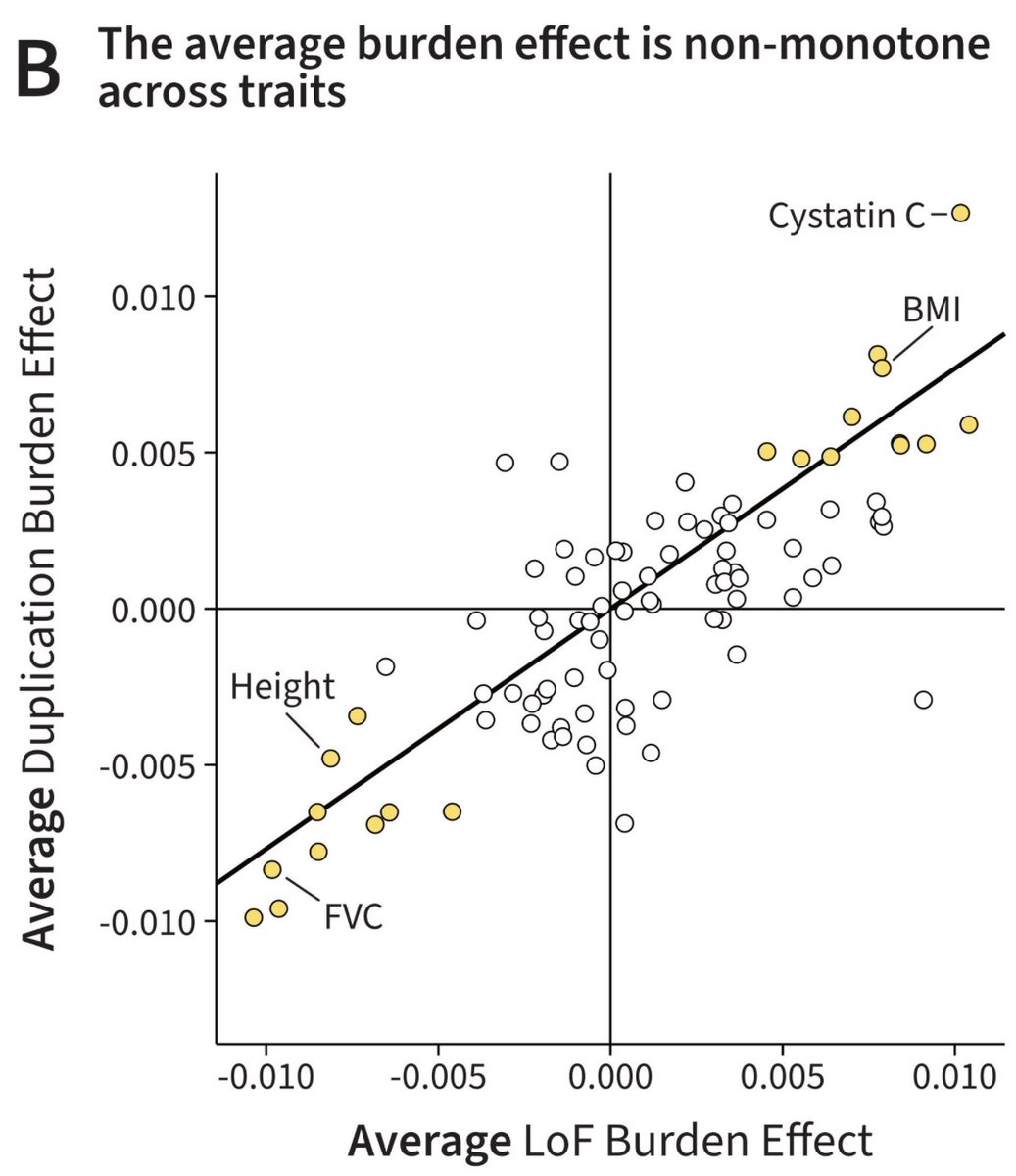
In a new preprint led by @TheNikhilMilind, we explored a fascinating paradox: For many traits the number of duplications or loss-of-function (LoF) mutations is correlated with phenotype. Curiously, for most traits, the AVERAGE direction of LoFs and Dups is the SAME. Why?
Jonathan Pritchard tweet media
English
4
54
192
28.9K
Mineto Ota retweetledi
Nikhil Milind
Nikhil Milind@TheNikhilMilind·
For many traits there is a correlation between the number of duplications or loss-of-function (LoF) mutations someone carries, and their phenotype. Curiously, for most traits, these effects are aligned in the SAME direction. Why?
Nikhil Milind tweet media
English
4
42
110
18.8K
Mineto Ota retweetledi
Hakhamanesh Mostafavi
Hakhamanesh Mostafavi@Hakha_Most·
#ASHG24 folks, I’m giving a talk on Nov 6 on the fundamental differences in gene discovery with common vs. rare genetic variants. Hope to see you there!
English
4
8
72
5.4K