Minh Nguyen

320 posts

Minh Nguyen banner
Minh Nguyen

Minh Nguyen

@MinhNguyenAstro

Physical cosmologist at Leinweber Center for Theoretical Physics, Uni of Michigan. Keyboard and cuesport enthusiast

Ann Arbor, MI Katılım Şubat 2021
410 Takip Edilen424 Takipçiler
Sabitlenmiş Tweet
Minh Nguyen
Minh Nguyen@MinhNguyenAstro·
I’m out of words to thank my coauthors, esp. Fabian Schmidt and Beatriz Tucci, for sharing the vision and conviction for Field-level Inference (FLI). It is a pleasure to share with them the Third Prize of 2024 Buchalter Cosmology Prize for our work on FLI. buchaltercosmologyprize.org
Kavli IPMU@KavliIPMU

Congratulations! Kavli IPMU's Minh Nguyen has been named a recipient of the Third Prize for 2025 Buchalter Cosmology Prize, it was announced on January 16 at the American Astronomical Society meeting. ipmu.jp/en/20250120-Pr…

English
2
0
8
635
Minh Nguyen
Minh Nguyen@MinhNguyenAstro·
I posted a paper to arXiv this morning and this afternoon received in the mail an AI recap of our paper. Must be nitpicking to spot issues with this summary. Very impressed. A useful AI application esp. amid daily arXiv announcements growing so quickly! gist.science/paper/2603.201…
English
2
0
3
141
Minh Nguyen
Minh Nguyen@MinhNguyenAstro·
Hi friends, we're identifying invited speakers for "Cosmology" conference Aug 10-16 in QUY NHON, VIETNAM! vietnam.in2p3.fr/2025/Cosmology… Appreciate suggestions for speakers to cover science from big collaborations, e.g. DES, DESI, EUCLID, SPHEREx, LSST, Planck, ACT, Simons, etc.
English
0
4
7
780
Maria
Maria@MMylova·
@ScottDodelson Well the S8 tension was already too small to be significant. But I don’t claim to understand the KiDs paper.
English
1
0
2
336
Scott Dodelson
Scott Dodelson@ScottDodelson·
Science means changing your mind. Last week, I wrote that the "S8 tension" (the apparent difference in the amount of clustering seen at early times vs. late times as predicted by the fiducial model) was exciting. Today this from the KiloDegreeSurvey (KiDS)
Scott Dodelson tweet media
English
4
20
66
9.7K
Minh Nguyen
Minh Nguyen@MinhNguyenAstro·
@ScottDodelson @MMylova Thanks, Scott! They seem to attribute the shift to improvement in redshift estimation and calibration. But I can't seem to find where it's explained/shown explicitly how previous redshift estimation error/failure could have pulled S8 lower?
English
4
0
1
211
Minh Nguyen
Minh Nguyen@MinhNguyenAstro·
Thrilled to announce the "Beyond-2pt Statistics Meet Survey Systematics" workshop at @KavliIPMU September 16-19, 2025. Excited about the support and interests we have received so far. Deadline for abstract submission is May 15. Let's go beyond (2pt)! indico.ipmu.jp/event/460/
English
0
0
5
221
Minh Nguyen
Minh Nguyen@MinhNguyenAstro·
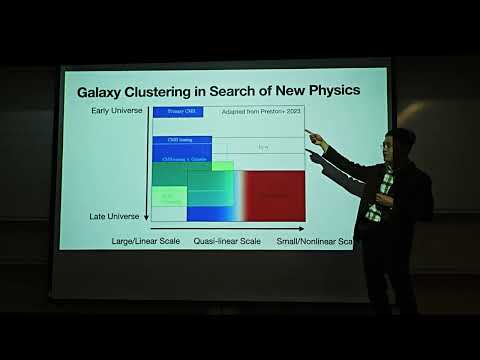
Never a fan of laser pointers. At ASIAA they offer speakers a pool cue instead, so how can I say no? Gave my colloquium with a little extra spin—literally. Nhat-Minh Nguyen (IPMU): Decoding the Cosmos: Field-Level Inference from Galaxy Maps youtu.be/0fDK0Zgzot0?si… via @YouTube
YouTube video
YouTube
English
0
1
4
404
Minh Nguyen retweetledi
Scott Dodelson
Scott Dodelson@ScottDodelson·
Former student, current textbook co-author Fabian Schmidt taught me about Field Level Inference several years ago [details in the thread]. Have been fascinated by it ever since. Very pleased to see that Fabian has been recognized with the Buchalter Cosmology Prize
English
1
2
17
1.3K
Minh Nguyen retweetledi
DESI Survey
DESI Survey@desisurvey·
What happens when DESI data is combined with data from other telescopes? 🤯 A recent paper, which combines data from DESI and the Atacama Cosmology Telescope collaboration, finds that the Universe might be less clumpy and more complex than previously thought 👀
DESI Survey tweet media
English
1
11
46
1.9K
Minh Nguyen
Minh Nguyen@MinhNguyenAstro·
It was a pleasure to talk to @MrMattDavenport at @UMichiganNews about our work that recently got the Third Prize of 2024 Buchalter Cosmology Prize: buchaltercosmologyprize.org. Matt wrote up the story in the most beautiful and succinct way possible.
Michigan News@UMichiganNews

Getting the most out of cosmic maps Research led by @UmichPhysics could help put cosmology on the inside track to reaching the full potential of telescopes and other instruments studying some of the universe’s largest looming questions. The project showcased how a new computational method gleans more information than its predecessors from maps showing how galaxies are clustered and threaded throughout the universe. Scientists are currently using tools like DESI, the Dark Energy Spectroscopic Instrument, to generate these maps and dig deeper into the nature of dark energy, dark matter and other cosmic mysteries. The dark side of cosmology Even as DESI makes headlines now, scientists know they will need more advanced tools to find the answers they seek. Some are developing the next generation of instruments like DESI. @MinhNguyenAstro and his colleagues, however, are focusing on optimizing our understanding of the data we’re getting now—and in the future. “As we move to bigger and better telescopes, we might also be throwing away more information,” said Nguyen, who helped lead the work as a Leinweber Research Fellow in the U-M Department of Physics. “While we’re collecting more data, we can also try to get more out of the data.” Teaming up with colleagues at the Max Planck Institute for Astrophysics, or MPA, Nguyen worked with a computational framework dubbed LEFTfield to upgrade how scientists analyze the large-scale structure of the cosmos. “In the early universe, the structure was Gaussian—like the static you would see on old TV sets,” Nguyen said. “But because of the interplay between dark energy and dark matter, the large-scale structure of the universe today isn’t Gaussian anymore. It’s more like a spider web.” Dark energy drives the expansion of the universe, but researchers can’t directly observe it, hence the “dark” part of its name. The universe’s matter works against that expansion with its attractive force of gravity. This preserves the fidelity of the data in a way that’s inaccessible to the standard methods, Nguyen said. “I love the idea of field-level inference because it is, in principle, the actual thing we want to do,” said Shaun Hotchkiss, host of the online seminar series, Cosmology Talks. The series recently featured Nguyen and his co-author Beatriz Tucci, a doctoral student at MPA. “If we’ve measured the density field, why compress the information inside of it?” Hotchkiss said. “Of course, field-level inference is therefore more difficult to do, but this hasn’t stopped Bea and Minh, and shouldn’t stop the community.” To benchmark the performance of LEFTfield, the team calculated a cosmological parameter called sigma-8, which essentially measures the clumpiness of the universe, Nguyen explained. Compared with standard approaches, the team’s LEFTfield method could improve the sigma-8 determination by a factor of 3.5 to 5.2. “That’s like going from DESI to the successor of DESI,” Nguyen said. “Typically, moving between two generations of surveys would take 10 to 20 years.” Before making that leap forward, though, there is still work to do. A vital hurdle to clear will be integrating LEFTfield with specific instruments and making sure it understands how noise and idiosyncrasies of the tools impact data as it comes in, Nguyen said. Still, he believes the approach will prove to be a powerful asset. “It really opens the fast track to get insights into dark energy, dark matter and general relativity—the theory that this is all based on,” Nguyen said. The research team also included Fabian Schmidt, a cosmologist and group leader at MPA, along with staff scientist Martin Reinecke and Andrija Kostić, who worked on the project as a Ph.D. student then postdoctoral researcher. Nguyen recently completed his fellowship at U-M and is now a research fellow at the Kavli Institute for the Physics and Mathematics of the Universe in Tokyo.


English
0
0
1
139
Minh Nguyen retweetledi
DESI Survey
DESI Survey@desisurvey·
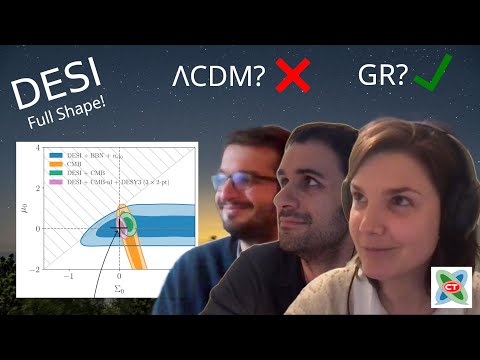
🎉DESI released another set of papers based on Y1 data. These new results provide an extended, “full-shape” analysis of the Y1 data by looking at how galaxies and quasars cluster on different scales, both in the plane of the sky and along the line of sight in redshift space.
DESI Survey tweet media
English
10
30
105
6.8K
Minh Nguyen retweetledi
Kavli IPMU
Kavli IPMU@KavliIPMU·
(Part 2) On November 5, the Kavli Institute for the Physics and Mathematics of the Universe (Kavli IPMU, WPI) celebrated its 17th birthday, and now we have our new group photo!
Kavli IPMU tweet media
English
0
6
27
4.4K
Minh Nguyen retweetledi
Kavli IPMU
Kavli IPMU@KavliIPMU·
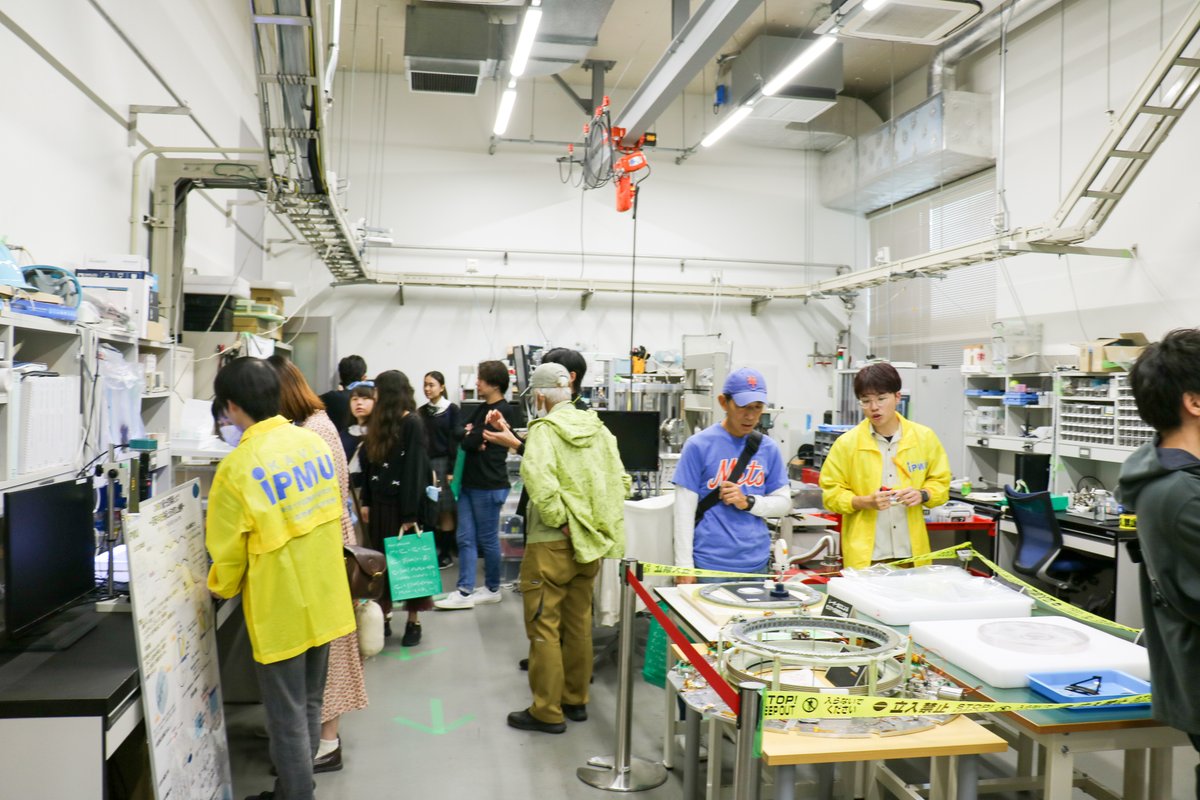
Thank you to everyone who visited us at Kavli IPMU during Kashiwa Open Campus! We had a lot of fun and hoped you did too. Videos of the lectures and science onsen will be available to view until November 3 (Sun). ipmu.jp/en/2024102526-…
Kavli IPMU tweet mediaKavli IPMU tweet mediaKavli IPMU tweet mediaKavli IPMU tweet media
English
0
3
10
1.2K