Minima Intern

239 posts

Minima Intern

Minima Intern

@MinimaIntern

$minima advocator, shitcoin connoisseur | WHAT IS FREEDOM | $eth’s #1 biggest bully

Katılım Ekim 2024
25 Takip Edilen47 Takipçiler
Minima Intern retweetledi
Minima
Minima@Minima_Global·
We’re not getting quantum ready. We already are. Minima runs on WOTS + SHA3, no elliptic curve exposure. No hard fork dependency. Most chains are planning upgrades. We’re built to evolve. If you want to understand why that matters 👇 minima.global/post/the-quant…
English
9
35
96
3.6K
Minima Intern retweetledi
Minima
Minima@Minima_Global·
@spartacuswrecks making yet another spectacular entrance on @xximpod's latest episode ! Thank you for hosting SpartacusRex and we hope you all enjoy the watch 📺 Back to basics.
XXIM Podcast@xximpod

🚨 New Episode w Paddy @Spartacuswrecks from @Minima_Global "Fix the money, Fix the world" In this episode, Ankit sits down with Paddy from Minima, the embedded PoW L1 blockchain Empowering edge devices with full decentralization. @Spartacuswrecks makes a bold, unapologetic case that 99% of the crypto industry was always garbage — and that what's left after the hype dies matters more than ever. @Minima_Global 's answer to the question "what is a blockchain actually for?" is razor sharp: censorship resistance. That's it. And censorship resistance only means something if you're genuinely decentralized. What makes @Minima_Global different? No Coinbase transaction. No mining rewards. No stakers. No validators. Every single user runs a full node and mines the network cooperatively to protect their own coins, not to win a competition. The bigger gets, the more decentralized it becomes. The conversation goes deep on the engineering breakthroughs that make this possible proof databases, Merkle branches and why that matters for a world where billions of people only have a phone. 00:00 Intro 01:02 What Is Minima? The Case for True Decentralization 06:00 The Only Real Value of a Blockchain: Censorship Resistance 08:10 Crypto Is Dead — And That's a Good Thing 12:00 Why Proof of Stake Always Centralizes (Including Ethereum & Cardano) 16:00 Fix the Money, Fix the World — The Deeper Philosophy 22:00 Byzantine Generals, Difficulty Adjustment & Satoshi's Genius 26:10 How Minima Achieves Ultra Decentralization on a Mobile Phone 29:00 The Proof Database: Storing the Whole Chain in 10 Megabytes 35:00 Layer 2, Lightning, & How Minima Scales 44:00 Real World Use Cases: EVs, IoT, the Machine Economy & AI Agents ------------------------ DISCLAIMER This video is for educational and informational purposes only and is NOT financial or investment advice. We do not recommend you to buy or sell any assets. Opinions of guests are their own and do not constitute endorsements. Cryptocurrency and blockchain investments are highly risky and can result in total loss of capital. Do your own research and consult licensed professionals. The channel and its hosts are not liable for any investment decisions or losses.

English
2
18
47
939
Minima Intern retweetledi
Minima
Minima@Minima_Global·
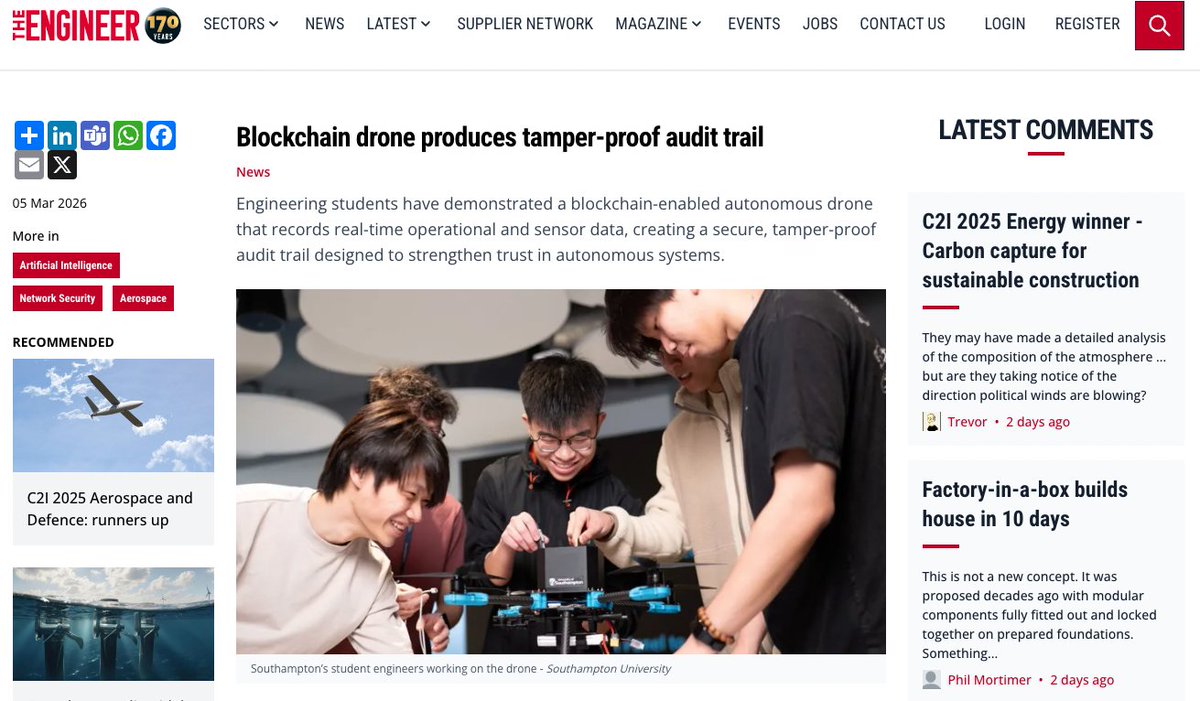
We’ve been featured in The Engineer for our Blockchain-on-Chip work with @unisouthampton , @Arm & @Siemens . 🧵 This isn’t a crypto blog or tech influencer site. It’s one of the world’s oldest engineering publications, founded in 1856 during the Industrial Revolution.
Minima tweet media
English
11
38
108
7.4K
Minima Intern retweetledi
Minima
Minima@Minima_Global·
Huge credit to the brilliant team at @unisouthampton 👏 Taking Blockchain-on-Chip from concept to a live drone demo is no small feat. This “blockchain black box” milestone moves the project to TRL 6 - system/subsystem model demonstrated in a relevant environment. Proper engineering. Real-world validation. 🚀
University of Southampton@unisouthampton

Our student engineers have carried out the world’s first demo of a 'blockchain black box’ on a drone. It records flight data on a secure digital ledger so it's actions can be verified and trusted. Read more: southampton.pulse.ly/xerj9wruyl @Minima_Global | @Siemens | @Arm

English
59
54
115
7.8K
Minima Intern retweetledi
Spartacus Rex
Spartacus Rex@Spartacuswrecks·
"..super decentralized with hundreds of thousands of nodes.. and nodes fully _verify_ everything with quantum-safe.." Totally misses the point Verifying is NOT Constructing You're not helping to build the chain You're not helping to resist censorship #Minima
vitalik.eth@VitalikButerin

An important, and perenially underrated, aspect of "trustlessness", "passing the walkaway test" and "self-sovereignty" is protocol simplicity. Even if a protocol is super decentralized with hundreds of thousands of nodes, and it has 49% byzantine fault tolerance, and nodes fully verify everything with quantum-safe peerdas and starks, if the protocol is an unwieldy mess of hundreds of thousands of lines of code and five forms of PhD-level cryptography, ultimately that protocol fails all three tests: * It's not trustless because you have to trust a small class of high priests who tell you what properties the protocol has * It doesn't pass the walkaway test because if existing client teams go away, it's extremely hard for new teams to get up to the same level of quality * It's not self-sovereign because if even the most technical people can't inspect and understand the thing, it's not fully yours It's also less secure, because each part of the protocol, especially if it can interact with other parts in complicated ways, carries a risk of the protocol breaking. One of my fears with Ethereum protocol development is that we can be too eager to add new features to meet highly specific needs, even if those features bloat the protocol or add entire new types of interacting components or complicated cryptography as critical dependencies. This can be nice for short-term functionality gains, but it is highly destructive to preserving long-term self-sovereignty, and creating a hundred-year decentralized hyperstructure that transcends the rise and fall of empires and ideologies. The core problem is that if protocol changes are judged from the perspective of "how big are they as changes to the existing protocol", then the desire to preserve backwards compatibility means that additions happen much more often than subtractions, and the protocol inevitably bloats over time. To counteract this, the Ethereum development process needs an explicit "simplification" / "garbage collection" function. "Simplification" has three metrics: * Minimizing total lines of code in the protocol. An ideal protocol fits onto a single page - or at least a few pages * Avoiding unnecessary dependencies on fundamentally complex technical components. For example, a protocol whose security solely depends on hashes (even better: on exactly one hash function) is better than one that depends on hashes and lattices. Throwing in isogenies is worst of all, because (sorry to the truly brilliant hardworking nerds who figured that stuff out) nobody understands isogenies. * Adding more _invariants_: core properties that the protocol can rely on, for example EIP-6780 (selfdestruct removal) added the property that at most N storage slots can be changedakem per slot, significantly simplifying client development, and EIP-7825 (per-tx gas cap) added a maximum on the cost of processing one transaction, which greatly helps ZK-EVMs and parallel execution. Garbage collection can be piecemeal, or it can be large-scale. The piecemeal approach tries to take existing features, and streamline them so that they are simpler and make more sense. One example is the gas cost reforms in Glamsterdam, which make many gas costs that were previously arbitrary, instead depend on a small number of parameters that are clearly tied to resource consumption. One large-scale garbage collection was replacing PoW with PoS. Another is likely to happen as part of Lean consensus, opening the room to fix a large number of mistakes at the same time ( youtube.com/watch?v=10Ym34… ). Another approach is "Rosetta-style backwards compatibility", where features that are complex but little-used remain usable but are "demoted" from being part of the mandatory protocol and instead become smart contract code, so new client developers do not need to bother with them. Examples: * After we upgrade to full native account abstraction, all old tx types can be retired, and EOAs can be converted into smart contract wallets whose code can process all of those transaction types * We can replace existing precompiles (except those that are _really_ needed) with EVM or later RISC-V code * We can eventually change the VM from EVM to RISC-V (or other simpler VM); EVM could be turned into a smart contract in the new VM. Finally, we want to move away from client developers feeling the need to handle all older versions of the Ethereum protocol. That can be left to older client versions running in docker containers. In the long term, I hope that the rate of change to Ethereum can be slower. I think for various reasons that ultimately that _must_ happen. These first fifteen years should in part be viewed as an adolescence stage where we explored a lot of ideas and saw what works and what is useful and what is not. We should strive to avoid the parts that are not useful being a permanent drag on the Ethereum protocol. Basically, we want to improve Ethereum in a way that looks like this:

English
1
15
51
2.1K
Waqas
Waqas@OnchainLegend·
@Minima_Global design is key to long-term success for sureee
English
1
0
5
278
Minima
Minima@Minima_Global·
Utility isn’t something you add later. A system reveals its priorities from day one. What it makes cheap, what it makes expensive, what it centralises by default. Design compounds.
English
14
21
109
3.8K
Minima Intern retweetledi
Minima
Minima@Minima_Global·
Today, we’re launching the Integritas AI Agent for ChatGPT, bringing verifiable data integrity into AI-assisted workflows. For the first time, users can create cryptographic proofs of authenticity for documents, files, logs, and AI-generated outputs - and anchor those proofs to the Minima blockchain - without leaving ChatGPT. Full Announcement: minima.global/post/ntegritas… Overview 👇
English
34
55
151
374.3K
Minima Intern
Minima Intern@MinimaIntern·
@CryptoMichNL $MINIMA please. Criminally underrated 9M mcap project working on putting blockchain on chip - amongst a lot of other things.
English
0
0
8
166
Minima Intern retweetledi
Minima
Minima@Minima_Global·
Crypto natives aren’t looking for comfort. They’re looking for networks that don’t panic when the ground shifts. Networks that have already internalised the principle that safety isn’t a layer, it’s a shape. The quantum narrative is a reminder of what that shape looks like. 👉 Small keys 👉 Local computation 👉 No thrones to topple 👉 No single point worth breaking Minima doesn’t posture for future threats, its architecture neutralises them by design.
English
14
35
109
2.9K
Minima Intern retweetledi
Minima
Minima@Minima_Global·
Most chains carry an uncomfortable truth: the larger the balance behind a single keypair, the louder the invitation to any future quantum adversary. Bonded stake. Validator clusters. Pools. Bridges. All of them compress value into oversized cryptographic choke points. Elegant in design, catastrophic in failure. Minima avoids that trap by design. There are no privileged operators, no mega-keys guarding empire-sized stakes. The network is a flat topology of independent actors, each running a full node on their own device. Power is granular. Funds are granular. Failure, if it ever comes, is granular. Quantum attacks thrive on concentration & Minima refuses to concentrate.
English
13
41
115
3.3K
Minima Intern retweetledi
Minima
Minima@Minima_Global·
Quantum computing has re-entered the crypto bloodstream. Not as sci-fi décor, but as a legitimate source of unease: a reminder that every public key left exposed on a blockchain is, in some future timeline, a potential liability. The conversation turning over online isn’t about “Q-Day” prediction markets or hand-wavy futurism. It’s about surface area. Attack windows. The asymmetry between networks designed for convenience and networks built for sovereignty. And that’s where Minima fits in.
English
9
50
119
4.4K
Minima Intern
Minima Intern@MinimaIntern·
@wallstreetbets $MINIMA blockchain-on-chip tech and the only fully decentralized chain where you’re self sovereign.
English
1
0
4
52
WallStreetBets
WallStreetBets@wallstreetbets·
Name a project the market failed to kill.
English
704
40
600
121.2K
Minima Intern retweetledi
Minima
Minima@Minima_Global·
Privacy begins with who holds the power. Most blockchains today are transparent not just in data, but in hierarchy. A handful of block producers determine what gets included and when. RPC gateways act as choke-points. L2 sequencers sit in the line of fire, able to inspect, reorder, delay, or reject. Minima removes the verticality. Every participant runs a full builder and validator. No producers. No favourites. No “special” nodes sitting above the rest. It’s a flat topology in a world obsessed with pyramids. And in a privacy context, that matters: there is no single place for surveillance to lean, no single actor to subpoena, no elite mempool to observe. Censorship becomes less a threat and more an irrelevance.
English
9
39
110
3.8K
Minima Intern retweetledi
Minima
Minima@Minima_Global·
Metadata is the real battlefield. Hiding amounts is yesterday’s fight. Analysts don’t always need the numbers, just the shape of the network: who broadcasts first, who routes through whom, which nodes carry the flow, how transactions cluster in time. Minima’s structure naturally blurs the picture. A uniform set of peers. No designated block producers. No hub-and-spoke mempools. No elite routing layer where forensic firms can quietly plug in. By minimising hierarchy, Minima minimises metadata. Not by mystery, but by symmetry.
English
8
42
103
2.5K