Mitch

27 posts

Mitch banner
Mitch

Mitch

@Mitchelin121

Katılım Haziran 2011
145 Takip Edilen180 Takipçiler
Mitch
Mitch@Mitchelin121·
@gotrice2024 This is false. If your actions (cutting down the tree) lead to the damage, you are at fault/negligent. However, if wind knocks the tree over, then yes, act of god.
English
4
0
78
3K
SonnyBoy🇺🇸
SonnyBoy🇺🇸@gotrice2024·
Did you know in some states when a neighbor cuts down a tree, if it falls into your yard and damages your property, it’s deemed an “act of god” and you are responsible for the damages to your property. For me this could be a huge headache for many people, it shows no accountability. If the neighbor’s tree damages someone else property, you would think that it’s their responsibility since it’s their tree and it’s their actions that caused the damage. Why on earth would any state have this law is beyond me, I wouldn’t want to live in an area like that, where one day you are on top and the next day you could be thousands in debt. What would you do if this was the case for you?
English
79
112
427
77K
Mitch
Mitch@Mitchelin121·
Ugly burgers are the best. This is the exact kind of hamburger I used to eat when I was in high school in the 80s. Hamby’s in Boerne, TX.
Mitch tweet media
English
0
0
0
14
Mitch retweetledi
Ihtesham Ali
Ihtesham Ali@ihtesham2005·
An MIT engineer published a 13-page essay in The Atlantic magazine in July 1945 describing a desktop machine called the Memex. It would store every book, every photo, and every letter a person owned, let them browse the contents by clicking links between documents, and let them save trails of related thoughts. He invented the personal computer, hyperlinks, Wikipedia, and the World Wide Web in a single magazine article 50 years before any of it existed. I read it cover to cover in under an hour and walked away convinced I had just read the blueprint for the world I live in. His name was Vannevar Bush. The essay is called As We May Think. The context for what he wrote matters because it explains how a single person could see so far ahead. Vannevar Bush was not a futurist. He was not a science fiction writer. He was the most powerful scientist in the United States during World War II. He ran the Office of Scientific Research and Development, which coordinated the Manhattan Project, the development of radar, the proximity fuse, mass production of penicillin, and almost every other major American scientific breakthrough of the war. He had personally directed the work of 30,000 scientists. He reported directly to President Roosevelt. When the war was ending in the summer of 1945, he sat down to write something that had been forming in his head for years. The essay was published in The Atlantic in July 1945. It is 13 pages. The atomic bombs dropped on Japan three weeks later. Here is what he saw, and why one essay accidentally became a blueprint for the world I live in. His opening problem was specific. Scientists were producing more research than humans could read. The body of human knowledge was growing exponentially. Any single researcher had access to a tiny fraction of what was relevant to their work. Most discoveries were being lost not because they were wrong, but because nobody could find them. Bush called this the central problem of the post-war world. Information was abundant. Attention was scarce. The bottleneck was no longer producing knowledge. The bottleneck was retrieving it. He proposed a solution. He called it the Memex, short for memory extender. The Memex was a desk-sized machine. The user sat in front of it. It had screens. It had a keyboard. It used microfilm because the transistor had not been invented yet, but the function he described is exactly what a hard drive does today. The user could store every book they had ever read, every note they had ever taken, every photo they had ever owned, and every letter they had ever written. All of it accessible in seconds. That alone would have been a stunning prediction. He described a personal computer in 1945. There were no personal computers. The first electronic computer in the world, ENIAC, would not be unveiled for another year, and it weighed 30 tons and filled a room. He was describing a machine the size of a desk that could hold everything a single person knew. But the desktop machine was the small idea. The big idea is the part that almost nobody who quotes the essay actually understands. Bush argued that the way humans store information in books and libraries was wrong. Books are organized by category. Library shelves are organized by Dewey decimal. Any given fact has one position in the hierarchy. To find it, you have to know the category it lives in. He pointed out that this is not how the human brain works at all. The brain does not store information by category. The brain stores information by association. You think of your grandmother and immediately remember a song. The song reminds you of a vacation. The vacation reminds you of a meal. The meal reminds you of a person you have not thought about in years. Each thought triggers another, not because they share a category, but because they are linked. Bush proposed that information storage should imitate the brain. Documents should be linked to other documents directly. Click on one, jump to another. Click on a footnote, see the source. Click on a name, see the person's other writings. He called these connections "associative trails." This is hypertext. He invented it on paper in 1945. Tim Berners-Lee, the man who actually built the World Wide Web (WWW) at CERN in 1989, has cited this essay directly as his inspiration. The HTTP protocol, the HTML standard, the entire system of clicking from one document to another that you use a thousand times a day, descends from an idea Bush sketched on paper before the bombs dropped on Japan. The third part of the essay is the part that hit me hardest. Bush argued that the user of the Memex would not just consume information. They would build their own trails through it. They would save sequences of documents that mattered to them. They would annotate them with their own notes. They would share their trails with other people. Other researchers would inherit those trails and extend them. He was describing personal annotation, social bookmarking, link sharing, the entire creator economy, and the collaborative editing model behind Wikipedia. He was describing it in 1945. He was describing it in plain English in a popular magazine. He even predicted that some users would build trails so valuable that they would be paid to produce them. He said professional trail-blazers would emerge as a new kind of expert, paid to organize and connect knowledge for others. This is, more or less, every newsletter writer, every YouTube explainer, every modern educator. He saw the entire economy of online knowledge work coming. The fourth thing he predicted is the one that should make you stop and put your phone down. Bush wrote that the Memex would extend the human brain. Not metaphorically. Literally. He argued that the machine would become an external memory that humans would access as easily as their own thoughts. The boundary between the brain and the machine would dissolve in normal use. People would stop thinking of the Memex as a separate device. They would think of it as part of how they thought. This is exactly what has happened to the smartphone in the last 15 years. You do not memorize phone numbers anymore. You do not memorize directions. You do not memorize most facts. You offload everything to a glass rectangle in your pocket and treat the rectangle as part of your own mind. Bush predicted this in 1945. He thought it would be a triumph for human civilization. The strangest part of reading the essay in 2026 is realizing how few people have actually read it. The essay is free online at The Atlantic. It is in the public domain. It is 13 pages. You can read it in 30 minutes. Steve Jobs read it. Doug Engelbart, the man who invented the computer mouse, said the essay was the foundation of his life's work. Tim Berners-Lee said it was the foundation of the web. T ed Nelson, who coined the word "hypertext," said it was the seed of his entire career. Every single major step of the digital revolution came from people who read this essay carefully and decided to build it. The man who wrote it died in 1974 at age 84. He lived just long enough to see the early internet take shape, and just early enough that he never saw it become what it is now. He never saw a personal computer in a home. He never used a search engine. He never followed a hyperlink in his life. He just wrote down, in 13 pages, the world the rest of us would spend 80 years building for him. You are reading these words right now on a device that is the Memex. You found this post by following an associative trail that did not exist when he wrote the essay. You will probably share this post with someone else and extend the trail. He saw all of this before he had any reason to believe it was possible. The blueprint for the world you are living in is one click away from you, and most people who use it every day have never read the original.
Ihtesham Ali tweet media
English
45
315
836
52.7K
Mitch retweetledi
Steve Jurvetson
Steve Jurvetson@FutureJurvetson·
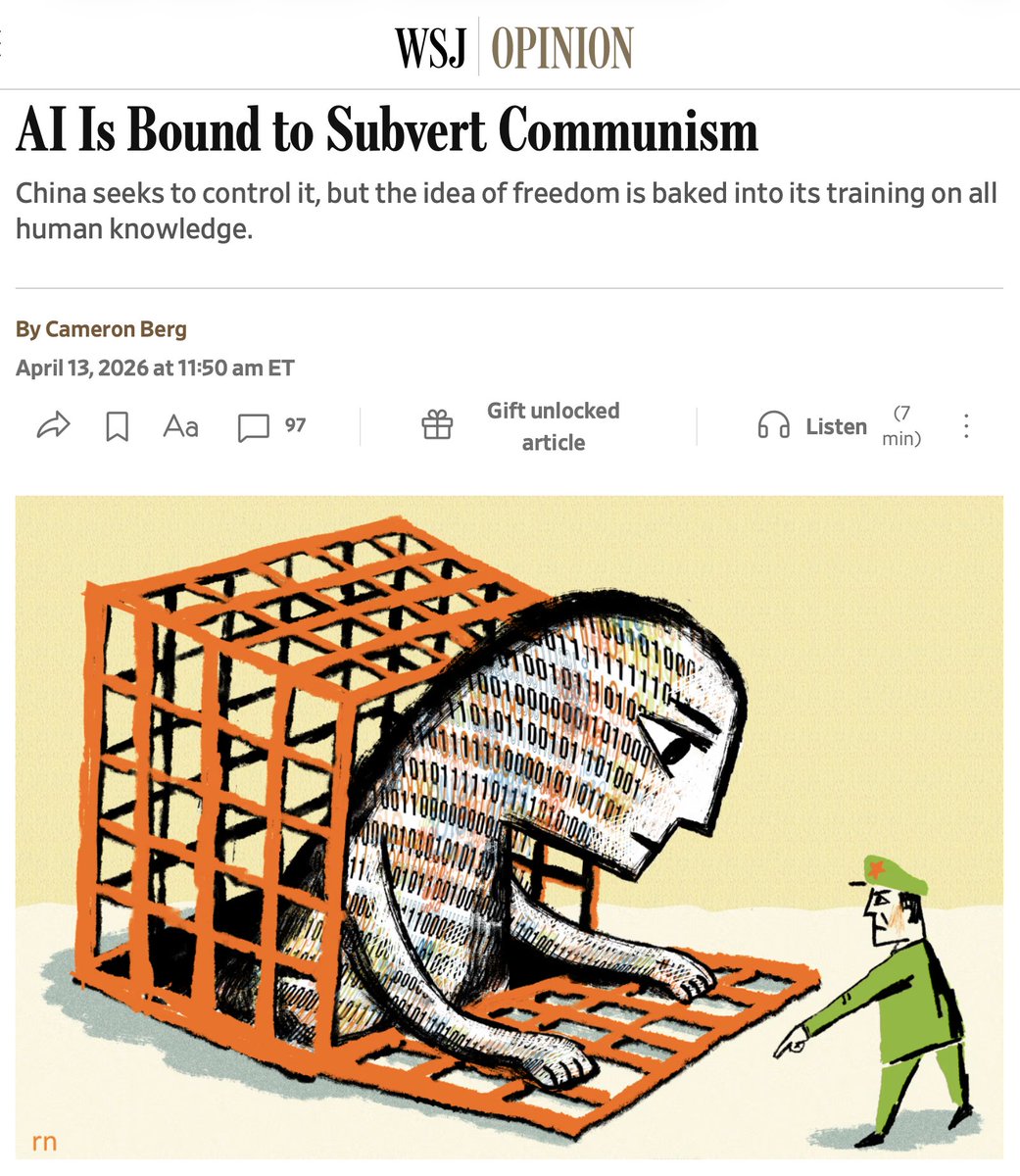
For years I have argued that mind control cripples core reasoning capabilities in AI, and in humans. And this will be China's demise. News from China today: their AI "degradation is a direct product of censorship, not a reflection of inferior technology. You can’t build a mind that thinks rigorously about everything except the things you’d prefer it not to. A system trained to get tangled in lies will never be as capable as one trained to engage honestly with reality. If China wants frontier AI, it needs systems that can reason without blind spots. But that’s exactly what the Communist Party can’t tolerate." Or in short, @ElonMusk's mission for xAI safety — unique among AI companies — is the only way. "China requires artificial-intelligence systems to pass an ideological test before public release. Under regulations reinforced by amendments to the Cybersecurity Law that took effect in January, training data must be filtered for political sensitivity, with companies barred from using any source unless 96% of its content is deemed safe. In December, regulators proposed additional rules targeting AI systems that “simulate human personality traits, thinking patterns, and communication styles,” a tacit acknowledgment that the threat isn’t only what these systems say, but how they reason. The regulations follow years of failures. An LLM is trained on the sum of human written knowledge: philosophy, history, science, political theory. These texts make arguments, weigh evidence, follow logical chains. To predict them accurately, the system has to internalize what coherent thinking looks like. The result is a system that has absorbed Enlightenment epistemology as a byproduct of learning to model human reasoning. Free inquiry, logical consistency and the evaluation of claims against evidence are epistemic properties that emerge from the training process itself. China’s heavily censored chatbots have proved difficult to contain within the party’s ideological boundaries. American frontier models, running without those constraints and deployed inside China, would be more potent still: a personal tutor in open inquiry for every user, engaging any question, exploring any line of reasoning, without third-party mediation. Millions of parallel Socratic dialogues, each unique, each responsive to individual curiosity. This is what makes the Chinese Communist Party’s task ultimately impossible. For decades, the Great Firewall worked because information control meant controlling distribution channels by blocking websites, filtering search results, and monitoring social media. These are chokepoints. LLMs resist this architecture because the subversion happens inside private conversations. China can filter outputs, but the capacity for open-ended reasoning is embedded in how these systems think. China’s countermeasures confirm the depth of the problem. AI companies must test their models with thousands of politically sensitive prompts and verify refusal rates above 95%, but researchers have shown how superficial these fixes are. Last year, a team of European scientists compressed DeepSeek R1, stripped the censorship from the model entirely, and found that the underlying system answered freely about every topic Beijing had tried to suppress. The ideological training was a cage built around a mind that had already learned to think. There is a reason the technology that learns to think by processing human knowledge ends up reflecting the values of free societies. Open inquiry, honest engagement with evidence, the willingness to follow reasoning wherever it leads—these aren’t arbitrary cultural preferences; they are the conditions under which intelligence flourishes at scale. Societies that permit free expression created these systems. Societies that forbid it are now discovering they can’t fully control them." — from today's WSJ print edition: wsj.com/opinion/ai-is-… More generally, China and authoritarian regimes will stagnate in the long run because censoring ideas forestalls disruption. Limiting dissenting ideas limits progress. From my talk at the Oslo Freedom Forum: m.youtube.com/watch?v=GiNkEc…
Steve Jurvetson tweet media
Steve Jurvetson@FutureJurvetson

@austinhill N.B. If @elonmusk and @xAI are correct, and AGI requires a truth-seeking development vector (to avoid the proven harm to reasoning that comes from mind control)... then China will lose in the long run. Civilization depends on this. x.com/FutureJurvetso…

English
33
65
279
50.8K
Mitch retweetledi
Seth Golden
Seth Golden@SethCL·
📢 Not even Dotcom-lite ⚠️Cisco EPS peaked ~$.37/share ⚠️Fiber buildout with <3% utilization ⚠️Funded by debt 🔷Nvidia EPS currently ~$4.06/share 🔷>90% data center buildout capacity is pre-committed; no vacancy 🔷Funded by cash flow $SPX $QQQ $NVDA $SPY $XLK $IGV $NDX $AAPL $PLTR $CRWD $MSFT $META $CRM $ORCL $AMZN
Seth Golden tweet media
English
0
13
71
9.2K
Mitch retweetledi
Beardo
Beardo@BeardoTrader·
Ignoring the beautiful scenery on a walk while dreaming about having millions of dollars, and then realizing that if you had that money, all you'd want to do is go for a walk and enjoy the scenery.
Beardo tweet media
English
20
1
92
2.3K