Jorge Morales Meoqui

10K posts

Jorge Morales Meoqui banner
Jorge Morales Meoqui

Jorge Morales Meoqui

@MoralesMeoqui

Cuban-born economist living in Austria. Tweets about economic theory and policy. Research on international trade.

Vienna Katılım Eylül 2012
829 Takip Edilen600 Takipçiler
Sabitlenmiş Tweet
Jorge Morales Meoqui
Jorge Morales Meoqui@MoralesMeoqui·
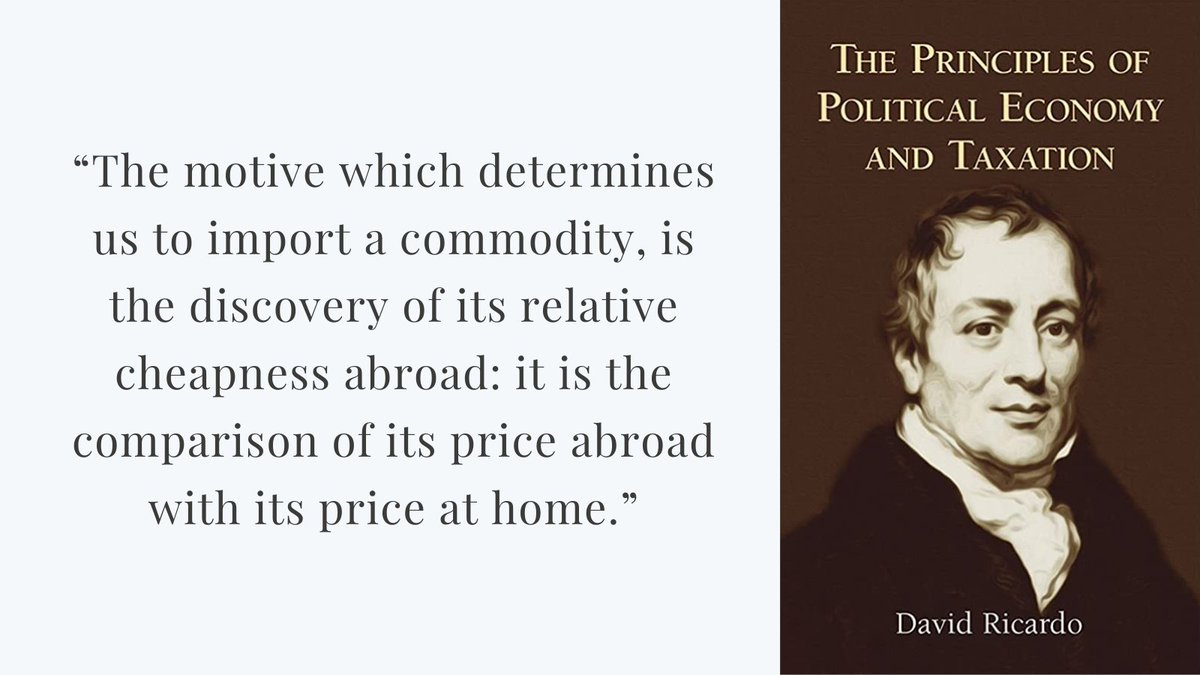
This paper’s main takeaway is that countries should not specialize according to their “comparative advantage.” David Ricardo consistently stated that countries should import a commodity whenever it is cheaper to buy than to make. #econtwitter cambridge.org/core/journals/…
English
0
1
6
1.8K
Jorge Morales Meoqui retweetledi
Economic thought
Economic thought@economicthought·
WP: An Astonishing Turn in the Attribution Debate on the Law of Comparative Advantage, by Jorge Morales Meoqui buff.ly/skuTxp3
Economic thought tweet media
English
0
1
3
481
Jorge Morales Meoqui
Jorge Morales Meoqui@MoralesMeoqui·
@JackBMontgomery @DanielJHannan Ricardo definitely wrote the passage you are quoting. What he did not say anything about was the theory of comparative advantage. This theory is a post-Ricardian construction by folks who didn't understand Ricardo's writings very well.
English
0
0
0
14
Jack Montgomery
Jack Montgomery@JackBMontgomery·
"Ricardo never said any such thing" — I gave you the quote, Dan. Surely you recognized it, if you've read Ricardo so much more thoroughly than I? On the Principles of Political Economy and Taxation, Chapter VII:
Jack Montgomery tweet media
English
1
0
0
85
Jorge Morales Meoqui
Jorge Morales Meoqui@MoralesMeoqui·
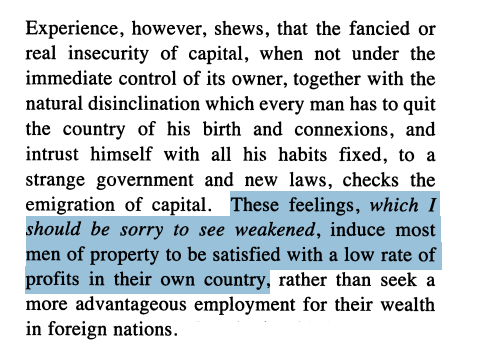
@DanielJHannan @JackBMontgomery There is nothing counterintuitive about the original case for free trade, as explained by Adam Smith and David Ricardo. Perhaps free trade will become more popular if you and others stop arguing for it by citing the nonsensical theory of comparative advantage.
Jorge Morales Meoqui tweet media
English
0
0
0
27
Jorge Morales Meoqui retweetledi
Bethany McLean
Bethany McLean@bethanymac12·
We’ve been sold a fake Adam Smith. In our latest Capitalisn’t, Glory Liu reveals that the guy who is most famous for the "invisble hand" was actually a theorist of power who warned against corporate capture. Full episode here: youtube.com/watch?v=AmmISO…
YouTube video
YouTube
English
6
11
35
5.6K
Jorge Morales Meoqui
Jorge Morales Meoqui@MoralesMeoqui·
@baoshaoshan @GlennLuk When read properly, it is quite easy to discover that Ricardo did not formulate any theory of comparative advantage. The common narrative is based on a misinterpretation of his famous numerical example about the exchange of English cloth and Portuguese wine.
English
0
0
0
5
Warwick Powell | 鲍韶山
Warwick Powell | 鲍韶山@baoshaoshan·
@GlennLuk … Read properly, Ricardo is not the theorist of frictionless trade, but a political economist grappling with how production structures, land scarcity & class distribution shape the trajectory of capitalism. …./3
English
3
0
4
170
Glenn
Glenn@GlennLuk·
David Ricardo formulated his theories on comparative advantage in the 19th century when global trade was dominated by physical goods and commodities. But we live in the 21st century when global trade is comprised of a far more complex (and harder to measure) mix of physical goods and intangible IP and services. A critical mistake Michael has consistently made on this topic is the implicit assumption that the physical goods trade — measured by the "trade surplus" — needs to balance, labeling any country that runs a persistent trade surplus (e.g. China) as "imbalanced". This may have been true in the 19th century but in the 21st century, the "trade surplus" (as Pettis defines it) itself is an increasingly antiquated proxy for holistic trade. Much of the trade in tech/IP and services flow through other line items of the balance of payments (BoP). If Ricardo were alive today, I suspect he would have expanded his theory of comparative advantage to incorporate these complexities of modern trade. This would mean that some countries like China can indeed develop decisive comparative advantage in broad manufacturing. Comparative advantages in manufacturing would be offset by comparative disadvantages in other areas: such as profits generated by MNCs, international travel, licensable IP as well as traditional areas that would be familiar to the 19th century version like commodities.
Michael Pettis@michaelxpettis

David Ricardo showed in 1817 that if each country produces according to its comparative advantage, global output is maximized. Many analysts argue today that China's trade surplus reflects its comparative advantage in producing everything, and so its trade surplus is good for global growth. But that's not true, and that is certainly not what Ricardo showed. China has a competitive advantage, not a comparative advantage, largely for the same reason that it has such weak consumption – large direct and indirect transfers from the household sector, in the form of an undervalued currency, cheap credit, restricted labor, overspending on infrastructure, land and other subsidies, etc., subsidize production across the board at the expense of household consumption. The point is that these lower production costs give China a competitive advantage in producing most things, but this not the same as a comparative advantage. The former means you are able to produce more cheaply than your trade partners. The latter means that the relative "cheapness" with which you produce some goods is greater than the relative "cheapness" with which you produce other goods, so that you can only have a comparative advantage in roughly half the goods you produce. This is because comparative advantage is about relative costs, not absolute costs, and while you can have lower absolute costs in most or even all things, by definition you cannot have lower relative costs in more than half of what you produce. Ricardo's example shows this very clearly. In his model. Portugal produced both textiles and wine more cheaply than England, which meant that Portugal had a competitive advantage in all goods, and England a competitive disadvantage in all goods. But Ricardo did not argue that the world would benefit if Portugal produced both wine and textiles, with England producing neither and acquiring them by running trade deficits with Portugal. Instead he showed that because the relative "cheapness" with which Portugal produced wine was greater than the relative "cheapness" with which it produced textiles, Portugal only had a comparative advantage in producing wine, and England had a comparative advantage in producing textiles. He showed that if Portugal only produced wine, and exported some of it to England to buy textiles, and if England only produced textiles, and exported some of it to Portugal to buy wine, trade would be balanced and total output would be maximized even with Portugal's competitive advantage in both. If you do the math in Ricardo's model, you quickly see that global output is maximized only when global trade is balanced. For global production to be maximized, countries should not be net exporters of all goods in which they have a competitive advantage. They should be net exporters only of those goods in which they have a comparative advantage, and they should use the proceeds of those export revenues to import those goods in which they have a comparative disadvantage. Once you allow trade to become persistently unbalanced, you run into the problem that Keynes identified in the 1930s – trade imbalances allow countries that have become more competitive by suppressing domestic demand to export weak domestic demand to the rest of the world. When that happens, either total global production is reduced and unemployment rises, or debt must rise in the deficit country to make up for the weak demand in the surplus country and to prevent unemployment from rising. Economists often cite David Ricardo's model of comparative advantage as one of the few, great, non-trivial models in economics, and so it is worrying that so few academic economists understand the math behind the model. Ricardo's whole point was to make the unintuitive point that competitive advantage is not the same as comparative advantage, and that the world benefits from balanced trade even when one country can produce everything more cheaply. This becomes more obvious when you realize that just by changing the value of the currency you can shift competitive advantage from one country to another, whereas comparative advantage is structural, and does not shift so easily. The main point, which surprisingly few academic economists understand, is that Ricardo's model of comparative advantage is a model of balanced trade.


English
5
5
62
4.7K
Jorge Morales Meoqui
Jorge Morales Meoqui@MoralesMeoqui·
@paulkrugman is referring here to the classical rule for specialization, the same rule used by Adam Smith and David Ricardo.
Jorge Morales Meoqui tweet media
English
0
0
1
45
Jorge Morales Meoqui
Jorge Morales Meoqui@MoralesMeoqui·
@juancahallak @IvanWerning Gracias por la respuesta, Juan Carlos, pero me parece importante desechar las narrativas falsas, en particular si se presentan como ejemplo de superioridad intelectual de los economistas (reto de Ulam a Samuelson). Por lo demás, no creo que sea posible anticipar esa afectación.
Español
0
0
1
60
Ivan Werning
Ivan Werning@IvanWerning·
La afirmación de abajo de @juancahallak es falsa en general. Mi contraejemplo se basa en el clásico de los clásicos del comercio, David Ricardo (1817). Aclaro: Acá no busco desmerecer a Juanca ni entrar a discutir todo su hilo (ni el de FS). Esta afirmación puntual me llamó la atención, me hizo pensar en ella. Me pareció educativo y divertido aclararlo nomás, así que con esa intención, ahi va… Hace un poco más de 200 años, David Ricardo escribió un capítulo brillante sobre comercio (primer uso claro de equilibrio general) donde introduce la idea de ventaja comparativa. Es muy simple! Se enseña en todos los cursos más básicos (pero no siempre se aprende!). Dos bienes: paño ("cloth") y vino ("wine"). Dos países: Inglaterra y Portugal. Un factor: trabajo, tecnologías lineales. Inglaterra tiene ventaja absoluta en ambos bienes (irrelevante) y ventaja comparativa en paño. El consumo de vino brindaba al agente representativo inglés una satisfacción a . consumo vino ingles + b . consumo vino portugués donde los números a≥0 y b≥0. Situación inicial: a=1, b<1 y suficientemente bajo. "Nos gusta Miramar, no tanto Brasil." Equilibrio: cero comercio. Inglaterra produce y consume su propio vino y paño. Cambio: “le toman el gustito a lo de afuera”, y pasamos a tener: b=1 a ≤ 1 como dijo Juanca “La satisfacción que antes te daba veranear adentro ahora te la da hacerlo afuera.” El nuevo equilibrio: comercio y especialización. Siguiendo a Ricardo: Inglaterra produce paño, importa vino portugués. Lo más importante: sube bienestar en Inglaterra. David Ricardo, un genio, no? Otro ejemplo que usar un modelo muy simple ayuda a aclarar conceptos e ideas difíciles e importantes. Es fácil confundirse sino! Feliz año! PS: The mathematician Stanislaw Ulam challenged the economist Paul Samuelson to name a principle in the social sciences that was both true and nonobvious. Samuelson replied "Ricardo's theory of comparative advantage." "That this idea is logically true need not be argued before a mathematician; that it is not trivial is attested by the thousands of important and intelligent men who have never been able to grasp the doctrine for themselves or to believe it after it was explained to them."
Ivan Werning tweet media
Español
14
16
106
22.1K
Jorge Morales Meoqui
Jorge Morales Meoqui@MoralesMeoqui·
@RaveaudGilles @BaldwinRE Unfortunately, this is a common misinterpretation of Ricardo's famous numerical example. Portugal's cloth was more expensive than England's, so it had no absolute advantage in cloth.
English
0
0
0
76
Gilles Raveaud
Gilles Raveaud@RaveaudGilles·
It's in the sense of Adam Smith: "absolute advantage" = a higher productivity (or lower unit production costs, if you prefer). The "problem" with this approach is that if country A has an absolute advantage over country B in *all* sectors, then trade between the two is impossible (B's products are more expensive). This was the starting point of Ricardo. In his example, Portugal had an absolute advantage over Britain in all the 2 goods produced: cloth, and wine. The genius of Ricardo was to "demonstrate" that, even in this case, trade was: 1. possible 2. beneficial to both countries. The political message was sublime: even the most efficient (richest) countries had an interest in trading with the least efficient (poorest) ones! This is why his demonstration is, in my opinion, the most impressive in the history of economics. Alas, it does not hold when capital can move around : in this case, English capitalists will invest ALL their money in Portugal, where rates of return are higher. The British economy - which Ricardo wanted to save with international trade - will plumet. Ricardo saw the problem. He dismissed it on silly grounds, imagining that British capitalists would nevertheless prefer to invest at home... But the fact is that there is no solution to this problem. When country A has an absolute advantage over country B *and* capital can freely move, investments will drop in B, and soar in A. Eventually, B's economy will be destroyed. This is what is happening today with China (A) and the EU (B). (I am sorry this is so loooooong)
English
5
3
17
4.6K
Richard Baldwin
Richard Baldwin@BaldwinRE·
Please define absolute advantage for me please. Compare and contrast it to comparative advantage.
Gilles Raveaud@RaveaudGilles

@BaldwinRE Thank you so very much. China has an absolute advantage over Europe in just about everything. Everybody understands it - except some economists, whose jobs are not on the line! 🤭

English
3
0
6
4.7K
Jorge Morales Meoqui retweetledi
Jorge Morales Meoqui
Jorge Morales Meoqui@MoralesMeoqui·
@BrianCAlbrecht To use your example, it is as if you guys were discussing Darwin's theory of creationism. That is the level of confusion. In light of Ricardo's genuine theory of international trade, @michaelxpettis' critique and your counterarguments are irrelevant.
English
1
0
1
67
Brian Albrecht
Brian Albrecht@BrianCAlbrecht·
@MoralesMeoqui I’m glad you like reading the classics, I do too. But nothing hinges on this being what’s actually in Ricardo. Darwin gets his name attached to a class of theories. Walras, same.
English
1
0
0
80
Jorge Morales Meoqui
Jorge Morales Meoqui@MoralesMeoqui·
@BrianCAlbrecht There is no such thing as David Ricardo's theory of comparative advantage. What you three are discussing is a common misinterpretation of Ricardo in Econ textbooks. It is complete nonsense. That is why it is essential to read the classics.
English
1
0
0
82