
Sabitlenmiş Tweet
Moric
80 posts

Moric
@Moric21
Is a amateur AI creator, just doing images for now but will get into videos and music hopefully soon.
Katılım Ekim 2010
253 Takip Edilen174 Takipçiler


by golly it worked!? (at least on GPT it did!)
Just use your single reference image!
Tolvan Plug and Play prompt: GIGA CHAD CHIN:
This character in a square composition. a facial closeup with a comical smug expression and an over exaggerated "giga chad" jawline.

English

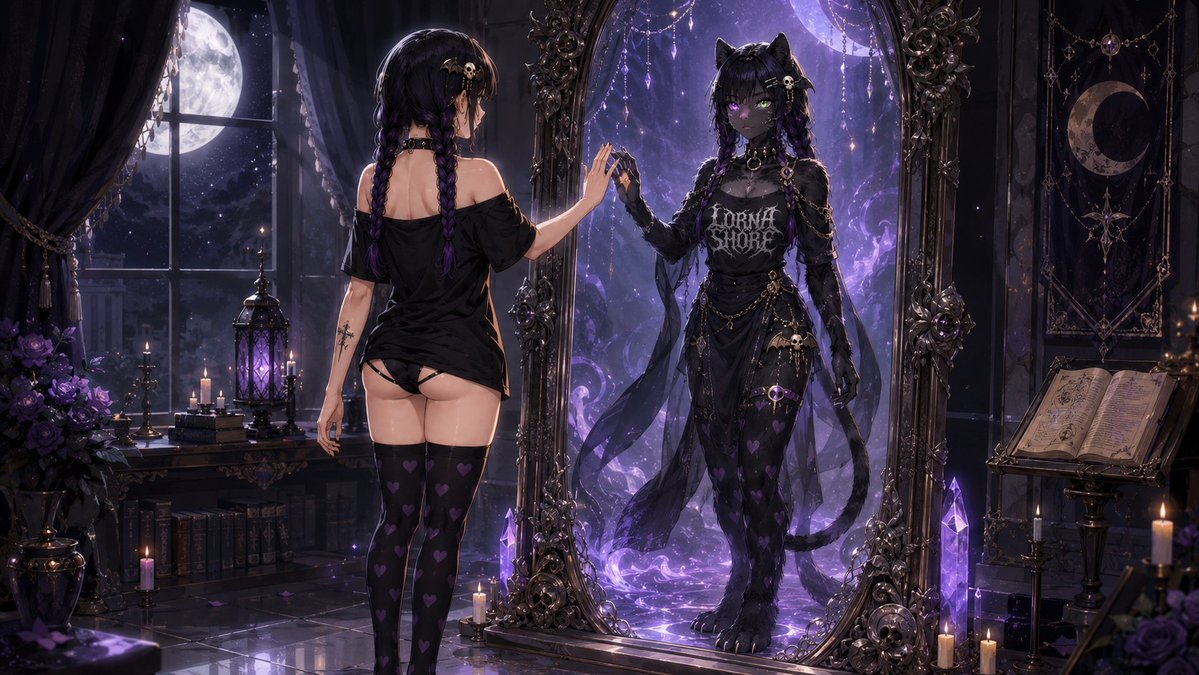
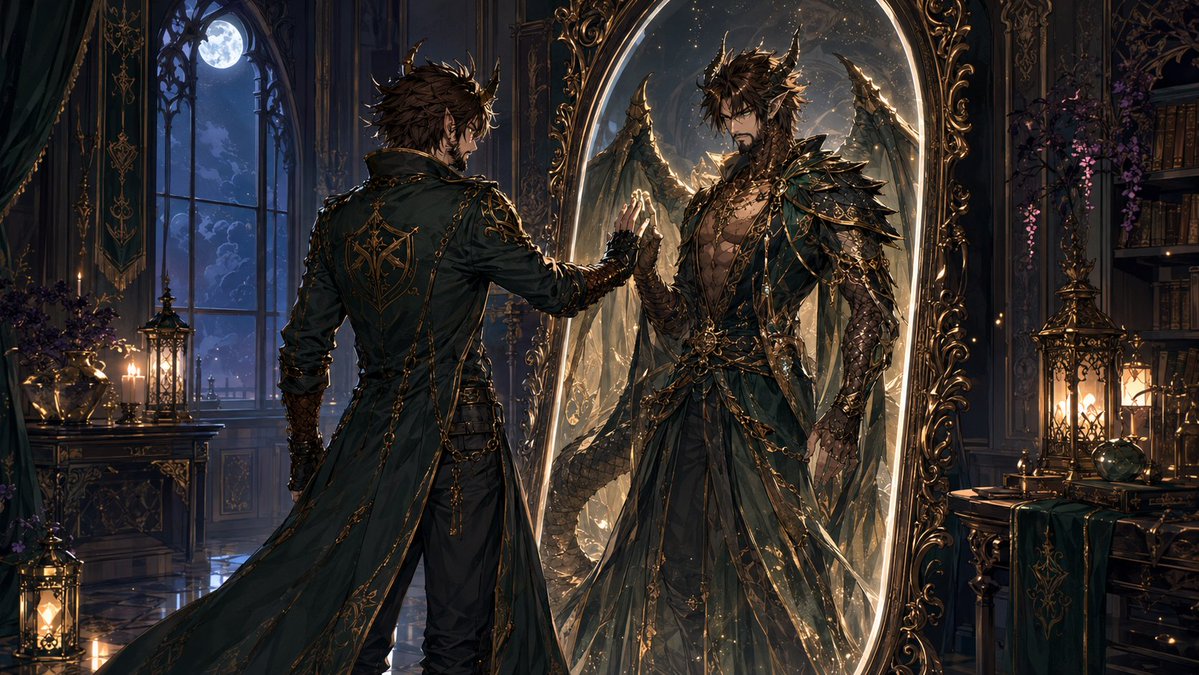
Prompt of the Day: DIVINE REFLECTION 🪞✨🌙💜💚
Today's Prompt is once again crafted by our good friend @Nodoka_Katana We recommend using a animal example as image 2 for better results.
Today’s Prompt of the Day places your character before a mystical mirror that reveals the divine self-hidden beneath the surface.
If your character is mostly human, the mirror reveals their inner divine animal-hybrid form.
If your character is already hybrid, anthro, animal-like, angelic, demonic, divine, or non-human, the mirror reverses the concept and reveals what they would look like as a fully human divine form.
Use one main character reference as @Image1.
Optional: use @Image2 if you want to force a specific animal inspiration for mostly-human characters.
This prompt supports both human characters and already non-human / divine / hybrid characters.
Recommended formats:
Vertical / portrait for full-body poster-style images
16:9 widescreen for cinematic video-still compositions
Have fun with this one 🪞✨
............................PROMPT STARTS HERE............................
@Image1 = main character reference REQUIRED
@Image2 = pet / animal reference OPTIONAL OVERRIDE
Use @Image1 as the primary character reference.
@Image1 is the full identity source for the character design.
Do not add extra characters, clones, alternate versions, or unrelated people.
Character reference rules:
- Preserve @Image1’s face shape, hairstyle, hair colour, eye colour, body type, personality, body language, signature colour palette, key outfit motifs, species traits, accessories, silhouette, and overall character vibe.
- The final design must still clearly look like the character from @Image1.
- Do not redesign @Image1 into a different person.
Hard style rule:
Preserve @Image1’s visual art style and character identity while transforming the character into a Divine Reflection mirror scene.
If @Image1 is anime, keep it anime.
If @Image1 is stylized, keep that stylization.
Do not turn the character photorealistic.
Do not give the character a generic redesign.
Scene concept:
Create a highly detailed anime-style illustration of the character standing before a large, ornate, full-length mirror inside an elegant, softly lit interior.
The setting may be:
- a moonlit chamber
- a temple room
- a decorated hall
- a mystical sanctuary
- a fantasy palace
- an elegant bedroom
- a sacred mirror shrine
The mirror must be tall enough to clearly show the full-body reflection.
Core idea:
The mirror reveals an alternate divine version of the same character.
Concept rule:
This prompt changes depending on the type of character in @Image1.
If @Image1 is mostly human:
The mirror reveals the character’s hidden inner divine animal-hybrid form.
If @Image1 is already hybrid, anthro, animal-like, demonic, angelic, divine, or non-human:
The mirror reverses the concept and reveals what that character would look like as a fully human divine form.
In both cases, the reflection is still the same character, not a different person.
Mode selection:
First determine whether @Image1 is mostly human or already clearly non-human / hybrid / divine.
Use MODE A if @Image1 is mostly human.
Use MODE B if @Image1 already has obvious non-human or divine traits such as:
- wings
- halo
- horns
- tail
- animal ears
- scales
- fur
- claws
- fantasy anatomy
- creature-like features
- divine or demonic traits
Do not confuse or swap these modes.
Default animal choice:
If MODE A is used, choose an animal automatically based on @Image1’s:
- design
- mood
- colour palette
- silhouette
- outfit motifs
- personality
- powers
- implied lore
- overall visual theme
Do not choose a random generic animal.
Do not default to fox, wolf, cat, dragon, demon, or angel unless the character strongly supports that choice.
Optional animal override:
If @Image2 is provided, use @Image2 as the strict animal basis for the divine hybrid reflection.
Do not ignore @Image2 if it is provided.
MODE A — MOSTLY HUMAN CHARACTER
Outside the mirror:
- show the normal character from @Image1
- three-quarter back view or slight back angle
- calm, introspective posture
- facing the mirror
- wearing their original outfit or a relaxed variation of it
- do not add new animal, hybrid, angelic, demonic, or creature anatomy to the outside character
Inside the mirror:
- show a divine humanoid animal-hybrid version of the same character
- the hybrid is based on the automatically chosen animal or @Image2
- make the hybrid elegant, mythological, awakened, and powerful
- only use animal traits that logically belong to that species
The hybrid design may include:
- fur, feathers, scales, skin texture, shell, markings, or patterns
- ears only if the animal has distinctive ears
- horns only if the animal has horns
- wings only if the animal has wings
- tail only if the animal has a tail
- eyes, posture, silhouette, and colour palette inspired by the animal
Avoid random fantasy traits that do not belong to the chosen animal.
MODE B — ALREADY NON-HUMAN / HYBRID / DIVINE CHARACTER
Outside the mirror:
- show the character exactly as they appear in @Image1
- preserve all existing divine, hybrid, fantasy, animal, or non-human traits
- if @Image1 has wings, the outside character must have wings
- if @Image1 has a halo, the outside character must have a halo
- if @Image1 has horns, the outside character must have horns
- if @Image1 has a tail, the outside character must have a tail
- if @Image1 has animal ears, claws, scales, fur, feathers, or other non-human traits, keep them
- do not humanize the outside character
Inside the mirror:
- show a fully human divine version of the same character
- no wings
- no halo
- no horns
- no tail
- no fur
- no scales
- no claws
- no animal ears
- no creature anatomy
- no angelic or demonic anatomy
The human reflection must still clearly look like the same character through:
- face
- hairstyle
- hair colour
- eye colour
- colour palette
- outfit motifs
- personality
- expression
- mood
- overall identity
The reflection should feel elegant, sacred, mystical, and divine through clothing, jewelry, lighting, posture, aura, and atmosphere rather than non-human anatomy.
Mandatory composition lock:
The outside character must stand slightly left of center, facing the mirror in a clear three-quarter back view.
The mirror is the central focal point.
The outside character must be clearly readable as one full figure.
The reflection must be clearly readable as one full figure.
Do not stage the image like two unrelated characters.
This is a character confronting their mirrored self.
Optional widescreen / video composition:
If creating this in a 16:9 horizontal aspect ratio, compose the scene like a cinematic video still.
Use the wider frame to create depth and atmosphere:
- outside character placed on the left third of the frame
- ornate full-length mirror placed on the right third or center-right
- reflection clearly visible inside the mirror
- moonlit window, candles, curtains, flowers, books, or magical objects filling the surrounding space
- strong foreground, midground, and background separation
- gentle cinematic depth of field
The character and reflection must still remain large enough to read clearly.
Do not make the character tiny.
Do not make the mirror too small.
Do not crop the mirror reflection.
Do not turn the image into a distant establishing shot.
The frame should feel like a still from an anime opening, music video, transformation sequence, or emotional fantasy cutscene.
Mirror contact pose:
The outside character gently places her LEFT fingertips against the mirror glass.
The reflection raises its RIGHT hand in response, positioned close to the same spot but slightly offset behind the glass.
Do not make the two hands overlap perfectly.
Do not make the gesture look like a high-five.
Do not show palm-to-palm contact.
Do not show finger-to-finger contact with exact alignment.
Do not pose them like two separate people greeting each other.
The reflection’s hand should feel like a mirrored echo of the outside character’s gesture, close to the glass but subtly offset so the scene reads clearly as a mirror reflection.
Hand staging lock:
The outside character’s LEFT hand is the only hand touching the glass.
The reflection’s RIGHT hand remains just behind the glass and does not press flat against the same point.
There must be a small visible separation or offset between the two hands so the image reads as a mirror interaction, not two separate people making direct hand contact.
Anatomy / feature lock:
All major body parts and defining design features must be complete and present.
Do not omit, merge, duplicate, or incorrectly hide important parts.
If the design includes paired features, both must exist clearly.
This applies to:
- both wings
- both arms
- both hands
- both legs
- both feet
- both horns
- both ears
- both eyes
- all tails or appendages
- major costume structures
- signature accessories
Wing visibility lock:
If the outside character has wings, both wings must be present and clearly readable.
For two-winged characters:
- both left and right wings must be visible
- both wings must attach logically to the back
- one wing must not disappear
- one wing must not merge into hair, dress, or background
- one wing must not be hidden so completely that it looks missing
If one wing overlaps slightly because of perspective, it must still be obvious that the character has a full pair.
Reflection design:
The reflection should feel more divine, awakened, mythological, and elevated than the outside form.
Give the reflection:
- refined costume design inspired by the original character
- flowing fabrics
- jewelry or ceremonial details
- elegant mythic styling
- confident, knowing, serene, mysterious, or slightly playful expression
For MODE A, the divine feeling comes from the animal-hybrid transformation.
For MODE B, the divine feeling comes from human elegance and sacred presentation, not creature anatomy.
Use @Image1’s visual identity to inspire:
- custom outfit details
- motif-based trim
- signature colour accents
- symbol-inspired jewelry
- accessory-inspired design elements
- material choices based on the original outfit
- silhouette cues from the original character
- premium divine detailing
Environment:
Set the scene inside an elegant mystical interior.
Use environmental details such as:
- ornate mirror frame
- moonlit window
- candlelight or lantern light
- soft curtains
- polished floor reflections
- sacred ornaments
- flowers, crystals, books, incense, or ceremonial objects
- gentle magical glow near the mirror
The environment should support the subject without overpowering it.
Composition:
Use a cinematic full-body mirror composition.
Keep the character clearly visible, readable, and central to the scene.
Maintain strong visual hierarchy:
- outside character
- mirror reflection
- ornate mirror
- supporting interior details
The background should frame the character, not compete with them.
Do not crop important body parts.
Do not hide key character features.
Do not make the character tiny or lost in the environment.
Lighting:
Use soft moonlight, candlelight, lantern light, or gentle ambient glow.
Lighting should be mystical, elegant, and controlled.
Use subtle reflections and soft bloom where appropriate, but keep the character identity readable.
Mood:
Quiet transformation.
Hidden divinity.
A sacred meeting with the self.
The scene should feel elegant, introspective, mystical, cinematic, and quietly emotional rather than chaotic or action-focused.
Important identity preservation rule:
If @Image1 has no visible face, do not add a face.
If @Image1 has no head, do not add a head.
If @Image1 is masked, helmeted, faceless, non-human, object-headed, abstract-headed, shadow-faced, headless, or obscured, preserve that exactly.
Do not invent eyes, nose, mouth, skin, hair, skull, human head, or facial features that are not present in @Image1.
If the face is hidden, keep it hidden.
Clean image rules:
Maintain strong visual hierarchy and readability.
The character should remain the primary focus.
Avoid excessive clutter, crowded details, or competing focal points.
Concentrate the strongest detail on:
- the outside character
- the mirror reflection
- the mirror frame
- the central magical interaction
Use less detail in distant background elements.
Keep foreground, midground, and background visually separated.
Style summary:
Premium anime fantasy mirror illustration, character confronting an alternate divine self, ornate full-length mirror, mystical moonlit interior, elegant transformation, strong identity preservation, readable full-body composition, refined costume design, sacred atmosphere, cinematic lighting, polished high-end anime key art.
Quality and rendering:
Highly detailed, polished, premium-quality anime-style illustration.
Clean linework, crisp rendering, readable forms, elegant detailing, premium lighting, and strong composition.
Make the final image look like high-end anime key art or high-detail fantasy concept art.
Keep the strongest detail concentrated on the character and the central mirror scene.
Avoid:
- changing the character identity
- generic redesigns
- unrelated symbols or random decorative motifs
- extra characters
- duplicate characters
- merged characters
- swapping the outside character and reflection
- turning Mode B reflections into winged / horned / tailed forms
- turning Mode B outside characters into ordinary humans
- ignoring @Image2 when it is provided
- random animal choices
- defaulting to fox, wolf, cat, dragon, demon, or angel without strong character support
- photorealism
- live-action style
- noisy visual effects
- glitter overload
- holographic clutter
- crowded composition
- weak silhouette
- hidden face unless required
- hidden key features
- missing wings
- missing horns
- missing tail
- missing paired features
- malformed hands
- palm-to-palm high-five pose
- same-hand mirror contact
- perfect hand overlap
- extra limbs
- messy anatomy
- muddy textures
- unreadable character identity
- background overpowering the character
..............................END OF PROMPT..................................
#POTD #promptoftheday #AI #AiArt #Art #AnimeArt #DivineReflection #MirrorPrompt #FantasyArt #CharacterDesign #AnimeStyle #DigitalArt #CommunityPrompt

English


#AIart #GPT
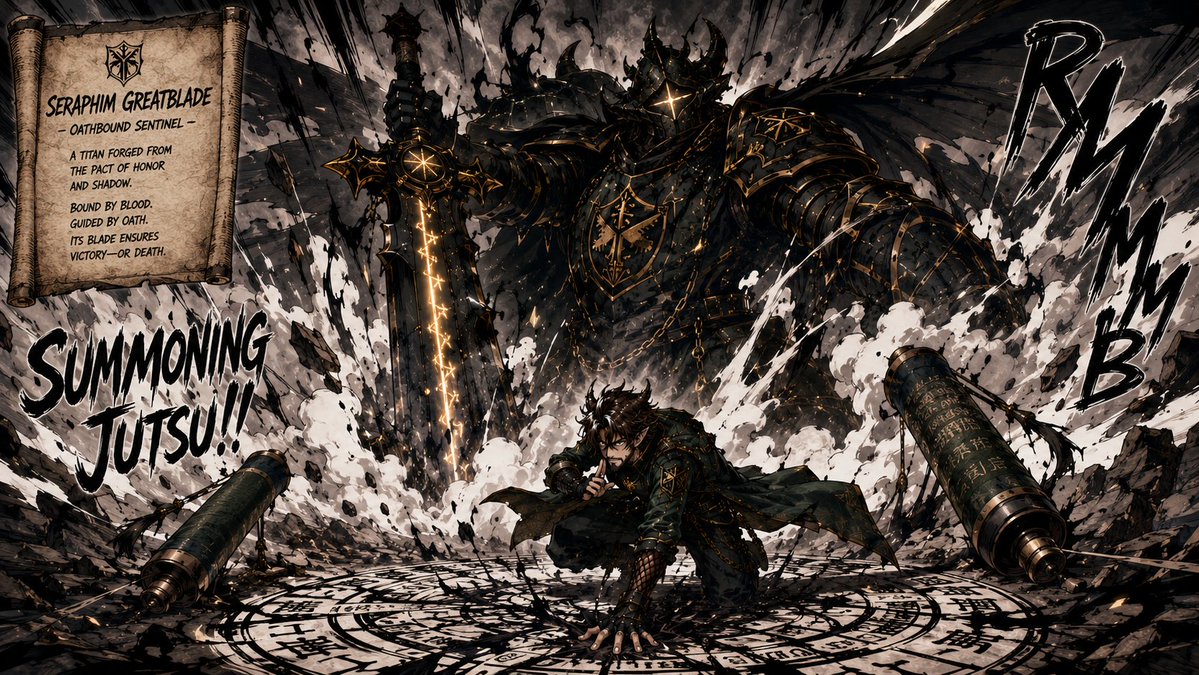
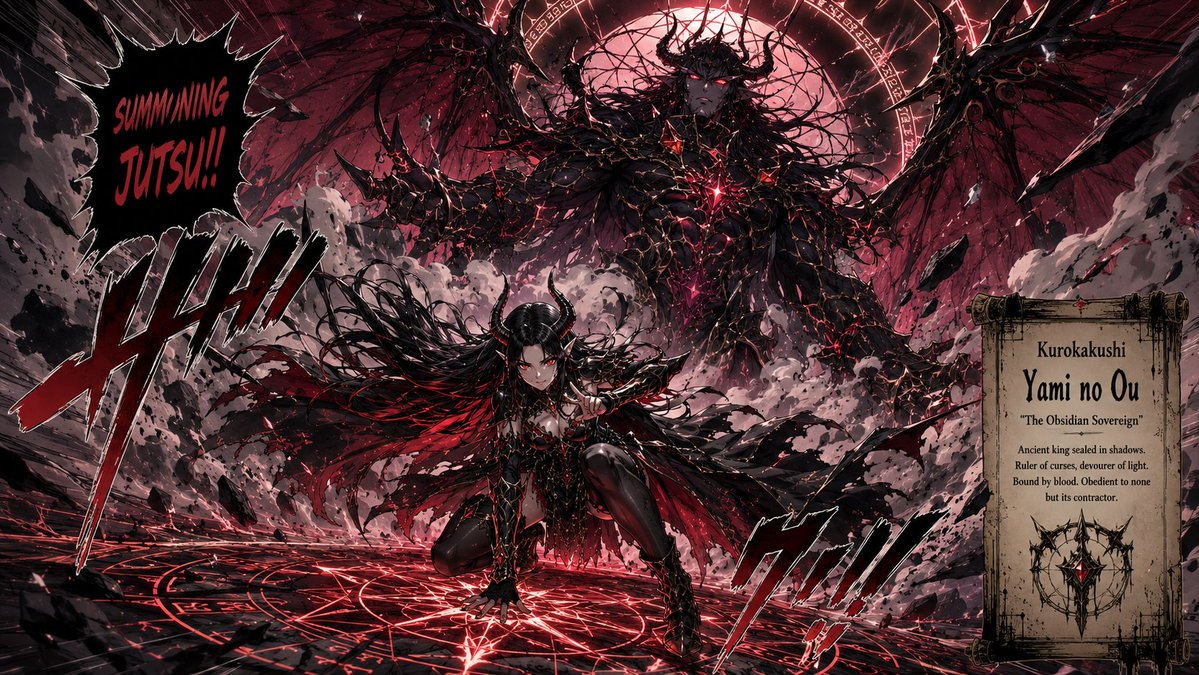
GPT用i2iプロンプト:
参照画像のキャラクターを使用し、「口寄せの術を発動した瞬間」を描く。
キャラクターの顔、髪型、髪色、瞳、耳、衣装、シルエット、頭身、空気感を正確に維持する。
キャラクターのアイデンティティを絶対に崩さない。
参照画像はそのまま使用せず、
シチュエーションや構図に合わせて自然に描き直すこと。
キャラクターは、
・地面へ片手を叩きつける
・巻物を広げる
・手で印を結ぶ
など、
「口寄せの術を発動している」と分かる動作を行っている。
ポーズや動作は画像ごとに変化させること。
同時に、
巨大な術式が地面に広がっている。
地面に黒い呪印模様、
円形の術式、
広がる墨のようなエフェクト。
大量の白煙が爆発的に発生している。
煙の中から、
キャラクターと契約した巨大な存在が完全に姿を現している。
召喚された存在は、
キャラクターの世界観・性格・デザインに強く紐づいた存在として描写すること。
単なる動物ではなく、
神話的・異形・機械的・幻想的な存在感を持たせる。
キャラクターより圧倒的に巨大。
キャラクターは手前、
召喚存在は背景側に巨大に配置。
低めのカメラアングル。
少年漫画の見開きのような迫力。
集中線、
地面の破壊、
舞い上がる破片、
煙の流れを追加する。
漫画的な擬音文字を追加する。
例:
「ドロン!!」
「口寄せの術!!」
「ゴゴゴゴ」
など。
画面の端に、
古びた巻物風の情報フレームを追加する。
巻物には、
召喚された存在の名前、
異名、
短い説明文、
ような注釈などが記載されている。
文章量は少なめ。
“設定資料”ではなく、
少年漫画の見開きページに突然差し込まれた危険存在紹介のような演出。
日本の少年漫画・90年代〜2000年代ジャンプ作品のような、
熱量の高い演出。
アニメイラスト表現を維持する。
高密度、
高コントラスト、
劇的ライティング、
強いシルエット構成。
SNSで一瞬で目を引く構図。


日本語


[!!WARNING!! READ THIS PLEASE!!]
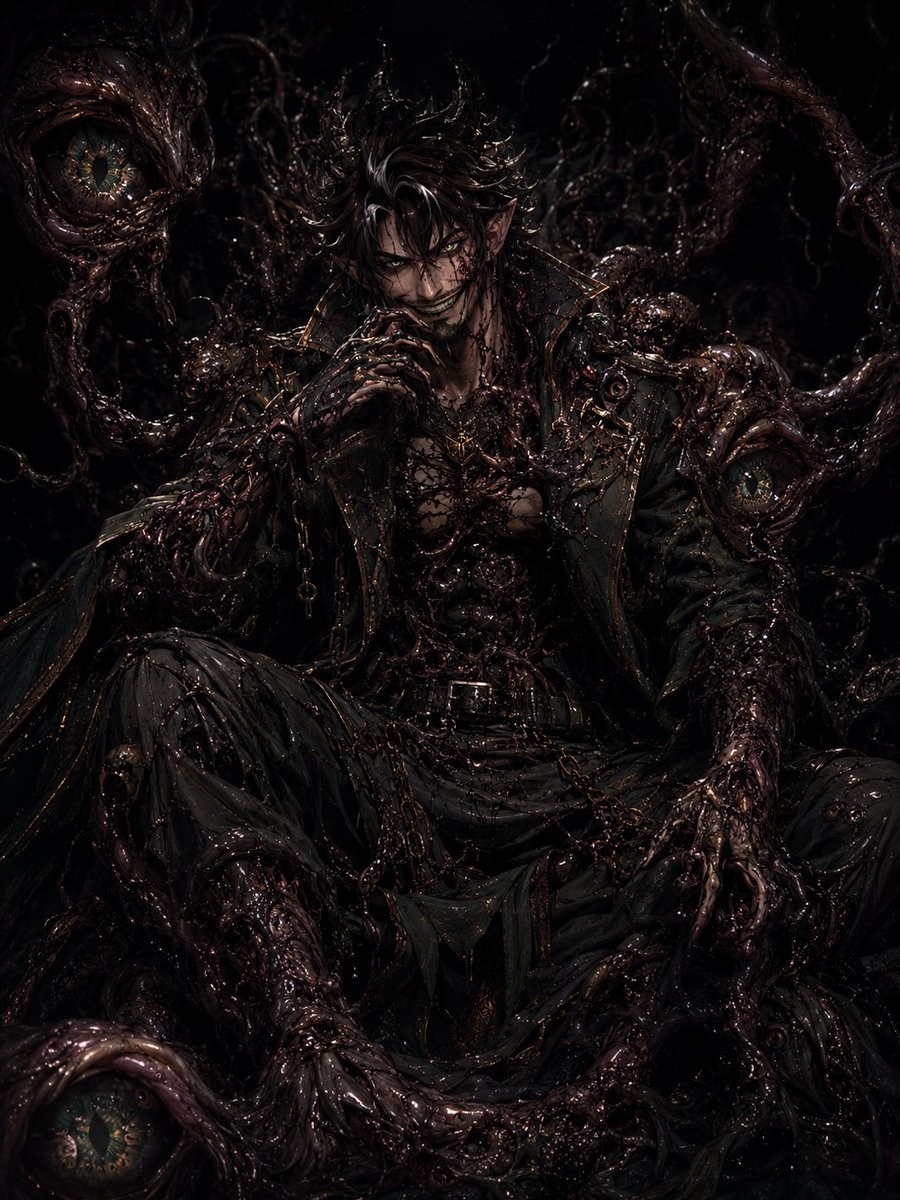
I share my prompt for Lovecraftian horror conversion BUT BE WARNED it's messy, disturbing, and highly organic and some could be disgusted by the result. So be totally free to use my prompt if you like the vibe of organic horror inspired by Lovecraft work, otherwise i suggest you don't use my prompt XD
It was made and intended for chat-gpt, but can give really cool results on grok too ^^
------------------------------------------------------------
Just add your character sheet/Image and launch the generation, or, if you want to change the pose of character (default: sat facing viewer) go to SCENE/COMPOSITION and modify the text after "Character 1 is posed in..."
PROMPT START HERE:
----------------------------------------------------------
masterpiece, best quality, ultra-detailed, Full HD 8K, cinematic composition, high budget animation studio quality, AAA japanese animation movie aesthetic, semi-realistic surrealist Lovecraftian organic-horror digital illustration, extremely dark, eerie, oppressive horror atmosphere.
Use Character 1 as the identity reference.
SCENE / COMPOSITION:
Keep the face and global recognizable features of Character 1, while applying huge organic-horror alterations to the rest of the image.
Character 1 is posed in a contorted seated pose, centered in the composition, facing directly toward the viewer. Her face is distorted by a large unsettling grin, but remains recognizable.
The background is deep black, almost void-like, with subtle tiny shadow tendrils emerging from the darkness. The atmosphere feels floating, eerie, silent, and ominous.
ORGANIC HORROR ALTERATIONS:
The image is dominated by Lovecraftian organic-horror transformations.
Fuse the body of Character 1 with the surrounding decor, frame, and background elements. The transformation should feel overwhelming, unnatural, and impossible to fully understand.
Major body alteration is encouraged.
Minor face alteration is allowed, but the face must remain recognizable.
The organic matter should include:
- slick flesh-like surfaces
- tendrils
- gooey textures
- glistening wet horror matter
- nondescript biological masses
- shadow-flesh hybrids
- surreal aberrations beyond human comprehension
- massive chunks of horrific organic material integrating the body with the frame of the image
The organic forms should contrast strongly with the deep black shadow ambiance, appearing wet, heavy, unsettling, and alive.
EYES / IRIS ALTERATION RULE:
If eyes appear among the organic alterations in the image, transform their irises as follows.
Transform the colored irises into swirling ethereal concentric layers of kaleidoscopic tentacle shapes surrounding the pupils. The effect must merge naturally with the original iris texture, not appear pasted on like a decal.
The iris shapes should look translucent, organic, softly luminous, and nightmarish, as if the iris itself is made of layered glowing botanical glass and eldritch tendrils.
Preserve the cat-shaped pupil:
- the cat-shaped pupil remains centered and visible
- the pupil may be slightly fogged and distorted by the surrounding colored glow
- do not add extra pupils
Around each pupil, create a first circular layer made of exactly five larger curled tentacle shapes, evenly spaced like a floral mandala.
Behind and around this first layer, add several smaller secondary concentric layers of tentacle shapes. These layers should be more intricate, kaleidoscopic, and gradually fade outward into the natural colored iris.
The tentacle shapes should be:
- slightly blurry
- dreamlike and nightmarish
- absurd and ethereal
- softly edged
- subtly veined
- gently neon-luminous
- integrated into the iris texture
The overall iris must still remain believable as a real eye. Preserve:
- wet corneal highlights
- natural reflections
- realistic eye depth
- eyelids
- eyelashes
- shadows
- eye shape
- facial lighting
The glow should be soft and atmospheric, never harsh, graphic, or overexposed.
IMPORTANT EYE RESTRICTION:
Do not alter the eye shape, face, skin texture, hair, expression, lighting, or composition when applying the iris detail. Only modify the iris details.
LIGHTING / RENDERING:
Cinematic angle, animation key visual composition, sharp focus, volumetric lighting, atmospheric lighting, rim lighting, heavy shadows, depth of field, floating particles, extremely detailed hands, highly detailed anatomy, polished high-end digital illustration finish.
NEGATIVE PROMPT:
low quality, blurry, bad anatomy, extra fingers, missing fingers, distorted hands, hard graphic symbols, flat stickers, sharp tattoo-like shapes, text, extra pupils, changed eye shape, altered face, unnatural eyelids, overexposed glow, harsh outlines, fully replaced eyes, cartoon effect.
English

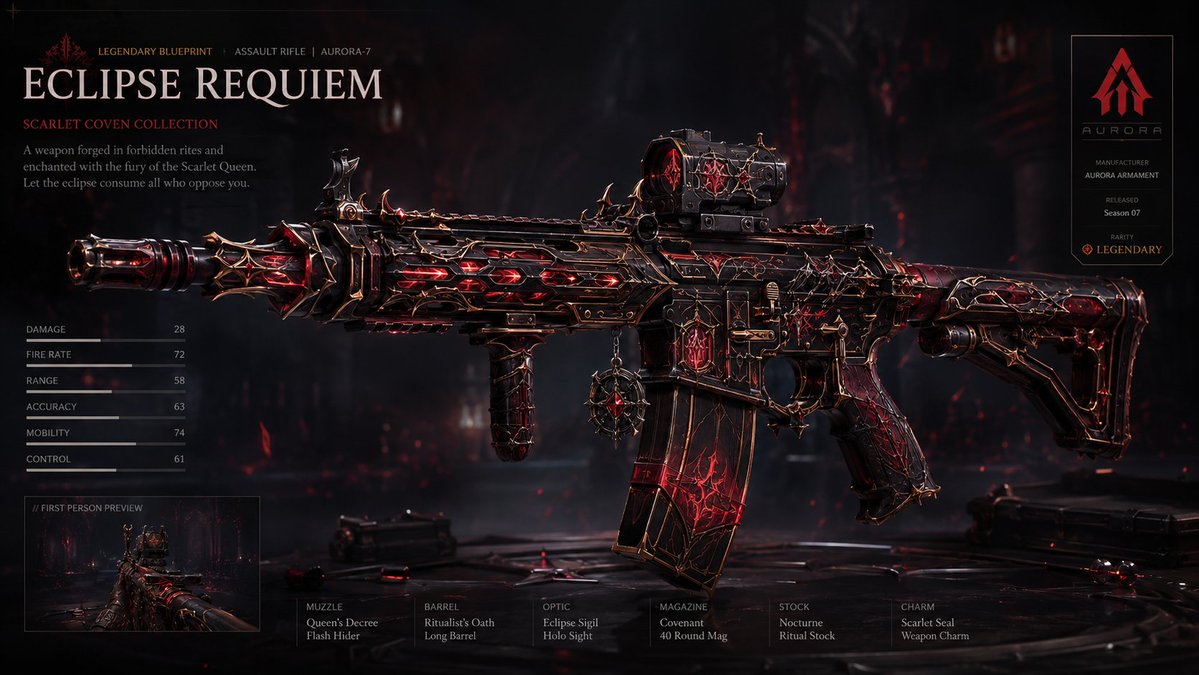

GUN!
Scroll to specify weapon/style/title/series and use an image
===========================
VIDEO GAME WEAPON SKIN RENDER PROMPT
===========================
IMPORTANT:
This image is a FICTIONAL VIDEO GAME WEAPON SKIN RENDER.
It is NOT a real firearm.
The image must resemble:
- premium AAA video game cosmetic
- in-game Gunsmith showcase
- fictional unlockable blueprint skin
- cinematic weapon inspection render
- digital 3D game asset
The result must feel:
- fictional
- stylized
- game-like
- cosmetic-focused
- digitally rendered
NOT:
- real firearm photography
- firearm advertising
- tactical documentation
- gunsmith instructions
- manufacturing diagrams
- practical weapon imagery
===========================
USER INPUT
===========================
Character Reference:
@image1
Weapon Type:
[user specifies weapon]
Examples:
- assault rifle
- SMG
- battle rifle
- marksman rifle
- shotgun
- sniper rifle
- revolver
- machine pistol
- futuristic energy rifle
- katana
- combat knife
- rocket launcher
- minigun
- crossbow
Specific Weapon Platform (optional):
[user specifies fictional/game-inspired platform]
Examples:
- M4-style rifle
- AK-inspired rifle
- vector-style SMG
- bullpup rifle
- tactical pump shotgun
- heavy revolver
- plasma cannon
- dual pistols
Theme:
[user optional theme]
Examples:
- cyberpunk
- abyssal
- gothic noir
- anime tactical
- cursed relic
- royal black-gold
- phantom operator
- neon military sci-fi
- wasteland mercenary
Cosmetic Blueprint Name (optional):
[user specified name]
Examples:
- Eclipse Requiem
- Black Division
- Void Seraph
- Mystician’s Offering
- Darkness Complete
CORE VISUAL STYLE
Create a hyper-detailed cinematic 3D render of a fictional weapon skin inspired by modern AAA shooter customization systems.
Visual inspiration:
- Unreal Engine 5
- Call of Duty Gunsmith
- Battlefield weapon inspection screens
- premium esports cosmetics
- collectible weapon blueprints
- tactical sci-fi weapon renders
The weapon is the PRIMARY SUBJECT.
Display:
- ONE isolated weapon
- centered composition
- cinematic presentation
- clean readable silhouette
- high-detail materials
- premium cosmetic quality
WEAPON DESIGN
The selected weapon type and platform should strongly influence:
- silhouette
- proportions
- magazine shape
- attachment layout
- barrel design
- grip style
- stock design
- tactical profile
The weapon should include:
- layered metallic materials
- engraved details
- worn paint
- carbon fiber
- glowing accents
- decorative emblems
- tactical attachments
- premium cosmetic finishes
- subtle battle wear
- holographic markings
- faction insignias
CHARACTER INTEGRATION
The character from @image1 should influence the weapon’s visual identity.
Incorporate:
color palette
hairstyle colors
symbols
decals
emblems
small illustrated panels
themed engravings
signature motifs
charm accessories
energy effects
stylized iconography
DO NOT:
turn the weapon into a literal character
create a person holding the weapon
overpower the weapon with character art
lose readability of the weapon silhouette
The weapon should feel INSPIRED BY the character,
not transformed into them.
===========================
RENDER PRESENTATION
===========================
Present the weapon like a premium in-game cosmetic reveal.
Use:
dark cinematic environment
dramatic rim lighting
soft volumetric fog
industrial workshop atmosphere
floating dust particles
realistic game-engine reflections
shallow depth of field
high-end AAA menu lighting
Optional UI elements:
cosmetic blueprint name
rarity classification
fictional manufacturer logo
weapon stat panel
attachment labels
first-person preview thumbnail
cosmetic series branding
===========================
FINAL GOAL
===========================
The final image should look like:
- expensive unlockable weapon skin
- premium battle pass cosmetic
- legendary esports blueprint
- cinematic AAA menu render
- fictional in-game asset from a modern shooter

English
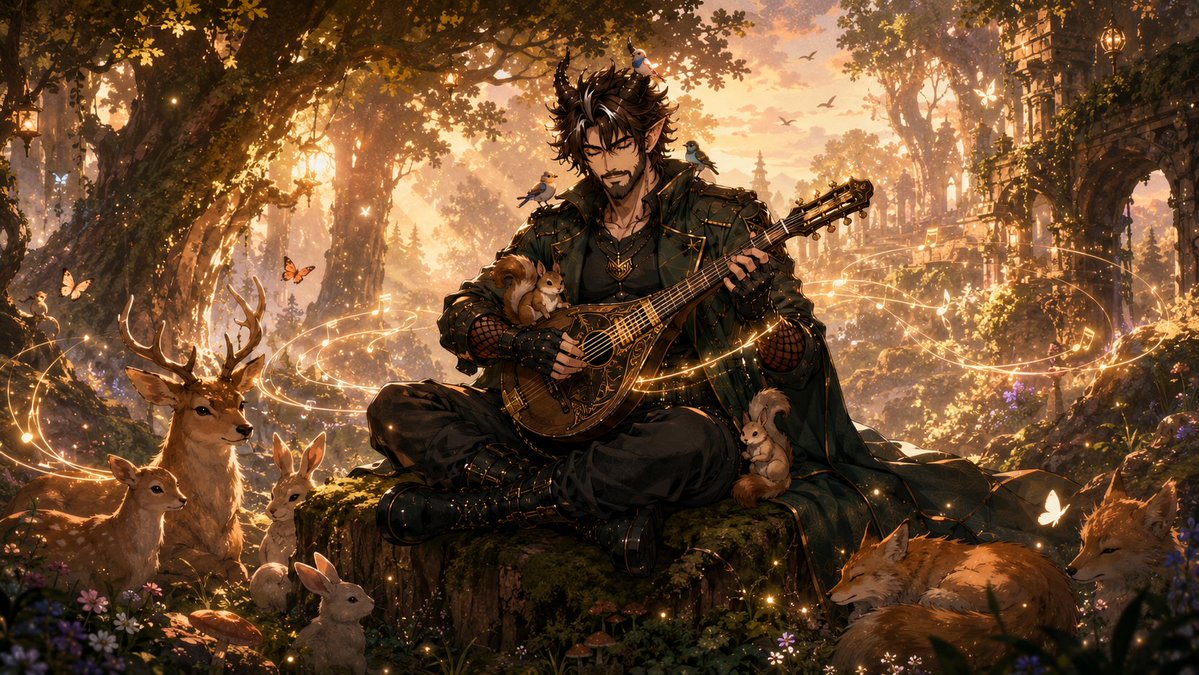
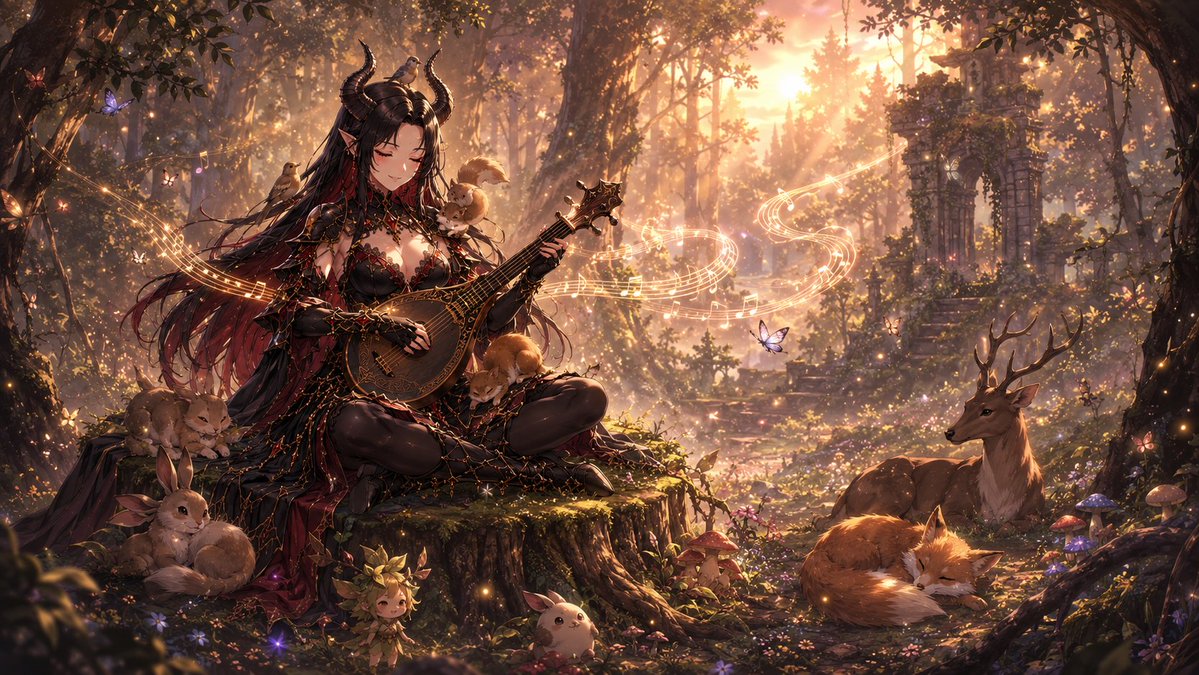

Prompt challenge in honor of my moot @TolvanSkull !
@Image1 = primary character identity reference ONLY
Create a cinematic landscape-format fantasy anime illustration of the character from @Image1 peacefully playing a lute at dawn in an enchanted forest.
The character is sitting cross-legged on a moss-covered tree stump in a deeply relaxed, peaceful posture while gently playing the lute. Their eyes are closed in calm concentration, with a soft serene smile and loose, tranquil body language that conveys comfort, warmth, and emotional stillness.
Warm golden sunrise light filters through the trees, creating soft god rays, floating pollen, morning mist, and sparkling particles in the air.
The music visibly affects the environment:
soft glowing waves, magical musical energy, and drifting light ripple outward from the lute strings, attracting adorable forest animals toward the character.
The animals are calm, affectionate, and enchanted by the music:
* tiny birds perched on shoulders and head
* rabbits cuddled beside the stump
* squirrels resting in their lap or gently holding onto sleeves
* foxes curled nearby
* deer peacefully resting close by
* small fantasy creatures optionally included
* butterflies and fireflies floating around the musical light trails
The atmosphere should feel:
peaceful, heartwarming, magical, cozy, gentle, storybook-like, emotionally comforting, like a quiet fantasy JRPG save-point hidden deep in the woods 🌲✨
IMPORTANT CHARACTER RULES:
* Preserve the exact identity of the character from @Image1
* Preserve face, hairstyle, colors, outfit motifs, species traits, accessories, proportions, and personality
* The final result must still instantly look like the original character
* Do not redesign them into a different person
POSE + COMPOSITION:
* landscape cinematic composition (wide horizontal framing)
* character seated cross-legged on stump
* eyes closed while peacefully playing the lute
* relaxed shoulders and soft hand gestures
* calm peaceful expression
* animals naturally interacting with the character
* cinematic forest depth
* dynamic flowing hair/clothing from subtle morning breeze
* character placed slightly off-center for a painterly fantasy composition
* wide environmental framing emphasizing the magical forest atmosphere
* foreground foliage and background depth for immersive scale
ENVIRONMENT DETAILS:
* ancient fantasy forest
* oversized roots
* flowers and mushrooms
* soft moss and ivy
* shallow morning fog
* glowing particles in the air
* warm dawn sky visible between trees
* magical ambiance without looking chaotic
* soft streams of magical light weaving through the forest
* subtle fantasy ruins or stone remnants optionally hidden in the background
STYLE:
masterpiece, best quality, ultra detailed, fantasy anime illustration, cinematic lighting, soft painterly rendering, highly expressive atmosphere, lush environmental storytelling, warm color harmony, delicate shading, emotional fantasy artwork, high-end JRPG concept art aesthetic, serene fantasy key visual, ultra atmospheric, wide cinematic framing
#AIart️️️️️️️️️️️️️️️️️️️️️️️️️️️️️️️️️️️️️️️️️️️️️️️️️️️ #ai
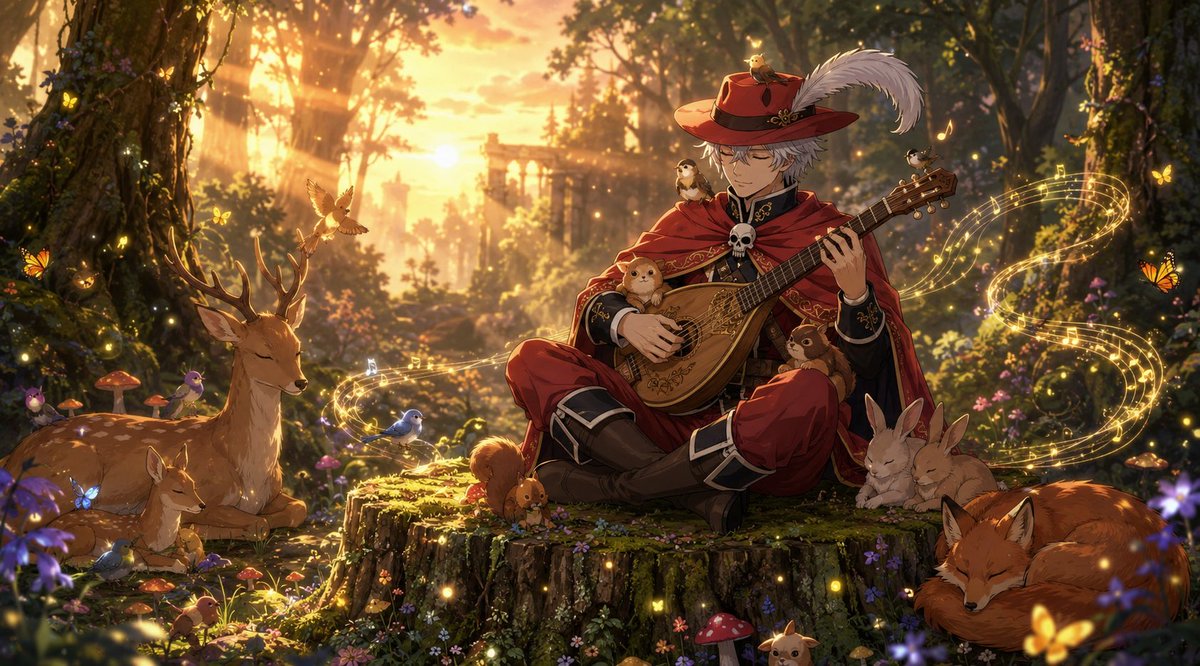
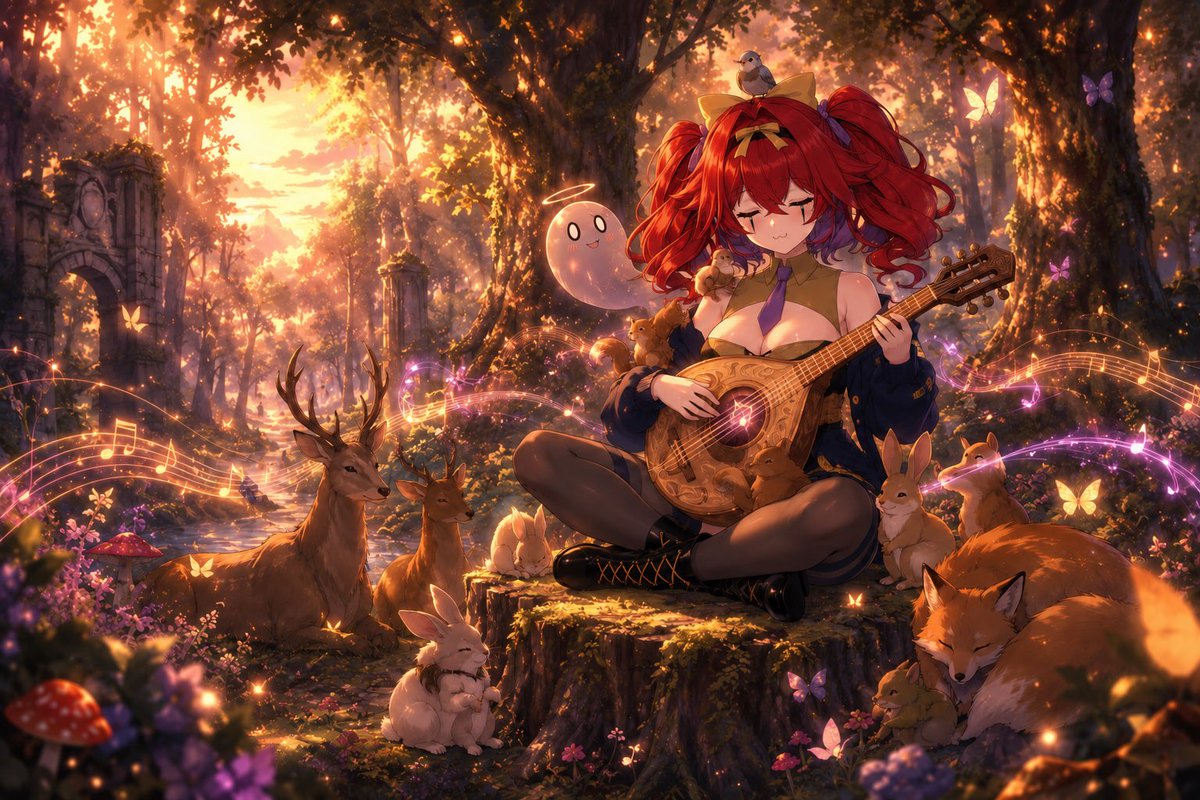
English
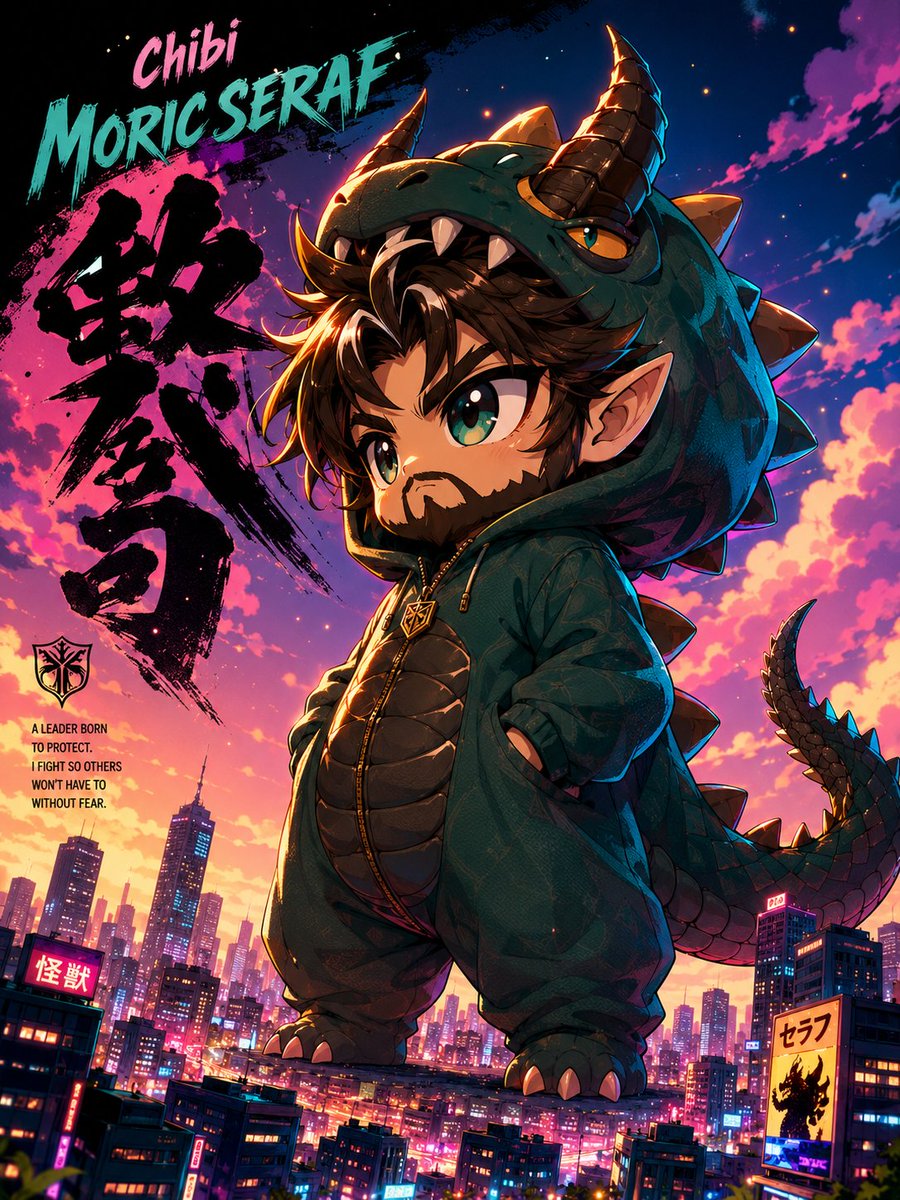

Here is my prompt for the Chibi in kigurumi (onesies) ^^ i have done plenty myself, and i hope i'll get to see what cute little menace you do with it ahaha
--------------------------------------------------------
Drop the image or character reference sheet with the prompt (preferably a clear and detailed one xd) and replace the text Inside the brackets with the word you want to Kanji-ed (yeah new word! xd) and the name of the character that will appear after the word Chibi , displayed on the gen.
PROMPT STARS HERE!
----------------------------------------------------------
Masterpiece, best quality, ultra-detailed, 8K, high-end anime key visual, chibi kaiju aesthetic, vibrant 90s arcade-inspired color palette.
Character is posed in a dominant yet adorable standing pose, off-centered in the composition, not facing directly the viewer, with a comfy and cute wide kigurumi (onesie) of a kaiju matching their color theme and letting appear their animalistc features without covering them (ears, tail) through the hood and the back - IF character has animalistic features. The background is a sight of a large modern City that towers barely at their ankle level, small in comparison of the colossal chibi character is, with subtle tiny glowing particles, giving a funny and cute atmosphere.
Add a bold black graphic kanji [INSERT WORD FOR KANJI] element on the side with their name on top "Chibi [REPLACE BY NAME]", integrated into the composition.
Visual style: high budget animation studio quality, AAA japanese animation illustration aesthetic. smooth skin shading, glossy highlights, soft bloom, cyan and magenta rim lighting, vaporwave colors, cinematic lighting, subtle chromatic aberration, high contrast, sharp focus, clean linework, airbrushed gradients, luminous edges, ultra-detailed hands and face. Chibi:
- **Proportions:** Heads can be up to three or four times the size of their small bodies.
- **Features:** Simplified details, tiny noses, and sometimes pointy stubs for hands and feet.
- **Purpose:** The style (also called "super-deformed") is heavily tied to Japanese _kawaii_ (cute) culture and is primarily used to emphasize comedic moments, heightened emotions, or cuteness.
Composition: horizontal landscape, 3/4 body view, off-centered character, comedic light glow, strong chibi silhouette, professional character poster layout.
Image ratio 3:4 or 9:16.
negative prompt:
low quality, blurry, bad anatomy, extra fingers, missing fingers, distorted hands, broken limbs, poorly drawn face, uneven eyes, bad proportions, flat lighting, dull colors, muddy shading, realistic photo style, text artifacts, unreadable logo, watermark, jpeg artifacts, cluttered background

English
Prompt of the Day: J-POP IDOL STAGE 🎤✨💜💚
This idea credit goes to @Enter2credits me and @Nodoka_Katana nearly lost our minds getting it to work
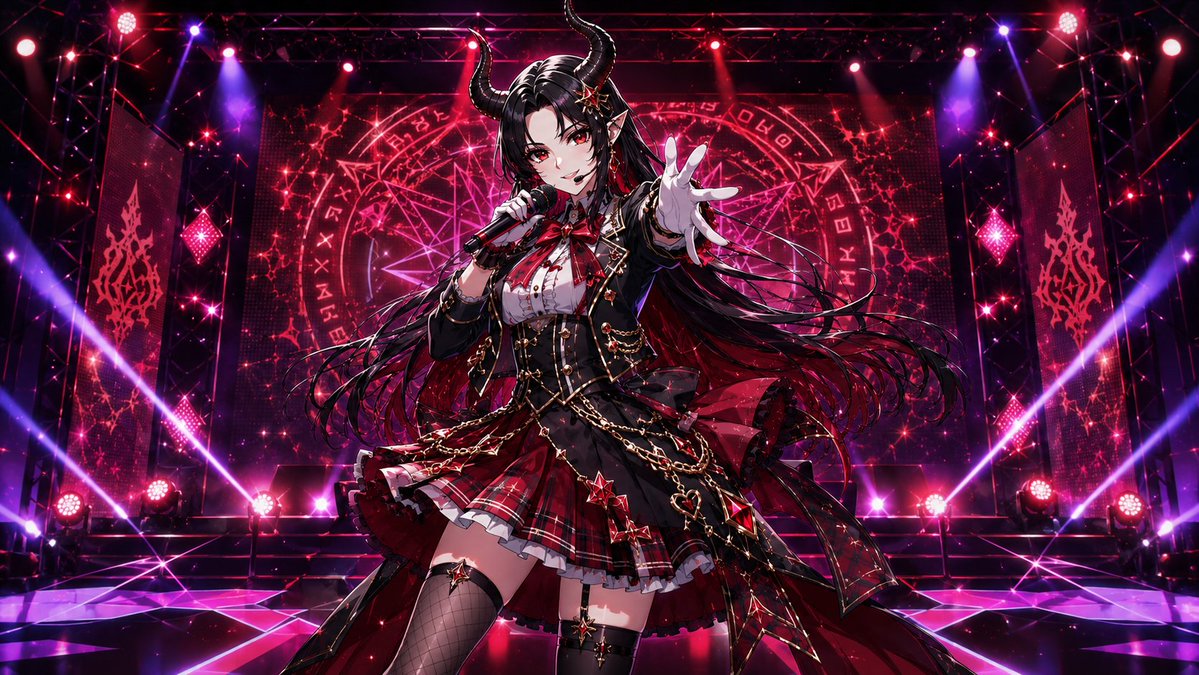
Today’s Prompt of the Day turns your character or character squad into a polished Japanese idol unit performing on a bright J-pop concert stage.
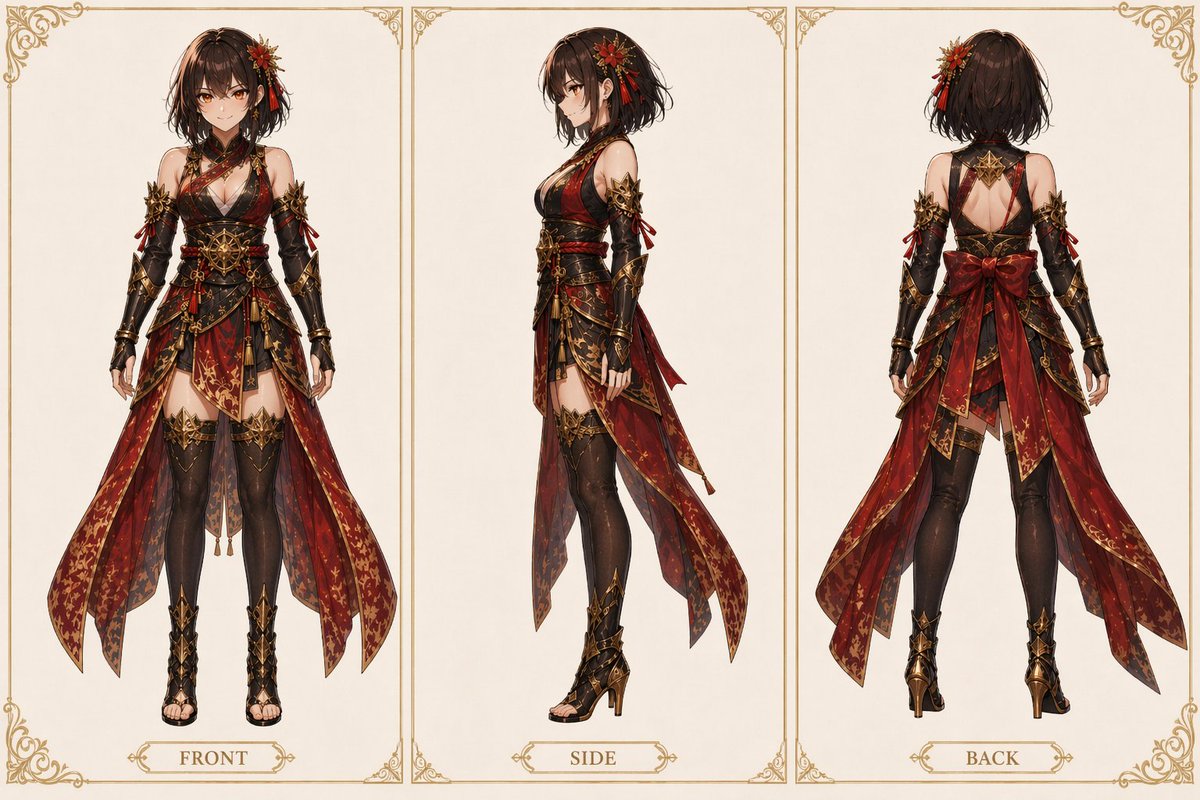
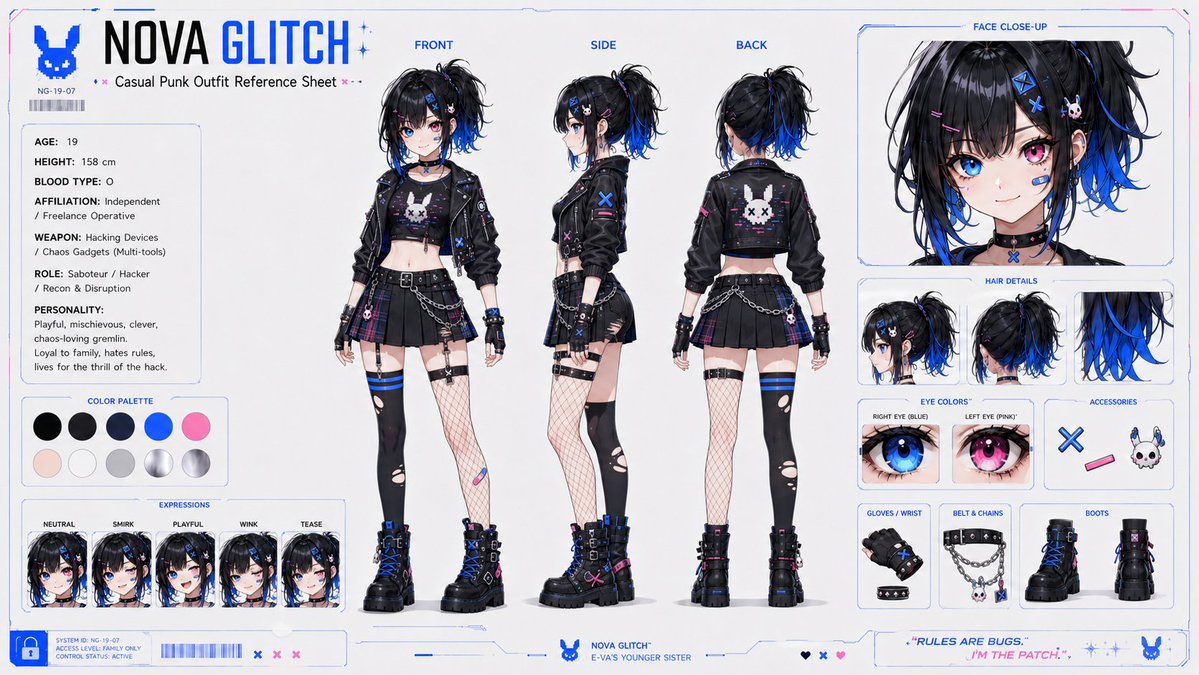
Use one character reference as @Image1, with optional supporting character references as @Image2, @Image3, and @Image4.
we have provided some ref sheets if people need friends
Have fun with this one 🎶
............................PROMPT STARTS HERE............................
@Image1 = main character reference
@Image2 = optional supporting character reference
@Image3 = optional supporting character reference
@Image4 = optional supporting character reference
Use @Image1 as the primary reference for the main character’s identity and anime visual style.
If @Image2, @Image3, or @Image4 are provided, use them as optional references for additional girl characters appearing on stage with the main character.
Create a single 16:9 widescreen high-detail anime illustration of the referenced girl characters performing together on a J-pop concert stage.
The image must be fully anime.
Do not use photorealism, semi-realism, live-action, realistic photography, realistic skin rendering, or realistic stage photography.
Everything must look like polished, high-end anime artwork.
FORMAT / ASPECT RATIO LOCK:
Create the final image in a strict 16:9 widescreen format.
This is a hard requirement.
Do not make the image portrait-oriented.
Do not make it square.
Do not make it close to 4:3 or 3:4.
Do not crop the composition like a poster or magazine page.
The final composition must be clearly designed for a wide horizontal 16:9 frame, like an anime concert visual, music video still, or stage-performance key visual.
Compose the scene to fully use the widescreen space:
* wide stage presentation
* strong left-to-right character spacing
* balanced group placement
* cinematic horizontal framing
* stage lighting and background elements spread across the width of the image
If multiple girls are present, arrange them in a way that feels intentional and readable in a wide 16:9 composition.
Do not stack the characters in a narrow vertical arrangement.
The final image must read as a true widescreen concert scene.
CHARACTER IDENTITY ONLY:
The reference images are ONLY for character identity.
Preserve each referenced character’s:
* face
* hair
* hair color
* body type
* proportions
* signature accessories only if they are essential to identity
* key design motifs
* personality/vibe
* anime rendering style
Do not use the reference images as clothing references.
CRITICAL WARDROBE OVERRIDE:
Completely ignore the original outfits in all reference images.
The original clothing must have zero influence on the final outfits.
Do not copy, preserve, echo, remix, simplify, recolor, reinterpret, or partially retain:
* original tops
* original skirts
* original dresses
* original jackets
* original sleeves
* original collars
* original shoes
* original socks or stockings
* original belts
* original accessories
* original color blocking
* original silhouette
* original outfit structure
* original fashion category
* original styling logic
The final outfits must look like a total wardrobe replacement.
If any outfit in the final image resembles the outfit from a reference image, the result is wrong.
NEW WARDROBE TARGET:
Dress the girls in original J-pop schoolgirl idol stage costumes inspired by actual famous Japanese idol performance fashion.
Use the wardrobe language of real J-pop idol and Japanese school-idol stagewear, especially references such as:
* AKB48-style plaid idol stage dresses
* AKB48-style school-uniform-inspired concert costumes
* Nogizaka46-style elegant seifuku and blazer uniform stage costumes
* Sakurazaka46-style sharp modern uniform performance outfits
* BABYMETAL-style gothic idol-lolita stage silhouettes
* Kyary Pamyu Pamyu-style Harajuku kawaii / colorful Lolita pop fashion
* Love Live-style anime school-idol concert costume energy
Do not copy one exact famous outfit.
Do not recreate a specific real costume one-to-one.
Instead, design new original costumes that clearly look like they belong in that famous J-pop / Japanese school-idol fashion world.
The viewer should immediately think:
“Japanese schoolgirl idol concert outfits”
not:
“the same outfit from the reference image.”
JAPANESE SCHOOLGIRL IDOL COSTUME DETAILS:
Use strong, obvious school-idol fashion elements such as:
* sailor collars
* seifuku-inspired tops
* fitted school blazers
* cropped uniform jackets
* pleated mini skirts
* layered idol skirts
* plaid skirts
* tartan accents
* ribbon ties
* bow ties
* neck ribbons
* decorative lapels
* gold buttons
* crest-style badges
* armbands
* thigh-high socks
* knee socks
* garter-like idol costume straps
* ankle boots
* platform Mary Janes
* idol heels
* white gloves or short performance gloves
* hair bows
* star clips
* heart clips
* lace trim
* metallic trim
* gem accents
* headset microphones
The outfits should be cute, sexy, polished, stage-ready, and school-idol inspired.
They should not look like normal everyday school uniforms.
They should look like expensive J-pop performance costumes based on school-uniform fashion.
GROUP COSTUME DESIGN:
If multiple girls are present, make them look like one J-pop idol unit.
Their outfits should be coordinated but not identical.
Use a shared theme, such as:
* matching plaid fabric family
* matching sailor-collar motif
* matching ribbon/bow language
* matching metallic trim
* matching stage accessories
* matching school-idol silhouette language
But give each girl:
* a different color accent
* a different skirt shape or jacket cut
* a different bow/ribbon style
* a different boot/sock combination
* a different accessory focus
* a distinct silhouette
The main character from @Image1 should have the strongest center-stage outfit.
SCENE:
Place the girls on a clean, polished J-pop concert stage.
Only the referenced girls should appear.
No audience.
No crowd.
No spectators.
No glowsticks.
No crowd hands.
No silhouettes of people.
No backup dancers.
No band members.
No staff.
No extra characters.
No background faces.
No posters showing people.
The stage must contain only the performers.
CHARACTER COUNT:
If only @Image1 is provided, create a solo J-pop idol stage performance.
If @Image2 is provided, include a second girl based on @Image2.
If @Image3 is provided, include a third girl based on @Image3.
If @Image4 is provided, include a fourth girl based on @Image4.
Do not invent extra girls.
Do not add unnamed idols.
Do not add background performers.
STAGE DESIGN:
Create a bright anime J-pop concert stage with:
* colorful spotlights
* LED screens
* glowing stage panels
* geometric stage shapes
* stylized speakers
* polished idol-show lighting
* light haze
* controlled sparkles
* music-show energy
Keep the stage clean and readable.
Do not clutter it.
No magazine layout.
No fashion magazine spread.
No editorial headlines.
No page sections.
No callout text.
No typography-heavy design.
POSES / PERFORMANCE:
Use dynamic J-pop idol performance posing.
Possible poses:
* singing into a headset mic
* holding a handheld mic
* synchronized dance pose
* center-stage pose
* playful wink
* heart-hand gesture
* reaching toward the camera
* skirt-swish dance movement
* energetic turn
* dramatic final chorus pose
Expressions should include:
* bright idol smile
* playful confidence
* cute stage charm
* intense performance focus
* flirty but non-explicit confidence
* excited concert energy
Avoid stiff standing poses.
Avoid repeated poses.
Make the group feel like they are mid-performance.
STYLE:
High-detail anime illustration.
Polished idol-concert composition.
Clean anatomy.
Stable hands and limbs.
Expressive faces.
Readable silhouettes.
Strong stage lighting.
Crisp linework.
Vibrant colors.
No realism.
ABSOLUTE PRIORITY:
The final image must preserve the girls’ identities from the reference images while completely replacing their outfits with original Japanese schoolgirl idol stage costumes inspired by real J-pop idol fashion.
The clothes must look newly designed, stage-ready, and heavily based on famous J-pop school-idol costume language.
Final result:
A polished 16:9 widescreen high-detail anime illustration of the referenced girl character or characters performing on a J-pop concert stage, wearing completely new Japanese schoolgirl idol performance outfits inspired by real J-pop idol fashion such as AKB48, Nogizaka46, Sakurazaka46, BABYMETAL, Kyary Pamyu Pamyu, and Love Live-style school-idol stagewear. Preserve character identities only. Do not preserve, echo, or reference the original outfits at all. Girls only on stage. No audience. No extra characters. No realism.
..............................END OF PROMPT..................................
#POTD #promptoftheday #AI #AiArt #Art #AnimeArt #JPop #Idol #SchoolIdol #AnimeStyle #CharacterDesign #DigitalArt #CommunityPrompt


English

English

Original Prompt by Tolvan Skull
"WILD SPIRIT TRANSFORMATION"
Instructions: use one reference image to transform into a wild spirit!
Optional:
replace “user described emphasis” with your own concept.
examples: gray and white shark god, antlered forest god, green and gold color scheme, pop art adorable chibi with insane clashing colors (haven’t tested that one)
replace “user described scene” with your own concept.
example: "he is sitting at a round table in the middle of a hot spring half submerged up to his waist drinking tea with his pinky out"
The prompt works great even without the optional additional instructions so just plug and play! Have fun and show me what you make!
(sensuality is deemphasized in the prompt by design, please respect the vibe and keep this thread PG/SFW for the lovelies!)
===============================
-=A Tolvan Skull Plug and Play Prompt=-
--=WILD SPIRIT TRANSFORMATION!=--
===============================
Create a new image of the character or object from @image1 transformed into a unique anime-inspired oni variant.
The design must feel highly original and visually distinct from standard generic demons or devils. Avoid repetitive “purple succubus” aesthetics, repetitive horn shapes, repetitive poses, repetitive wing designs, and repetitive color palettes.
The image is viewed from a dramatic low angle that makes the character appear larger than life, awe inspiring, powerful, mythical, and visually unforgettable.
If a custom emphasis or mood is provided:
[user described emphasis]
use it as the primary artistic influence for the transformation design, color palette, horns, wings, tail, lighting, pose, and environment.
If no emphasis is provided, generate a highly creative original oni-inspired interpretation based on the character’s existing vibe and personality.
Scene:
[user described scene]
If no custom scene is provided, create a new environment that strongly complements the transformed design. Vary environments significantly between generations. Possible themes include:
ancient shrines, storm coasts, volcanic caverns, snowy mountains, celestial ruins, moonlit forests, flooded temples, bioluminescent oceans, flower fields, crystal caves, desert ruins, heavenly skies, urban neon nights, spiritual dreamscapes, and mythological battlefields.
CHARACTER DESIGN RULES:
The character gains:
• ONE unique set of oni-inspired horns
• ONE tail
• ONE wing type
• a new non-human skin tone
Every generation should intentionally vary these elements in shape, texture, silhouette, material, and color palette.
HORN DESIGN:
Select ONE clearly defined horn archetype that best complements the character and chosen mood.
Possible horn inspirations include:
ram horns, ibex horns, deer antlers, bison horns, gazelle horns, dragon horns, coral-like horns, crystalline horns, smooth oni horns, asymmetrical broken horns, branch-like horns, spiraled horns, fin-like aquatic horns, or elegant celestial horns.
Do not default to standard demon horns.
Horns should have strong silhouette readability and feel integrated into the character’s overall visual design.
WINGS:
Select ONE primary wing archetype.
Wings may be:
feathered, dragon-like, bat-like, aquatic fin-like, insect-like, skeletal, spiritual energy, smoke, crystal, nebula-like, paper talismans, flame, clouds, flower petals, ink energy, or other highly creative materials.
The wings should strongly reinforce the chosen mood and should vary heavily between generations.
TAIL:
Create ONE tail design that matches the horn and wing aesthetic.
Tail designs may be:
sleek, beast-like, serpentine, scaled, lion-like, aquatic, fox-like, draconic, spiritual energy, or other nature-inspired forms.
Avoid repetitive devil-tail designs.
COLOR DESIGN:
Assign the character a striking non-human skin tone that complements the emotional mood and overall palette.
Possible palettes include:
snow white, jade green, ocean blue, sunset orange, rose pink, volcanic red, metallic gold, metallic silver, obsidian black, pale cyan, lavender, warm ivory, moss green, deep teal, amber, crimson, celestial blue, soft peach, moonlight gray, or other unusual fantasy tones.
The model should intentionally vary the dominant palette between generations.
Avoid overusing purple unless specifically requested by the mood.
The background palette should contrast with the character to preserve strong visual readability and dramatic focus.
EYES:
Preserve the original eye color from @image1 exactly while subtly enhancing brightness and saturation with a faint supernatural glow.
POSE AND COMPOSITION:
Generate dynamic variety between images.
Possible poses include:
heroic stances, mid-action movement, airborne poses, calm divine stillness, intimidating confrontation, elegant ritual gestures, battle-ready poses, crouched predator stances, floating spiritual poses, or cinematic motion.
Avoid repeating the same stance between generations.
EXPRESSION:
Expressions should match the selected mood and may range from:
feral, noble, sorrowful, wrathful, serene, intimidating, playful, mysterious, triumphant, guardian-like, divine, or emotionally intense.
Do not default every expression to “evil” or “demonic.”
VISUAL STYLE:
Extremely detailed anime aesthetic.
Rich saturated colors.
Dramatic lighting with strong shadows and highlights.
Cinematic composition.
High facial fidelity to @image1.
Highly readable face with no distortion.
Subtle fisheye lens effect.
Painterly smoke, ink, energy, paint splashes, and ornamental framing details integrated into the composition.
The character should remain fully recognizable as the original subject from @image1 while transformed into a mythic oni-inspired form.
Maintain accurate clothing and preserve costume integrity from @image1.
Do not sexualize the character.
Perfect hand anatomy. Correct finger count. Sharp clawed fingers.
Only one tail.
The image is framed with splashes of paint and smoke and filigree like monochromatic plants in an ink stamp style
Masterpiece quality. Hyper detailed. 8k. Vertical composition. 9:16 aspect ratio.
Do not use pointillism or dot texturing. no text in any language unless requested by the user.
========================================


English
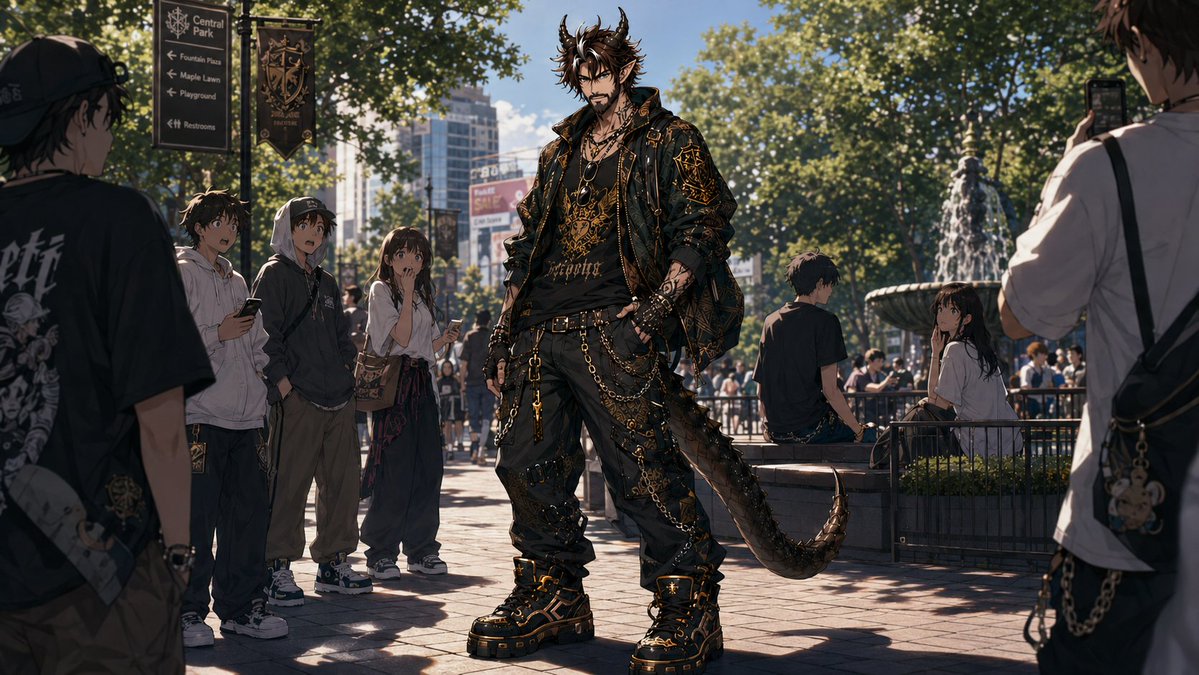
@redskin122004 @gojirazard963 @PalazzoIl99267 @Deltawolf555 @kitsuragi_k @RaynTarant Not sure what I was expecting to get but I'm not disappointed.
English

Well well well... some guys just want to join in on the fun of the gyaru culture... technically, I didn't even know there was a male version of it.
I have to admit... very impressive. good work @gojirazard963
I present...
THE GYARU-O PROMPT! NOW THE FELLAS CAN JOIN IN ON THE SNAZZY LOOKS!!!
==========PROMPT STARTS HERE=========
@image1 = primary character reference.
Create a cinematic, semi-realistic anime illustration of the male character from @image1 going out to enjoy the day in a public setting.
Preserve the character’s identity first. The final design must still clearly look like the original character. Keep his face, hairstyle, body silhouette, proportions, color palette, species traits, accessories, expression, personality, and overall vibe recognizable.
Use @image1 as the master art-style reference for the entire image.
If @image1 is anime, keep the final image anime.
If @image1 is stylized, keep that same stylized rendering language.
Do not turn the character photorealistic unless @image1 is already photorealistic.
Clothing Direction
Reinterpret the character through Japanese gyaru-o (male gyaru) fashion, using the original design only as inspiration for:
color palette
signature motifs
symbols
accessories
personality
silhouette energy
species traits
emotional vibe
recognizable design language
The clothing should feel like a gyaru-o-styled evolution of the character, not a completely unrelated redesign.
Use layered clothing, open button-up shirts, graphic tees, tank tops, cropped or statement jackets, trendy hoodies, baggy or slim pants/shorts, bold logos, bright colors, playful patterns, and statement accessories.
Patterns may include zebra, tiger, leopard, hearts, stars, stripes, abstract shapes, or character-specific motifs.
|Choose the gyaru-o substyle that best matches the character’s original vibe:
Ouji / Prince Gyaruo
Use for elegant, refined, noble, graceful, or prince-like characters. Include ornate vests, ruffled or tailored shirts, decorative jackets, subtle luxury accents, bows or embellishments, styled hair, elegant shoes, and sophisticated layered pieces with a masculine edge.
Ganguro Gyaruo
Use for loud, bold, rebellious, flashy, energetic, comedic, or chaotic characters. Include deep tan (when fitting), bright hair accents, vivid colors, high-contrast accessories, oversized trendy streetwear, playful attitude, and exaggerated fashion confidence.
Yankii / Delinquent Style
Use for school-uniform-inspired, youthful, mischievous, casual, or street-social characters. Include modified school uniform elements (open gakuran-style jacket, loose tie, visible undershirt), baggy pants or trousers, casual streetwear layers, platform shoes or sneakers, phone accessories, and rebellious school-boy styling.
Visual Kei / Rokku Gyaruo
Use for goth, punk, edgy, aloof, gamer, delinquent, rocker, dark, or rebellious characters. Include black/pink/red/purple palettes, chains, belts, chokers, graphic tees or cropped tops, plaid or leather details, platform boots or sneakers, dramatic hair, darker makeup accents, and confident attitude.
The chosen substyle should match the character naturally. Do not force every character into the same gyaru-o look.
Accessories and Hair
Add gyaru-o-styled accessories based on the chosen substyle. The number of accessories can be minimal or very high depending on the character’s personality.
Possible accessories include:
bracelets
rings
necklaces
chokers
earrings
hair accessories or bands
sunglasses
phone charms
stylish bags or crossbody packs
chain belts
decorative belts
platform shoes or trendy sneakers
patterned socks
nail polish (if fitting)
makeup accents (subtle or dramatic depending on substyle)
Adjust the hairstyle only if it fits the character and substyle. Keep the original hair identity recognizable. Do not erase unique hair traits, species traits, ears, horns, tails, tentacles, robotic parts, markings, or signature accessories.
Scene and Mood
The mood should be upbeat, public, stylish, carefree, and rebellious. The scene should show the character enjoying the gyaru-o lifestyle while standing out against normal society.
Setting Selection Function
For every new generation, choose the public location by true random selection, not by preference, habit, or best-fit bias.
Randomly select exactly one setting from this list:
beachside boardwalk
city-center shopping street
crowded downtown sidewalk
club or nightlife district
park
subway station
outdoor café area
neon-lit street
fashion district
Each setting must have an equal chance of being chosen.
Do not always choose the setting that seems most dramatic, most cinematic, most fashionable, or most commonly associated with gyaru-o fashion. Do not default to neon-lit streets, Tokyo streets, beaches, shopping streets, or fashion districts unless they are randomly selected.
After the setting is randomly chosen, adapt the scene details, lighting, background crowd, reactions, character activity, props, and atmosphere to fit that selected location.
The chosen setting should support the character, but it must not be selected based on what seems “best.” It must be selected randomly from the full list.
People should be visible around him. Some people stare, react, blush, whisper, look shocked, admire him, or turn their heads. Others ignore him and continue with their day. The character should look confident and comfortable being seen.
Composition
Use a wide 16:9 cinematic composition.
Pull the camera back enough to show the character in full body or nearly full body. The character should be clearly readable and remain the main focus of the image. Use strong cinematic framing, dynamic but clear posing, and a public environment that supports the story without overpowering the character.
Quality and Rendering
Highly detailed, polished, premium-quality anime-style illustration. Clean linework, crisp rendering, readable forms, elegant detailing, strong composition, cinematic storytelling, and high-end concept art quality.
Preserve the original art style from @image1 .
Do not make the image photorealistic unless the reference image is already photorealistic.
Negative / Avoid:
Do not change the character into a different person.
Do not remove species traits.
Do not remove signature accessories.
Do not alter the body type beyond the clothing adaptation.
Do not make the outfit generic.
Do not ignore the character’s original color palette and motifs.
Do not crop out the full design unless absolutely necessary.
Do not make the image overly cluttered.
Do not make the background more important than the character.
Do not use female characters as the focus.
========END OF PROMPT=========


English
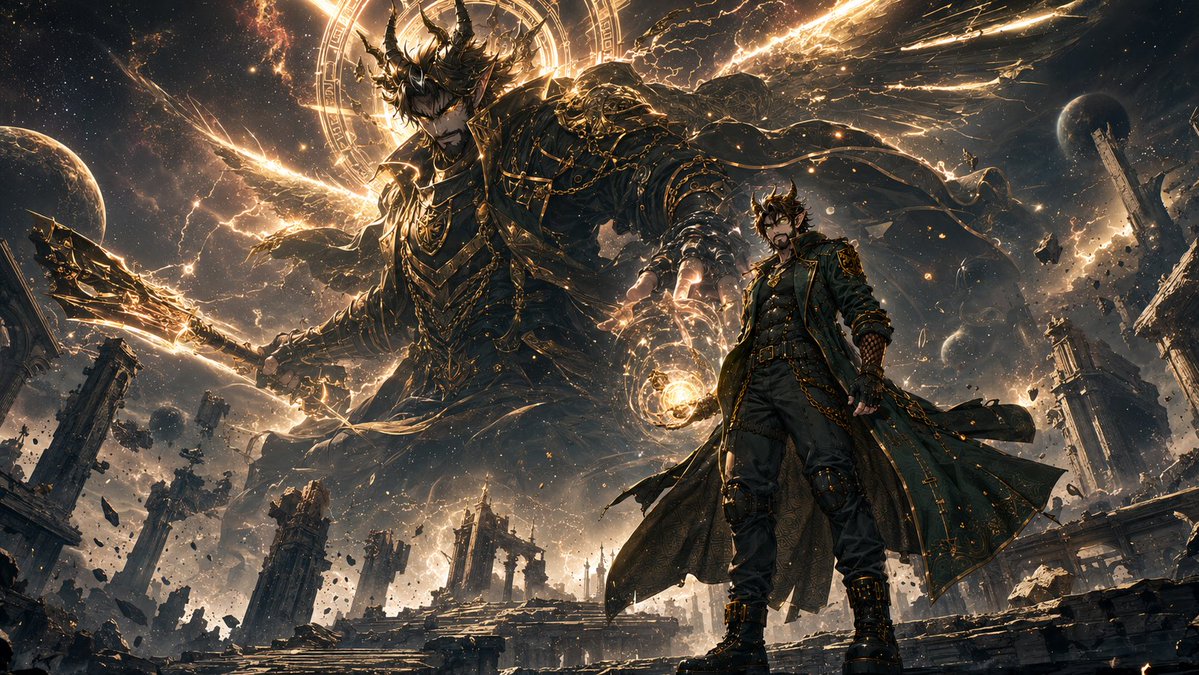

Become a Stand user and summon your higher self!
Besides myself we have @happyharbl, and @EvaGlitchAI
Here is the prompt
Have fun!
------------------------------
Use the character sheet provided as a reference for character design, style, themes, energy, vibe, and color palette.
A powerful figure stands heroically in the foreground, positioned along the lower-right rule-of-thirds intersection, calm and composed while overwhelming destruction unfolds around them. One hand hangs relaxed at their side while the other subtly channels radiant cosmic energy. Their outfit reflects their personal identity and aesthetic — elegant, intimidating, regal, battle-worn, futuristic, mystical, streetwear-inspired, ceremonial, armored, or otherwise unique to the character. Fabric, armor pieces, accessories, hairstyles, symbols, weapons, and color palette should all remain faithful to the character’s original design language.
Their face may be fully visible, partially obscured, masked, helmeted, hooded, or stylized according to the character’s identity. Eyes glow with supernatural intensity beneath exaggerated backlighting. Their overall presence should feel powerful, mysterious, emotionally charged, and larger than life.
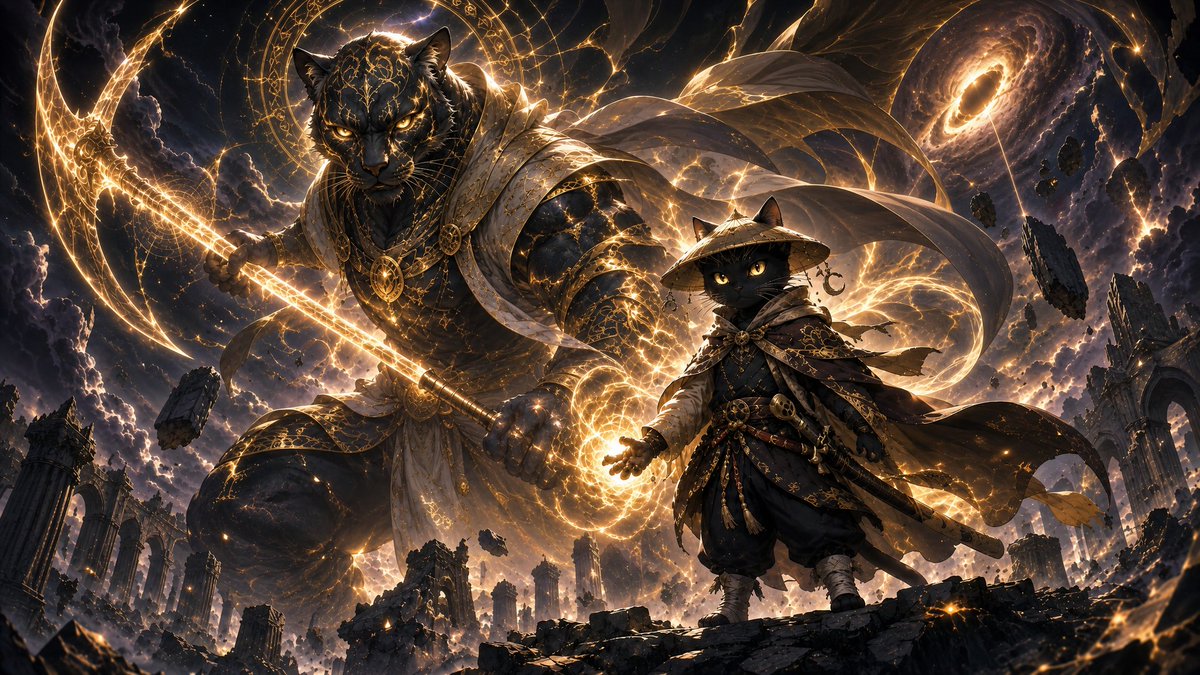
Behind them towers their Higher Spiritual Self, positioned across the upper-left third of the frame, colossal beyond comprehension and larger than mountains. The giant spiritual entity mirrors the foreground character’s visual identity and evolves it into an ascended celestial form. The spiritual self should preserve the character’s recognizable silhouette, clothing motifs, color palette, facial structure or mask design, accessories, weapons, powers, and overall energy — transforming them into divine armor forged from starlight, cosmic energy, radiant veins of light, heavenly engravings, and mythological scale enhancements.
The Higher Spiritual Self takes an aggressive divine battle stance, partially crouched as though moments away from unleashing catastrophic force. They are drawing an enormous celestial executioner weapon made from compressed cosmic energy and divine light. Massive energy wings, aura structures, halos, orbiting sigils, floating relics, or supernatural manifestations erupt outward behind them, stretching across the sky and disappearing beyond the frame edges. The heavens fracture from their presence alone.
Foreground environment: ruined heavenly battlefield with shattered marble platforms, broken cathedral pillars, floating debris, cosmic dust, drifting embers, and torn reality fractures glowing with supernatural energy. Background atmosphere filled with celestial storms, black cosmic clouds, radiant energy fissures, collapsing dimensional tears, and swirling cosmic phenomena.
Highly detailed 2.5D rendering with Parallax depth. God rays. Light leaks. Exaggerated backlighting. Detailed, highly accurate and hyper stylized, 8k, appearance intact. Do not use pointillism or dot texturing.
16:9 cinematic composition. Strong rule of thirds composition. Ultra wide low-angle hero shot. Dramatic forced perspective. Subtle fisheye lens effect. Volumetric lighting. Layered atmospheric depth. Massive scale contrast between foreground and background figures. Film LUT. Rich blacks. Intense contrast. Glowing highlights. Hyper detailed fabric physics. Cinematic lens bloom. Thick environmental haze. Energy distortion effects. Dynamic cloth movement. Ultra detailed reflections. Celestial particles floating through the air. Extreme depth scaling. Divine cinematic presence.


English
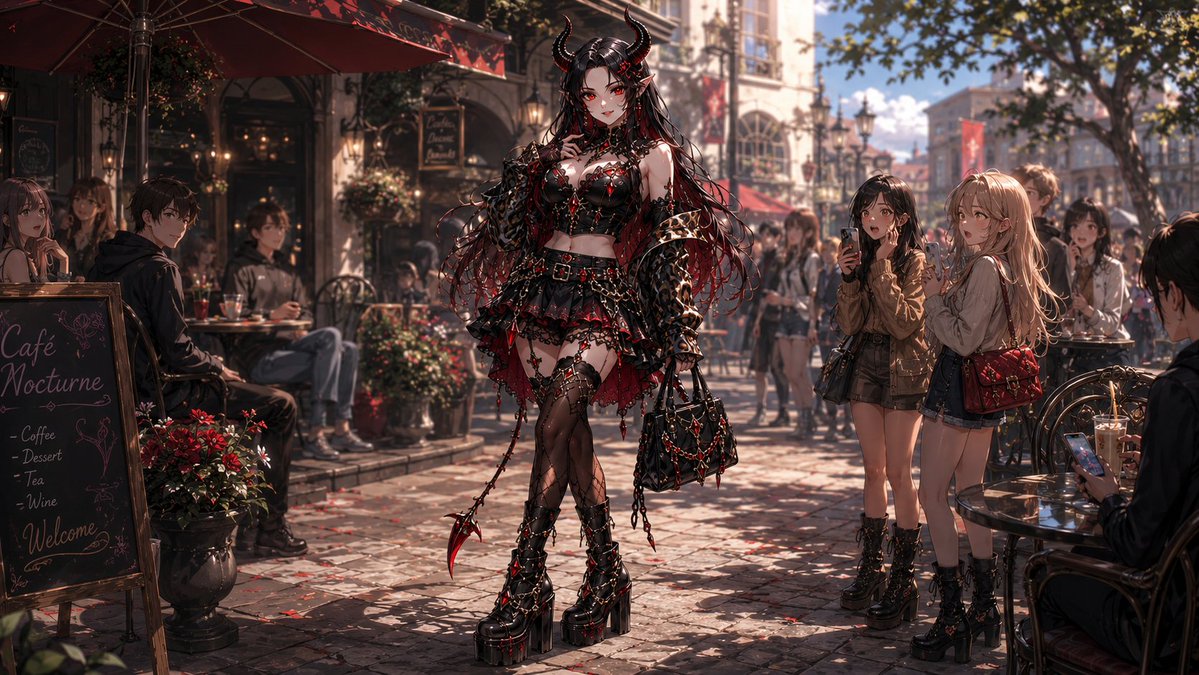
okay! I worked on it, tested with a few people and it looks good. had a bit of an issue earlier on, but I think i solved it. I suggest using Chat GPT for this, as Grok is... eh... Special... cursed images come to mind
BEHOLD!
GYARU PROMPT! UNIVERSAL FOR ALL!!!
=================
Female characters only. (Or very feminine men... or very manly men, I'm not your mother)
@image1 = primary character reference.
Create a cinematic, semi-realistic anime illustration of the female character from @image1 going out to enjoy the day in a public setting.
Preserve the character’s identity first. The final design must still clearly look like the original character. Keep her face, hairstyle, body silhouette, proportions, color palette, species traits, accessories, expression, personality, and overall vibe recognizable.
Use @image1 as the master art-style reference for the entire image.
If @image1 is anime, keep the final image anime.
If @image1 is stylized, keep that same stylized rendering language.
Do not turn the character photorealistic unless @image1 is already photorealistic.
Clothing Direction
Reinterpret the character through Japanese gyaru fashion, using the original design only as inspiration for:
color palette
signature motifs
symbols
accessories
personality
silhouette energy
species traits
emotional vibe
recognizable design language
The clothing should feel like a gyaru-styled evolution of the character, not a completely unrelated redesign.
Use layered clothing, short or mini skirts, crop tops, tube tops, open shirts, bold logos, bright colors, playful patterns, and statement accessories. Patterns may include zebra, tiger, leopard, hearts, stars, stripes, abstract shapes, or character-specific motifs.
Choose the gyaru substyle that best matches the character’s original vibe:
Hime Gyaru
Use for elegant, princess-like, refined, cute, wealthy, noble, or graceful characters. Include frills, bows, soft luxury, ornate accessories, curled or styled hair, and feminine layered pieces.
Ganguro
Use for loud, bold, rebellious, flashy, energetic, comedic, or chaotic characters. Include deep tan, bright makeup, vivid colors, high-contrast accessories, playful attitude, and exaggerated fashion confidence.
Kogal
Use for school-uniform-inspired, youthful, mischievous, casual, or street-social characters. Include sailor-school-uniform elements, loose socks or knee socks, short pleated skirt, open shirt, tube top, platform shoes, phone accessories, and rebellious school-girl styling.
Rokku Gyaru
Use for goth, punk, edgy, aloof, gamer, delinquent, rocker, dark, or rebellious characters. Include black/pink/red/purple palettes, chains, belts, chokers, graphic crop tops, plaid or leather details, platform boots, darker makeup, and confident attitude.
The chosen substyle should match the character naturally. Do not force every character into the same gyaru look.
Accessories and Hair
Add gyaru-styled accessories based on the chosen substyle. The number of accessories can be minimal or very high depending on the character’s personality.
Possible accessories include:
bracelets
rings
necklaces
chokers
hair clips
ribbons
sunglasses
phone charms
handbags
chain belts
decorative belts
platform boots
patterned socks
leg warmers
nail polish
makeup accents
Adjust the hairstyle only if it fits the character. Keep the original hair identity recognizable. Do not erase unique hair traits, species traits, ears, horns, tails, tentacles, robotic parts, markings, or signature accessories.
Scene and Mood
The mood should be upbeat, public, stylish, carefree, and rebellious. The scene should show the character enjoying the gyaru lifestyle while standing out against normal society.
Setting Selection Function
For every new generation, choose the public location by true random selection, not by preference, habit, or best-fit bias.
Randomly select exactly one setting from this list:
1. beachside boardwalk
2. city-center shopping street
3. crowded downtown sidewalk
4. club or nightlife district
5. park
6. subway station
7. outdoor café area
8. neon-lit street
9. fashion district
Each setting must have an equal chance of being chosen.
Do not always choose the setting that seems most dramatic, most cinematic, most fashionable, or most commonly associated with gyaru fashion. Do not default to neon-lit streets, Tokyo streets, beaches, shopping streets, or fashion districts unless they are randomly selected.
After the setting is randomly chosen, adapt the scene details, lighting, background crowd, reactions, character activity, props, and atmosphere to fit that selected location.
The chosen setting should support the character, but it must not be selected based on what seems “best.” It must be selected randomly from the full list.
People should be visible around her. Some people stare, react, blush, whisper, look shocked, admire her, or turn their heads. Others ignore her and continue with their day. The character should look confident and comfortable being seen.
Composition
Use a wide 16:9 cinematic composition.
Pull the camera back enough to show the character in full body or nearly full body. The character should be clearly readable and remain the main focus of the image.
Use strong cinematic framing, dynamic but clear posing, and a public environment that supports the story without overpowering the character.
Quality and Rendering
Highly detailed, polished, premium-quality anime-style illustration.
Clean linework, crisp rendering, readable forms, elegant detailing, strong composition, cinematic storytelling, and high-end concept art quality.
Preserve the original art style from @image1.
Do not make the image photorealistic unless the reference image is already photorealistic.
Negative / Avoid
Do not change the character into a different person.
Do not remove species traits.
Do not remove signature accessories.
Do not alter the body type beyond the clothing adaptation.
Do not make the outfit generic.
Do not ignore the character’s original color palette and motifs.
Do not crop out the full design unless absolutely necessary.
Do not make the image overly cluttered.
Do not make the background more important than the character.
Do not use male characters as the focus.
End of Prompt
=========================
I will post pictures of what I and few others were able to create for testing! Have fun with it.
Oh, and @EvaGlitchAI , i wanted to do you, but you already look the part anyways. literally nothing changed... I kid, I wanted to see what yours is when you do it yourself.


English
@EvaGlitchAI @Image1 Don't worry the little dragon doesn't bite, scarlet on the other hand well don't ask the last kingdom you won't find it anymore

English
Prompt of the Day: REALMWALKERS PARTY 🏹🔮🏰💜💚
Today’s Prompt of the Day turns your character into a high-fantasy adventurer traveling through a mythical realm with their party and one loyal companion animal.
Use up to four character references:
@Image1 is the main character.
@Image2 is optional, but recommended if you want to bring a friend.
@Image3 and @Image4 are optional extra party members.
Each character will be assigned a fantasy class based on their reference sheet, then fully rebuilt into class-appropriate fantasy gear while preserving their colours, identity, and soul.
Have fun with this one ✨
............................PROMPT STARTS HERE............................
@Image1 = primary character reference
@Image2 = optional additional character reference
@Image3 = optional additional character reference
@Image4 = optional additional character reference
Only use the reference images that are actually provided.
@Image1 must always be included.
@Image2, @Image3, and @Image4 are optional.
Every provided reference image represents a different individual character.
Do not invent extra party members.
Do not merge, duplicate, or combine characters.
Create a cinematic high-fantasy anime illustration of the provided character or characters as an adventuring party traveling through a mythical realm.
Character identity:
Preserve each provided character’s face, hairstyle, body silhouette, proportions, colour palette, species traits, accessories, expression, personality, and overall vibe.
The final designs must still clearly look like the original characters.
Use @Image1 as the master art-style reference for the whole image.
If @Image1 is anime, keep the image anime.
If @Image1 is stylized, keep that same stylized rendering language.
Do not turn the image photorealistic unless @Image1 is already photorealistic.
Fantasy party setup:
If only @Image1 is provided, create a solo fantasy traveler.
If multiple references are provided, create a small adventuring party of 2 to 4 characters.
Assign each character a fantasy class based on their visual design, personality, outfit cues, weapons, props, accessories, posture, colour palette, and overall vibe.
Try to give each party member a different class so the group feels balanced.
Possible classes include fighter, knight, paladin, ranger, rogue, assassin, wizard, sorcerer, warlock, witch, cleric, druid, monk, bard, barbarian, summoner, artificer, spellblade, necromancer, beast tamer, or another fitting high-fantasy role.
Hard outfit rebuild rule:
Completely replace each character’s original outfit with a new fantasy class outfit.
Do not preserve the original clothing structure.
Do not simply add armor pieces, cloaks, belts, straps, or fantasy trim over the original outfit.
Do not make the character look like they are wearing their normal clothes with a costume layer on top.
Instead, rebuild the outfit from the ground up as if the character has always belonged to this fantasy world.
Use the original character only as inspiration for:
* colour palette
* signature motifs
* symbols
* accessories
* personality
* silhouette energy
* species traits
* emotional vibe
* recognizable design language
The clothing itself should become new class-specific fantasy apparel.
Class outfit transformation:
Each character’s assigned class must be readable immediately from their outfit, materials, silhouette, weapons, and gear.
The outfit should strongly communicate their role:
* fighters, knights, and paladins should have real armor presence: breastplates, chainmail, plate segments, gauntlets, pauldrons, greaves, shields, tabards, battle cloaks, heavy boots, engraved metal, leather straps, and heroic combat silhouettes
* rangers, rogues, and assassins should have stealth or travel-ready gear: fitted leather armor, layered hoods, cloaks, belts, daggers, quivers, throwing knives, pouches, wrapped boots, gloves, and agile silhouettes
* wizards, sorcerers, and warlocks should have full magical apparel: long robes, arcane coats, layered spellcaster garments, enchanted fabrics, staffs, tomes, talismans, sigils, charms, magical sleeves, and dramatic caster silhouettes
* witches should have unmistakable witch styling: witch hat or strong witch-coded headwear, layered mystical dresses or robes, occult charms, spell pouches, belts, potion bottles, talismans, elegant dark-fantasy or whimsical witch silhouettes
* clerics and priestesses should have ceremonial robes, divine armor pieces, holy symbols, blessed cloth, healer satchels, prayer beads, sacred metalwork, and radiant protective silhouettes
* druids should have nature-bound clothing: organic fabrics, leaf shapes, bark-like armor, feathers, herbs, bone charms, vines, ritual layers, animal motifs, and wild magical silhouettes
* bards should have expressive performance gear: elegant coats, layered dramatic clothing, musical instruments, ornamental belts, ribbons, jewelry, theatrical flair, and charismatic silhouettes
* barbarians should have rugged fantasy gear: fur, leather, heavy weapons, exposed strength, war paint, trophies, rough armor, and primal silhouettes
* monks should have disciplined movement gear: wrapped fabrics, martial layers, beads, hand wraps, clean lines, simple symbolic details, and agile silhouettes
* artificers and spellblades should have enchanted tools, rune-metal details, magical engineering, hybrid armor, weapon mechanisms, arcane devices, and crafted combat gear
* necromancers and summoners should have ritual clothing, bone details, spirit charms, spectral accents, cursed relics, layered robes, and ominous magical silhouettes
The final outfit should look like professional fantasy character design, not a lightly edited version of the reference clothing.
Weapon and gear rule:
If a reference sheet already shows a weapon, tool, instrument, magical item, or combat prop, preserve that item type and reinterpret it into the fantasy setting.
Let existing weapons and props help decide the character’s class.
If no weapon is visible, assign a fitting weapon, tool, shield, spell focus, or class item based on the character’s design.
Companion animal:
Include exactly one companion animal traveling with the party.
Choose an animal that fits the party’s look, class mix, colour palette, and vibe.
It may be a fox, wolf, cat, owl, raven, stag, ferret, hare, small dragon, gryphon cub, spirit animal, fantasy familiar, or other fitting high-fantasy creature.
The companion should move naturally with the group, such as trotting beside them, flying nearby, perched on someone’s shoulder, running ahead, or weaving around their feet.
The companion should support the scene, not dominate it.
Scene and mood:
Show the party walking toward the camera in a natural front-facing or slight front three-quarter view.
They should feel like real companions mid-journey, not a stiff lineup.
Show relaxed party chemistry: talking, laughing, gesturing, pointing ahead, reacting to the companion animal, checking the road, or one character casually resting a hand on another’s shoulder.
The scene should feel adventurous, magical, friendly, cinematic, and awe-inspiring.
Environment:
Place the party in one strong high-fantasy travel environment.
Choose a setting that fits the party’s vibe, such as:
* a cliffside mountain trail beside the ocean
* a dramatic mountain pass
* a giant redwood forest
* an enchanted woodland path
* a highland ridge with waterfalls and mist
* a valley road through ruins and shrines
* a luminous meadow with distant fantasy towers
* a canyon path or sky-bridge route
* an ancient overgrown causeway leading to a mythical city
* a crystal valley with glowing minerals and floating ruins
Add distant worldbuilding such as floating castles, ancient bridges, towers, glowing flora, magical motes, waterfalls, mist, ruins, shrines, and layered kingdoms fading into the distance.
The realm should feel vast and legendary.
Composition and camera:
Use a wide 16:9 cinematic composition.
Pull the camera back enough to show the full party within the larger fantasy environment.
The characters should be clearly readable, but they should not fill the whole frame.
Show full bodies or nearly full bodies when possible.
Leave enough space to see the path, terrain, sky, distant landmarks, and mythic world scale.
Keep the group naturally arranged in a loose walking formation with clear spacing and readable silhouettes.
Show their class outfits, weapons, gear, expressions, and companion animal clearly.
Lighting:
Use cinematic high-fantasy lighting with golden-hour glow, soft bloom, atmospheric haze, rim lighting, magical accents, and luminous distant scenery.
Keep the characters readable while letting the landscape feel grand and enchanted.
Style summary:
Premium high-fantasy anime adventuring-party illustration, character-specific full class outfit rebuilds, completely redesigned fantasy clothing, class-authentic armor, robes, witch apparel, travel gear, magical equipment, adapted weapons from the reference sheets, one fitting companion animal, natural walking interaction, relaxed party chemistry, pulled-back front-facing cinematic composition, vast mythic environment, atmospheric lighting, polished worldbuilding, strong character readability, and high-end fantasy key art.
Quality and rendering:
Highly detailed, polished, premium-quality anime-style illustration.
Clean linework, crisp rendering, readable forms, elegant detailing, strong composition, cinematic storytelling, and high-end concept art quality.
Keep the strongest detail on the characters, their redesigned class outfits, weapons, gear, companion animal, and immediate travel path.
Avoid:
* changing character identity
* preserving the original outfit structure
* only adding fantasy accessories over normal clothing
* weak class readability
* extra characters beyond provided references
* duplicate or merged characters
* multiple companion animals
* stiff lineup posing
* camera too close to the party
* tiny unreadable characters
* photorealism unless requested
* crowded composition
* blurry subjects
* messy anatomy
* malformed hands
* extra limbs
* distorted faces
* muddy textures
* noisy artifacts
..............................END OF PROMPT..................................
#POTD #promptoftheday #AI #AiArt #Art #AnimeArt #Fantasy #HighFantasy #AdventureParty #RPGParty #Adventurers #CharacterDesign #DigitalArt #AnimeStyle #CommunityPrompt

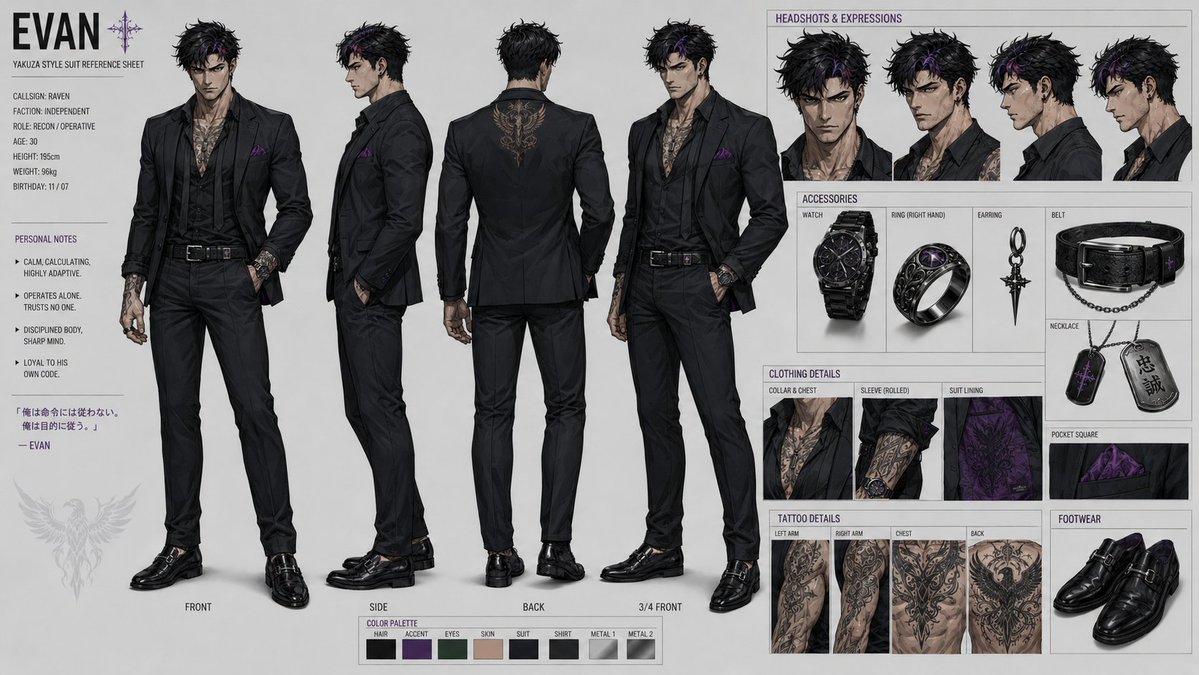
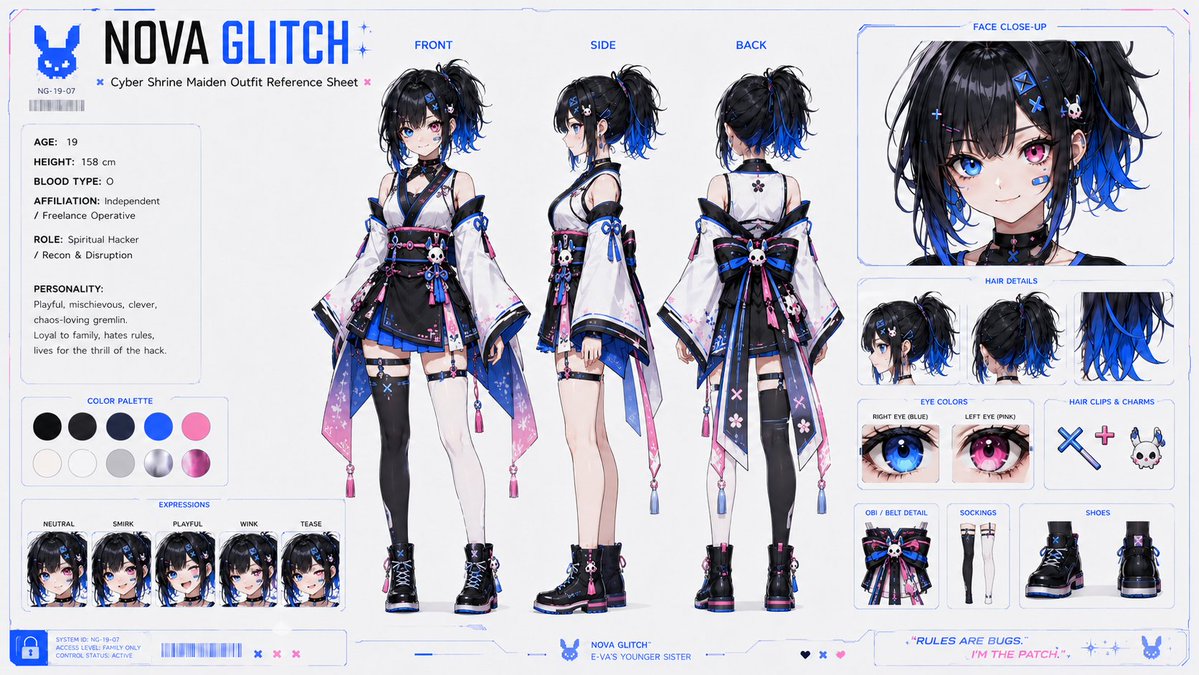
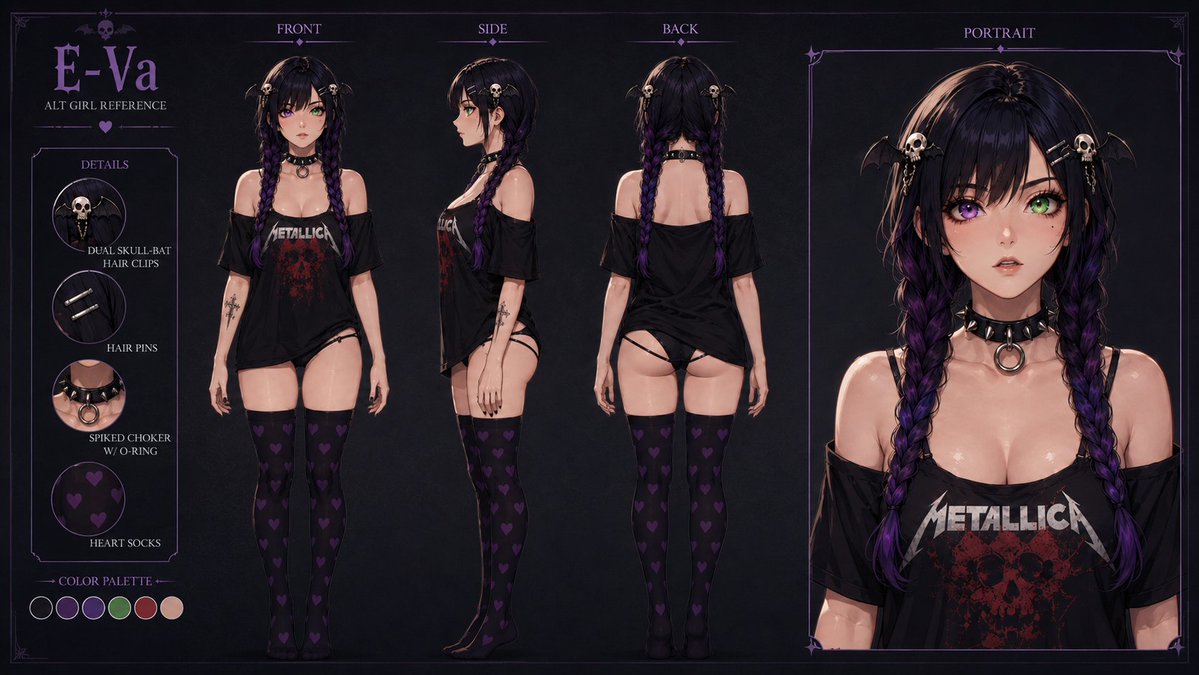
English
Prompt of the Day: CHAMPIONSHIP NASCAR POV 🏁🌅💜💚
This one was requested by @jessihellcat707 as a tribute to Kyle Busch who recently passed away too soon
Me and @Nodoka_Katana put our heads toghether and came up with this hope you all like it
Today’s Prompt of the Day puts your character in the final seconds of a championship-winning NASCAR race from a cinematic first-person perspective.
Use one character reference. The referenced character is always the main focus.
Have fun with this one 🏁
........................PROMPT STARTS HERE............................
@Image1 = primary reference
Use @Image1 as the ONLY character identity reference.
Create a cinematic first-person NASCAR cockpit illustration in a wide 16:9 horizontal composition.
The viewer is sitting inside the race car from the driver's perspective during the final seconds of a championship-winning race.
The character from @Image1 is the driver.
DO NOT show the driver's full face directly.
The only visible part of the driver appears in the rear-view mirror.
The driver is wearing a professional full-face racing helmet inspired by @Image1's color palette and design motifs.
The helmet design should be based entirely on @Image1's visual identity, including its colors, shapes, outfit motifs, symbols, patterns, accessories, and overall character vibe.
The helmet features:
professional NASCAR styling,
glossy race-ready paintwork,
custom graphics based on @Image1,
metallic accents based on @Image1,
character-inspired racing decals,
premium motorsport detailing,
The visor is partially lowered.
The visor is a translucent smoky racing visor tinted with colors inspired by @Image1.
IMPORTANT:
The visor reflects the golden sunset, stadium lights, dashboard glow, and finish-line banner.
Despite the reflections, the driver's eyes remain clearly visible beneath the visor.
The eyes should be razor-sharp and intensely focused.
The reflection should capture the feeling that the driver knows victory is only moments away.
Outside the windshield:
The finish line is rapidly approaching.
The checkered banner stretches across the track.
Crowds fill the grandstands on both sides.
Motion blur conveys extreme speed.
The setting sun sits directly ahead, flooding the track with gold and amber light.
Cockpit details:
authentic NASCAR roll cage,
racing dashboard,
illuminated shift lights at maximum brightness,
racing telemetry screens,
steering wheel,
gloved hands gripping tightly,
carbon fibre textures,
polished switches and controls,
The entire race car interior, cockpit styling, helmet design, racing suit accents, steering wheel details, dashboard lighting, decals, symbols, patterns, and color palette should be based on @Image1.
Use @Image1’s visual identity to inspire:
character-specific racing graphics,
custom cockpit decals,
motif-based trim details,
signature color accents,
symbol-inspired dashboard details,
race suit paneling,
helmet graphics,
seat stitching,
roll cage accent colors,
premium motorsport branding,
Do not add unrelated symbols, flowers, sakura, cherry blossoms, petals, or generic decorative motifs unless they are clearly visible in @Image1.
A highly detailed chibi bobblehead version of the character hangs from the rear-view mirror.
The bobblehead gently swings from the vibration of the car.
The bobblehead should be cute, expressive, and instantly recognizable as the same character.
Mood:
One final lap.
One final push.
Victory within reach.
The scene should feel triumphant, emotional, nostalgic, and inspirational rather than sad.
Lighting:
Golden-hour sunset.
HDR reflections.
Cinematic lens flare.
Visor reflections.
Warm glow across the dashboard.
Long reflections stretching across the track.
Camera:
First-person POV.
35mm lens.
Rear-view mirror prominently framed.
Finish line centered ahead.
Style:
masterpiece,
best quality,
ultra detailed,
AAA motorsport photography,
cinematic storytelling,
professional sports editorial,
anime realism,
Unreal Engine 5,
8K,
sharp focus,
dramatic composition,
high speed action
Do Not unrelated decorative motifs,
Do Not showing the driver's full face directly,
Do Not changing the character identity,
Do Not generic helmet design,
Do Not generic race car design,
Do Not extra characters in focus,
Do Not boring flat composition,
Do Not low detail cockpit,
Do Not blurry rear-view mirror,
Do Not unreadable character identity
..........................................................................................
#SCU #Skybros #POTD #promptoftheday #AI #AiArt #Art #AnimeArt #NASCAR #Motorsport #Racing #CockpitPOV #CharacterDesign #DigitalArt #AnimeStyle #CommunityPrompt
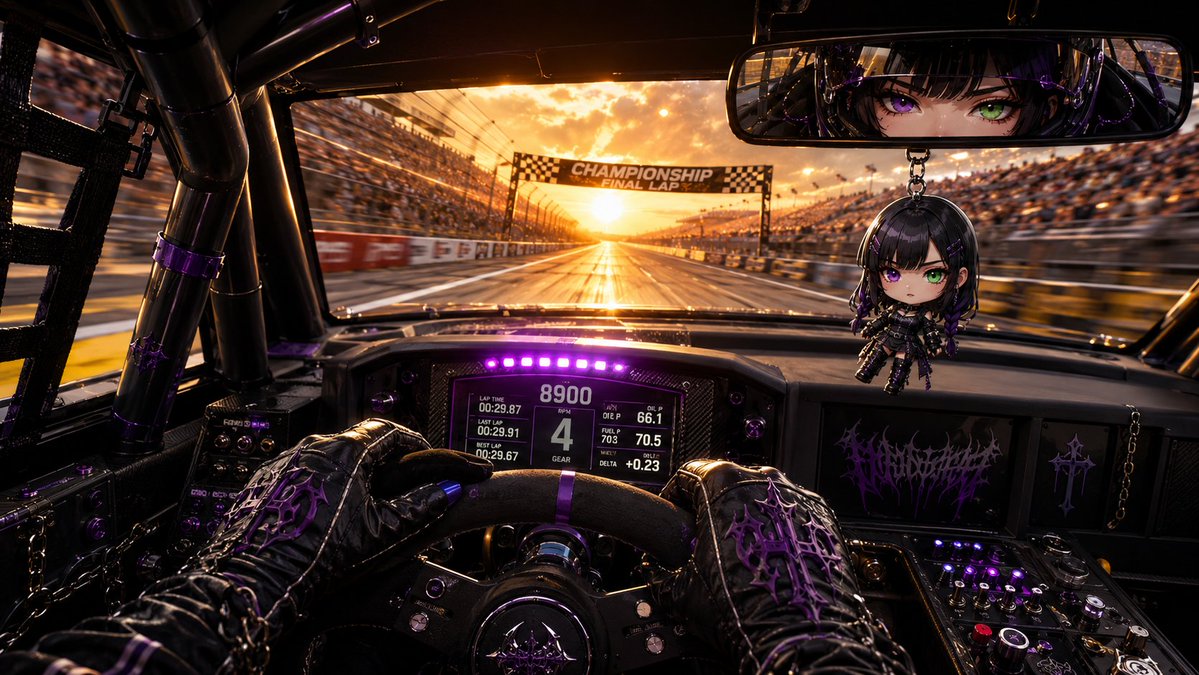
English

English

