Moya Sarner

14.8K posts

Moya Sarner banner
Moya Sarner

Moya Sarner

@MoyaSarner

"Sarner is beset by a gnawing doubt" -- The Sunday Times NHS psychodynamic psychotherapist Guardian columnist Author of When I Grow Up

London Katılım Eylül 2009
2.7K Takip Edilen2.4K Takipçiler
Sabitlenmiş Tweet
Moya Sarner
Moya Sarner@MoyaSarner·
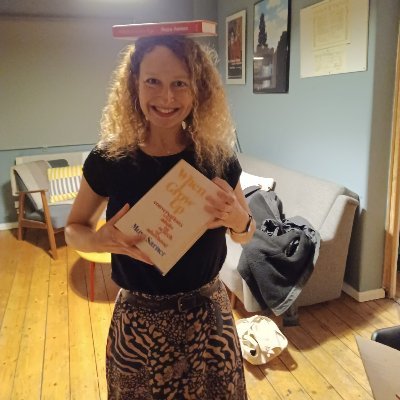
I may or may not be an adult - you'll have to read the book to find out - but I am definitely now a published author. Isn't she beautiful? Read all about it in the Guardian's Saturday magazine and online: theguardian.com/lifeandstyle/2…
Moya Sarner tweet media
English
11
6
83
0
Moya Sarner
Moya Sarner@MoyaSarner·
@proud_penelope @DrGipps ☝️I think when narcissistic defences have been employed for a whole lifetime - perhaps originally to defend against abominable pain - tolerance for any kind of pain at all never grows and so any pain is experienced as unbearable... Also, I 💜 Symington he is my absolute fave
English
0
1
3
39
Frannyfanny
Frannyfanny@proud_penelope·
1/2 “When narcissism is opted for, it is to protect the individual against appalling pain. It is quite difficult to be in the presence of someone with severe mental pain, & because of this sometimes there are therapeutic situations in which both the patient & the analyst protect
English
1
1
54
5.8K
Moya Sarner
Moya Sarner@MoyaSarner·
It was a total delight to unleash my true feelings on AI therapy, so far as the editor would allow unherd.com/2026/03/chatbo… "It’s available wherever, whenever, and offers immediate responses that are designed to flatter rather than challenge, to tell you exactly what you want...
English
2
3
18
3.3K
Mel
Mel@the_mel_jar·
Before I entered into my own clinical training, I once asked my analyst, “what is the difference between ‘psychodynamic’ and ‘psychoanalytic’? And why is it that so many seem to prefer ‘psychodynamic’?” She replied, “Some people try to get as far away from Freud as they can.”
Edward A. Perin - Psychologist@DoctorPerin

Psychoanalysis is a method of applying psychodynamic science. Psychodynamic science is the formal study of interactions and interdependence of psychological variables at different levels of awareness.

English
12
8
114
12.9K
Anastasia Tempest
Anastasia Tempest@Anastasia_T22·
@MoyaSarner Moya good afternoon, I would like to send you an email, have you an email address? I have written something for The Guardian, how can I get it published? Best wishes. Anastasia👨🏻‍🦼
English
1
0
0
19
Moya Sarner
Moya Sarner@MoyaSarner·
@KemtrupTweets between your earliest experiences and your current difficulties; that helps you see how you're using your closest relationships to play out your deepest unconscious conflicts, and that’s why you're so stuck. This insight only grows out of a real, meaningful, emotional experience.
English
1
0
2
33
Kemtrup
Kemtrup@KemtrupTweets·
Some things a therapist NEEDS to do that LLM’s struggle with: -Enforce the frame, eg not let sessions go on too long -Realize that a series of questions can be an unintentional “trap” into an enactment and refuse to answer -Not be bullied by increasing aggression or
English
6
12
116
9.8K
Chris W
Chris W@FishHutBlackDog·
@MoyaSarner "This is my last column for you." I've only just stumbled across this and, when I read that line, I exclaimed a silent and inward "Oh NO!" I've loved reading your column and I will be reading your book. theguardian.com/lifeandstyle/2…
English
1
0
1
29
Mel
Mel@the_mel_jar·
All right, personal anecdote that segues into Mel's overall philosophy time: so I have taught various things over the years, and yet I have only begun teaching graduate students and postgraduates in psychology for the past two years. I will say that one thing that has been a hard, humbling lesson for me to learn over these past two years is JUST how upset and scared people can be made by the second approach as Nadeem describes here, which does include Klein and others, and just how common this is (it seems to include perhaps most people who are studying to become therapists, now, in my anecdotal experience). I have, of course, known for a long time that this is a dividing line amongst many in psychology and psychoanalysis as a whole. However, I suppose I truly did not realize just how resistant we seem to have become, as a culture, to the second variation of understanding humans and our minds here. I have a joke that I came into grad school, myself, as a Rogerian, in which I hopefully, sincerely, and yet naively, with very good intentions, believed that at baseline, people are good, and therapy is meant to support the inherent goodness in us all. But then I left grad school as a Lacanian, in which I felt like I deeply understood what Lacan said with, "the whole world is mad." I understood that we are all either neurotic, psychotic, or perverse, or perhaps all three of these, even, if we want to go outside of Lacan's vision. In any event, we are all mad, we are all messed up, and that's OK, that's allowed. I had a realization that this is the true meaning of learning to love yourself and others: that we learn to love ourselves and others not by pretending that we are not all this, all "mad" and messed up in these ways, but rather, by embracing it, so that we do not fear "madness" in ourselves or in others, and we begin to enjoy the experience of being human in a deeper, wiser, and far more interesting sense. Again, I can say stuff like this until I am blue in the face, though, and all people will still want to do is to say: "I am not messed up, though, not as messed up as others. And if I am, it is not my fault, or my doing, or I am being misunderstood. This seems anti-therapeutic, to me. It sounds like you are just trying to universalize whatever insanity you might have, because you do not understand how very sane I am." I think responses like these are very frustrating but more profoundly than that, truly tragic, you know. I do. But I also know that it takes time for many people to get there, and that sadly, maybe for many of us, it's simply too painful and hard to do so. But I still have hope. I have hope that we can actually integrate all of these ideas -- to consider ourselves as "good" and as "bad," all at once, to speak to what Melanie Klein was truly trying to get us to consider. But I simply do not believe that we can do that, if we bypass the step where we really do reflect on how messed up we are. This is what I see people trying to do, and it is, in fact, a mistake, in my opinion. We don't get to "the whole world is mad," or to "we are both good and bad objects," and recognize this, laugh at this knowingly, and feel OK with that, if we bypass the step in which we embrace our own madness or, deeper than that, our lack of "goodness." If we refuse to do that, then we will never learn that "madness" is neither good OR bad, it just is, and that humans are neither good nor bad, they just are.
Nadeem Hasan, Psy.D.@nadeemhasanpsyd

Rousseau → Attachment-oriented therapy: You’re born good and harmed by others. Hobbes → Klein: You weren’t born so innocent—you have destructive (vs. selfish) impulses that need to be survived and integrated (vs. contained).

English
16
26
219
40.5K
Mel
Mel@the_mel_jar·
“If your therapist is making you uncomfortable by asking anything of you that seems difficult, even simply by not affirming every single aspect of your conscious or unconscious anger towards your detested object of choice, might I recommend my coaching services in psychedelics?”
English
6
6
79
4.8K