Nate Longshore

1.1K posts

Nate Longshore banner
Nate Longshore

Nate Longshore

@mrlongshore

Dad | QB Method 20+ yrs Developing QBs (HS → NFL) Building Quarterbacks Through Structured Curriculum & Defensive Mastery 🎥 QB Room Membership ↓

Las Vegas, NV Katılım Ocak 2020
20.8K Takip Edilen26.9K Takipçiler
Sabitlenmiş Tweet
Nate Longshore
Nate Longshore@mrlongshore·
Most quarterbacks don’t struggle because they can’t throw. They struggle because the game is moving too fast. Coverage rotation. Pressure tells. Situational football. Pre-snap decisions. Post-snap answers. That’s the gap. The QB Room is where I slow the game down and teach quarterbacks how to think, not just what to do. Inside the QB Room ($19/month): • Breakdowns on coverages, pressures, and defensive structure • Game-film based teaching you can apply immediately • Situational football: down & distance, field position, clock, personnel • Concepts that connect practice, film study, and game day This isn’t drills. This isn’t hype. It’s how quarterbacks learn to see the game clearly and make better decisions when it matters. If you’re serious about developing as a quarterback, or coaching one, this is where that work lives. 👉 Join the QB Room here: qbmethod.com/portfolio/item…
Nate Longshore tweet media
English
1
13
121
26.6K
Nate Longshore
Nate Longshore@mrlongshore·
BTW... Settlement fund is $300M+
English
0
0
0
98
Nate Longshore
Nate Longshore@mrlongshore·
A lot of people in college athletics had “volunteer” titles while doing very real full-time work behind the scenes. This lawsuit and settlement process is worth being aware of if you coached in an NCAA Division I program between 2019–2023 (non-baseball sports). The case centers around allegations of wage suppression tied to NCAA volunteer coach rules. Whether you agree with everything happening in college athletics or not, this is another major reminder that the entire structure of the industry is changing rapidly. More info here: ncaavolunteercoachlawsuit.com
English
0
4
11
1.5K
Jeff Steinberg
Jeff Steinberg@CoachSteiny·
@mrlongshore Love watching his Granada Hills highlights. Coach put him at 7 yards in gun.
English
1
0
1
77
Nate Longshore
Nate Longshore@mrlongshore·
Watching old high school tape of the great ones is always useful because it strips the evaluation back to the beginning. This is John Elway in an all-star game after missing time with a knee injury his senior year. The final career became obvious later, but the high school tape already shows the traits: controlled movement, rare arm talent, confidence outside structure, and the ability to change the game when the moment demanded it. The throws are the lesson. Three and hitch + a laser into the curl. Step up and layer the deep cross. Roll left, throw back across the field, and drop a 60-yard ball to win the game. That is not just arm strength. That is body control, field vision, and competitive command showing up early. Evaluators should always ask one question when watching young quarterbacks: what elite traits can survive as the game gets faster and the players get better? With Elway, the answer was clear. The arm was rare, but the confidence to access the whole field was the separator.
English
2
5
28
4.2K
Joe Arrigo
Joe Arrigo@JoeArrigo_·
@mrlongshore I feel that. I think it’d be an interesting topic for us this week to compare some of the OG’s and the way they threw & their mechanics to some of the players that are playing now with the way they throw & their mechanics.
English
1
0
1
12
Nate Longshore
Nate Longshore@mrlongshore·
@JoeArrigo_ Honestly, all the new cameras that capture the beautiful throws at these workouts had me needing a reminder of what the OGs looked like.
English
1
0
2
32
Coach McCormick
Coach McCormick@CoachMcCormick_·
@mrlongshore You are unable to save a copy it says it is limited and can only be viewed.
English
1
0
1
6
Nate Longshore
Nate Longshore@mrlongshore·
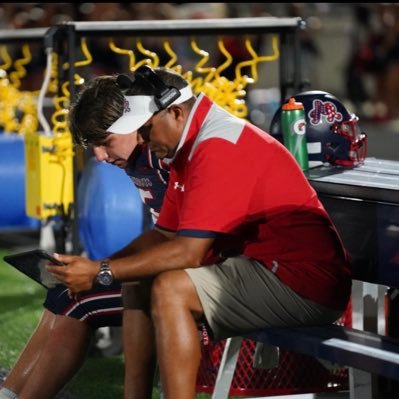
An organized practice is a productive practice. QBs, you should know the practice plan before you ever step on the field. Not so you can pace yourself, but so you understand the emphasis, the sequencing, and the intent of every period. If the team is in 3rd down mode, know the situational standard. If the period is red zone, understand you've got to quicken up and shorten up. If the plan shifts to team, special teams, or a pressure period, your job is to help the offense transition with urgency and clarity. The quarterback is an extension of the coaching staff. Alignment with the coaches allows you to reinforce tempo, communicate expectations, and help every period accomplish what it was designed to accomplish. Practice structure is not just for coaches. It is a leadership tool for the quarterback.
Nate Longshore tweet media
English
1
8
64
3.7K
Nate Longshore
Nate Longshore@mrlongshore·
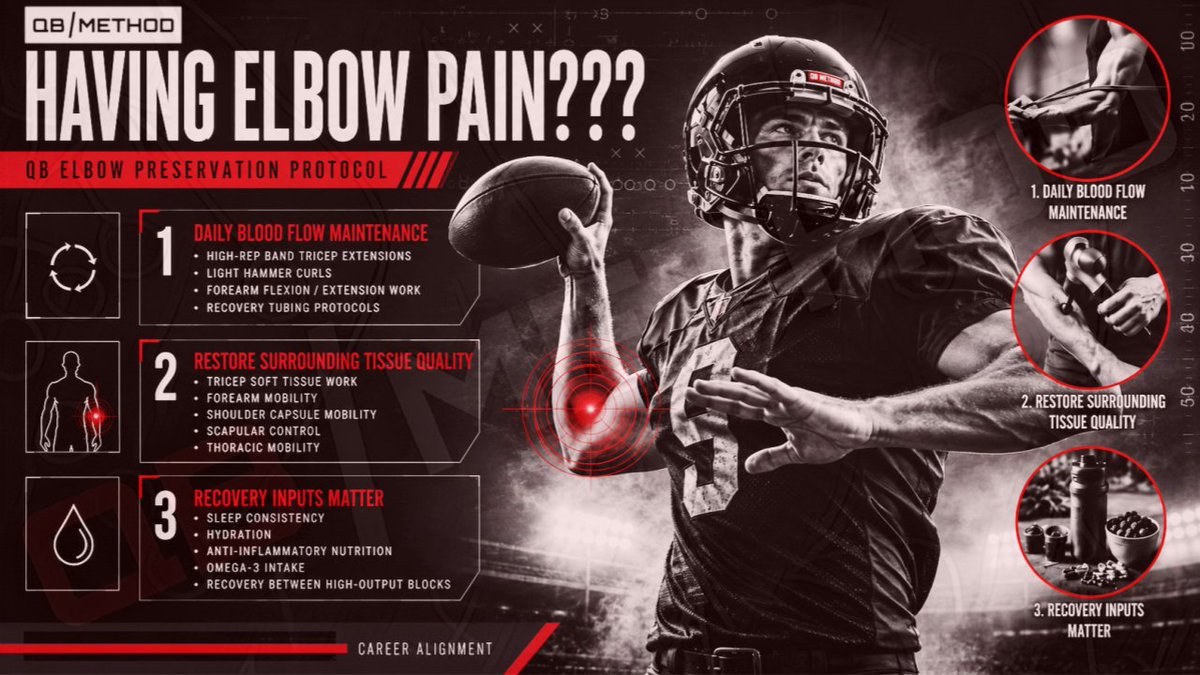
Elbow pain is rarely solved by simply throwing less. More often, it is a tissue quality, recovery, and workload management problem that has finally reached a threshold. This protocol is completely anecdotal, but after implementing many of these recovery measures years ago, largely borrowed from the powerlifting world, I personally stopped dealing with elbow pain from throwing altogether. High-rep blood flow work, restoring tissue quality around the forearm and tricep, and taking recovery inputs seriously changed the durability of my arm long term. Quarterbacks place enormous repetitive stress on the elbow through high-volume throwing. If the surrounding tissue loses quality, if the shoulder and scapular systems stop moving efficiently, or if recovery discipline erodes, force begins leaking into structures that were never meant to absorb that much repeated stress. A strong arm is not just about velocity. It is about sustainability. Daily blood flow work. Soft tissue maintenance. Scapular control. Thoracic mobility. Sleep consistency. Hydration. Anti-inflammatory nutrition. These are not flashy answers, but durability is usually built through disciplined accumulation, not shortcuts.
Nate Longshore tweet media
English
0
4
32
3.3K
Nate Longshore
Nate Longshore@mrlongshore·
Pocket movement is not about escaping first. The best quarterbacks understand how to move without destroying the structure of the play. A subtle climb, a quiet reset, or replacing the edge can be the difference between taking a sack and delivering the ball on time. The objective is not to run from color. The objective is to maintain pocket integrity, keep your throwing profile alive, and give the concept enough time to declare. When the quarterback drifts, opens the door to pressure, or loses his base, the throw usually becomes harder than it needed to be. Real pocket movement is disciplined. Move just enough to protect the throw, not so much that you abandon the read. The pocket is not always clean. Your movement still has to be.
GIF
English
2
6
43
2.3K
Nate Longshore
Nate Longshore@mrlongshore·
Cover 2 is one of the first coverages every quarterback learns, but it should not be treated like a beginner coverage. The base structure is middle open, two deep half safeties, corners responsible for the flats, and five underneath zone defenders working to shrink the intermediate windows. The QB has to understand the stress points: the hole shot outside the corner and underneath the safety, the middle weakness between the safeties, and the leverage of the Mike if the defense carries a Tampa modifier. The problem is that Cover 2 rarely stays clean. Cloud, Sky, Tampa, Trap, Palms, Mini, and Match adjustments can all change the responsibility of one defender and completely alter the picture for the quarterback. That is why coverage recognition is not just naming the shell. It is identifying the modifier, confirming rotation, and sequencing the progression with discipline. This Cover 2 install is part of the full defensive install series inside our online QB Room. DM me for details.
English
0
7
40
3.5K
Nate Longshore
Nate Longshore@mrlongshore·
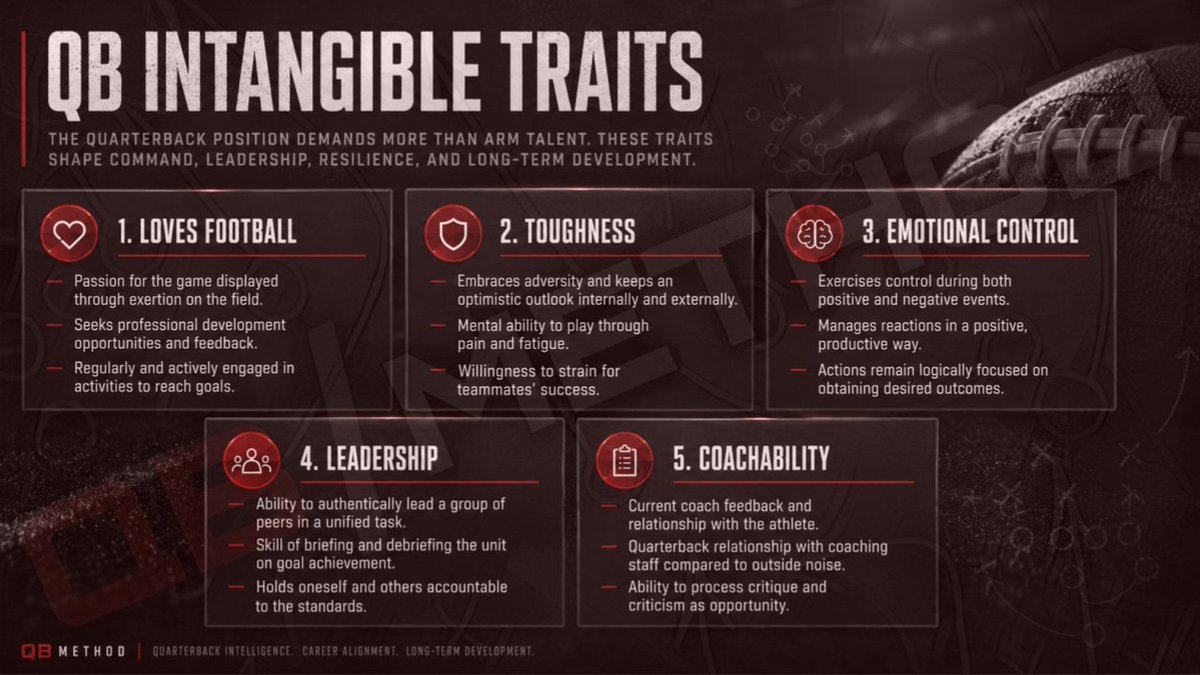
The Quarterback position demands command, and command includes the traits that show up when the play breaks, the drive gets hard, the coach corrects you, or the room needs stability. Loves Football. Football is too demanding to fake. The quarterback has to enjoy the work that does not always get attention: film study, walkthrough detail, recovery, feedback, extra throws, and constant refinement. If a QB does not truly love the game, the invisible work usually disappears first. Toughness. Toughness is not just taking a hit and getting up. It is the ability to handle adversity, strain through fatigue, keep an optimistic outlook, and still serve the teammates around you. Every season will test the quarterback’s capacity to keep operating when the situation is uncomfortable. Emotional Control. The quarterback cannot ride every possession emotionally. A touchdown, turnover, bad call, missed throw, or protection issue cannot change the command of the next huddle. The offense needs a stabilizer, not a thermometer. Leadership. Leadership has to become behavioral. Brief the unit. Debrief the mistake. Hold the standard without making everything personal. The best quarterbacks do not just demand accountability from others, they live under the same standard first. Coachability. This may be one of the clearest separators in long-term development. A quarterback who can process critique without turning it into outside noise gives himself a chance to keep improving. The coach-player relationship matters because correction is part of the position. Physical ability gets attention early. These traits determine whether development becomes durable.
Nate Longshore tweet media
English
3
33
183
15.2K
Nate Longshore
Nate Longshore@mrlongshore·
Simplified, you could describe Red 8 as a red-zone Cover 4 variation that becomes more zone-conscious and landmark based, with defenders trying to build a layered "picket fence” protecting the front line and using the backline as a defender. The defense is less concerned with defending deep so it plays physical and communication heavy.
English
0
0
3
87
Nate Longshore
Nate Longshore@mrlongshore·
The Hi Red Zone is where defensive structure becomes more intentional. Once the ball reaches the +20 to +11, defenses are not defending the whole field the same way. Space is starting to compress, but there is still enough grass for vertical throws, access throws, and intermediate concepts to matter. That creates a unique coverage problem. The trend that stands out most is the volume of Cover 4, Cover 1, and Cover 3. Cover 4 showing up as the highest average coverage in this data is worth studying. It tells you defenses want vision, bodies over the top, and the ability to match routes without immediately giving up leverage. In this part of the field, that makes sense. You are close enough to scoring territory that explosives matter, but far enough out that offenses can still stretch the defense. For coaches studying this offseason, it might be worth looking at the teams at the top of each coverage category to see whether their conviction in a specific structure creates favorable outcomes through higher rep counts. The value is not in copying the call sheet. The value is in understanding whether repeated exposure to the same coverage family creates better execution, cleaner rules, and more durable answers in the Hi Red Zone. The coaching question is not just, “What coverage do they play?” The better question is: What problem are they trying to solve at the +20 to +11, and how does that change the quarterback’s progression discipline? Hi Red Zone study should be its own offseason cut-up. Red zone compresses space and time, but the high red zone still demands full-field answers. That is where coverage structure tells the truth.
Nate Longshore tweet media
English
1
11
88
8.9K
Nate Longshore
Nate Longshore@mrlongshore·
Every offense needs a built-in emergency procedure. Not a perfect answer. Not a 400-page adjustment menu. Just a clean “protect the drive” mechanism when the defense wins the pre-snap picture. Good kill systems function like structural insurance. Pressure indicators change late, leverage distorts the concept, protection math becomes unstable, or the quarterback simply does not like the picture. Instead of forcing a bad call into a bad look, the offense defaults to something simple, repeatable, and low-risk that everyone can execute under compression. The best part is that it does not need to be complicated. A protected Inside Zone. A universal hitch concept. A formation-based access throw. Something the quarterback can deploy quickly with minimal communication strain while cadence and operation stay intact. The goal is not finding the perfect play. The goal is avoiding disaster. Too many offenses spend all their time building explosive answers while neglecting emergency structure. But sometimes the highest-level quarterbacking decision is recognizing when the original concept no longer fits the situation and calmly getting the offense to the next snap. Protect the drive first. Then go hunt explosives later.
Nate Longshore tweet media
English
0
5
53
5.2K