Sabitlenmiş Tweet

"Isn't $LMND just another insurtech?"
This chart can lay that argument to rest.
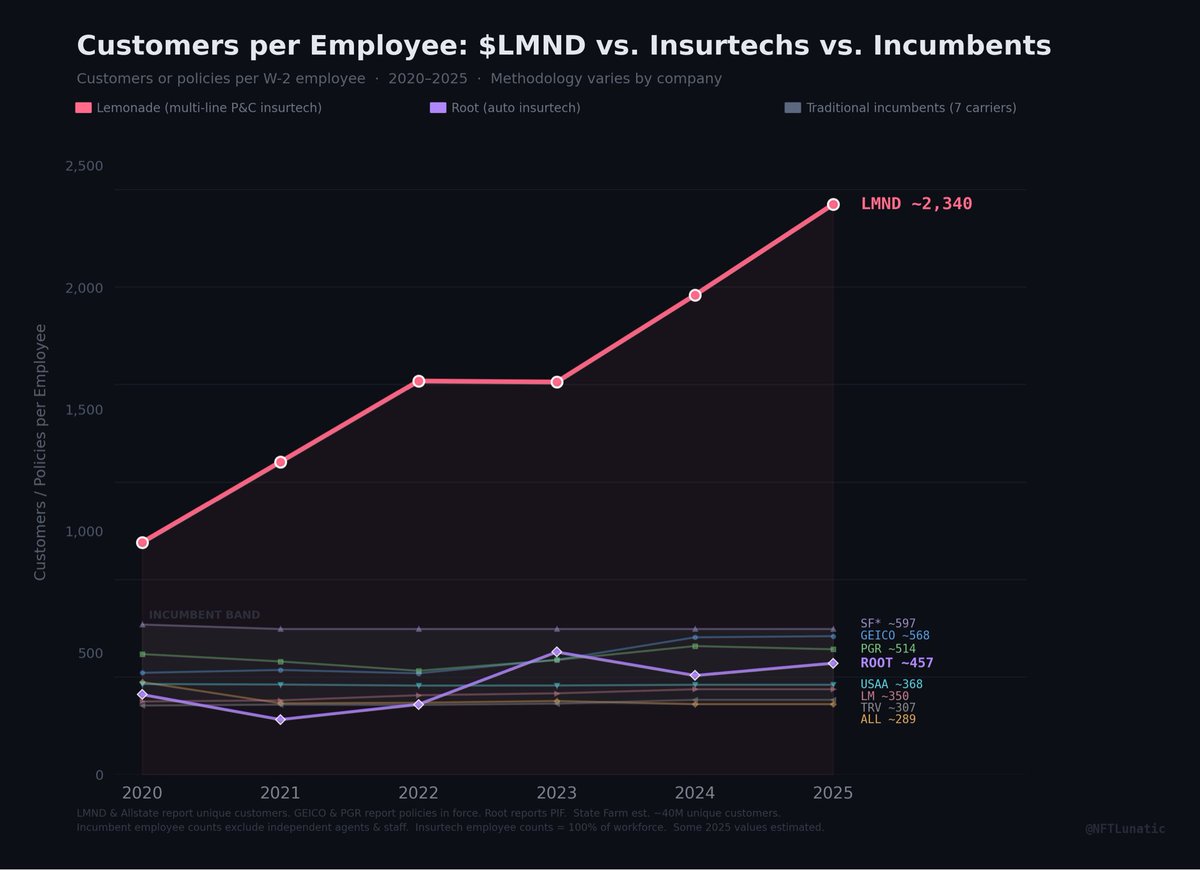
Customers per employee, 2020–2025:
$LMND vs. $ROOT vs. 7 major incumbents.
$ROOT is the perfect test case. Same era. Same "insurtech" label. Same direct-to-consumer P&C model. Public company with clean data.
$ROOT at 457 customers per employee.
GEICO at 568.
Progressive at 514.
Root IS the incumbent band.
Why? $ROOT innovation was telematics — better pricing through driving data. That helped them reach profitability. But it didn't change how many humans they need to operate.
Root hired 341 people last year to add 73K policies. $LMND hired 47 to add 570K.
That's not a difference of degree. It's a difference of kind.
$LMND didn't just digitize the front end. AI Maya underwrites. AI Jim handles claims. The marginal customer costs almost nothing to serve.
$ROOT used tech to price better. $LMND used AI to run the company.
That's why one curve compounds and the other flatlines.
This also kills the bear argument that competitors will "just copy $LMND playbook."
$ROOT has been trying for 9 years. Backed by $1.2B+ in funding. Public since 2020. Building technology from scratch with no legacy constraints.
And they still ended up in the incumbent band.
If a well-funded, tech-native insurtech with zero legacy baggage can't replicate this efficiency curve, what makes anyone think State Farm or Allstate will?
$LMND AI-first architecture isn't a feature. It's a compound advantage that gets harder to replicate every quarter — because every new customer, claim, and interaction feeds the models that make the next one cheaper to serve.
The moat isn’t JUST the AI operating system running the company. It’s 3 million customers (and growing) training the AI.
English