Ibn Musashi

41.5K posts

Ibn Musashi banner
Ibn Musashi

Ibn Musashi

@Musashi0x

“Just don't die. And if you survive, you’ll have no choice, but to make it” - @degenspartan

Katılım Ekim 2010
5.2K Takip Edilen612 Takipçiler
Ibn Musashi retweetledi
The Assembly
The Assembly@InTheAssembly·
Jensen Huang, Nvidia’s CEO, just told you where to invest in 2026.
English
138
502
6.8K
697.2K
Ibn Musashi retweetledi
Noah
Noah@antibearthesis·
$NVDA CEO is telling you to buy energy stocks He is literally saying demand will 1000x Stocks positioned to benefit: - $CEG - $VST - $OKLO - $BE - $GEV - $IREN​​​​​​​​​​​​​​​​​​​​​​​​​​​​​​​​​​​​​​​​​​​ “This is the best time in the history of humanity to invest in sustainable energy” In 2025, he was early on semis and neoclouds: - $NBIS at $22 → +600% - $INTC at $23 → +500% - $SNDK at $275 → +400% - $CRWV at $40 → +200% - $TSM at $240 → +80% He’s not guessing. He’s showing you the roadmap. Are you going to ignore him again?
English
163
844
6.3K
610.8K
Ibn Musashi retweetledi
SensaMarket
SensaMarket@sensa_market·
50 AI Stocks
SensaMarket tweet media
English
1
97
468
15.9K
Ibn Musashi retweetledi
Ben Pouladian
Ben Pouladian@benitoz·
I read a lot of Peter Lynch. Met him once. The one rule I carry into tech investing is the most boring one he ever wrote, know what you own, down to the physics if the position demands it. For me that has meant living inside NVIDIA's stack for years, and pulling apart the alternatives next to it, Trainium, the TPU, every serious accelerator someone is willing to tape out against Jensen. I was also an early investor in Mellanox, the networking company NVIDIA bought to own the switched fabric the entire scale up era now runs on. So when the conversation turns to networking as the real moat, this is not theory to me. It is a position I watched become the thesis. You do not understand what you own until you understand what could take it. @GavinSBaker at @SohnIdeaContest just gave the most physically grounded read on AI infrastructure I have heard this cycle, and it is a Lynch lesson in disguise. The reframe that matters: The last terrestrial mega data center may already be on someone's drawing board. Everything else follows from two constraints, watts and wafers, and Gavin walks both down to first principles. That is the work. Most people are pricing the narrative. Lynch would have asked what the thing actually is. 1. TSMC is the global rate limiter Jensen reportedly visits every quarter asking to double or triple leading edge capacity. TSMC expands at roughly 5 percent. A handful of disciplined operators in Taiwan are the physical governor on the entire AI buildout. This is the part the bubble crowd misses. The constraint is not demand and it is not capital. It is one fab's deliberate refusal to overbuild. That stretches the cycle longer and smoother instead of bubble and bust. It reads like the mid 1990s capacity cycle, not a standard 25 year memory peak where a 60 to 70 percent price spike would be your signal to cut the weed and walk. I have held NVIDIA since 2016 for exactly this reason. Owning it meant understanding it. The thesis was never the chip. It was the chokepoint. 2. The most underestimated silicon is Trainium Consensus is still pricing a one horse race. Gavin's sharpest non NVIDIA call is AWS Trainium, specifically Trainium 3 ramping in the back half of 2026. Here is the part that took me a while to internalize from studying these architectures side by side. As frontier models go fully Mixture of Experts, inference stops being a matmul problem and becomes a networking problem. You need a switched scale up fabric, not just fast chips. Today two organizations on earth have a working one. NVIDIA and Amazon. NVIDIA's came from Mellanox, which is the whole reason I sized that position the way I did years ago, the bet was always that networking would decide this, not raw flops. The TPU is formidable in its own lane, but the scale up fabric is the moat people are not modeling, and it is why I track every accelerator, not just the one I own. 3. The neocloud moat is operational, not arbitrage The lazy take is that CoreWeave and Crusoe are just renting hyperscaler slack. Gavin's counter is that running dense GPU clusters is like driving an F1 car. Looks easy until you try it. Top tier neoclouds run 2 to 3x the hardware utilization per hour of lower tier providers. That is an execution and inventory moat, and it compounds. 4. The structural short nobody is pricing Watts and wafers eventually force the buildout off the planet. Gavin expects orbital data infrastructure to prove technical and economic viability within roughly two years and take meaningful share by the end of the decade. Space solves power with unattenuated solar and solves cooling with massive radiators in the satellite's own shadow. Dense single rack nodes stitched together with lasers into a virtual hyperscale cluster in orbit. The unpriced risk is everything that over expanded to serve a terrestrial buildout. Cooling, power, industrial equipment names sized for a curve that may bend down within seven years. The whole interview is a lesson in pattern recognition over narrative. Lynch built a career on retail investors knowing their companies better than Wall Street did. The same edge exists in AI infrastructure right now, it just requires you to understand watts and wafers instead of same store sales. If you are not modeling the physical boundaries of the stack through the lens of history, you are not underwriting the position. You are following it.
English
27
65
602
88.3K
Ibn Musashi retweetledi
BookNote
BookNote@BookNoteApp·
9 books that will teach you more than 3 years of university: 1) Skin in the Game by Nassim Taleb
BookNote tweet media
English
15
398
2.7K
391.7K
Ibn Musashi retweetledi
Bilaal- BD investing
Bilaal- BD investing@bdinvestingg·
Photonics value chain in 5 layers. The companies building AI’s optical backbone. $AXTI – Compound semiconductor substrates. Small, cyclical AI photonics supplier. $AAOI – Optical transceivers for AI data centers. High risk, high upside. $LITE – Diversified photonics. Stable, slower growth than AAOI. $ASML – Only maker of EUV lithography machines. Irreplaceable monopoly. $ONTO – Semiconductor inspection/metrology tools. Smaller KLAC alternative.
Bilaal- BD investing tweet media
English
22
111
531
109.7K
Ibn Musashi retweetledi
Investing visuals
Investing visuals@InvestingVisual·
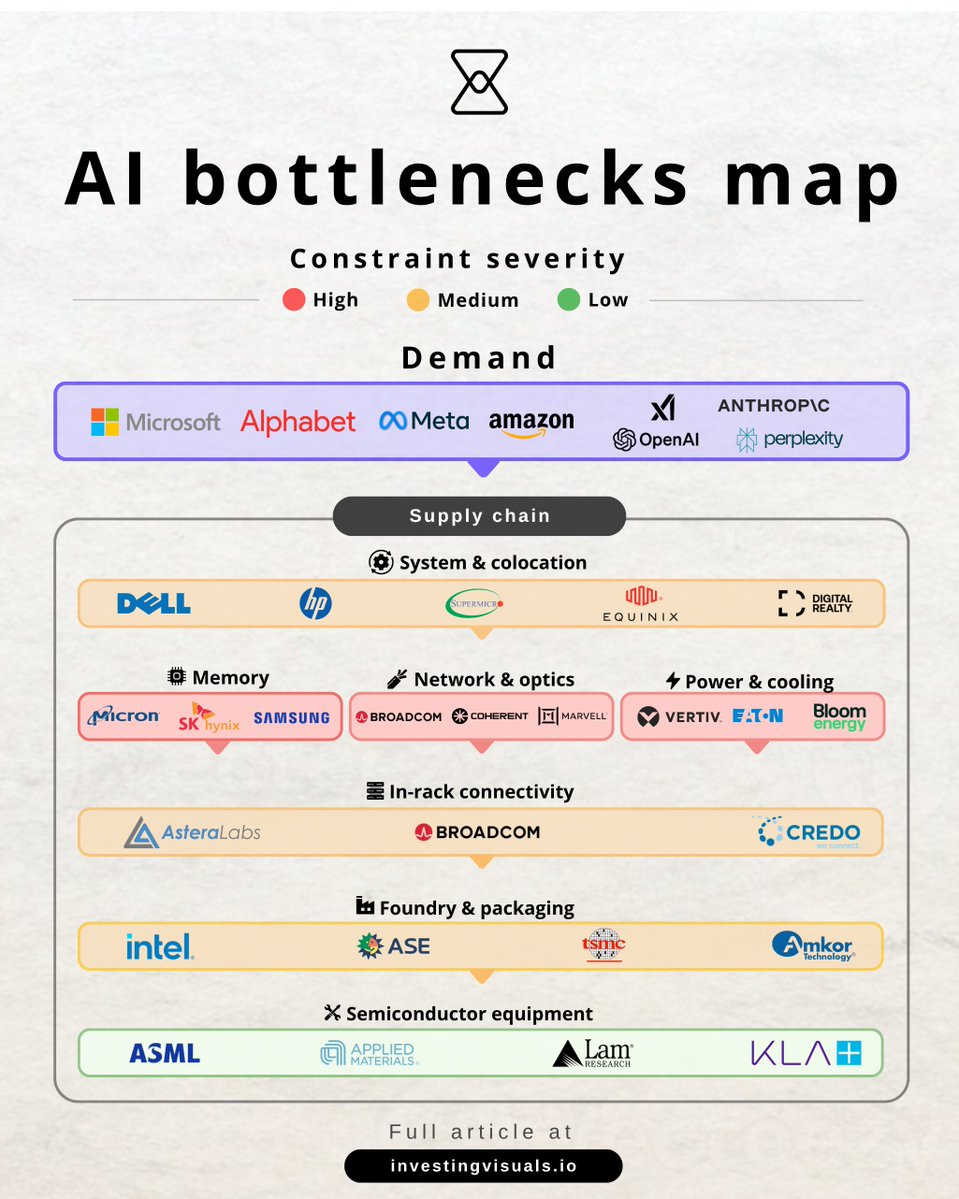
The AI data center bottlenecks map & key players: Demand: • $MSFT • $GOOGL • $META • $AMZN • Leading LLM providers Layer 1 - Systems & colocation: • $DELL • $HPQ • $SMCI • $EQIX • $DLR Layer 2A - Memory: • $MU • $HYNSE • $SMSD Layer 2B - Networking & optics: • $AVGO • $COHR • $MRVL Layer 2C - Power & cooling: • $VRT • $ETN • $BE Layer 3 - In-rack connectivity: • $AVGO • $ALAB • $CRDO Layer 4 - Foundry & packaging: • $INTC • $ASX • $TSM • $AMCR Layer 5 - Semiconductor equipment: • $ASML • $AMAT • $LRCX • $KLAC Note that this isn't an exhaustive list, but rather an overview of the most important businesses per segment. I hope you found this breakdown insightful! I've covered the supply chain in more detail in the article linked below.
Investing visuals tweet media
Investing visuals@InvestingVisual

I just published my latest research article: The AI data center bottlenecks map, covering: • The AI supply chain • The key players at critical bottlenecks • Where to look as constraints move down the supply chain I loved diving into this over the past few weeks with the goal of fully understanding the dynamics of the AI data center buildout and (of course) visualize it. I focused particularly on businesses operating at critical bottlenecks such as memory, connectivity, and cooling. It’s the type of research I wish I’d done two years ago to spot winners like $MU and $LITE earlier. But as long as demand remains insatiable, constraints will simply move to other parts of the supply chain, creating great opportunities if you know where to look👇 investingvisuals.io/ai-data-center…

English
19
125
476
69.1K
Ibn Musashi retweetledi
Rallies
Rallies@ralliesai·
HOWARD MARKS' OAKTREE CAPITAL JUST UPDATED THEIR PORTFOLIO Here's a full deep dive on every move they made in Q1 2026: Top 10 equity holdings: 🥇 Torm PLC $TRMD: $675M 🥈 Expand Energy $CHK: $575M 🥉 AngloGold Ashanti $AU: $314M 4. Garrett Motion $GTX: $265M 5. Telephone and Data Systems $TDS: $181M 6. Viper Energy $VNOM: $178M 7. Core Scientific $CORZ: $140M 8. SunOpta $STKL: $134M 9. Petrobras $PBR: $126M (NEW) 10. Barrick Mining $B: $107M New positions: - $QQQ puts: $329M (Nasdaq hedge) - $XOP puts: $182M (oil & gas hedge) - Petrobras $PBR: $126M - Coinbase convertible: $52M - Credo Technology $CRDO: $51M - YPF: $41M - $LYB puts: $40M - Embraer: $27M - NRG Energy $NRG: $7M Biggest adds: - American Water Capital convertible: +1,532% - Bentley Systems convertible: +598% - Trip .com convertible: +538% - Unity Software convertible: +296% - Strategy convertible: +110% - Block convertible: +85% - DraftKings convertible: +76% - Okta convertible: +66% - Telephone and Data Systems $TDS: +16% shares - Core Scientific $CORZ: +13% shares Biggest trims: - Alvotech $ALVO: -82% - CEMEX: -52% - Ecovyst $ECVT: -44% - Nokia $NOK: -40% - Viper Energy $VNOM: -40% - Telecom Argentina $TEO: -31% - AngloGold Ashanti $AU: -16% - Garrett Motion $GTX: -15% - Torm PLC $TRMD: -10% shares (still #1 by value due to price gain) Full exits: - $SMH puts: $312M (closed semi hedge) - $SPY puts: $263M (closed broad market hedge) - Indivior $INDV.L: $255M (re-listed as $ASRT in US) - FTAI Aviation $FTAI: $102M - $ORCL puts: $97M - Nu Holdings $NU: $75M - Cable One convertible: $58M - Grab Holdings $GRAB: $56M - Airbnb convertible: $50M - $MAR puts: $47M The rotation: out of broad market and semis. Into concentrated bearish bets on the Nasdaq and oil & gas sector specifically.
Rallies tweet media
English
1
1
4
1.3K
Ibn Musashi retweetledi
Evan
Evan@StockMKTNewz·
HOWARD MARKS AND OAKTREE CAPITAL JUST UPDATED THEIR $4 BILLION PORTFOLIO This is what Howard Marks owned as of the end of Q1 2026 TORM $TRMD: $757.6M Expand Energy $EXE: $503.0M Garrett Motion $GTX: $461.0M AngloGold Ashanti $AU: $312.8M Core Scientific $CORZ: $229.8M Viper Energy $VNOM: $181.0M Telephone and Data Systems $TDS: $178.0M Nokia $NOK: $157.2M SunOpta $STKL: $134.7M Petroleo Brasileiro $PBR: $120.8M Talen Energy $TLN: $115.0M Barrick $B: $110.5M CBL & Associates $CBL: $99.4M Itau Unibanco $ITUB: $97.9M Liberty Global $LBTYA: $97.1M Credo Technology $CRDO: $96.3M TransAlta $TAC: $84.2M Freeport-McMoran $FCX: $77.4M Kilroy Realty $KRC: $65.7M Grupo Aeromexico $AERO: $59.6M XP Inc $XP: $56.5M Bausch + Lomb $BLCO: $54.1M Runway Growth Finance $RWAY: $46.8M Liberty Latin America $LILAK: $44.4M YPF Sociedad Anonima $YPF: $39.3M Array Digital Infrastructure $AD: $36.9M Cemex $CX: $35.7M Ecovyst $ECVT: $34.7M Embraer $EMBJ: $26.2M Ternium $TX: $25.6M Rice Acquisition 3 $KRSP: $24.9M Oaktree Specialty Lending $OCSL: $22.2M Telecom Argentina $TEO: $20.1M Simply Good Foods $SMPL: $13.0M Magnachip Semiconductor $MX: $12.1M SmartRent $SMRT: $8.7M Battalion Oil $BATL: $6.6M NRG Energy $NRG: $6.6M Optimum Communications $OPTU: $6.5M Liberty Latin America A $LILA: $6.3M Asertio Holdings $ASRT $5M Invesco Senior Loan ETF $BKLN: $4.1M HDFC Bank $HDB: $2.8M PDD Holdings $PDD: $459K Alvotech $ALVO: $333K BioXcel Therapeutics $BTAI: $289K (Source @ralliesai)
Evan tweet mediaEvan tweet media
English
25
40
407
78.7K
Ibn Musashi retweetledi
The Assembly
The Assembly@InTheAssembly·
Renaissance Technologies just dropped their Q1 2026 13F. – $63.9 billion portfolio – 3,213 individual positions The most successful quant fund in history just rotated AGGRESSIVELY this quarter. Here is exactly what they bought and sold:
English
35
39
846
330.9K
Ibn Musashi retweetledi
Mark
Mark@MajidTulsh32058·
These 10 stocks are on the verge of major breakouts — rich before 2030: 1. Caterpillar - $CAT 2. Deere - $DE 3. Eaton - $ETN 4. Cummins - $CMI 5. Rockwell Automation - $ROK 6. Honeywell - $HON 7. Siemens - $SIEGY 8. ABB - $ABBNY 9. Emerson - $EMR 10. PTC - $PTC
Mark tweet media
English
1
140
736
42K
Ibn Musashi retweetledi
Chamath Palihapitiya
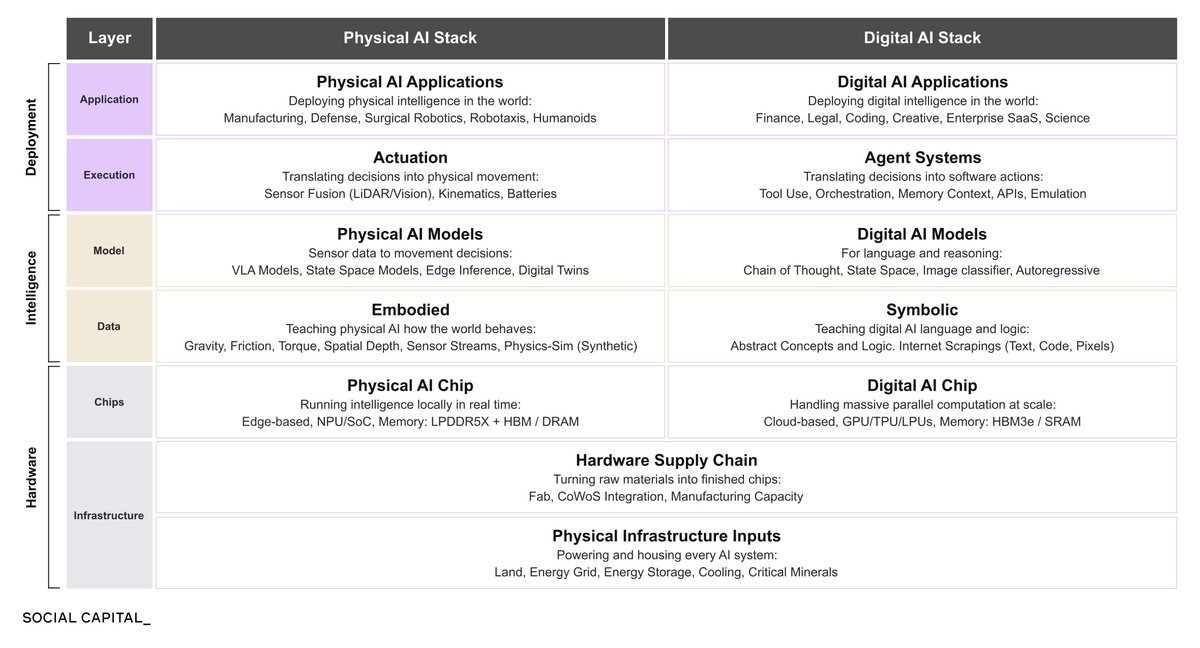
A framework to understand how value accrues across the AI stack. This is a blueprint for understanding what builds AI into its pragmatic parts: what each layer is, where it ends, and where value is accrued. So here’s how you can think about it: 1. Layer 1 - Infrastructure Before any AI model trains or any robot moves, an industrial foundation must exist. Land, energy grids, cooling systems, critical minerals, and fabrication facilities. Infrastructure is the constraint that all the other layers depend on. 2. Layer 2 - Chips Transistors that are etched onto silicon wafers using extreme ultraviolet light. This is what allows both physical and digital AI to take an input, process it, and return a predictive output. The more transistors that fit on a chip, the more computation it can perform. 3. Layer 3 - Data Both digital and physical models train on data. Digital models train on text, code, and images; physical models train on gravity, friction, depth, and sensor streams. The more accurate the data, the more accurate the output. 4. Layer 4 - Models A model is a system that learns from examples. Feed it enough examples of inputs paired with correct outputs, and it adjusts its internal structure until it can predict correct outputs on inputs it has never seen before. LLMs represent a specific class trained on text. They learn by processing billions of examples of human language, developing the ability to write, reason, summarize, and generate code. 5. Layer 5 - Execution This is what lets models take actions on behalf of users. The execution layer lets models pursue objectives through sequential action: observing the environment, reasoning about the next step, acting, and looping until the goal is reached. 6. Layer 6 - Application All of the AI Stack’s revenue originates at the application layer, then goes to the layers below. Every dollar paid for AI is paid for an outcome, a task completed, and an answer delivered. Nobody wants H100s for their own sake. They want H100s because someone, somewhere, wants to run an application. These are the different layers that make up the entire ecosystem of AI. We did a full study on the AI stack. If you want to read about it, head over to my Substack (chamath.substack.com/p/the-ai-stack)
Chamath Palihapitiya tweet media
English
100
222
1.6K
155.5K
Ibn Musashi retweetledi
Sergey
Sergey@SergeyCYW·
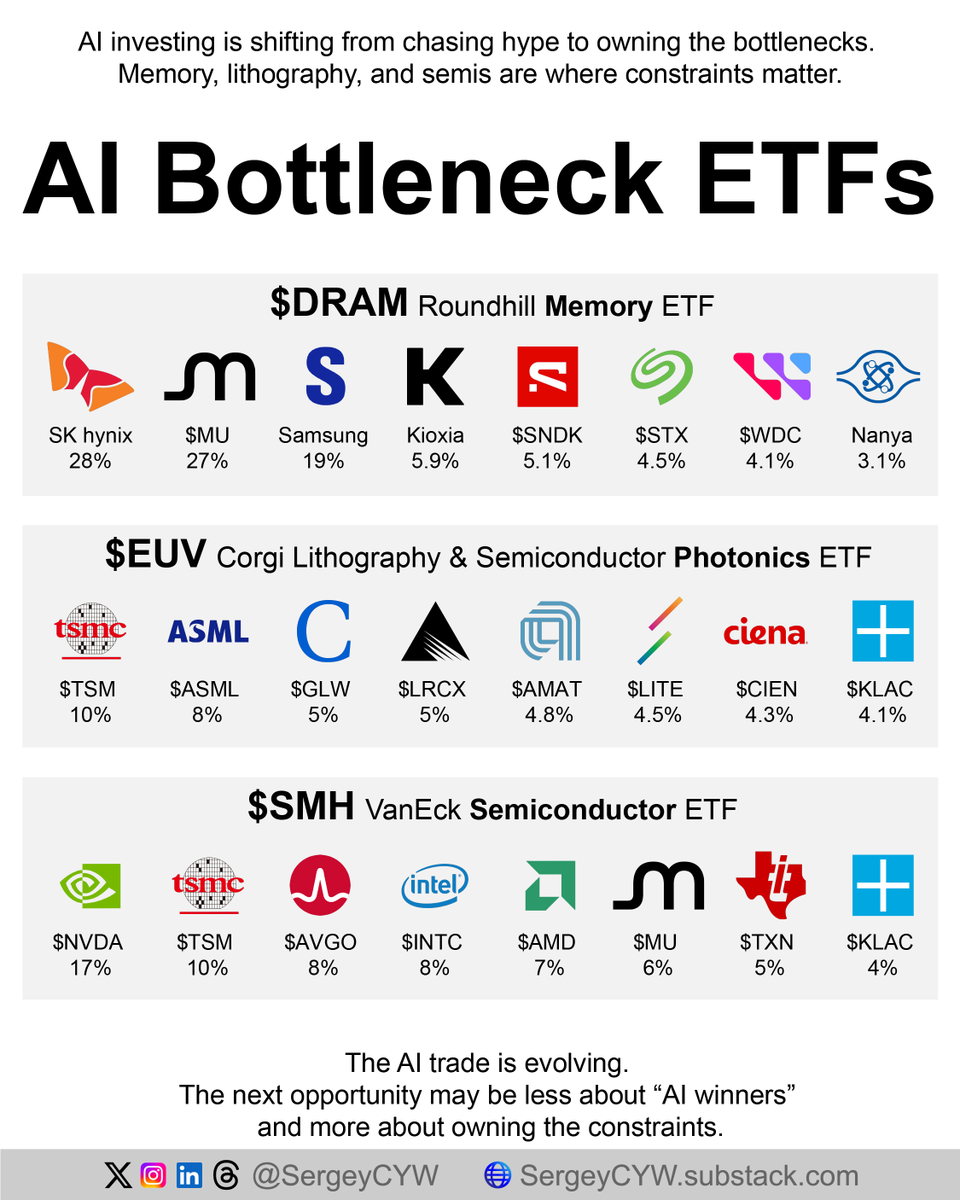
Three ETFs Targeting the Next AI Infrastructure Bottlenecks The first wave: own the obvious AI leaders. But investors may now need to ask where the bottlenecks are forming. Three ETFs offer a useful framework for this shift: SMH, DRAM, and EUV. Each targets a different layer of the AI infrastructure chain. SMH gives broad semiconductor exposure, DRAM isolates the memory bottleneck, and EUV targets lithography, photonics, and optical infrastructure. SMH is the most institutionalized option. It provides exposure to large semiconductor and semiconductor-equipment companies rather than one narrow choke point. Key holdings include $NVDA at 17%, $TSM at 10%, $AVGO at 8%, $INTC at 8%, $AMD at 7%, $MU at 6%, $TXN at 5%, and $KLAC at 4%. This makes SMH the most natural core holding of the group for investors who want exposure to the full AI hardware stack. It covers GPUs, foundries, custom silicon, CPUs, memory, analog chips, and semiconductor manufacturing tools. The trade-off is lower purity. SMH is not a single bottleneck bet. It is a broad semiconductor ecosystem bet. DRAM is more targeted. It is designed around the AI memory squeeze, with exposure to HBM, DRAM, NAND, and storage demand. The fund is highly concentrated. Its largest positions are SK Hynix at 28.15%, $MU at 27.16%, and Samsung at 19.67%. Together, these companies dominate the global memory supply chain. Smaller holdings such as Kioxia, $SNDK, $STX, $WDC, Nanya, and Winbond add exposure across NAND, SSDs, HDDs, and specialty memory. DRAM is arguably the cleanest expression of the AI memory bottleneck. It is also more momentum-driven and concentrated than SMH, with a higher 0.65% expense ratio. EUV is the most specialized and higher-risk ETF in the group. It focuses on the “light layer” of AI infrastructure: photonics, EUV lithography, optical networking, semiconductor inspection, and precision manufacturing tools. Holdings include $TSM at 9.52%, $ASML at 7.97%, $GLW at 5.19%, $LRCX at 4.98%, $AMAT at 4.84%, $LITE at 4.46%, $CIEN at 4.32%, and $KLAC at 4.07%. AI data centers increasingly face limits around power, bandwidth, packaging, and interconnect speed. Photonics and advanced lithography may become critical as compute demand scales. Framework: SMH = core AI semiconductor exposure DRAM = memory bandwidth and capacity bottleneck EUV = lithography, photonics, and optical infrastructure bottleneck
Sergey tweet media
English
20
185
890
57.8K
Ibn Musashi retweetledi
Lin
Lin@Speculator_io·
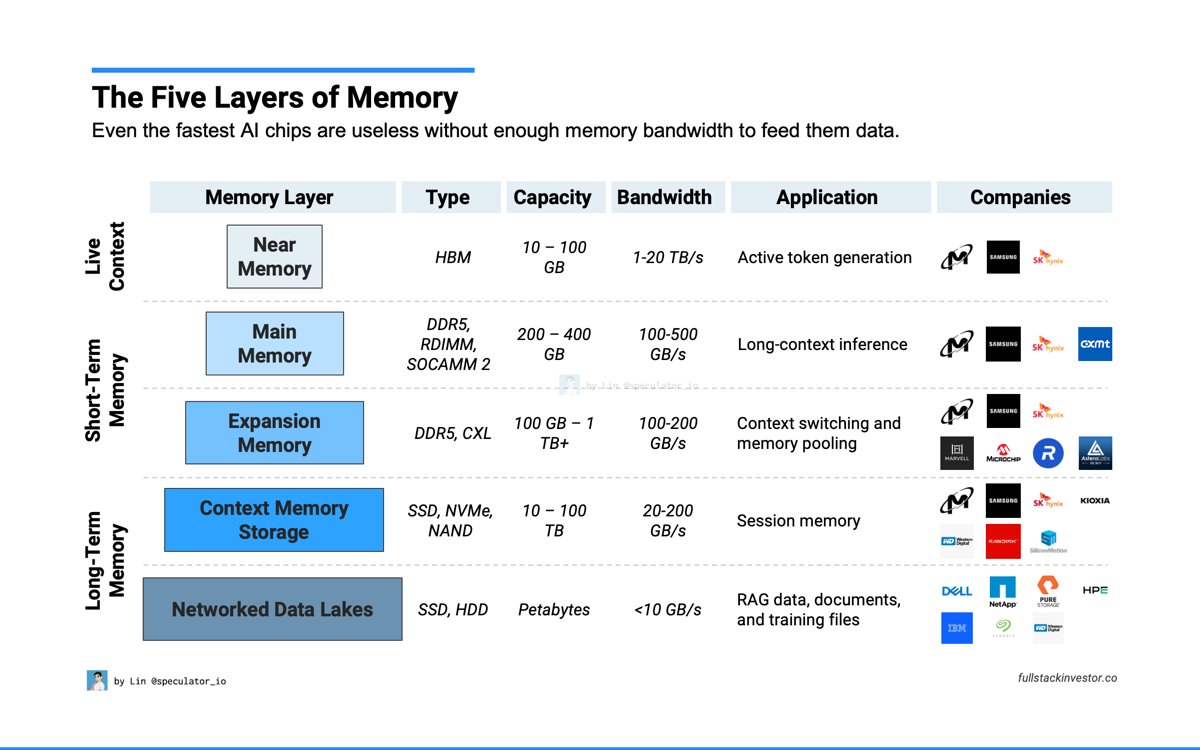
The Five Layers of Memory 1. Near Memory: Sk hynix, Samsung $MU 2. Main Memory: Sk hynix, Samsung, CMXT $MU 3. Expansion Memory: SK hynix, Samsung $MU $ALAB $MRVL $MCHP $RMBS 4. Contexted Memory: SK hynix, Samsung, Kioxia $MU $WDC $SNDK $SIMO 5. Data Lakes: $STX $WDC $DELL $NTAP $P $HPE $IBM
Lin tweet media
English
48
185
895
76.3K
Ibn Musashi retweetledi
Muhammad Ayan
Muhammad Ayan@socialwithaayan·
50 WEBSITES GOOGLE DOESN'T WANT YOU TO KNOW 1. 12ft. io — bypass any paywall 2. libgen. is — millions of free textbooks 3. sci-hub. se — free research papers 4. alternativeto. net — find free app alternatives 5. justwatch. com — find where to stream anything 6. archive. org — access any old webpage ever 7. gutenberg. org — 70K free classic books 8. pdfdrive. com — free PDF downloads 9. openculture. com — free courses from top unis 10. wolframalpha. com — solve any math instantly 11. photopea. com — free Photoshop in browser 12. squoosh. app — compress any image free 13. remove. bg — remove image backgrounds free 14. cleanup. pictures — erase objects from photos 15. unscreen. com — remove video backgrounds 16. carbon. now. sh — turn code into art 17. ray. so — beautiful code screenshots 18. shots. so — free product mockups 19. smartmockups. com — mockups without Photoshop 20. haveibeenpwned. com — check if you were hacked 21. virustotal. com — scan any file for malware 22. privnote. com — send self destructing messages 23. temp-mail. org — disposable email instantly 24. file. io — share files that auto delete 25. archive. ph — save any webpage forever 26. similarsites. com — find any site alternatives 27. radio. garden — listen to any radio worldwide 28. everynoise. com — explore every music genre 29. tunefind. com — find songs from any show 30. musicforprogramming. net — music to focus with 31. mynoise. net — custom focus soundscapes 32. coffitivity. com — cafe sounds for productivity 33. elicit. org — AI research paper assistant 34. consensus. app — search what science agrees on 35. connectedpapers. com — map research visually 36. semanticscholar. org — free academic search 37. scispace. com — understand any research paper 38. summarize. tech — summarize any YouTube video 39. phind. com — AI search for developers 40. regex101. com — test any regex instantly 41. codebeautify. org — format any code cleanly 42. jsonformatter. org — read JSON like a human 43. explainshell. com — understand terminal commands 44. raindrop. io — bookmark manager that works 45. downdetector. com — check if any site is down 46. tineye. com — reverse image search 47. fast. com — check your internet speed 48. smallpdf. com — edit PDFs free 49. ilovepdf. com — merge and split PDFs 50. 10minutemail. com — temp email in seconds The internet is bigger than Google shows you. Most people never leave the first page.
Muhammad Ayan tweet mediaMuhammad Ayan tweet mediaMuhammad Ayan tweet mediaMuhammad Ayan tweet media
English
160
4.6K
15K
701.8K
Ibn Musashi retweetledi
Jason Luongo
Jason Luongo@JasonL_Capital·
10 stocks within the AI infrastructure stack that you need to be aware of: 1. Power - $BE 2. Chips - $NVDA 3. Memory - $MU 4. Optics - $LITE 5. Cooling - $VRT 6. Photonics - $AAOI 7. Networking - $ANET 8. Substrates - $AXTI 9. Data Centers - $IREN 10. Hyperscalers - $AMZN Power, compute, networking, cooling, and photonics all play a critical role in the AI buildout.
English
33
156
744
63.2K
Ibn Musashi retweetledi
Roan
Roan@RohOnChain·
The secret of Hedge Funds is revealed in a 17 page PDF. Stanford released the complete Hidden Markov Model framework that quants at firms like Jane Street & Two Sigma are known to use & released it for free. Bookmark this & read the article below before someone takes it down.
Roan tweet media
Roan@RohOnChain

x.com/i/article/2053…

English
44
460
2.5K
252.2K