NCIL

46 posts

NCIL

NCIL

@NCILab

The NeuroCognitive Imaging Lab (NCIL) is devoted to improving quality of life through brain research.

Dalhousie University Katılım Ekim 2010
23 Takip Edilen25 Takipçiler
NCIL
NCIL@NCILab·
His primary research interests include brain-computer interfaces, machine learning, and neural data science. Danny loves chatting about research and brainstorming ideas, so feel free to reach out if you'd like to talk nerdy.
English
0
0
2
0
NCIL
NCIL@NCILab·
This week’s #LabMemberOfTheWeek is Daniel Godfrey! Danny was born at a very early age. Then he became a graphic designer, a salsa dance teacher, and a martial artist. Now he's a sailor, a Python coder, and a Master's student of Experimental Psychology.
NCIL tweet media
English
1
1
3
0
NCIL
NCIL@NCILab·
and multivariate analyses to investigate how human speech affects memory formation and retrieval.
NCIL tweet media
English
0
0
2
0
NCIL
NCIL@NCILab·
This week’s #LabMemberOfTheWeek is Lyam Bailey! Lyam is an international PhD student from Wales, UK. He completed a BSc in Psychology at Bangor University, before joining NCIL and completing an MSc in Psychology and Neuroscience. Lyam's current work primarily involves using fMRI
English
1
1
2
0
NCIL
NCIL@NCILab·
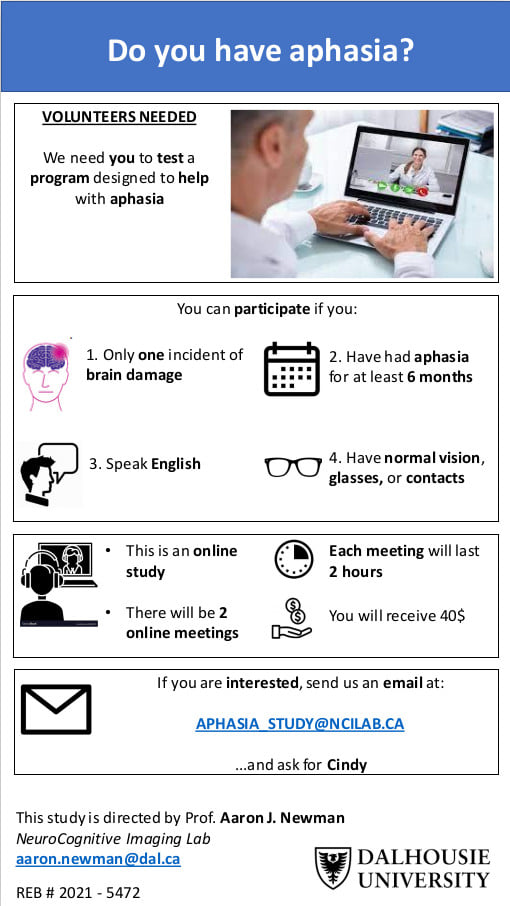
We will ask you to try a computer program we developed to help with aphasia, and then ask your opinion about how we can improve the program.
English
0
0
2
0
NCIL
NCIL@NCILab·
The current study is another step towards NCIL's goal of developing effective at-home tools to help people. Each person with aphasia will need a partner to help with participation in this study.
English
1
0
2
0
NCIL
NCIL@NCILab·
The NeuroCognitive Imaging Lab (NCIL) is inviting people with #aphasia to participate in a study. Aphasia is a language disorder caused by stroke or other brain injury. It's very challenging to recover from, and requires lots of practice.
NCIL tweet media
English
1
1
2
0
NCIL
NCIL@NCILab·
recovery of brain function after stroke or brain injury. The central theme of Francesco's work is developing and testing a novel computer-based therapy for aphasia.
English
0
0
2
0
NCIL
NCIL@NCILab·
This week’s #LabMemberOfTheWeek is Francesco Usai! Francesco is enrolled in the Psychology/Neuroscience PhD program. His main interest is the study of language disorders, along with innovative and more effective techniques to promote...
NCIL tweet media
English
1
1
2
0
NCIL
NCIL@NCILab·
She is a member of the teaching team for the Science and Technology Innovation, Commercialization and Entrepreneurship class taught through the SURGE Sandbox and plays roller derby in her spare time.
English
0
0
2
0
NCIL
NCIL@NCILab·
As a PhD student, her work focuses on auditory language processing in congenitally blind adults and the role of the visual cortex in the language system.
English
1
0
3
0
NCIL
NCIL@NCILab·
This week’s #LabMemberOfTheWeek is Kiera O’Neil! Originally from Winnipeg, Kiera came to NCIL to do her MSc. in Neuroscience, investigating the impact of game-based training strategies on adult second learning outcomes and brain function.
NCIL tweet media
English
1
1
2
0
NCIL
NCIL@NCILab·
I will illustrate the process and its advantages in the context of an ERP study of sentence processing. This will be a rather technical topic, but I'll do my best to make it accessible while at the same time geeking out on some hard-core science!
English
0
0
2
0
NCIL
NCIL@NCILab·
Message from Dr. Newman: I will cover Phillip Alday's 2019 paper, How much baseline correction do we need in ERP research? Extended GLM model can replace baseline correction while lifting its limits, and talk about its relevance to language studies.
English
1
0
2
0
NCIL
NCIL@NCILab·
Presentation Title: "Considering the baseline in ERP analysis: Why and how" When: Friday - June 25, 2021 at 12:30pm Where: via Microsoft Teams (teams.microsoft.com/l/meetup-join/…) Presented by: Dr. Aaron Newman
NCIL tweet media
English
1
1
2
0
NCIL
NCIL@NCILab·
widespread adoption. In this session, we will discuss challenges facing BCI and dig into a recent research contribution by Demazure et al. (2021), which takes interesting steps towards applying BCI to solve real-world problems.
English
0
0
2
0
NCIL
NCIL@NCILab·
Description: Brain-computer interfaces (BCIs) offer the promise of a new type of capability: the ability for humans to control information technologies using brain signals alone. However, limitations in non-invasive BCIs have so far prevented this technology from achieving...
English
1
0
2
0
NCIL
NCIL@NCILab·
Presentation Title: Brain-Computer Interfaces Pt. 3: Can BCI be used outside the lab? When: Friday - June 18, 2021 at 12:30pm Where: via Microsoft Teams (teams.microsoft.com/l/meetup-join/…) Presented by: Dr. Colin Conrad (Assistant Prof in Information Management and valued member of NCIL!)
NCIL tweet media
English
1
1
2
0
NCIL
NCIL@NCILab·
IN doing so, she seized opportunities to learn new research skills. In her downtime, Cindy is writing about empathy and loves hiking with Kelsey. She’s looking forward to the return of research in the lab and collaborating in person with her lab mates at NCIL.
English
0
0
2
0
NCIL
NCIL@NCILab·
She is grateful to have continued working during the pandemic, especially from home in Stonehurst. Like everyone, she had to pivot and conduct her work completely online.
English
1
0
2
0
NCIL
NCIL@NCILab·
This week’s #LabMemberOfTheWeek is our very own lab manager, Dr. Cindy Hamon-Hill!
NCIL tweet mediaNCIL tweet media
English
1
1
2
0