National Law School of India Review

365 posts

National Law School of India Review banner
National Law School of India Review

National Law School of India Review

@NLSIRev

The NLSIR is the flagship student-edited law review at @NLSIUofficial and the oldest student-edited legal academic journal in India.

Bengaluru Katılım Ekim 2018
22 Takip Edilen1.6K Takipçiler
National Law School of India Review
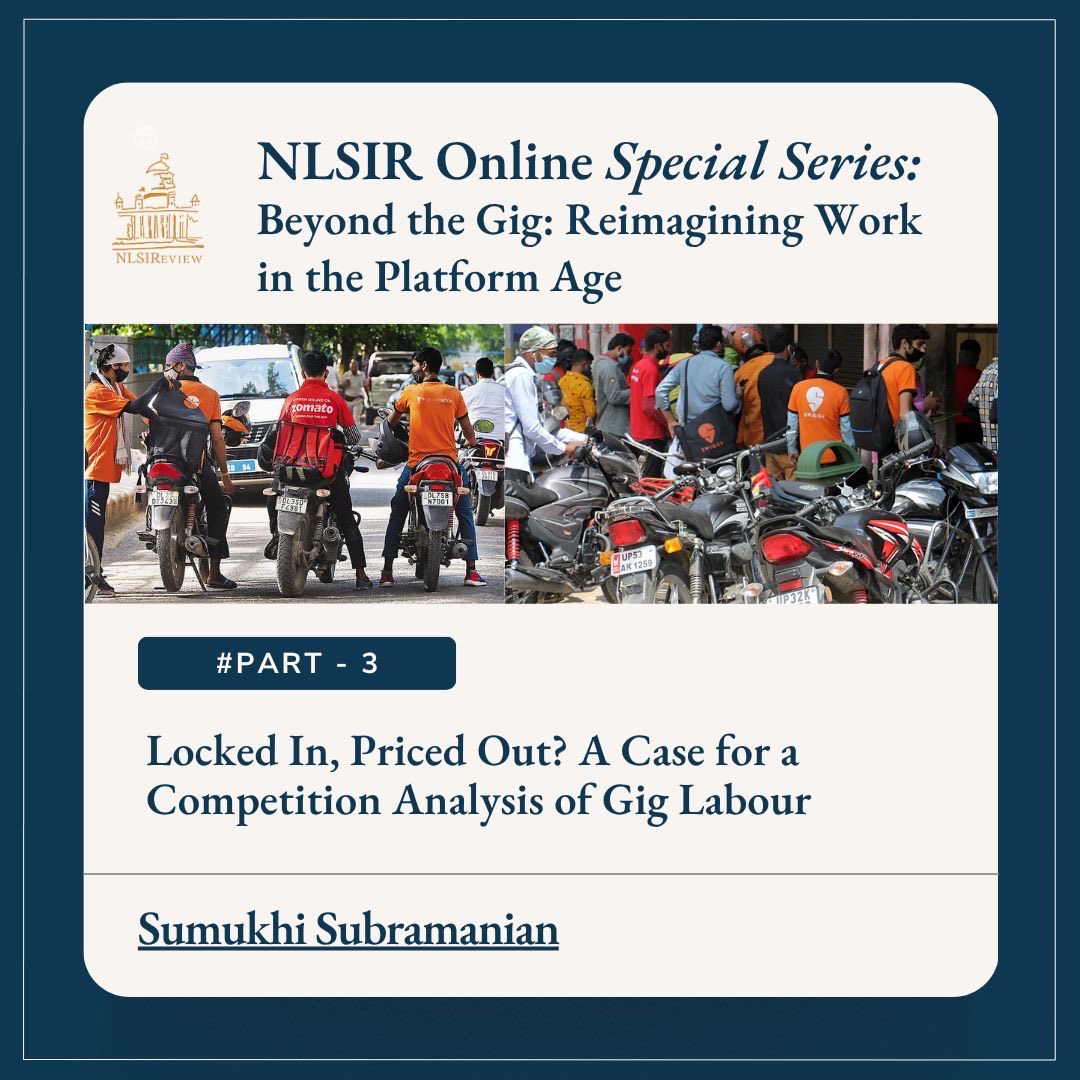
In the latest #BeyondTheGig piece for NLSIR, Sumukhi Subramanian explores how gig platforms in India leverage "algorithmic lock-in" to dominate labor markets. From oligopsonistic power to the gaps in the Draft Digital Competition Bill, this is a must-read on why our current laws might be missing the bigger picture of worker mobility. Read the piece through the link in our bio!
National Law School of India Review tweet media
English
0
0
0
52
National Law School of India Review
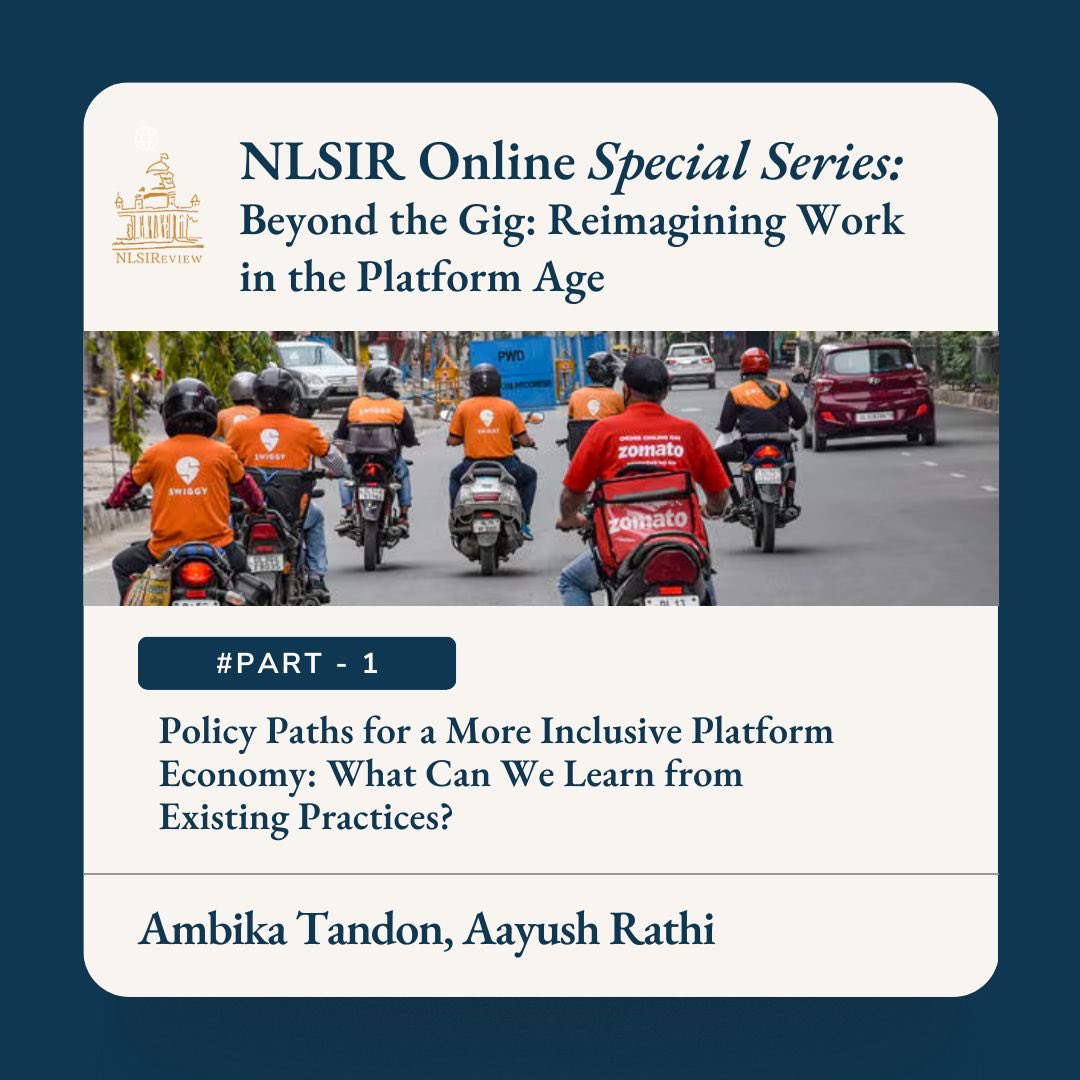
The gig economy promises flexibility, but reproduces inequality. In the first piece of 'Beyond the Gig,' Ambika Tandon and Aayush Rathi map the critical gender gaps in platform work and chart a policy path forward. Read now via the link in bio!
National Law School of India Review tweet media
English
0
0
0
53
National Law School of India Review
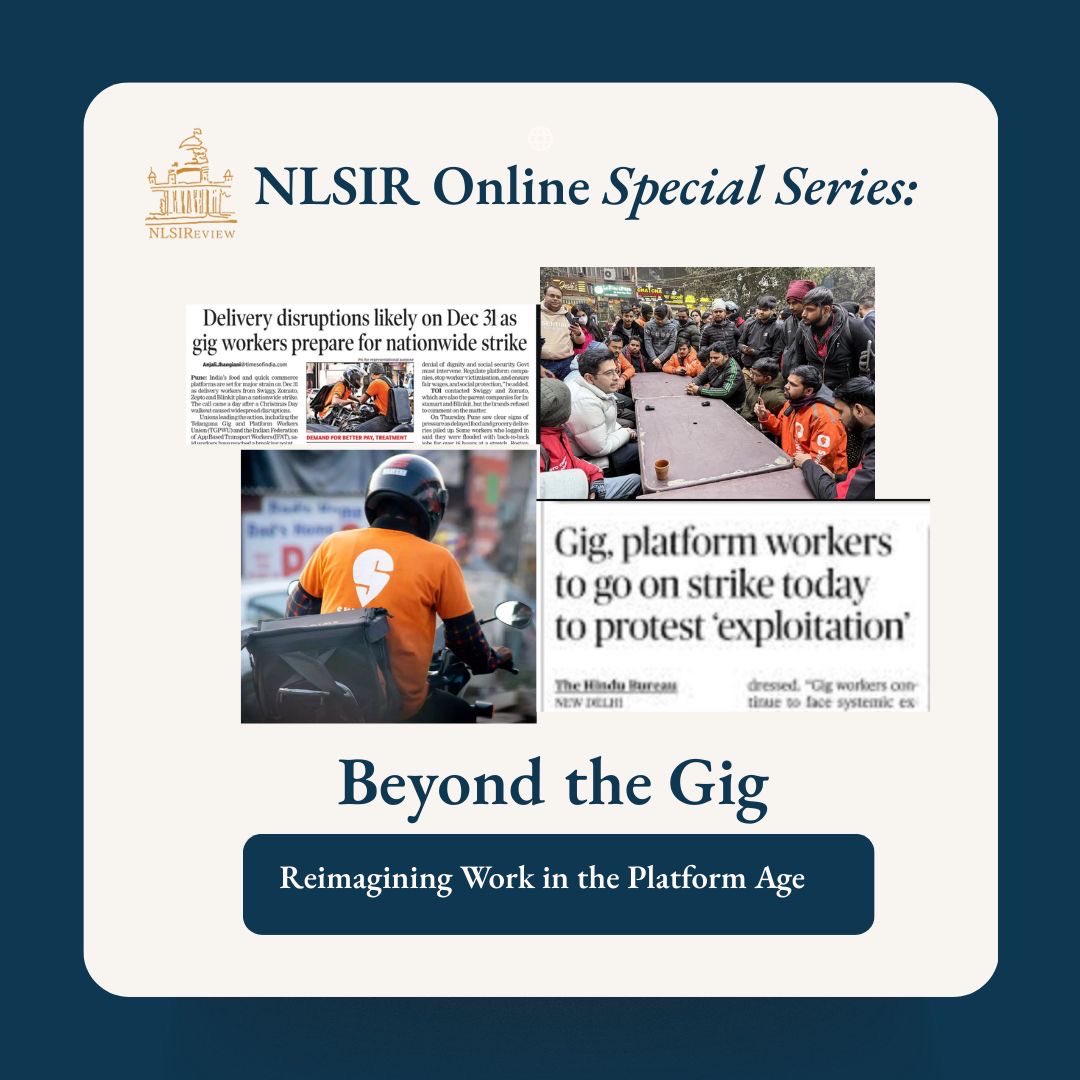
Gig workers keep India moving, but the law is still catching up. With 4 new labour codes now in force, NLSIR Online launches 'Beyond the Gig: Reimagining Work in the Platform Age' - interrogating the gaps, the failures, and the way forward. Stay tuned. (Image credits - Frontline, The Times of India, and The Hindu)
National Law School of India Review tweet media
English
0
0
0
35
National Law School of India Review
This piece critiques the marital rape exception in Indian law, and argues that this colonial-era loophole survives despite modern constitutional protections for bodily autonomy and dignity. Beyond criminal statutes, the source identifies a sex-consent matrix in family law that views marriage as a site of sexual entitlement rather than a relationship of equals. Consequently, the authors advocate for a dual reform approach that involves striking down the legal exception and restructuring marriage laws to prioritize continuous consent.
English
0
0
1
23
National Law School of India Review
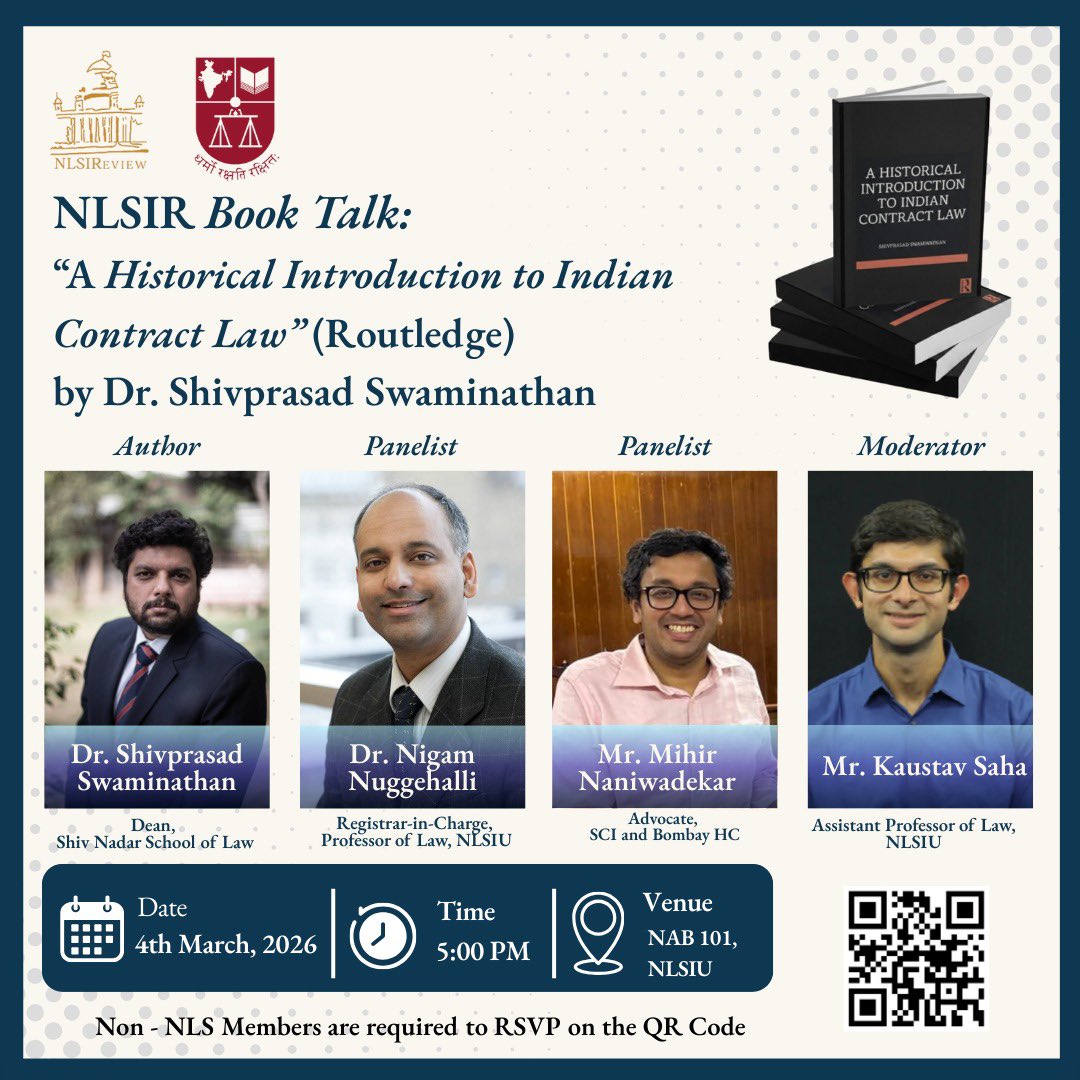
NLSIR is delighted to host a Book Talk on A Historical Introduction to Indian Contract Law (Routledge) by Dr. Shivprasad Swaminathan, Dean, Shiv Nadar School of Law. He will be joined by Prof. (Dr.) Nigam Nuggehalli (Registrar-in-Charge & Professor of Law, NLSIU) and Mr. Mihir Naniwadekar (Advocate, Supreme Court of India & Bombay High Court), with the discussion moderated by Mr. Kaustav Saha (Assistant Professor of Law, NLSIU). 📍 New Academic Block (NAB) 101, NLS Campus 🗓 4 March 2026 | ⏰ 5:00 PM The conversation will explore foundational questions in contract law, including privity, undue influence, unjust enrichment, damages, and stipulated sums.
National Law School of India Review tweet media
English
0
2
9
472
National Law School of India Review
The National Law School of India Review presents Volume 36, Issue 1 (2025). We extend our gratitude to our authors, reviewers, and editors for their work in bringing this issue to publication. The full issue can be accessed at the NLSIR Repository.
National Law School of India Review tweet media
English
0
0
2
154
National Law School of India Review
In this piece for NLSIR Online, Rishit Jain argues that India's law criminalizing the consumption of all Child Sexual Abuse Material (CSEAM), while not doing the same for the most abusive forms of Non-Consensual Intimate Imagery (NCII) of adults, is based on a flawed and illogical distinction.
English
1
0
0
68
National Law School of India Review
In this piece for NLSIR Online, @viraj_thakur19 and Nida Adeel argue that the Delhi High Court's ruling in EPI v. MSA erroneously granted an anti-arbitration injunction based on an arbitrator's non-disclosure. The authors suggest that the court mistakenly applied the low-threshold disclosure standard (ICC Art. 11) instead of the objective "justifiable doubts" challenge standard (ICC Art. 14) to find the proceedings "oppressive." This conflation, which disregards the ICC Court's own findings, represents a form of procedural hyper-vigilance that undermines party autonomy and international arbitral norms.
English
1
1
7
376
National Law School of India Review
In this piece for NLSIR Online, Arnav Mathur argues that the doctrine of the “chilling effect,” traditionally viewed through a fear-of-legal-harm lens, has been central to safeguarding free speech in the Indian constitutional jurisprudence. Yet in Kunal Kamra v. Union of India, the Bombay High Court’s decision invalidating an overbroad amendment to India’s IT Rules raises deeper questions: is fear of prosecution the only force that deters expression?
English
1
1
7
702
National Law School of India Review
In this piece for NLSIR Online @y_yash15sinha tackles a critical contradiction within India's Insolvency and Bankruptcy Code: how to calculate the minimum payout for dissenting secured creditors during a corporate resolution. It argues against the view that these creditors can claim the full value of their collateral (as per their original contract), a position endorsed in the Ruchi Soya ruling. Instead, the article fiercely advocates for the Amit Metaliks approach, which treats the collateral as part of a common pool to be distributed among all creditors.
English
1
0
4
363
National Law School of India Review
In this piece for NLSIR Online, Shubhankar Sharan and Arima Kaushal critique the Supreme Court's novel proposal to hold lawyers personally liable for ambiguous contract clauses, arguing that while the intent to curb pathological arbitration is sound, the Court's reliance on suo motu powers is misplaced and unworkable. The article exposes a critical regulatory gap: India's legal framework, designed for litigators, entirely overlooks transactional lawyers.
English
1
1
12
501
National Law School of India Review
We are pleased to announce that NLSIR Online has a new home - accessible via nlsir.com or forum.nls.ac.in/nlsir-online/ Launched in 2018 as the online companion to India’s oldest student-run law review, NLSIR Online has become a hub for short-form scholarship on India and the Global South—featuring timely, incisive writing from leading academics, practitioners, and students worldwide. Over the past year, we have expanded our efforts to deepen and diversify short-form legal scholarship in India. This includes: ▪ Showcasing contemporary debates in both Public and Private Law. ▪ Publishing special series on The Legacy of D.Y.C, Courting the Climate Crisis, and Law & AI. ▪ Introducing NLSIR On Line, a series of conversations with eminent scholars and practitioners, including a sitting Judge of the Supreme Court of India. This transition marks the next phase in our endeavour to platform pioneering legal thought and strengthen NLSIR Online’s role as a forum for critical engagement with pressing questions of law and policy. Visit our new home: nlsir.com
English
0
0
8
1.8K