NOUN School of Postgraduate Studies retweetledi
NOUN School of Postgraduate Studies
39 posts

NOUN School of Postgraduate Studies
@NOUNSPGS_NG
Welcome to the official X account of the School of Postgraduate Studies (SPGS), National Open University of Nigeria (NOUN).
Abuja, Nigeria Katılım Kasım 2024
18 Takip Edilen29 Takipçiler
NOUN School of Postgraduate Studies retweetledi


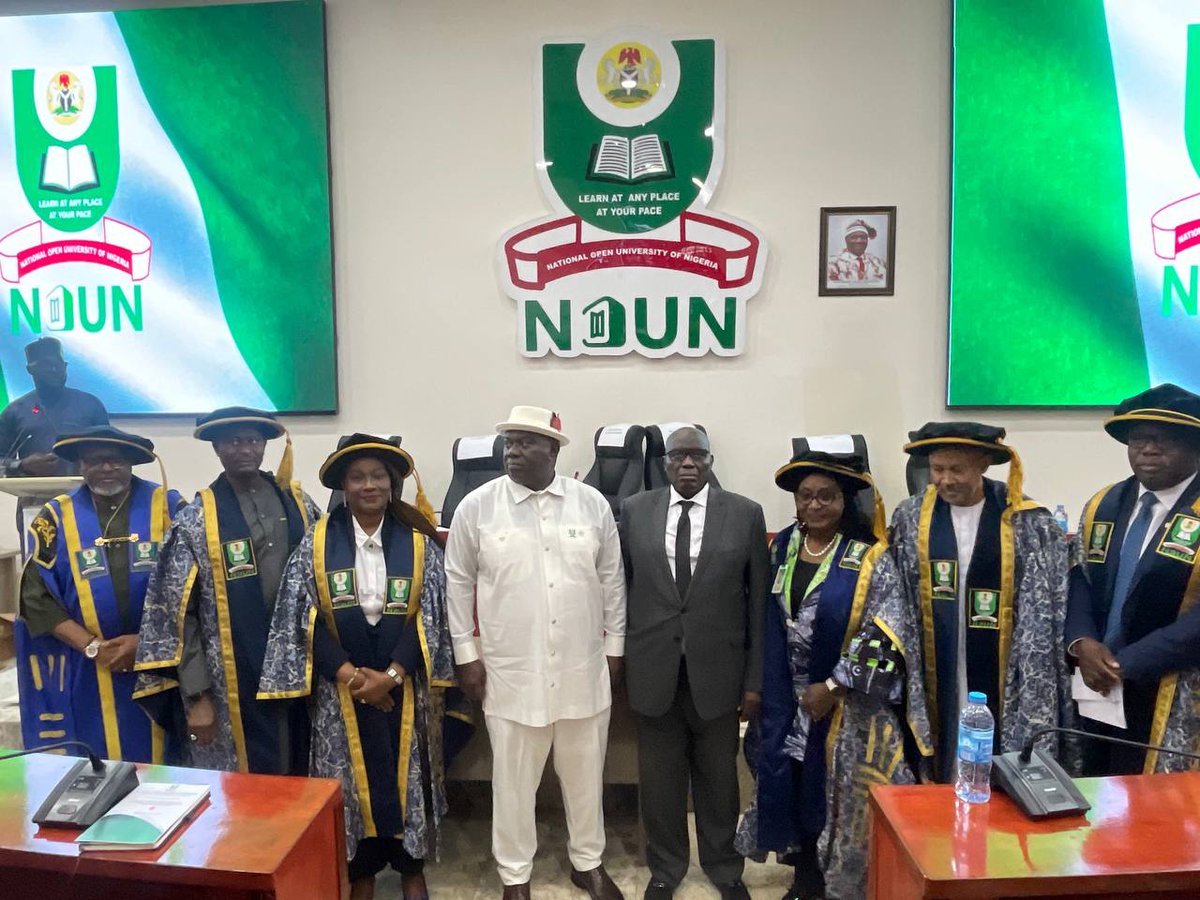
UDUMA ASSUMES OFFICE AS NOUN VC, OUTLINES PRIORITIES
The new Vice-Chancellor of the National Open University of Nigeria (NOUN), Prof. Uduma Oji Uduma, has identified six priority areas for his administration as he assumed office on Wednesday.
These include strengthening of study centres, enhancing learner support systems, improving ICT and digital infrastructure, ensuring the integrity of e-examinations, promoting staff welfare, and sustaining quality assurance and accreditation standards.
Uduma made the statement at a ceremony when his predecessor in office, Prof. Olufemi Ayinde Peters, handed over the baton of leadership to him as Vice-Chancellor for the next five years.
The handover ceremony, held at the university's headquarters in Abuja, marked the beginning of a new chapter in the institution's history.
Uduma, a Professor of Philosophy and one-time Deputy Vice-Chancellor Academic of the NOUN, assumed office as the sixth Vice-Chancellor of the institution.
His emergence as VC was first announced by the Pro-Chancellor and Chairman of the Governing Council of the university, Malam Isa Yuguda, during a press conference held on October 10, 2025 in Abuja.
In his assumption of office speech, titled, “Rising to Build: Stewardship, Access, and Excellence for a New NOUN Era,” Uduma described his appointment as a “solemn national trust” and a call to purposeful service.
According to him, “Leadership is not ornamental; it is functional. It is not a posture of arrival, but a posture of responsibility.”
While reaffirming the NOUN’s mandate, the new VC emphasised the university’s core mission of democratising access to quality higher education and removing barriers of geography, age, employment status, gender and circumstance.
He recalled his time as the director of the Abakaliki study centre of the university, saying he is now the first NOUN Vice-Chancellor with a prior study centre experience, underlining his commitment to improving the centres under his administration.
“I come into this office not to experiment, but to build,” he said.
The VC acknowledged a growing influx of young learners into the Open and Distance Learning (ODL) system, a phenomenon he described as an evolution of NOUN’s mandate rather than a departure from it.
He stressed the need to balance flexibility with discipline and innovation with academic integrity.
He called for unity across board - the university Council, management, staff, students, alumni, and partners - while stressing the need for continuity and collective ownership.
Uduma also urged the university community to “rise up and build,” adding that NOUN must continue to serve as a model of open and distance learning that combines access with credibility and national service with global relevance.
He paid a glowing tribute to his predecessor, Professor Olufemi A. Peters, as well as the previous captains of the institution, describing the university’s leadership as “a relay, not a rupture.”
He pledged to consolidate existing gains while advancing the university’s mission in a rapidly evolving digital and knowledge-driven environment.
In his valedictory speech, Prof. Peters appreciated the NOUN council, Senate, principal officers and staff who stood by him all through his five-year tenure.
“I am profoundly grateful to God Almighty for raising me when hope seemed lost, God has been good to Femi Peters,” he added.
He commended his successor for his efforts in visiting different directorates, units and study centres during his waiting period, which, according to him, has prepared him to hit the ground running.
Earlier, in his speech, the Deputy Vice-Chancellor, Academics, Prof. Chiedu Mafiana, appreciated the outgoing VC for his resilence in ensuring NOUN was etched on the world map as regards ODL.
In his vote of thanks, the university Registrar, Mr. Oladipo Ajayi, welcomed the new Vice-Chancellor, adding, “We welcome you at this defining moment of history. As you have often said, you are the keeper, the gatekeeper standing between the legacy of the old guards and the promise of the future. The Senate is confident that you will carry this sacred trust with wisdom, courage, and vision.”
Ajayi also described Peters as someone who “stands, truly, as one of the last of the Mohicans, a custodian of institutional memory, an exemplar of fidelity, and a member of that noble old guard who kept faith when faith mattered most; who held the compass steady when the waters were uncertain; and who remained a guiding spirit in preserving and advancing the very essence of our defining mandate: Open and Distance Learning.”
The ceremony witnessed the presentation of a handover note, the NOUN Act of 1983 as amended in 2018; the seal of the university which represents the symbol of the VC's Office; gavel of the Senate, and a red pen, which signifies office.
The ceremony was also marked by dignity and reflection as colleagues, staff, family, friends and associates .gathered to witness the symbolic transfer of authority.
nounnews.nou.edu.ng/.../uduma-assu…...


English

𝗣𝘂𝗯𝗹𝗶𝗰𝗮𝘁𝗶𝗼𝗻𝘀, 𝗡𝗼𝘁 𝗠𝗶𝗿𝗮𝗰𝗹𝗲𝘀: 𝗧𝗵𝗲 𝗠𝗶𝘀𝗴𝘂𝗶𝗱𝗲𝗱 𝗪𝗮𝗿 𝗔𝗴𝗮𝗶𝗻𝘀𝘁 𝗔𝗰𝗮𝗱𝗲𝗺𝗶𝗰𝘀
𝘉𝘺 𝘝𝘪𝘤𝘵𝘰𝘳 𝘖. 𝘖𝘭𝘶𝘮𝘦𝘬𝘶𝘯
𝘈𝘥𝘥𝘳𝘦𝘴𝘴: 𝘈𝘥𝘦𝘬𝘶𝘯𝘭𝘦 𝘈𝘫𝘢𝘴𝘪𝘯 𝘜𝘯𝘪𝘷𝘦𝘳𝘴𝘪𝘵𝘺, 𝘈𝘬𝘶𝘯𝘨𝘣𝘢-À𝘬ó𝘬ò.
(𝘈 𝘵𝘦𝘢𝘤𝘩𝘦𝘳, 𝘳𝘦𝘴𝘦𝘢𝘳𝘤𝘩𝘦𝘳 𝘢𝘯𝘥 𝘱𝘢𝘴𝘴𝘪𝘰𝘯𝘢𝘵𝘦 𝘦𝘯𝘵𝘳𝘦𝘱𝘳𝘦𝘯𝘦𝘶𝘳 𝘰𝘧 43+ 𝘺𝘦𝘢𝘳𝘴)
There’s a growing social media pastime these days: mocking academics. The popular accusation? That professors and researchers are obsessed with publishing papers instead of inventing the next big thing — as if publishing is a form of intellectual vanity, and innovation the only true measure of worth.
The truth, however, is far more complex — and far less flattering to the critics than they might wish to admit.
𝐖𝐡𝐞𝐧 𝐄𝐟𝐟𝐨𝐫𝐭 𝐌𝐞𝐞𝐭𝐬 𝐚 𝐒𝐤𝐞𝐰𝐞𝐝 𝐘𝐚𝐫𝐝𝐬𝐭𝐢𝐜𝐤
The modern academic world runs on one principle: what you cannot measure, you cannot promote.
And so, the system has found an easy way to measure — by counting publications. Every promotion panel, every career appraisal, and every institutional benchmark comes down to numbers: how many papers, in what journals, with what citation scores.
In such an environment, effort is invisible unless it produces a measurable output.
Hours spent mentoring students, pursuing socially beneficial projects, or engaging communities in applied research are rarely recorded. The result is a distorted incentive system — one that tells academics, “Forget the community; publish or perish.”
And then, ironically, society turns around to accuse them of doing exactly what they were trained and rewarded to do.
𝐑𝐞𝐬𝐞𝐚𝐫𝐜𝐡 𝐈𝐬𝐧’𝐭 𝐈𝐧𝐧𝐨𝐯𝐚𝐭𝐢𝐨𝐧 — 𝐈𝐭 𝐄𝐧𝐚𝐛𝐥𝐞𝐬 𝐈𝐭
Publishing is not an escape from innovation; it is its first breath.
Every invention you can name — from penicillin to the internet — began as an idea in a research paper. Discovery thrives on documented knowledge. Publications are the academic world’s way of preserving, sharing, and testing those ideas before they reach the production floor.
To ask academics to “innovate instead of publish” is to ask farmers to harvest crops they were never funded to plant.
𝐓𝐡𝐞 𝐑𝐞𝐚𝐥 𝐌𝐢𝐬𝐬𝐢𝐧𝐠 𝐋𝐢𝐧𝐤
The disconnect lies not in the classroom but in the corridors of government and industry.
In developed nations, research rarely ends at publication. Industry scouts the universities, licenses patents, funds prototypes, and scales discoveries into products. Governments invest billions in research and development, ensuring that scholarly work translates into societal impact.
In many developing nations, however, that chain is broken.
Universities operate in silos, industries import technology instead of collaborating locally, and governments pay lip service to research funding. So, academic discoveries sit idle — not because the professors are lazy, but because the ecosystem for innovation is absent.
𝐂𝐨𝐮𝐧𝐭𝐢𝐧𝐠 𝐖𝐡𝐚𝐭 𝐂𝐨𝐮𝐧𝐭𝐬 — 𝐚𝐧𝐝 𝐖𝐡𝐚𝐭 𝐃𝐨𝐞𝐬𝐧’𝐭
The obsession with “measurable output” in academic promotion has created a quiet crisis.
Genuine intellectual curiosity has been replaced by strategic publishing. Scholars now spend more time formatting papers for journals than exploring problems that matter to their communities.
𝐁𝐮𝐭 𝐰𝐡𝐨 𝐬𝐞𝐭 𝐮𝐩 𝐭𝐡𝐞 𝐬𝐲𝐬𝐭𝐞𝐦 𝐭𝐡𝐢𝐬 𝐰𝐚𝐲?
It wasn’t the academics; it was the bureaucrats who built performance templates that reward quantity over impact.
When a lecturer’s promotion depends on having “three papers in a Scopus-indexed journal,” even the most passionate researcher learns to play the numbers game.
And when those who labour in the field of applied problem-solving get no recognition because their work isn’t easily measurable, the entire system loses its soul.
𝐈𝐧𝐧𝐨𝐯𝐚𝐭𝐢𝐨𝐧 𝐈𝐬 𝐄𝐯𝐞𝐫𝐲𝐨𝐧𝐞’𝐬 𝐉𝐨𝐛
Innovation doesn’t sprout from academia alone. It is the product of a three-way handshake between the university, industry, and government.
The academic provides the thinking, industry provides the doing, and government provides the enabling environment.
To dump the entire weight of innovation on scholars — without funding, laboratories, or industrial partners — is as unfair as blaming a librarian for low literacy rates.
Until government funds research with continuity, and industries see universities as partners rather than ornamental institutions, there will be no sustainable innovation culture.
𝐀 𝐒𝐨𝐜𝐢𝐞𝐭𝐲 𝐓𝐡𝐚𝐭 𝐃𝐞𝐫𝐢𝐝𝐞𝐬 𝐈𝐭𝐬 𝐓𝐡𝐢𝐧𝐤𝐞𝐫𝐬
It’s deeply ironic that a society which underfunds research, undervalues education, and neglects industry linkages suddenly wakes up to blame scholars for “not innovating.”
It is like clipping the wings of a bird and mocking it for not flying.
Academics are not the problem; the system of reward and recognition is.
As long as promotions continue to depend solely on quantifiable outputs — publications, citation scores, and conference attendance — rather than the unquantifiable but vital efforts of mentorship, applied research, and societal engagement, the story will remain the same.
𝐖𝐡𝐚𝐭 𝐌𝐮𝐬𝐭 𝐂𝐡𝐚𝐧𝐠𝐞
If we truly want innovation, we must start by reforming how we measure academic excellence:
Reward collaboration with industry and communities.
Value projects that produce solutions, not just papers.
Recognize mentorship, local research impact, and real-world application.
Fund research as an investment, not a formality.
Academia should not be a treadmill for paper production but a cradle for national progress.
𝐂𝐨𝐧𝐜𝐥𝐮𝐬𝐢𝐨𝐧: 𝐑𝐞𝐬𝐩𝐞𝐜𝐭 𝐭𝐡𝐞 𝐏𝐫𝐨𝐜𝐞𝐬𝐬
Publications are not vanity; they are the building blocks of innovation.
The professor writing his tenth paper is not running from discovery — he is documenting the pathway to it.
If the nation wants more innovators, then it must build a system that rewards effort, curiosity, and collaboration, not just measurable output.
Until then, we must stop blaming academics for doing exactly what we trained, structured, and rewarded them to do.
Català

Finance professor in Ireland loses 12 papers in journals he edited – Retraction Watch retractionwatch.com/2026/01/08/fin…
English
NOUN School of Postgraduate Studies retweetledi

How NOT to Write a Scientific Review Article
Most review articles fail for one simple reason.
The authors never learned what a review article actually is.
An important paper by David A. Sanders in Clinical Biochemistry. It exposes the silent mistakes scholars make, and the standards editors rarely say out loud.
Here is what every researcher must understand.
1. Do NOT write a review by stitching together abstracts.
A review is not a list of “A et al found…” and “B et al reported…”.
Sanders shows that this approach dominates weak reviews and signals that the authors never read the actual papers.
2. Do NOT copy sentences, paraphrase old reviews, or follow their structure.
He documents cases where review authors reused text, order, and ideas from earlier reviews. This is academic recycling, and it harms the field.
3. Do NOT write a review if you have not read every cited article.
A review is a collective intellectual position.
If each author has not read each reference and the full manuscript, they should not be coauthors.
4. Do NOT build your review around someone else’s framework.
Sanders warns that reading other reviews too early shapes your order, your model, and even your language. Build your own analysis first.
5. Do NOT copy and paste “to edit later.”
He calls this the beginning of accidental plagiarism. Once pasted, the sentence will follow you into submission.
6. Do NOT write a review without a clear message, model, and direction.
Every paragraph must move the field forward.
A true review synthesizes data, identifies gaps, and proposes testable ideas.
7. Do NOT hide controversial data. Show it.
Figures and tables are evidence. If a dataset is central or disputed, display it so readers can reach their own conclusions.
The point is simple.
A review article is original scholarship, in synthesis
It demands depth, clarity, honesty, and courage.
If done well, it becomes a reference point for the field.
If done poorly, it becomes noise.
Found this useful? Repost.
-Copied -
English

noun.zoom.us/webinar/regist…
#NOUNPostgraduate
#6thQuarterlyWorkshop
#2ndStatisticsClinic
#PhilosophyInThesis
#PostgraduateStudies
#VirtualLearning
#NOUNEducation
#AcademicResearch
#StatsForResearch
#DoctoralThesis
#OpenUniversity
#EducationNigeria
#OnlineLearning
#AcademicLife
#HigherEducation
#BamikoleOgunleye
#ProfEkanola
#AdebolaEkanola
#EkanolaPhilosophy
#AfricanPhilosophy
#EthicsInAfrica
#uduma
#opateye
#Orebiyi
#PCR

QME
NOUN School of Postgraduate Studies retweetledi

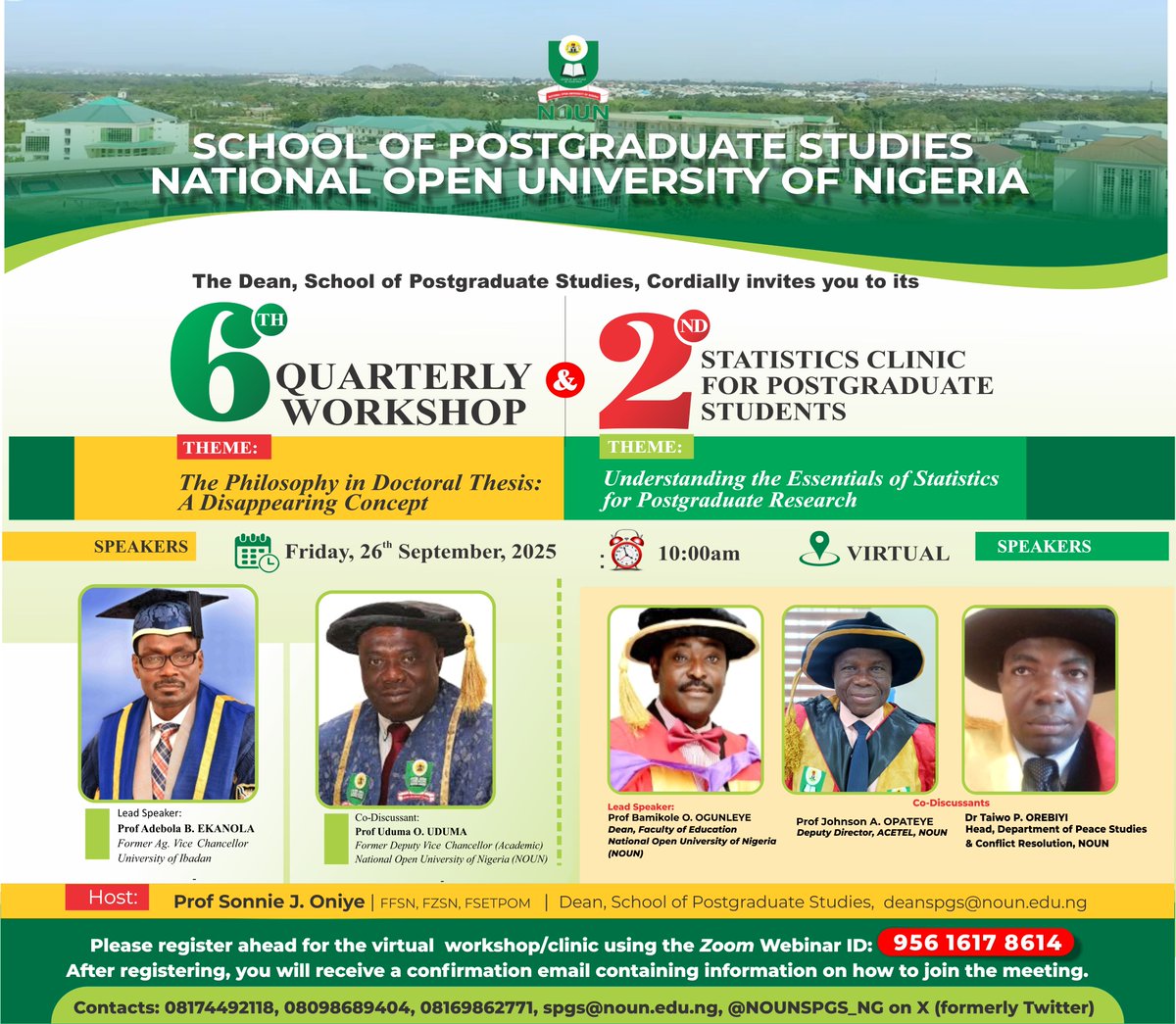
noun.zoom.us/webinar/regist… Invitation to the 6th Quarterly Workshop/2nd Statistics Clinic for Postgraduate Students.
English

The article below was copied (source unknown). However, it captures some of the challenges facing postgraduate programmes in the 21st century. Enjoy read....
From Business Centres to Lecture Centres: The Betrayal of Research in Nigerian Universities
A creeping cancer corrodes our campuses. A silent scandal shames our scholars. A brazen betrayal batters our books. Across Nigeria’s tertiary institutions, undergraduates, Master’s students, and even PhD candidates now flock to roadside business centres not to type their research, but to trade their integrity.
What should be a sacred scholarly journey has been reduced to a shameful shortcut. Business centres originally designed to print documents and bind assignments have transformed into fraudulent factories of dissertations. They have become mills of mediocrity, producing projects without passion, theses without thought, and dissertations without data.
The Anatomy of Academic Anarchy
Here is how the racket runs: operators, usually with nothing beyond secondary school education, hoard heaps of past projects, dissertations, and theses. They function as shadow libraries of laziness. When students arrive with desperation, these operators dust off old documents, tweak the title, replace the author’s name, and roll out chapters like a tailor fitting cloth to size.
Chapter One is delivered like a preview.
Chapter Two — the literature review — is served with borrowed brilliance.
By Chapter Three, the farce becomes frightening. Methodologies without measurement. Data without discovery. Analyses without authenticity. Students submit projects supposedly based on research, yet they never step into the field, never administer instruments, never encounter respondents.
It is fiction dressed as fact, counterfeit parading as competence, and fraud masquerading as scholarship.
The Dangerous Domino Effect
This decay has created a dangerous domino effect in our universities and beyond.
1. Competence is Crippled.
Students who skip research do not master research. They graduate with certificates but without skills, wear gowns but lack grounding, collect diplomas but miss discipline. Their minds remain shallow even as their transcripts are full.
2. Reputation is Ruined.
Nigeria’s theses and dissertations suffer disgrace abroad. When graduates cannot defend their methodology, when PhD holders stumble over data analysis, when Master’s graduates cannot even design a questionnaire, our academic credibility crumbles. The global community sees us as exporters of titles, not thinkers; degree holders, not diligent researchers.
3. Innovation is Injured.
Nations rise on the shoulders of research — in medicine, agriculture, education, and engineering. But Nigeria cannot innovate if its intellectual engines are powered by plagiarism. We cannot build bridges with borrowed bricks, nor erect towers of knowledge on recycled trash.
4. Mediocrity Multiplies.
The tragedy is cyclical. Some of these “graduates” secure teaching jobs, becoming lecturers who supervise research they never learnt to conduct. Others infiltrate research institutes, fabricating findings for policies that affect millions. Thus, ignorance becomes institutionalised, and fraud becomes formalised,
The Cultural Roots of the Rot
Why has this betrayal thrived? Three cultural culprits stand tall:
The Cult of Certificates. In Nigeria, the degree is prized above the discipline. Society celebrates the paper, not the process. Students therefore chase shortcuts to secure the prized parchment.
The Crisis of Capacity. Many students are poorly trained in research methods. Some never learn statistics or struggle with academic writing. Without proper mentorship, they panic — and business centres present the perfect escape.
The Collapse of Conscience. Some Supervisors, sometimes overwhelmed and underpaid, fail to scrutinise rigorously. Some turn a blind eye. A few even collude, recommending business centres to students. Silence breeds complicity.
Remedies for Redemption
If this betrayal is to be broken, Nigeria must act with urgency, unity, and unflinching resolve. Remedies must be rigorous, remedies must be ruthless, remedies must be real.
1. Supervisors Must See Substance
Supervisors should never approve ghost research. No raw data, no defence. No fieldwork, no final draft. Every student must present evidence: filled questionnaires, signed attestations, interview transcripts, or experiment logs. Without proof, projects should be rejected.
2. Repositories, Reviews, and Rigour
Universities must create central repositories where every dissertation and thesis is stored. This will make recycling impossible. Combined with plagiarism detectors, recycled rubbish will be revealed and rejected. Rigour must replace routine.
3. Fieldwork as Foundation
Graduation should not be granted without ground-truth. Students must produce verifiable evidence of field activity: photographs, geotagged records, audio/video clips, or signed endorsements by respondents. Fieldwork must be non-negotiable.
4. Punish Parasites and Pretenders
Cheating must attract consequences. Students caught outsourcing projects should face suspension, expulsion, or degree withdrawal. Business centre operators caught recycling research should face sanctions: heavy fines, licence withdrawal, or prosecution. If fraud pays, fraud will persist.
5. Mentorship, Methods, and Mastery
Rather than abandon students, universities must invest in research clinics — intensive workshops where students are taught how to design, gather, and analyse data. Mentorship should be consistent, not cosmetic. Mastery should be nurtured, not assumed.
6. Government Backing and Policy Support
The state must step in. Through the National Universities Commission (NUC) and related agencies, government should mandate minimum standards for research, enforce digital repositories, and prosecute cases of academic fraud. Without policy teeth, reforms remain mere talk.
A Call to Courage and Conscience
Let us face the facts with fearless honesty:
Education without integrity is ignorance with a certificate.
Degrees without diligence are diplomas of deception.
A nation that rewards shortcuts will soon cut short its future.
Our ivory towers must not become hollow towers. From business centres to lecture centres, this betrayal must be broken. Students must study, lecturers must lead, supervisors must scrutinise, and institutions must stand firm. Anything less is collusion. Anything less is catastrophe.
The time to act is now. If we continue to condone this conspiracy of convenience, we risk raising generations of graduates who are qualified on paper but disqualified in practice, competent in certificates but incompetent in conduct.
Nigeria cannot afford to barter its brains for borrowed pages. We must reclaim our research, restore our rigour, and rescue our reputation. Only then will our campuses shine as centres of creativity, not cemeteries of copy-and-paste.
Perhaps the next phase of this academic absurdity is not far away. Imagine the flyers soon to litter our streets:
PhD in 3 Days! Free Binding, Free Abstract, Free Acknowledgements. Pay Only When Supervisor Approves!
Buy 1 Dissertation, Get 1 Journal Article Free — Limited Offer!
MBA Projects in 24 Hours: No Stress, No Survey, No Statistics!
It is laughable, ludicrous, and lamentable. But satire mirrors reality. This is where we are headed if nothing changes.
The Final Word
We must stop this shame before satire becomes standard, before parody becomes policy, before mockery becomes method. The time to act is now. Let Nigeria reclaim its research, restore its rigour, and rescue its reputation.
Education is not meant to be outsourced. Research is not meant to be recycled. Degrees are not meant to be decorated lies.
From business centres to lecture centres, let integrity reign.
Social Seer, 2025
English