Finance & Startups

6.1K posts

Finance & Startups

Finance & Startups

@NSCCFinance

NSCC School of Business offers a B.A. Diploma, specializing in investment, planning, risk and entrepreneurship. Linked In Group:NSCCFinance

Waterfront Campus, Dartmouth Katılım Mayıs 2012
444 Takip Edilen349 Takipçiler
Finance & Startups retweetledi
Harvard Business Review
Harvard Business Review@HarvardBiz·
It's tempting to put as much information as possible on your LinkedIn profile. But it's important to personalize your profile to attract the right people. hbr.org/2015/05/how-to…
English
4
56
162
64K
Finance & Startups retweetledi
IRCC
IRCC@CitImmCanada·
Reminders for international students: - Starting January 1, 2024, the cost-of-living financial requirement for study permit applicants will change. More info: #doc3" target="_blank" rel="nofollow noopener">canada.ca/en/immigration… - If you already have a study permit or you applied for a study permit before December 7, 2023, you will be able to work off campus for more than 20 hours per week until April 30, 2024. More info: #hours" target="_blank" rel="nofollow noopener">canada.ca/en/immigration…
IRCC@CitImmCanada

Starting January 1, 2024, the cost-of-living financial requirement for study permit applicants will be raised to ensure that international students are better prepared for life in Canada. This threshold will be adjusted each year, similarly to other immigration programs. Learn more: canada.ca/en/immigration… For 2024, a single applicant will need to show they have $20,635 in addition to their first year of tuition and travel costs. This change will apply to new study permit applications received on or after January 1, 2024. In addition, Minister Miller has provided an update on three temporary policies that were set to expire at the end of 2023, including the following: · International students already in Canada, as well as applicants who have already submitted an application for a study permit as of December 7, 2023, will be able to work off-campus for more than 20 hours per week until April 30, 2024. · The measure that has allowed international students to count time spent studying online towards the length of a future post-graduation work permit, as long as it constitutes less than 50% of the program of study, will continue to be in place for students who begin a study program before September 1, 2024. · A temporary policy was introduced on three occasions to provide an additional 18-month work permit to post-graduation work permit holders as their initial work permit was expiring. Foreign nationals with a post-graduation work permit expiring up to December 31, 2023, remain eligible to apply. However, this temporary policy will not be extended further.

English
37
134
401
322.4K
Finance & Startups retweetledi
Sesame Street
Sesame Street@sesamestreet·
Happy Diwali from @Elmo, @KalPenn, and all your friends on Sesame Street. We hope your day is filled with love and joy. ♥️ #Diwali
English
45
819
5.7K
326K
Finance & Startups retweetledi
Michael Arrington 🏴‍☠️
Costco selling gold bars for UNDER spot (even while paying by credit card) is just so great. Red pill America. Bitcoin next.
Michael Arrington 🏴‍☠️ tweet media
English
17
5
52
15K
Finance & Startups retweetledi
Rich Falk-Wallace
Rich Falk-Wallace@richfalkwallace·
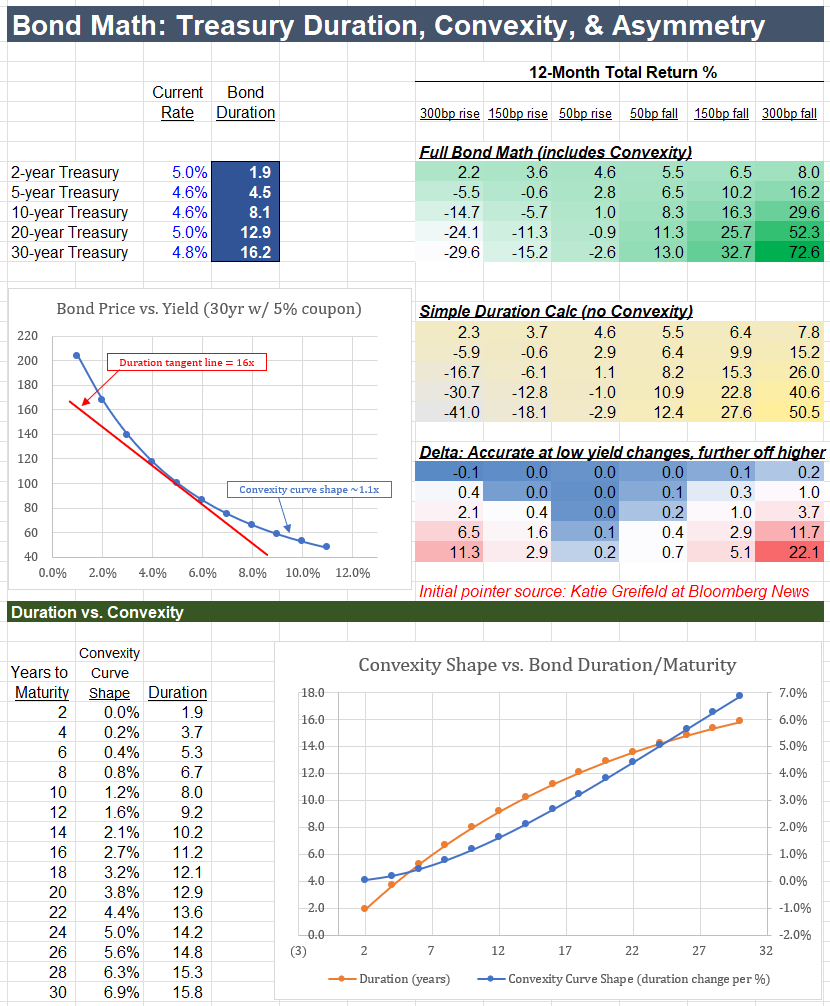
Bond math is now key to today's financial markets Let know if you'd like the sheet. The table on the right reflects a powerful new dynamic: If rates fall 50bps, 20yr Treasuries earn 11.3% over the next year. But if rates rise by 50bps, they lose just 0.9% -- an 11:1 up/down ratio. The 5 year-average 20yr yield is just 2.5%, compared to today's 5%+ yield. At that lower history, the same 50bps up/down math sat at just 2:1, much less skewed. So in the context of recession fears, commodity shock, and mixed econ data, that return skew is drawing cross-asset investors -- hedge funds & asset managers normally less involved in Treasuries. This competition for capital is one of many mechanisms by which higher rates challenge equity returns. Several items are pushing long rates up: the rise of JGB long rates, US deficits, persistent inflation, the dollar, and others. But implicit in the new investor framing of long-bond risk/reward is also the changing impact of the duration math, and the role of convexity across the curve. Which is worth understanding. Duration describes the average time it takes to receive any set of cash flows. Whereas a bond's maturity is simply the date principal is repaid. As a result, maturity and duration differ if there is a coupon: the larger the coupon relative to the principal (& price), the shorter the relative duration. So, if a 10yr bond at par has no coupon, its duration is 10 years. If the same bond has a 10% coupon, its duration is 6.5 years, since much of the total cash investors get comes in every year via coupon. But the duration has another very useful property: It also exactly equals the bond price change associated with a 1% change in its yield. Thus, for the same 6.5 year duration bond, if the yield falls to 9%, the price rises from 100 to exactly 106.5. The next question is how duration changes: Is the 6.5 duration constant as yields move from 10% to 9% to 8%? No -- because the weighted average life has changed at each increment. This change is the bond's "convexity." And it is the driver of why a 3% rate fall means a gain of 70%+ while a 3% rise means a loss of just 30%. You can see that difference in the first chart below: Red is the duration of a 5% coupon / 5% yield 30-year bond: 16 years. Blue is the actual bond price across yields. The difference between the two lines is the effect of convexity: The price change slows as yields rise And rises steeply as yields fall. Next shows the curve of convexity itself shifting across maturities. Directional views on Treasuries here are a function of growth path, fed policy, and a host of other factors. Sometimes you make that bet. But other times, or if you're restricted to markets competing for scarce capital, Knowing the asymmetries & reaction functions across markets Improves your ability to anticipate and act In your area of focus. That's all for now. Let know if you'd like the math.
Rich Falk-Wallace tweet media
English
663
764
4.2K
1.1M
Finance & Startups retweetledi
Bill Ackman
Bill Ackman@BillAckman·
Some advice for students: If an organization of which you are a member puts out a public statement you disagree with, you have a few choices. You can: Stay silent and have the entire world conclude that you stand by the statement. Convince the other members of the group to withdraw or otherwise modify the statement so that it can reflect the views of all members. Or you can resign in protest. Claiming that you had no involvement or knowledge of the statement, but remaining a member of the organization without it withdrawing the statement is perhaps the worst of the alternatives, as it appears to simply be an attempt to avoid accountability while continuing to be a member of the organization. If you were managing a business, would you hire someone who blamed the despicable violent acts of a terrorist group on the victims? I don’t think so. Would you hire someone who was a member of a school club who issued a statement blaming lynchings by the KKK on their victims? I don’t think so. Would you want them to be an associate at your law firm? Of course not. It is not harassment to seek to understand the character of the candidates that you are considering for employment. In fact, as CEO, it is your obligation to do so on behalf of all of the other employees in your company, the clients and customers it serves, and all of your other stakeholders. I have heard that the above inquiry has made some members of the groups which put out the statement feel ‘unsafe,’ a word that is sadly overused in universities today. Ask yourself how unsafe it would feel in Israel beginning Saturday early morning and how unsafe it feels now? Ask yourself how unsafe your Jewish classmates feel when 32 clubs published a statement assigning sole responsibility for the heinous, deathly acts of terrorists to Israel and the Jews? Experience is making mistakes and learning from them. If you have made a mistake, acknowledge it, and immediately correct your mistaken actions. Public statements made by organizations of which you are a member can have a material negative impact on your reputation. I have learned from experience that the best time to fix a mistake is now.
English
2.8K
7K
38K
9.5M
Finance & Startups retweetledi
Christine Duhaime
Christine Duhaime@cduhaime·
This is so sad; and going to be devastating for Canada long term. For all the years I promoted Canadian tech & Ai domestically and externally, I can say that the 5 things we did wrong as a country were: (a) VC system subsidized by federal govt, which is men only club and subsidizes VC partners, not startups; (b) no grant money; (c) no federal support for startups or even to groups that try to make ecosystems to foster entrepreneurship; (d) funding a cluster concept instead of talented startups where money was available only in certain areas in a few cities which went against the natural flow of talent and growth of innovation like cleantech for Vancouver and AI for Montreal, when most of that talent was in Ontario. And (5), no investment in researching future trends and technology changes to make sure Canada is keeping up and supporting future tech so that we are leaders and not followers. I always thought Canada should put out an annual paper on tech and it’s future so we have a vision for the future as a country. Not too late Canada!!
Global National@GlobalNational

Younger Canadians are shying away from entrepreneurship, RBC report says dlvr.it/Sx2tk6

English
93
67
471
139.2K
Finance & Startups retweetledi
Charlie Bilello
Charlie Bilello@charliebilello·
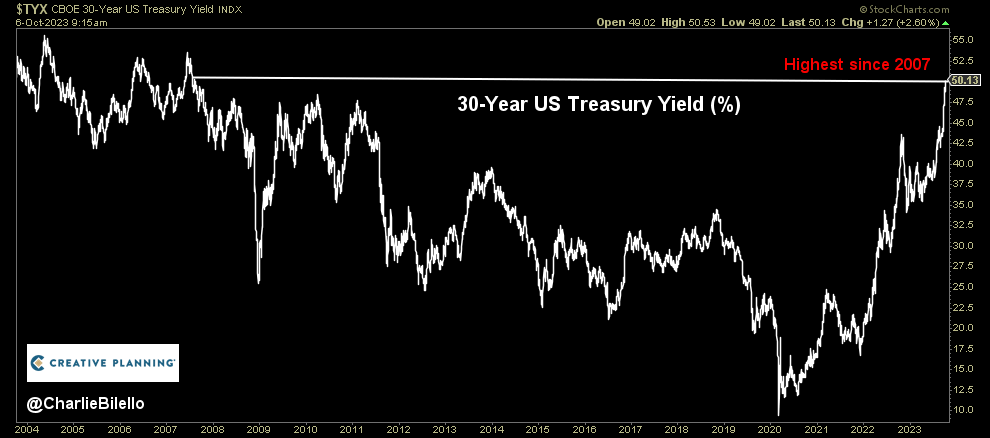
30-Year Treasury Yield just crossed above 5% for the first time since 2007. Was below 1% in March 2020.
Charlie Bilello tweet media
English
24
157
621
149.2K
Finance & Startups retweetledi
Jon Erlichman
Jon Erlichman@JonErlichman·
Things that didn’t exist 25 years ago: Tesla SpaceX iPhone YouTube X Facebook Gmail Instagram Bitcoin Netflix streaming WhatsApp TikTok LinkedIn iPad Snapchat Amazon Prime Skype Reddit Airbnb Etsy Lyft Uber Wikipedia Pinterest App Store Spotify Skype Fitbit emojis Tinder Stripe Nest Slack Xbox Shopify Kindle Zoom Chrome Minecraft ChatGPT Alexa DraftKings Quora Salesforce Messenger Coinbase Alibaba Ethereum Peloton Crocs Google Maps Telegram Roblox Swiffer WeChat Mailchimp Beyond Meat Samsung Galaxy Amazon Web Services FaceTime Wayfair Dropbox Twilio DocuSign AirPods Roku Chewy Spanx Zillow Venmo Avatar iPod Instacart Coke Zero Palantir Canva Twitch Bumble BuzzFeed S’well Moderna hashtags Fortnite Pumpkin Spice Latte Toms Shoes Stitch Fix Alexa DoorDash Warby Parker Everlane Discord Carvana Casper Square McGriddle Tide Pods Elf on the Shelf FanDuel Shake Shack The Hunger Games PlayStation Nokia 3310
English
639
1.5K
9K
2.9M
Finance & Startups retweetledi
Mohamed A. El-Erian
Mohamed A. El-Erian@elerianm·
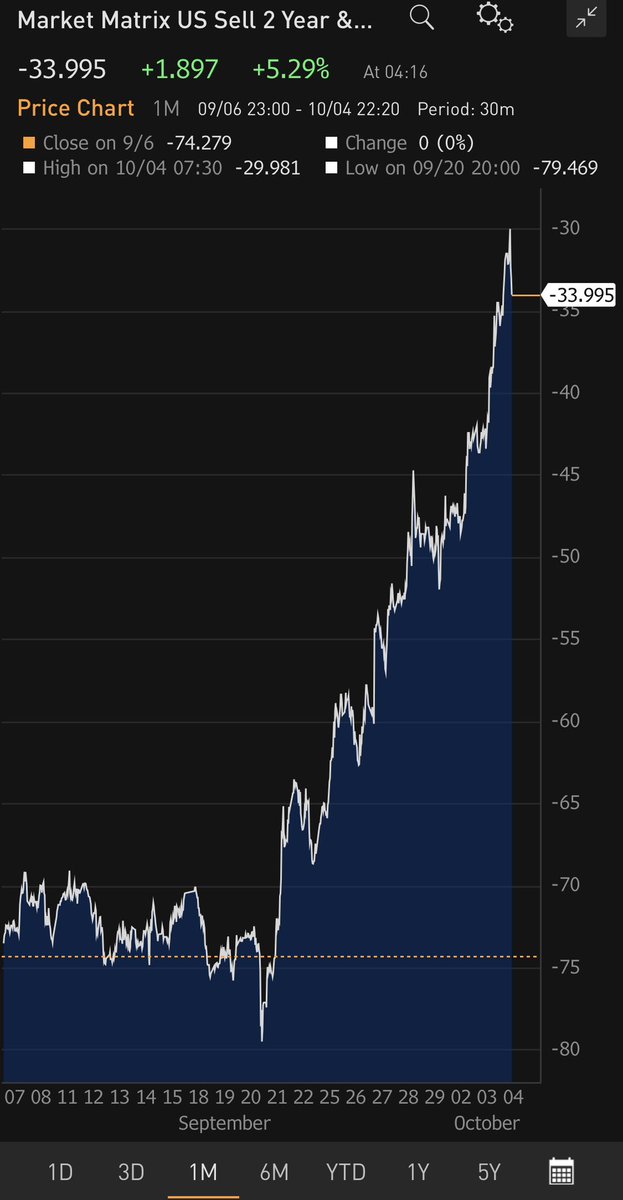
The dis-inversion of the curve (2s-10s now at minus 34) illustrates that the selloff in bonds has been led by the longer end of the yield curve. Compare this to the 2022 selloff which was led by the front end. All this is consistent with the 2022 selloff being a reaction to rates going higher and this year’s to rates staying high. #economy #markets #econtwitter
Mohamed A. El-Erian tweet media
English
66
196
864
262.2K
Finance & Startups retweetledi
Mohamed A. El-Erian
Mohamed A. El-Erian@elerianm·
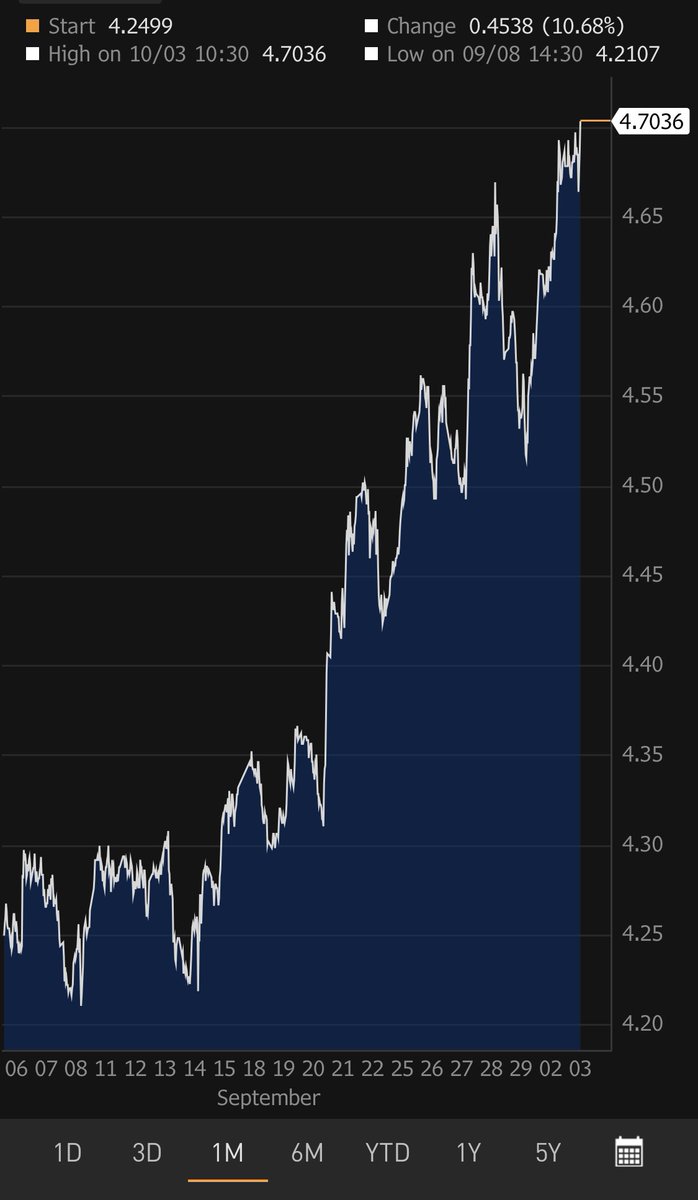
The yield on the 10-year US government bond is currently trading above 4.70%. Simply put: Last year was about #markets adjusting to higher rates. This year is about markets adjusting to rates staying high for longer. The process of market adjustment is ongoing while that of the #economy is at a significantly earlier stage. More to follow on this. #EconTwitter
Mohamed A. El-Erian tweet media
English
90
260
1.4K
471.5K
Finance & Startups retweetledi
Bill Gross
Bill Gross@real_bill_gross·
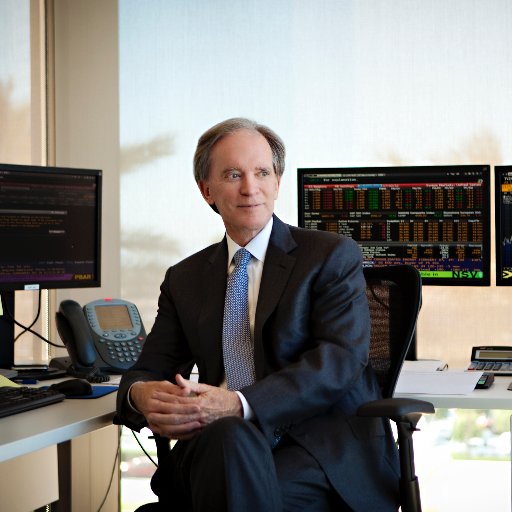
30 yr mtge at 7.7%. This shuts down housing mkt. New investment outlook tomorrow
English
147
445
3.7K
1M
Finance & Startups retweetledi
Jim Cramer
Jim Cramer@jimcramer·
Fixated on that 20-year's inability to take out 5% and how there has to be some serious money betting short on that piece of paper ....
English
18
10
107
88.8K
Finance & Startups retweetledi
Statistics Canada
Statistics Canada@StatCan_eng·
After celebrating the Canadian population reaching 40 million on June 16, the country’s population was estimated at 40,097,761 on July 1, 2023, an increase of 1,158,705 people (+2.9%) from July 1, 2022. www150.statcan.gc.ca/n1/daily-quoti…
Statistics Canada tweet media
English
16
17
39
66K
Finance & Startups retweetledi
Charlie Bilello
Charlie Bilello@charliebilello·
3 years ago: 30-yr mortgage rate was 2.9% & median existing home price in the US was $310k. Today: 30-yr mortgage rate is 7.2% & median home price is $407k. Result: $19k increase in down payment (20% down) and 114% increase in monthly payment (from $1,032 to $2,210).
English
49
152
582
174.5K
Finance & Startups retweetledi
Bill Ackman
Bill Ackman@BillAckman·
I believe that long-term rates, e.g, 30-year rates, will rise further from here. As such, we remain short bonds through the ownership of swaptions. The world is a structurally different place than it was. The peace dividend is no more. The long-term deflationary effects of outsourcing production to China are no more. Workers and unions’ bargaining power continues to rise. Strikes abound, with more likely to come as successful walkouts achieve substantial wage gains. Energy prices are rising rapidly. Not refilling the SPR was a misguided and dangerous mistake. Our strategic assets should never be used to achieve short-term political objectives. Now we must refill the SPR while OPEC and Russia cut production. The green energy transition is and will remain incalculably expensive. And higher gas prices will raise inflationary expectations. Just ask your average American. They see the prices at the pump and in the grocery store and don’t believe inflation is moderating. Our national debt is $33 trillion and rising rapidly. There is no sign of fiscal discipline by either party or by the presumptive presidential nominees. And each debt ceiling is an opportunity for our divided government and its most extreme actors to get media attention, and for our nation to threaten default. This is not a good way to recruit the many new buyers we need for our bonds. The government is selling hundreds of billions of bills, notes and bonds weekly. China and other foreign nations, historically major buyers of our debt, are now selling. And the QT unwind experiment has barely begun. Imagine trying to do a massive IPO where the underwriter, insiders and short sellers are all selling at once, competing to hit every bid on the way down while the analysts downgrade their ratings to ‘Sell.’ Our economy is outperforming expectations. Major infrastructure spending is beginning to contribute to economic growth and the supply of additional debt. Recession predictions have been pushed out beyond 2024. The long-term inflation rate is not going back to 2% no matter how many times Chairman Powell reiterates it as his target. It was arbitrarily set at 2% after the financial crisis in a world very different from the one we live in now. I bumped into the CIO of one of the world’s largest fixed income asset managers the other night and asked him how it was going. He looked like he had had a tough day. He greeted me by saying: ‘There are just too many bonds’ — a veritable tsunami of new issuance each week. I asked him what he was going to do about it. He said: ‘The only thing you can do is step away.’ I have been surprised at how low long-term rates are. I think the best explanation is that bond investors thought of 4% as a high rate of interest because rates hadn’t breached 4% for nearly 15 years. When investors saw the ‘opportunity’ to lock in 4% for 30 years, they grabbed it as a ‘once-in-their-career opportunity,’ but today’s world is very different from the one they have experienced up until now. The long-term inflation rate plus the real rate of interest plus term premium suggests that 5.5% is an appropriate yield for 30-year Treasurys. And query whether 0.5% is a sufficient real long term rate in an increasingly risky world. And the technicals could cause yields to go even higher, particularly in the short term. We saw the beginnings of that today. It wasn’t that long ago that a previous generation thought five percent was a low rate of interest for a long-term, fixed-rate obligation. But I could be wrong. AI might save us.
Bill Ackman@BillAckman

I have been surprised how low US long-term rates have remained in light of structural changes that are likely to lead to higher levels of long-term inflation including de-globalization, higher defense costs, the energy transition, growing entitlements, and the greater bargaining power of workers. As a result, I would be very surprised if we don’t find ourselves in a world with persistent ~3% inflation. From a supply/demand perspective, long-term Treasurys (T) also look overbought. With $32 trillion of debt and large deficits as far as the eye can see and higher refi rates, an increasing supply of T is assured. When you couple new issuance with QT, it is hard to imagine how the market absorbs such a large increase in supply without materially higher rates. I have also been puzzled as to why the @USTreasury hasn’t been financing our government in the longer part of the curve in light of materially lower long-term rates. This does not look like prudent term management in my opinion. Then consider China’s (and other countries’) desire to decouple financially from the US, YCC ending in Japan increasing the relative appeal of Yen bonds vs. T for the largest foreign owner of T, and growing concerns about US governance, fiscal responsibility, and political divisiveness recently referenced in Fitch’s downgrade. So if long-term inflation is 3% instead of 2% and history holds, then we could see the 30-year T yield = 3% + 0.5% (the real rate) + 2% (term premium) or 5.5%, and it can happen soon. There are many times in history where the bond market reprices the long end of the curve in a matter of weeks, and this seems like one of those times. That’s why we are short in size the 30-year T — first as a hedge on the impact of higher LT rates on stocks, and second because we believe it is a high probability standalone bet. There are few macro investments that still offer reasonably probable asymmetric payoffs and this is one of them. The best hedges are the ones you would invest in anyway even if you didn’t need the hedge. This fits that bill, and also I think we need the hedge.

English
917
2.3K
12.1K
6.2M
Finance & Startups retweetledi
Charlie Bilello
Charlie Bilello@charliebilello·
2023 Total Returns... The Enormous Eight... $NVDA: +183% $META: +149% $TSLA: +109% $AMZN: +55% $GOOGL: +49% $AAPL: +35% $MSFT: +35% $NFLX: +31% Everyone Else... S&P 500 Equal Weight ETF $RSP: +3% S&P Small Cap ETF $IJR: +1%
English
43
169
681
224.5K