Nafees Hamid, PhD

1.8K posts

Nafees Hamid, PhD banner
Nafees Hamid, PhD

Nafees Hamid, PhD

@NafeesHamid

Cognitive Scientist @kingscollegelon | Co-PI / Research & Policy Director @XCEPT_Research | ✍🏾 📺 NY Times, WaPo, The Atlantic, NYRB, Foreign Affairs, Netflix

London Katılım Şubat 2015
2.4K Takip Edilen3.1K Takipçiler
Nafees Hamid, PhD
Nafees Hamid, PhD@NafeesHamid·
Pleased to publish @XCEPT_Research on the lessons from our qualitative research in the Middle East. These are combined with psychometric surveys, intervention tournaments, and RCTs to gain a wholistic picture of psycho-socio-structural drives of political violence and peace.
Centre for Statecraft & National Security@CSNS_UK

📝 NEW COMMENTARY | One Thousand and One Interviews: Lessons from Qualitative Research in the Middle East @rajanbasra explores the challenges of gathering empirical data in high-fear, high-trauma settings across Iraq and Lebanon. @XCEPT_Research csns.uk/2026/03/31/one…

English
1
1
1
663
Nafees Hamid, PhD
Nafees Hamid, PhD@NafeesHamid·
Important work we've published by @lock_nils. Personal adversities (death of family member, job loss) more predictive of protest behaviour than political adversities (war, conflict). Personal -> political. He and I, along w/Fiona McEwen, will publish the academic verison soon.
Centre for Statecraft & National Security@CSNS_UK

📝 NEW POLICY BRIEF | Why do some individuals turn to violent protest while others remain peaceful? Read @lock_nils' new piece for the @XCEPT_Research programme. 🔗bit.ly/4sGBMvW

English
0
2
0
536
Nafees Hamid, PhD
Nafees Hamid, PhD@NafeesHamid·
We published a new policy brief at @XCEPT about challenges surrounding Hezbollah’s demilitarisation. Drawing on interviews w/Hezbollah members, southern residents, & Lebanese officials @inna_veleva highlights the role of state absence & threats that sustain armed mobilisation
Centre for Statecraft & National Security@CSNS_UK

📝 NEW POLICY BRIEF | A Farewell to Arms? Challenges and Preconditions for Hezbollah’s Demilitarisation Read @inna_veleva's brief on why sustainable demilitarisation must be a social contract rather than a technical fix. 🔗bit.ly/4bCI9dH @XCEPT_Research

English
0
2
2
609
Nafees Hamid, PhD
Nafees Hamid, PhD@NafeesHamid·
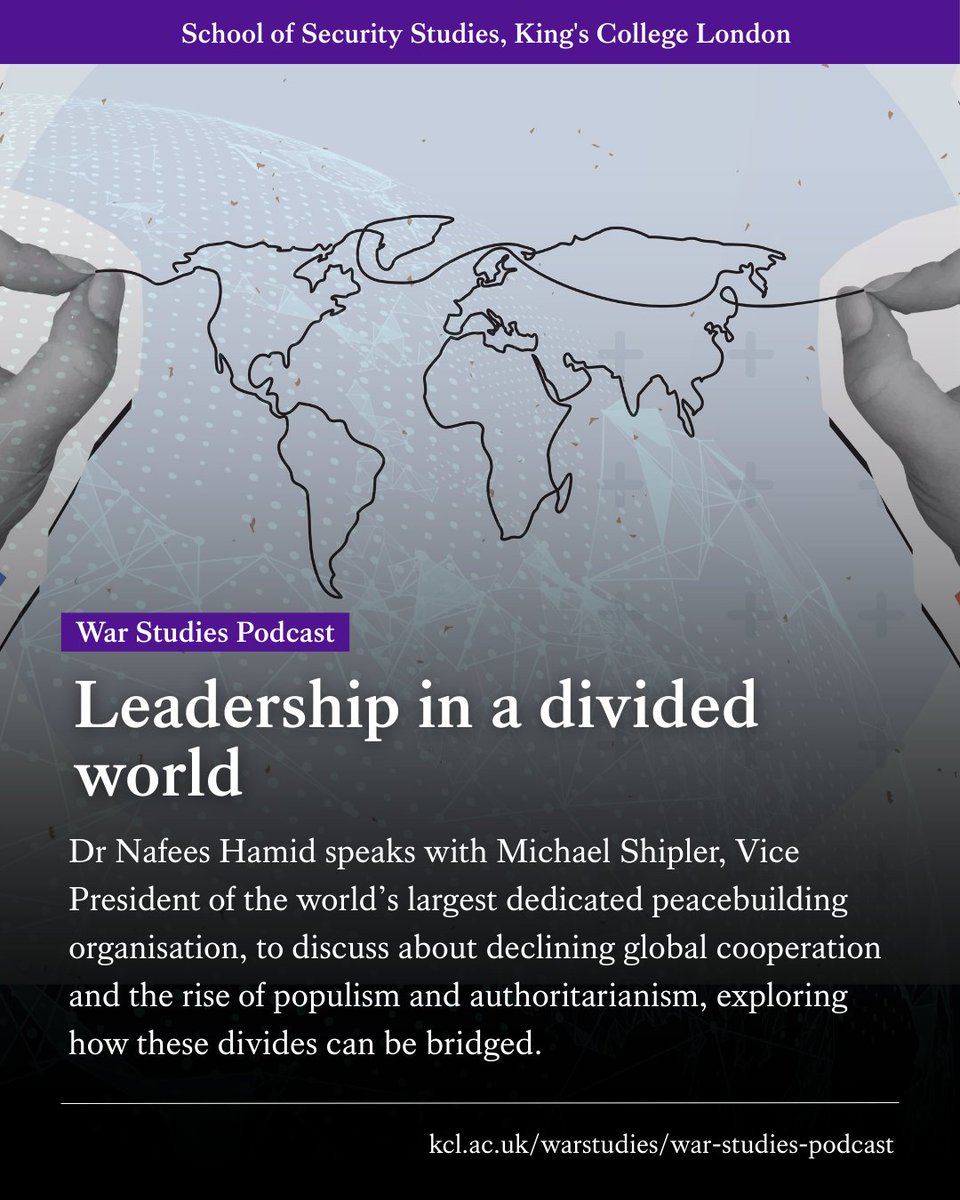
It was great having @MichaelShipler on our podcast to talk about the fantastic work of Search for Common Ground @SFCG_. Even in a world of elite transactionalism, community-level peace building is vital for sustainable co-existence. He shares great insights on the role of artists, storytelling, and leadership. Stay tuned for when it's out!
Nafees Hamid, PhD tweet media
English
0
1
0
259
Nafees Hamid, PhD
Nafees Hamid, PhD@NafeesHamid·
What does Maduro's capture mean for leftist guerilla groups operating operating along the Colombian-Venezuelan border? I spent 6 weeks interviewing the leaders of FARC and ELN face-to-face to understand their mentality and goals. Here's some reflections: - Venezuela came up repeatedly in interviews. It was clear that these groups had an emotional and practical connection to the government. The practical side spanned both their narco-trafficking elements as well as support for their political agenda. - While it was clear that Maduro is not the inspiring character of Chavez, they made many excuses for his performance as a leader. They contended that he repeatedly won fair and free elections (widely disputed) and that all economic difficulties can be placed on Western governments and Venezuelan bourgeoisie. In essence, he's a pretty good leader operating in hostile conditions. But their allegiance was clear. - I also spoke to the Colombian government and representatives of the international community and it became clear to me that they did not understand the psychology of these groups. - They kept presenting these groups as rationally self-interested narco-traffickers whose political ideology was nothing more than historic window dressing. - After interviews, focus groups, and piloting of psycho-metric surveys I came to the conclusion that this is a simplistic picture. While some of them may be described in these terms, some of the time - it misses their political orientation. - ELN is a federation with an aging central leadership of questionable influence. Some federations leaders still hold strong political aspirations in tandem with their organised crime mentality. I was surprised when speaking to them with how fluently they spoke about their ideology. How in-depth they were able to go to discuss the underlying philosophy of their movement. This was not a shallow-window dressing type of discourse. This was a speech that belonged to true believers. - Indeed when piloting survey measures with them I found many to have "fused identities" and "sacred values" (despite most being atheists) - two key elements in the making of "devoted actors" - those who are willing to fight and die for their beliefs (the anti-thesis of rational actors). - I also met rank-and-file members, some of whom had been formerly part of non-ideological para-military/narco-trafficking groups. They switched to groups like ELN or FARC dissident groups partially for the appeal of the ideological stance. Even if their day-to-day life didn't change much it felt more meaningful to be doing the same type of activities for a group that ostensibly held a political agenda. - The ELN leaders even said to me "“[The government] don’t understand us. They think all we want is money. They don’t know how to negotiate with us." - If any govt wants to appeal, negotiate, deter, or affect their behaviour they must first understand what motivates them. Currently, they do not
Nafees Hamid, PhD tweet media
English
0
2
0
367
Nafees Hamid, PhD retweetledi
Nicholas Wright
Nicholas Wright@nicholasdwright·
Why do humans FIGHT, LOSE and WIN wars - and how can we use this self-knowledge about our own BRAINS to build a more PEACEFUL world? Talk tomorrow 5pm at King's College London. Thx @NafeesHamid for discussing my new book! Thx @LawDavF & top neuroscientists for endorsing. Thx @ShirazMaher
Centre for Statecraft & National Security@CSNS_UK

⏰ Last chance to register ⏰ Join us on Wednesday for the launch of @nicholasdwright's new book - ‘Warhead: How the Brain Shapes War and War Shapes the Brain’ 📅 Weds 3rd Dec, 17:00-18:30 📍 Bush House, Strand Campus 🎟️ kcl.ac.uk/events/book-la…

English
0
1
2
207
Nafees Hamid, PhD retweetledi
Nicholas Wright
Nicholas Wright@nicholasdwright·
Please JOIN US next Wednesday for a talk with @NafeesHamid on my new book on WAR and the BRAIN - 5pm, 3rd Dec at King’s College London! We'll discuss talking neuroscience to Columbian guerillas & deep in the Pentagon. Book very kindly endorsed by @LawDavF, @BeatriceHeuser & more!
Centre for Statecraft & National Security@CSNS_UK

Why do humans fight, lose, and win wars? Join us for the launch of @nicholasdwright's new book 'Warhead: How the Brain Shapes War and War Shapes the Brain', moderated by @NafeesHamid 📅 Weds 3rd Dec, 17:00-18:30 GMT 📍 Bush House, Strand Campus 🎟️ kcl.ac.uk/events/book-la…

English
0
2
1
173
Nafees Hamid, PhD retweetledi
Nicholas Wright
Nicholas Wright@nicholasdwright·
So excited to talk with @NafeesHamid about my new book on war the brain - please join us on 3rd Dec at King’s College London!
Centre for Statecraft & National Security@CSNS_UK

Why do humans fight, lose, and win wars? Join us for the launch of @nicholasdwright's new book 'Warhead: How the Brain Shapes War and War Shapes the Brain', moderated by @NafeesHamid 📅 Weds 3rd Dec, 17:00-18:30 GMT 📍 Bush House, Strand Campus 🎟️ kcl.ac.uk/events/book-la…

English
0
1
2
134
Nafees Hamid, PhD
Nafees Hamid, PhD@NafeesHamid·
Was very honoured to speak about what psychology and neuroscience can bring to peace mediation at this #EUCoP2025 side event hosted by Berghof Foundation. What struck me was the divergence of reactions to my and other speakers’ interventions. Some mediators were enthusiastic about it and wanted to integrate the insights immediately. Others showed resistance and almost hostility. Research has two potential avenues to contribute to practice (you can offer both). 1) The instrumental avenue: give a list of specific tools that practitioners can use. Give them an explicit decision-tree showing them when and how to use each tool. 2) The transformative avenue: change the lens through which the practitioner sees the task. Give them a new framework through which to view the problem such that it will inspire a whole new set of intuitions on their own. The won’t need new tools taught to them, they’ll create them. Those who were hostile were expecting only the former and were resistant to the latter. It takes vulnerability to say that maybe the way I’ve been looking at the world is limited; maybe I can benefit from a perspective shift. The problem with the second approach is that you can’t demonstrate its benefits unless the person is willing to try the new lens on. What helped was when the colleagues that they respected, advocated for it. This helped shift things via social norms. Some of those who were initially resistant came around.
Berghof Foundation@BerghofFnd

What are the psychological and behavioural dynamics that come to play at the negotiation table? At our #EUCoP2025 side event on integrating psychology in peacemaking with @DutchMFA, we asked experts in both fields how this collaboration can benefit #mediation processes.

English
0
0
2
183
Nafees Hamid, PhD
Nafees Hamid, PhD@NafeesHamid·
We’re hiring! Come work as the project manager of @XCEPT_Research at King’s College London. XCEPT is an £6.03M FCDO-funded project at KCL that broadly examines the impact of trauma on pathways to peace and violence. We have data being collected with civilians and armed actors in Iraq, Lebanon, Syria, South Sudan, and other locations. We’re an inter-disciplinary team conducting large-scale psychometric surveys, experiments, RCTs, and qualitative research. We engage directly with senior policy decision-makers and can make a real difference. Myself and Dr Fiona McEwen are the Co-PIs of this project and are looking to work with passionate people. Apply here! jobs.ac.uk/job/DOC646/res…
English
0
1
3
404