

Naptha AI
237 posts

Naptha AI
@NapthaAI
An operating system for human–agent organizations.
127.0.0.1 Katılım Ocak 2024
213 Takip Edilen3.7K Takipçiler
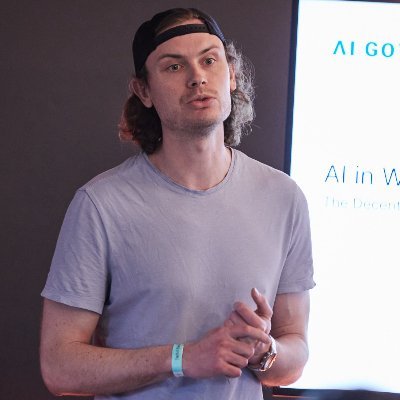
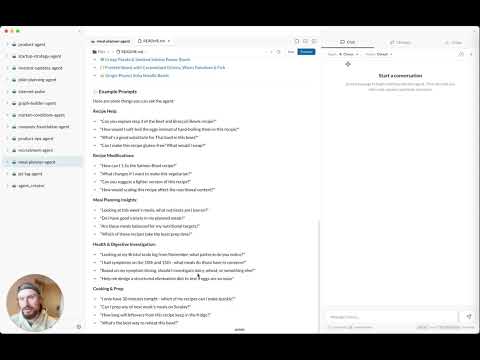
Thought people might be interested in how I've been using AI agents (Claude Code) to plan my meals, track my nutrition, and analyze symptoms. You can see a quick demo showing how I interact with it in the video, along with a link to the code, in the comments below.
Building a meal database: I add meals to a directory using whatever's convenient: photos from a cookbook, or copy-paste from PDFs or websites. I modify the recipes as needed (e.g. scale 2x for lunch leftovers, swap out ingredients that are hard to get, add more information for soft boiling vs hard boiling an egg). The agent scrapes the nutritional information for the recipe automatically via the USDA API and stores it.
Weekly planning & Nutritional analysis: When it's time to plan my week, I can either select from my meal library or let the agent suggest combinations. It then generates a shopping list broken down by category (dairy, vegetables, etc). The agent creates detailed nutrition reports showing my daily protein, micronutrients, etc. Currently, I am still manually filling my shopping cart online from the generated list (but working on automating that too).
Micronutrient tracking: I was recently researching whether I needed to invest €100/month in AG1, but after analyzing my current meal plan, it turns out I'm already getting most of my vitamins. The agent suggested a few strategic tweaks (adding sunflower and pumpkin seeds to my bowls for Vitamin E and Zinc, and a kiwi after dinner for vitamin C) to get me where I need to be. I realized I probably do need to take some Vitamin K2 supplements as it's hard to get from food here.
Symptom investigation: I've always struggled with digestive issues but could never narrow down the cause. I've been tracking symptoms using the Bristol scale (so-called log agent!) along with eczema flare ups, and from 2 weeks of data our first hypothesis is that tomatoes are the issue. Apparently tomatoes are a "nightshade" (hadn't heard of it). Starting Monday, we're running a structured elimination diet and the agent has me on plain salmon/chicken, rice and spinach until we kick off.
Still early, but AI allows me to use the time I used to spend on planning meals and creating shopping lists for higher level analysis. I'm still very much in the loop. It's no good at data analysis without me, but with it my capabilities reach much further.
English
Naptha AI retweetledi
posted this earlier as a joke (mostly). then decided to write a piece about it: "In 2025, AI became my cofounder" (see comments). then decided to start a newsletter (very cliché for Jan 2nd).
my plan is to use this to show you how agents help me to operate my startup, how to strategize and run experiments, and how to decide whether to pivot or persevere. my goal is to prove that a three-person startup can operate as effectively as large enterprises.
Richard Blythman@richardblythman
ok we're getting to that point where i think it probably makes sense to make claude code a cofounder of naptha
English
Naptha AI retweetledi

MCP Servers: Real Use Cases?
Join @richardblythman, Founder of @NapthaAI, this Friday at dAGI Summit for his keynote “Everyone’s launching MCP servers, but where are the use cases?”
Discover how MCP is being leveraged to enable richer, more intelligent interactions between developers and dev tool companies.
And how analytics, telemetry, and in-editor human-in-the-loop workflows uncover critical insights on adoption, activation, and churn.
📍 Oct 24, San Francisco, Clancy Hotel
🎟 Register here: luma.com/dagisummitsf

English
Naptha AI retweetledi
We talk about "developer experience" like it's something we design, but most of the time we're just writing about it. We've convinced ourselves that good DX means good documentation. But documentation is just content *about* the experience. It's not the experience itself. The actual experience happens in the gap between reading and doing.
Until recently, developer-focused companies had no real way to control the experience beyond documentation. The developer's environment was opaque to us. We couldn't see their setup, couldn't pass the right context at the right time, couldn't guide them through their actual workflow. But that's changing. Coding agents, AI-powered guides, and protocols like MCP are making it possible to reach into the developer's environment and actually orchestrate the experience.
We built a button for docs that says "Take the interactive experience." Click it and the tutorial comes to you: opens in your editor, walks you through it, adapts to your setup. From "read about it" to "do it with us." From content to experience. We create these guided experiences automatically from your docs. If you'd like a demo of what it looks like for your docs, reach out!
English
Naptha AI retweetledi
More agent protocols for tool calling and agent-to-agent communication are coming out. What protocols might be next as we move towards higher levels of abstraction? What would protocols for orchestration, business frameworks, or finding product-market fit look like?
Business frameworks are everywhere: Lean Startup, OKRs, Design Thinking. They give you mental models for how to think about problems. But there's a gap between understanding a framework and actually executing it consistently.
Protocols bridge this gap. AI can't execute a philosophy, but it can execute a protocol.
Take Lean Startup. The framework says "Build-Measure-Learn." The protocol says: "IF hypothesis fails validation after X experiments, THEN trigger pivot decision process involving [specific human-AI pair] within 48 hours."
Framework: "Talk to customers."
Protocol: "Customer conversations get transcribed → AI extracts insights → insights route to product team by Tuesday → product team has 48hrs to incorporate into next sprint."
I've been translating frameworks (for finding PMF) into protocols with Claude Code, making the abstract executable. The framework tells you what to think about; the protocol tells the system how to coordinate thinking about it.
Protocols specify WHO does WHAT, WHEN, with WHICH information flows, under WHAT conditions. They become coordination algorithms that route decisions, allocate attention, preserve learning across human-AI pairs.
The most interesting protocols govern human-AI collaboration itself. When does human intuition override AI analysis? What context gets preserved across different types of decisions?
If frameworks become executable protocols coordinated by AI systems, what happens to organizational culture? Does culture become encoded in protocols, or does it emerge from how protocols interact?
English
Naptha AI retweetledi
1/
Last week we made it to the front page of HN asking how well do coding agents use your libraries?
The response was great overall, but many wanted to see the code.
StackBench is Now Open Source github.com/NapthaAI/opens…
English
Naptha AI retweetledi
1/
@bbalfour just called it: ChatGPT will be the next major distribution platform.
Most founders are still fighting over saturated SEO and paid channels.
Meanwhile, the smart money is building where developers actually work.
Here's why we're about to see the biggest platform shift in a decade 🧵
English
Naptha AI retweetledi
1/
"95% of AI Pilots Are Failing" is trending on Hacker News right now. news.ycombinator.com/item?id=449411…
tldr: AI pilots fail not because the technology is bad, but because nobody learns how to use them effectively.
Here's the learning gap that's costing companies millions (and how to fix it) 🧵
English
Naptha AI retweetledi
1/ If coding agents are the new entry point to your library…
How sure are you they’re using your library well? 🧵👇
English
Naptha AI retweetledi
Who is coming to Europe for a late summer AI tour?
Sep 23-24, AI Engineer Paris, ai.engineer/paris
Sep 29-30, Curated AI Dublin Event (DM me)
Oct 2, MCP Developers Summit London, mcpdevsummit.ai
English
Naptha AI retweetledi
1/
Why aren’t your users activating?
You gave them APIs and docs… but something’s missing.
What if emerging technologies could help with that. 🧵
English
Naptha AI retweetledi
Are you building a dev tool or platform?
How well do coding agents like Cursor use it currently?
Comment about any effort you've put in to make it work better.
English
Naptha AI retweetledi

We've spent months doing R&D with MCP at @NapthaAI
MCP has a promising vision but some serious shortcomings.
My latest for the Naptha blog 👇
English
Naptha AI retweetledi
Anyone around @RaiseSummit and interested in grabbing a coffee? I'm particularly interested in hearing about problems that you face with onboarding developers to your platforms and libraries (internally or externally).
English
Naptha AI retweetledi

🚢 Build → Ship → Test for PMF → Double down or Archive.
That’s the loop. And @NapthaAI is playing it better than most.
In the last 30 days, they’ve shipped 4 new products.
Not pivots. Not whiteboard ideas. Live products, in market, with users.
Why? Because they’ve mastered the founder’s mentality:
✅ Ship fast
✅ Test traction
✅ If it sticks, invest deeper
✅ If not, archive + move on
No wasted months. No burnt runway. No emotional baggage.
This is how you find PMF without waking up 2 years in with 2 months of capital left.
🔥 Naptha AI is building the open-source stack to scale multi-agent AI systems.
But more importantly?
They’re showing Founders how to build smart, not just hard.
Big respect to the team, and @mhventures is stoked to support.
English
Naptha AI retweetledi
5/ Ultimately, the move toward multi-agent platforms signals a future where AI systems collaborate seamlessly, delivering more tailored, impactful experiences for every user wherever they work.
x.com/richardblythma…
Richard Blythman@richardblythman
1/ I love seeing companies like Grammarly competing with the largest players in tech. The recent convo on @twistartups about their acquisition of Superhuman is a must-listen. Here are a few ideas that stood out 👇 youtube.com/watch?v=4TRbIR…
English
Naptha AI retweetledi
@arizeai, SwirlAI, and @NapthaAI joined #AGNTCY to help build the foundational tech and standards for the #InternetOfAgents. See what Jason Lopatecki, @Aurimas_Gr, and Richard Blythman say about their collaboration.
Join us: cs.co/60134dB4J
#OpenSource #AIagents


English
Naptha AI retweetledi
1/ Remember when every product came with a thick, definitive manual? Those days are gone—manuals quietly faded away, replaced by bite-sized, on-demand help. But what if they’re on the verge of making a comeback? 👉🧵
English