Nathan D.

20.2K posts

Nathan D.

Nathan D.

@NateDOhDoubleG

Katılım Haziran 2010
357 Takip Edilen75 Takipçiler
Nathan D. retweetledi
Anish Moonka
Anish Moonka@anishmoonka·
Winston Churchill fought his depression with bricks. He'd lay them for hours at his country home in Kent. He joined the bricklayers' union. And in 1921 he wrote about why it worked. It took psychology another 75 years to catch up. He called his depression the "Black Dog." It followed him for decades. His method for fighting it back was as basic as it sounds: laying brick after brick, hour after hour. Churchill spelled out his theory in a long essay for The Strand Magazine. People who think for a living, he wrote, can't fix a tired brain just by resting it. They have to use a different part of themselves. The part that moves the eyes and the hands. Woodworking, chemistry, bookbinding, bricklaying, painting. Anything that drags the body into a problem the mind can't solve by itself. Modern psychology now calls this behavioral activation. It's one of the most-studied depression treatments out there. Depression sets a behavior trap. You feel bad, so you stop doing things, and doing less means less to feel good about. Feeling worse makes you do even less. The loop tightens until you can't breathe inside it. Behavioral activation breaks the loop from the action side. You schedule the activity first, even when every part of you doesn't want to. Doing it produces small rewards: a wall gets straighter, a painting fills in, a messy room gets clean. Those small rewards slowly rewire the brain. Action comes first, and the feeling follows. Researchers at the University of Washington put this to the test in 2006. They studied 241 adults with major depression and compared three treatments: behavioral activation, regular talk therapy, and antidepressants. For the people who were most severely depressed, behavioral activation matched the drugs. It beat the talk therapy. A 2014 review of more than 1,500 patients across 26 trials backed up the result. Physical work like bricklaying does something extra on top of this. It crowds out rumination, the looping bad thoughts that grind people down during the worst stretches of depression. Bricklaying needs both hands and gives feedback brick by brick: each one is straight or crooked. After an hour you can see exactly how much wall you built. No room left for the mental chewing. The line George Mack used in his post, "depression hates a moving target," is good poetry. The science behind it is sharper. Depression hates a brain that has somewhere else to be.
George Mack@george__mack

Winston Churchill used to lay 200 bricks per day to keep his mind busy when feeling down. Depression hates a moving target.

English
850
11.6K
56.3K
6.9M
Nathan D. retweetledi
Anish Moonka
Anish Moonka@anishmoonka·
The cathedral in this video is only standing because of one man. In 1906, a deep-sea diver in a 200-pound suit climbed down into pitch-black water under the building and started laying bags of cement by hand. Six hours a day. In total darkness. For five years. His name was William Walker. By the early 1900s, the cathedral was sinking. It was built in 1079 on what used to be a riverbed. The medieval builders knew the ground was soft, so they laid the foundations on wooden logs. That worked for 800 years. Then the wood rotted. Cracks opened in the walls. Some were big enough for owls to roost in. Stones started falling from the ceiling. The architect's report said the east end was going to collapse. The fix was supposed to be simple. Dig out the rotted wood. Pour concrete. But every time workers dug a trench, it flooded with groundwater. Even powerful steam pumps couldn't keep up. So the engineer in charge, Francis Fox, suggested something nobody had tried. Send a diver down there. A man in a sealed suit, breathing through a hose from the surface, could lay sacks of cement at the bottom of the trench. Once the cement set, the water could be pumped out and bricklayers could finish the job. Walker took the contract. He worked 20 feet under the surface. The water was so muddy that even at noon he couldn't see his own hands. He worked by touch. By 1911 he had laid 25,800 bags of cement, 114,900 concrete blocks, and 900,000 bricks under the cathedral. All of it by himself, in the dark. Every weekend he cycled 70 miles home to South London to see his wife and kids. Every Monday he took the train back and got back in the suit. When the work was done, King George V handed him a silver bowl in front of a packed cathedral. Walker said the whole thing made him uncomfortable. He died six years later in the Spanish flu pandemic. His gravestone in London reads: 'The diver who with his own hands saved Winchester Cathedral.' The statues in those alcoves were also carved much later than the building. They went up in the 1880s and 1890s. The medieval originals had been smashed in the 1540s. One of the new statues is Queen Victoria. So that feeling of 'this is incredible for something 500 years old' is only half right. A lot of what's in that frame is from the 1880s. And the building holding it up is only still standing because of one man and a hose.
World Scholar@WorldScholar_

It's unbelievable how this level of detail is possible today, let alone 500 years ago. How do you even fathom building something like this? Winchester Cathedral, England.

English
29
565
3K
161.9K
Shane Cashman
Shane Cashman@ShaneCashman·
Headless human bodies, infinitely cloned mice, schizophrenic crackheads, alien hybrid breeding programs, a vampire in Singapore, swords attached to drones, Kristi Noem’s cross-dressing husband, 200-year-old tortoise caught up in a crypto scam, Artemis II crew locked inside a big soda can, $23 million toilet breaks in fake space, two crows eat Rapunzel’s hair, Lindsey Graham drinks blood at Disney to celebrate war, 14-year-old runs for governor in Vermont, Gucci Mane kidnapped, influencer kidnapped herself at gunpoint, scientists plotting to kidnap asteroids, slaughterhouse theft rings on the rise because cow gallstones are worth more than gold, missing U.S. airman in Iran, F-35 crash in Nevada, flying saucer over Philadelphia, giant robots battle in Detroit, robot centaurs in China, portals to Waffle House, and they want to put pig semen in your eye to cure cancer—how was your week?
English
250
666
3.8K
196.4K
Nathan D.
Nathan D.@NateDOhDoubleG·
Math is the Word. In the beginning there was the Word, and the Word was God. @ShaneCashman
The Curious Tales@thecurioustales

If Earth lost gravity for seven seconds, you wouldn’t float peacefully above your kitchen floor. Every ocean on the planet would simultaneously abandon its basin, and the atmosphere would begin dispersing into space. The viral claim about August 12, 2026 is not being seriously examined by scientists as a genuine possibility. It is being seriously dismantled. Gravity is not a setting that toggles. It emerges from the mass of Earth itself, roughly 6 septillion kilograms of rock, iron, and molten metal pulling everything toward its center at 9.8 meters per second squared. That force does not schedule interruptions, and no known force in the universe can suspend it temporarily without destroying the planet entirely in the process. For gravity to pause even briefly, Earth’s mass would have to vanish, not merely reduce. No planetary alignment, solar flare, or astronomical configuration on any known calendar produces that outcome. The planets are tracked with enough mathematical precision that a gravitational disruption of this magnitude on a specific future date would already appear in orbital calculations made today. Nothing points to August 12. What scientists genuinely investigate regarding gravitational anomalies involves gravitational waves, ripples in spacetime produced by colliding black holes and neutron stars billions of light years away. LIGO first detected them in 2015. Those waves stretch and compress spacetime by distances smaller than a single proton. You would not feel them. You would absolutely not float. The reason this hoax returns every few years under different dates is simple psychology. Weightlessness is one of the most viscerally appealing ideas the human brain generates. It reads as total freedom, freedom from everything, literally. The body wants it to be real, so the mind lowers its verification threshold and shares the claim before examining it. The universe runs on math, and the math on this one closed a long time ago.

English
0
0
0
30
Nathan D. retweetledi
Savitri Mumukshu - सावित्री मुमुक्षु
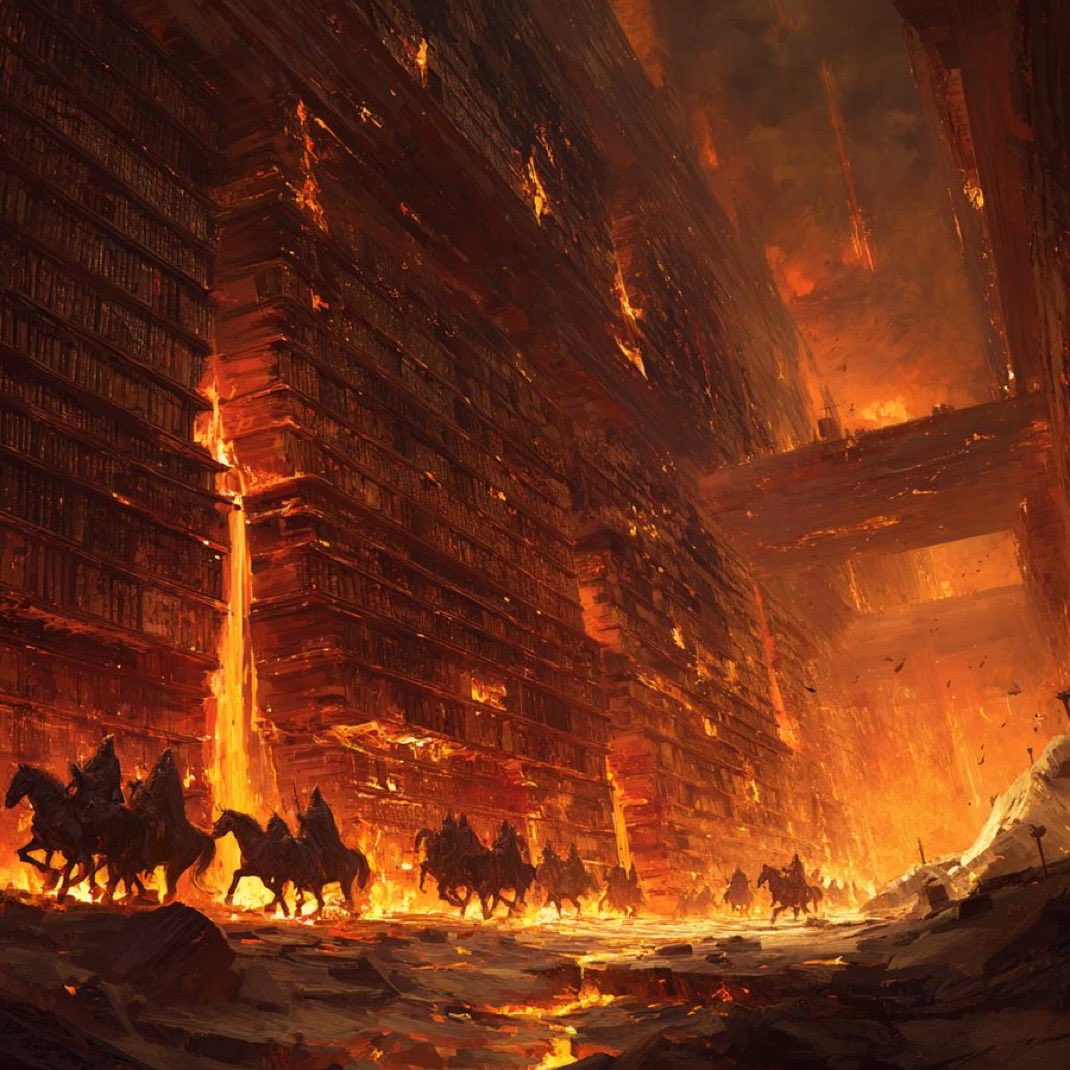
If Iran finally gets liberated it truly will be Karmic rebalancing. The 7000 year old civilization of Persia was doomed the moment that Islam ravaged it. The history of Iran after Islamic conquest was a bloody saga of murderous genocide, oppression, misery and massacre. Every vestige of Persia's original culture was forcibly erased by the sword to ensure Islam's domination When the Muslim army first saw the vast library of Ctesiphon, the commander Saad ibn-e Abi Vaghas, asked Caliph Omar what to do with the books. Omar’s reply sealed the fate of Persian knowledge: “If the books contradict the Koran, they are blasphemous and if they are in agreement with the Koran, then they are not needed, as for us only Koran is sufficient.” With that, the huge library was destroyed and knowledge systems of generations of Persian scholars were burnt to ashes or thrown into the Euphrates. Millennia of science, philosophy, medicine, poetry and literature were erased in the pillage. Irreplaceable libraries of Khwarezmia, Ray, Khorassan & many others were burned to the ground, world famous universities like Gondishapour were decimated, and scholars butchered like flies. A civilization that once rivaled Greece and India in learning had its soul ripped out by a swarm of fanatic beasts. Genocidal massacres became state policy. Entire cities were wiped out, captives hanged by the millions, women and children sold in slave markets, and Zoroastrians taxed into submission under the jizya system. Those who converted weren’t welcomed - the Muslims branded them as Mawali, “freed slaves,” barred from all dignity or rights. The Persians were called Ajam, “mute” in a horrifying testimony to their complete powerlessness and erasure of their language, identity, and existence. By the order of Yazid ibn-e Mohalleb in Gorgan so many Persians were beheaded that their blood mixed with water would power the millstone to produce as much as one day's meal for him. One Umayyad Caliph even stated, “Milk the Persians, and when the milk runs dry, suck their blood.” This was not a clash of empires - it was a scorched-earth murderous crusade to crush an ancient civilization and rewrite history under the banner of Muslim victory. Persia wasn’t just conquered. It was gagged, gutted, and ground into the desert. And the smoke that rose from its burning books marked the silence that has lasted for centuries even till today. The Iranian people deserve freedom from the Ayatollahs of the Islamic regime. The original Persia deserves to live again.
Savitri Mumukshu - सावित्री मुमुक्षु tweet media
عبدالله موسولچی@Mosolchi

Ilhan, just for your information We Iranians don't give a shit about Ramadan I'm having lunch right now We are waiting for the US attack to overthrow your friend the Ayatollah

English
150
1.6K
5.2K
257.7K
Nathan D. retweetledi
Megha
Megha@megha_lilly·
Anime is interesting because western boys are given no such encouragement and power from western culture anymore. Strength, heroism, endurance, will and wrath are all ideas that feminism and marxism has stripped from western culture. This is why Emily Wilson and Hollywood are so threatened by the Odyssey and need to cut it down. Meanwhile, little western boys learn how to be brave, how to be a good friend and how to be strong from Naruto, HunterXHunter and Attack on Titan.
AKIRA THE DON@akirathedon

English
321
1.5K
21.5K
863.6K
Nathan D. retweetledi
Orpheus
Orpheus@DiscoOrpheus·
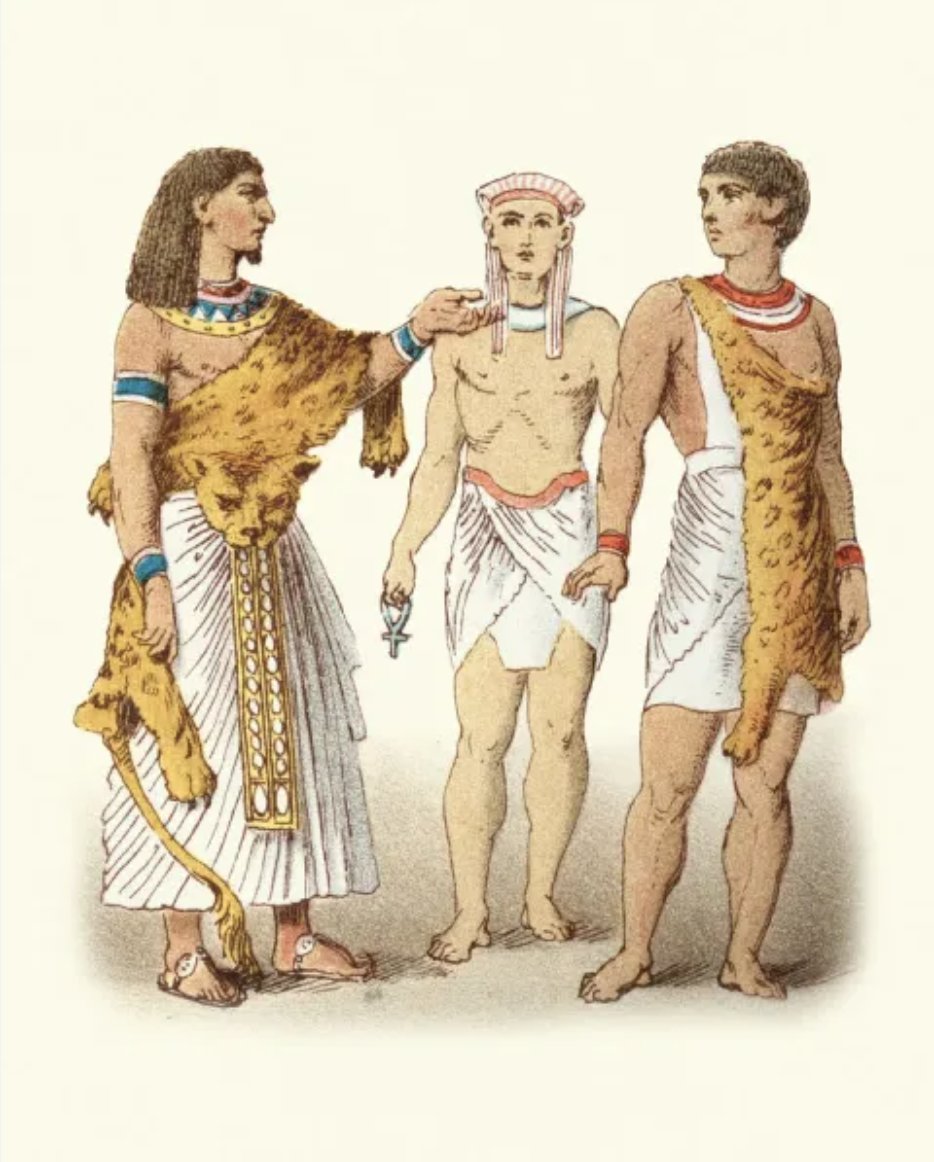
When the Celtic Druids met the Egyptian Priests, they had no problem understanding each other They could speak about "the harmony of the spheres" together, they could look at the same sky and imbibe the same lore, the same meaning, the same inference According to Diogenes Laertius: "The Druids taught that the ideal for people was to live in harmony with nature and themselves, accepting that pain and death were not evil but essential...and that the only evil was moral weakness." There message to the common people was, "Revere the gods, do not do evil to each other, and exercise courage."
Orpheus tweet mediaOrpheus tweet media
English
35
212
1.7K
61.5K
Nathan D. retweetledi
Dr. M.F. Khan
Dr. M.F. Khan@Dr_TheHistories·
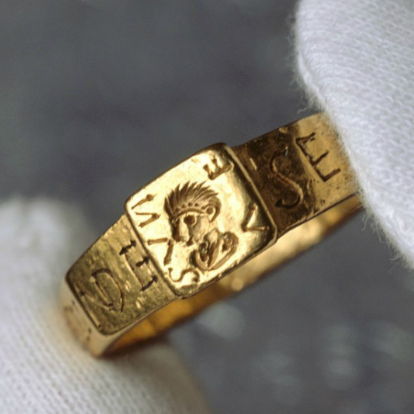
In late 18th Century, a curious gold ring was dug up on farmland near Silchester in England. The ring bore the name “Senicianus” and a small engraved image. For decades it was simply an odd relic from the Roman past, its story unknown. Then, more than a century later, archaeologists uncovered a thin lead tablet at the Roman temple complex of Nodens in Lydney Park, miles away from where the ring had been found. The tablet contained a curse written by a man named Silvianus. It asked the god Nodens to deny health to anyone who bore the name Senicianus until the stolen ring was returned to the temple. This was a typical Roman curse tablet, a way for victims of theft to call on divine justice when earthly justice was out of reach. The ring and the tablet seemed to fit together like two halves of a forgotten dispute from Roman Britain, preserved in metal and lead for centuries. When the temple site was studied in the 1920s, one of the scholars asked to examine the strange names and inscriptions was an Oxford professor named J. R. R. Tolkien. He was consulted as an expert in languages, and the eerie connection between a cursed ring and a mysterious name has often been noted as an intriguing coincidence in the life of the man who would later write about one of the most famous rings in literature. #drthehistories
Dr. M.F. Khan tweet media
English
81
1.1K
6.9K
262K