Neha Narula

5.9K posts

Neha Narula

Neha Narula

@neha

I work on scaling systems and platforms for the internet. Director of Digital Currency @medialab, BoD @blocks. PhD from @MIT_CSAIL, formerly @digg, @google.

Cambridge, MA // NYC Katılım Temmuz 2006
2.2K Takip Edilen45.9K Takipçiler
Neha Narula retweetledi

Macro Musings
Macro Musings@Macro_Musings·
New episode! Neha Narula, Anders Brownworth, and Daniel Aronoff on Understanding Stablecoins in the GENIUS Era Watch @neha, @anders94, @danaronoff, and @DavidBeckworth discuss their work at DCI, the current state of stablecoins, their paper on the hidden plumbing of stablecoins, the basic mechanics of stablecoins, the technical and operational risks of stablecoins, the implications for the treasury market, interoperability between blockchains, and much more. youtu.be/7IxjJAPQFb8

YouTube video
YouTube
English
2
3
15
8.3K
Hannah Rosenberg⚡
Hannah Rosenberg⚡@hmichellerose·
If I ever quit tech I think I'd run one of those hippie dippie wellness retreats, but like w/ science. So you can totally bring your crystals, but we also have Cognitive Behavioral Therapy & anti-inflammatory food. Chant whatever you want but you have to do your EMDR session! It won't cost an obscene amount cuz it's just some shack on the side of a mountain in Peru. So you just have to get down there then it's like $250! 🧘🏻‍♀️⛰️
English
3
0
17
808
Neha Narula retweetledi
Michael Mosier
Michael Mosier@m_mosier_·
Meaningful recognition of the legitimacy & importance of privacy as security in todays US Treasury "Report on Innovative Methods To Detect Illicit Activity Involving Digital Assets" (p.8):
Michael Mosier tweet media
English
23
49
221
93.8K
Neha Narula
Neha Narula@neha·
@VitalikButerin I think this is missing that state is the *result* of computation on data. In the extreme you could avoid materializing state (UTXO set, state trie) and recompute from the data (blockchain) each time you needed to access it. That doesn't help you scale.
English
0
0
0
216
vitalik.eth
vitalik.eth@VitalikButerin·
The scaling hierarchy in blockchains: Computation > data > state Computation is easier to scale than data. You can parallelize it, require the block builder to provide all kinds of "hints" for it, or just replace arbitrary amounts of it with a proof of it. Data is in the middle. If an availability guarantee on data is required, then that guarantee is required, no way around it. But you _can_ split it up and erasure code it, a la PeerDAS. You can do graceful degradation for it: if a node only has 1/10 the data capacity of the other nodes, it can always produce blocks 1/10 the size. State is the hardest. To guarantee the ability to verify even one transaction, you need the full state. If you replace the state with a tree and keep the root, you need the full state to be able to update that root. There _are_ ways to split it up, but they involve architecture changes, they are fundamentally not general-purpose. Hence, if you can replace state with data (without introducing new forms of centralization), by default you should seriously consider it. And if you can replace data with computation (without introducing new forms of centralization), by default you should seriously consider it.
English
445
240
1.8K
182.9K
Neha Narula retweetledi
Nariman Gharib
Nariman Gharib@NarimanGharib·
Exclusive: Obtained Starlink terminal debug data from Iran during the ongoing internet shutdown. The telemetry shows direct evidence of GPS spoofing: the dish detected 18 GPS satellites with valid signal lock, but activated its anti-spoofing countermeasures (inhibitGps: true). This isn't simple jamming; the government appears to be broadcasting fake GPS signals to confuse terminals. The impact: 20%+ sustained packet loss, connection never stabilized after 24 minutes, bandwidth restricted, and beam pointing ~1° off target. Starlink stayed online but was barely usable. The anti-spoofing detection works, but SpaceX's fallback positioning can't currently maintain normal performance under electronic warfare. First documented technical evidence of state-level GPS spoofing against consumer satellite internet. github.com/narimangharib/…
Nariman Gharib tweet media
English
1
1.6K
6.2K
691.4K
Neha Narula
Neha Narula@neha·
@bhalligan @tjparker fwiw I don't think #1 is an issue. SF and NYC are both way more expensive than Boston and yet better for startups. I think it is #2, but even more so density and mentorship. When I lived in SF/SV you tripped over VCs and people in tech and starting companies. It was a default.
English
0
0
0
47
Brian Halligan
Brian Halligan@bhalligan·
@tjparker Wasn't aware of some of those policy issues. I see it as two main things: 1. Its too expensive. Build housing. 2. Its not fun. Fix happy hours, open later, fix liquor licenses. There's nothing we can do about the cold winters, but we can make a nice dent in those 2 issues.
English
4
0
4
553
Brian Halligan
Brian Halligan@bhalligan·
I did a bunch of analysis of the AI 50 produced by Fortune this year (not perfect, but vaguely right). Of the 50 companies listed, 2 are Boston (actually Cambridge), Suno and OpenEvidence. OpenEvidence is headquartered in Miami. So, 1 out of 50 is actually in Greater Boston. Thank you @MikeyShulman! 17 of the 50 top ai companies have founders that went to school in Boston. The average age of those 17 founders was 28.5 years old when they started the company. We need to make Boston a great place to start a company. We need to make Boston an extremely attractive place for new grads to put down roots. There is a lot to like about Boston! A bunch of us are getting together on Wednesday night to talk about it. This is a problem worth solving. Lets continue discussing, debating, and engaging on how to improve the region. I'd like to see some of the elected officials who are DM'g me weigh in here.
Brian Halligan@bhalligan

I’m starting to worry about Massachusetts 1. Biotech is way off from a few years ago 2. Only 1 of the top 50 ai companies are in MA 3. The Fed research funding cuts hitting MIT, Harvard, Whoi are brutal. 4. The millionaires tax is working in the short run, but I know a lot of wealthy folks preparing for a FL move. 5. A glut of empty condos 6. It’s not “cool” for young folks 7. It’s expensive as sh-t. I honestly don’t think the MA/Boston govt can do that much about it as they are kind of macro issues. I give them big credit for working on building more housing and fixing the T, which will help. I’m trying to help w HubSpot, partnering w WHOI, teaching at MIT. I’d like to help more. Specifically I’d like to encourage and help more ai and climate companies in the state. I think ai and climate should be our dual growth engines.

English
77
14
268
97.7K
Rick Dudley (afdudley.eth)
Rick Dudley (afdudley.eth)@AFDudley0·
@xCryptoAlucard Regardless of gender, S-Tier wordcels are far more rare than S-Tier shape rotators, but A-Tier wordcels and shape rotators are about equal. Similarly, it's the distribution genius women and the general obliviousness to it that's note worthy to me.
English
1
0
2
215
Rick Dudley (afdudley.eth)
Rick Dudley (afdudley.eth)@AFDudley0·
If I was a better writer, I'd write a short essay on how many genius women I've met working in crypto and how no one seems to notice.
English
9
4
39
3.2K
ria bhutoria
ria bhutoria@riabhutoria·
I’ve been thinking about how AI agents will make payments A lot of people say agents need stablecoins. Wallets are easier to spin up than bank accounts; stablecoins are more programmable, composable, etc. At the same time, Stripe is powering agents on existing rails (like with Perplexity), and companies like Nekuda are building SDKs on top of card networks. I'm trying to develop a clearer POV on which setup actually works better today - what's the best writing or thinking on this?
English
15
3
62
7.8K
calle
calle@callebtc·
at a cypherpunk conference. some thoughts: - interesting humans with many different backgrounds: hacktivists, cryptographers, civil society activists, infrastructure guys, electronic voting people, vpn people, tor devs, solarpunks, radio comms, file sharing, internet archive, general freedom tech, and many more. - bitcoin is mentioned all the time but there are practically no bitcoiners in sight. I'm the bitcoin guy now. - everyone knows about nostr. people are very interested in it. maybe 2-3 nostr users are here, no devs. many people representing bluesky. I'm the nostr guy now. - many people know about cashu and bitchat. lots of excitement. - many synergies, lots of groups and companies working together. the urgency is obvious. cypherpunk vibes are strong. verdict: bitcoin and nostr are severely under-represented in communities where a lot of important work is done. shitcoin phobia isn't a good reason to not engage in a much larger discourse about privacy, freedom, and technology. we haven't lost the plot but there's a lot more to do.
calle tweet media
English
24
34
374
21.7K
Sheharyar Malik
Sheharyar Malik@the_city_dude·
@neha hey neha! is the updated course being uploaded somewhere yet? I could only find the 2018 version for now
English
1
0
0
38
Neha Narula
Neha Narula@neha·
We’re launching DCI Global, a nascent research network to study real-world Bitcoin & stablecoin use, starting with a joint MIT–UnB open-source course to build global capacity.
English
12
25
103
26.7K
Neha Narula
Neha Narula@neha·
@rohangrey @gladstein I was *not* slighting comprehensive answers -- merely providing them in the tweet thread format. I appreciate comprehensive answers, and now that we've moved to the doc I'm hoping it will be a bit easier to read and digest.
English
0
0
1
47
Rohan Grey
Rohan Grey@rohangrey·
@neha @gladstein To give a more comprehensive answer it's "this is an essay omg". Can't win either way, and id prefer to *not* do the kind of response that this shorthand medium would normally have in this scenario, which is to be as glib and reductive in response as the thing being responded to
English
1
0
0
89
Neha Narula
Neha Narula@neha·
@rohangrey @gladstein Implicit in this is "Many people seem to think this is interesting and useful, so I'd like to understand it better and please help do that, if you have the energy and time (which I appreciate). But unfortunately (no fault implied) what you've said so far is not helping me.
English
1
0
0
44
Neha Narula
Neha Narula@neha·
@rohangrey @gladstein I left six (one of which was a correction). A bit different than an essay! Anyway, I have done exactly what you suggest (changed the format). If this doc doesn't work for you just let me know (and send me your email address if you'd like edit access)
English
1
0
0
68
Rohan Grey
Rohan Grey@rohangrey·
@neha @gladstein Neha, you were the one who left multiple different replies to my initial tweet! I put the response in a single thread in the same forum as you first contacted me. With respect, if you want an easier way to discuss complex ideas than a long tweet thread don't discuss them here
English
1
0
0
74
Rohan Grey
Rohan Grey@rohangrey·
@neha @gladstein Crypto etc, even as most of their economic critiques remain sound. But wouldn't be the first time people w otherwise good frameworks downplayed the cultural significance of new technologies, and the associated transformative economic effects that come with it.
English
1
0
1
104
Neha Narula
Neha Narula@neha·
@rohangrey @gladstein > "instead locating both its historical origins (empirical claim) and core logic (theoretic claim) in legal acceptance by public authorities of nominal tokens" if you start with this, then how do you explain forms of money that have popped up with the existence of a state?
English
1
0
0
159
Neha Narula
Neha Narula@neha·
@rohangrey @gladstein because I would *not* describe mainstream economics views on money today as based in "precious metals and bartering of commodities." they definitely emphasize the role of central banks and credit. but they do not identify with MMT.
English
0
0
0
93
Neha Narula
Neha Narula@neha·
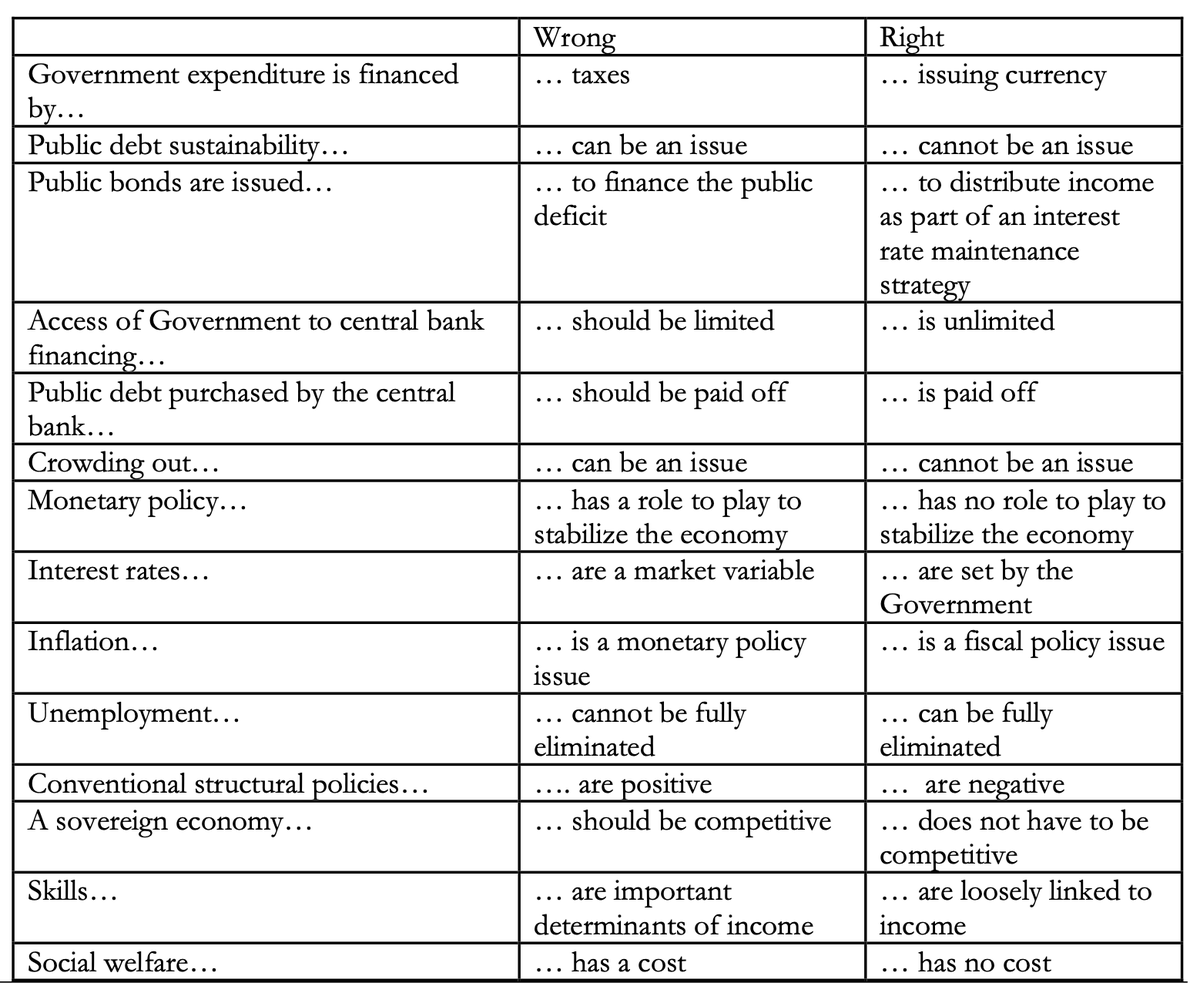
@rohangrey @gladstein it sounds like you disagree with the characterization of MMT in this article, which is kind of summarized in this chart. is that correct? if so, how would you define MMT, in particularly emphasizing the difference from *mainstream* economics views on money today (not metallism)?
Neha Narula tweet media
English
2
0
0
167