

Daniel Aronoff
1.7K posts
Daniel Aronoff
@danaronoff
Research Scientist MIT. PhD Economics MIT. BSc Philosophy & Econ 1st Class Honors LSE. Areas: Market Design, Cryptography and Digital Currencies.
Katılım Nisan 2009
50 Takip Edilen208 Takipçiler

Double/debiased learning operates entirely at the estimation layer, not at the identification level.
In particular, it assumes that the causal parameter is already identified, typically via an ignorability or back-door type condition Y_x _||_ X | Z. Under that assumption, the effect can be written as a functional of the observed data, and the role of DML is to estimate this functional in a way that is robust to misspecification of nuisance components (e.g., the outcome or propensity models).
So the "de-biasing" refers to orthogonalizing the estimation problem with respect to these nuisance functions. Here, “orthogonality” is in the Neyman sense: the score for the parameter is constructed to be locally insensitive to errors in nuisance estimation, not to violations of causal assumptions. It does not address bias due to unobserved confounding.
From the perspective of our paper, the key issue arises earlier: whether assumptions like ignorability are actually justified. DML takes that as given, while our focus is on making those assumptions structurally transparent and assessable.
English

They statement "one starts from a structural model and derives potential outcomes" is a bit misleading. True, those who know structural models can derive any needed PO. But do they need to? Once you have an SCM, you can derive all answers directly from it, no need to go to PO (unless your editor is a PO priest). Conversely, those who do not know SCM, never derive PO's, they just posit them for mathematical convenience, to get the result they want, not because they are judged to be plausible (confessed by PO researchers).
Elias Bareinboim@eliasbareinboim
The "fast food vs slow food" analogy is indeed quite good, and you can literally see it in Fig. 1 (attached) of causalai.net/r120.pdf, where potential outcomes sit downstream of an SCM. But I think this is a bit too simplistic, the relationship is more nuanced than that. It is not just that "one starts from a structural model and derives potential outcomes." The two operate at different levels of abstraction. PO is a compressed representation of the underlying causal model, and like any compression, it inevitably discards structure. That loss is exactly where the trouble begins. Statements like Yx _||_ X | Z look deceptively simple, but assessing them may implicitly require reasoning over a combinatorial number of causal configurations within Z. In practice, this is almost never done explicitly, which is why ignorability often becomes an article of faith rather than a testable judgment. So the issue is not that abstraction is bad; it is that the current abstraction hides the very structure needed to justify it. There is a beautiful possibility here to get the best of both worlds: retain the coarse, operational view that makes PO attractive to so many, while making just enough structure explicit so that assumptions like ignorability can actually be assessed (e.g., via CG(3)). Curious how @yudapearl , @VC31415, and @guido_imbens see this; this tension between abstraction and interpretability has been long-standing, and the paper offers a concrete way to reconcile the two by identifying the right level of structure.
English
@bryan_caplan It is because they oppose Jews. No Jews, no news (notice how little press is devoted to the protesters in Iran or the victims of Houthi’s etc…
English
Standard estimate say there are 20-30k Hamas members.
Yet this tiny, impoverished, militarily feeble group has indirectly dominated not just headlines but world history for almost 3 years.
What a weird world.
English
@HillelNeuer How would Gutierres “know” what Israel’s strategy was? Did the Israeli government publicly announce it or privately consult him? He is just shouting blood libel against the Jews at every opportunity. Btw he has expressed no human concern for the prople of Iran.
English
“Israel’s strategy was to draw the U.S. into a war,” says UN's António Guterres.
This is false—and deeply irresponsible.
It infantilizes America and blames Israel for a war driven by Iran’s pursuit of nuclear weapons, calls to destroy the U.S. and Israel, and global terrorism.

Sam Coates Sky@SamCoatesSky
Israel drew US into war, claims UN Sec Gen to @annemcelvoy
English
@McFaul @RushDoshi Iran is a pathway for China to become dominant in the ME . You must be aware that China is the largest purchaser of Iran’s oil and its principal supplier of critical munitions components and that it allegedly intended to supply Iran with anti-navel cruise missiles.
English

Professor @RushDoshi outlines in detail the biggest challenge to American interests in the 21st century. Yet, instead of focusing on China, Trump has launched another war of choice in the Middle East. Good way to lose the 21st century.
Rush Doshi@RushDoshi
On Tuesday, I testified before the House Homeland Security Committee on China's strides in robotics and AI. I warned that we lost solar, batteries, and EVs -- now we're at risk of losing robotics and AI. If that happens, it would irreversibly change the balance of power. Five points: 1️⃣ China aims to win the next industrial revolution. PRC leaders believe history is shaped by industrial revolutions. The first, steam power, made Britain dominant. The second and third, electrification and mass manufacturing, made America dominant. China is determined to win the fourth. 2️⃣ In robotics, China is already winning. In 2024, China installed 300,000 new industrial robots. America installed 30,000. China now has over 2 million robots in its factories — five times more than the US. A decade ago, it imported 75% of its robots. Today it makes 60% domestically. This year alone, China may spend $400 billion on industrial policy. The entire US CHIPS Act provided $50 billion across multiple years. If we fall behind here, U.S. reindustrialization becomes farfetched. 3️⃣ In AI, we're ahead — but selling off the advantage. China has more energy, more talent, and makes the edge devices. But America still leads because of chips, according to China's own AI companies. US chips are 4-5x better than China's today. We are debating whether to surrender that edge. 4️⃣ We are inviting risks of cyberespionage and catastrophic cyberattacks. PRC law requires its companies to cooperate with intelligence services and never disclose it. Today's robots carry LiDAR, microphones, and cameras — they are mobile surveillance platforms. But the bigger risk is cyberattack. We know China has compromised our power, gas, water, telecommunications, and transportation infrastructure in preparation for cyberattack. We cannot deploy robots in sensitive facilities from the very country targeting those facilities. 5️⃣ Here's what we must do. Extend ICTS rules to cover Chinese robots. Direct CISA to audit where they're deployed in critical infrastructure. Ban federal procurement of Chinese robotics and AI. Strengthen semiconductor export controls. Stop treating American AI companies with more regulatory scrutiny than Chinese ones. And build allied scale in robotics—a trading bloc with preferential terms for the members that can rival China's scale in in the sector. Thanks to @HomelandDemsIt and @HomelandGOP for the hearing on this topic, and grateful to join @MRobbinsAUVSI and colleagues from Scale and Boston Dynamics for a great discussion.
English
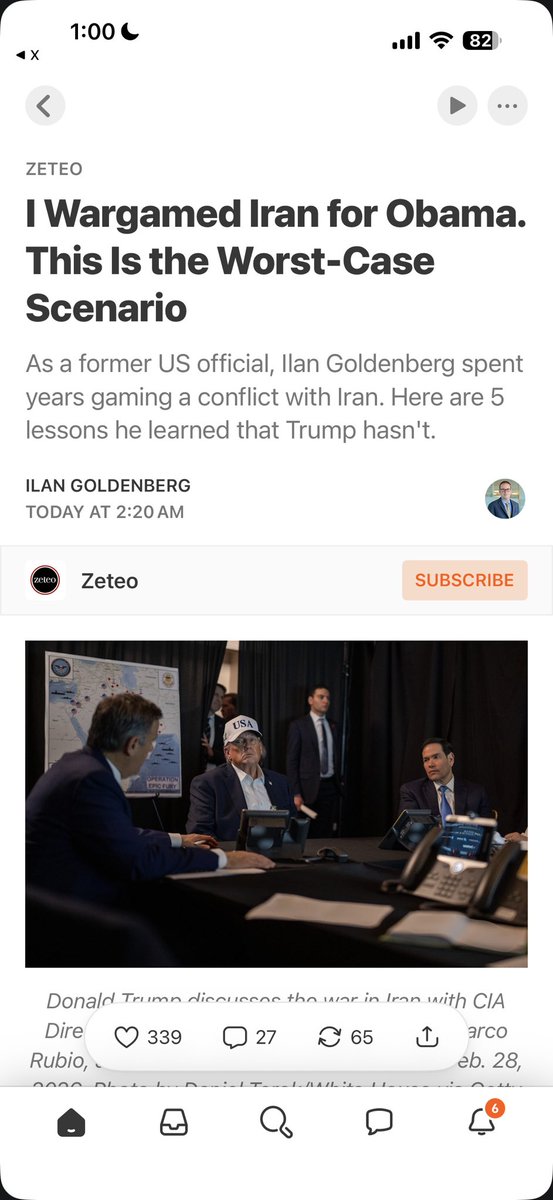
@YashengHuang In addition, Goldenberg commits a fatal methodological error (which I am surprised you do not notice): nowhere does he evaluate the risk in the baseline case of taking no military action. Therefore, he does not provide a useful analysis.
English

If this is the way he has waged a war of choice, I shudder to think how he is going to wage a war of necessity.
English
@McFaul Enriching the Iranian regime? Aren’t you worried about your credibility as an academic and supposed expert on this matter? Anyone who can count beans knows your assertion is beyond comprehension.
English
Remember when Republicans ridiculed Obama for lifting some sanctions because Iran agreed to limits on its nuclear program?
Now, Trump is enriching the Iranian regime that is attacking our partners and us.
Let's see if those same critics voice their objection now to lifting sanctions on Iran. I'm expecting crickets.
Aaron Rupar@atrupar
Bessent: "We unsanctioned Russian oil ... in the coming days, we may unsanction the Iranian oil that's on the water"
English
@YashengHuang Ilan Goldenberg is not a reliable source. He is a political operative wo military experience. There is a danger of selection bias in finding sources on this matter.
English
@McFaul Amazing you do not recognize that Europecis a beneficiary of stripping Iran of its nuclear capability (as the German Chancellor recognizes) and that the US is the largest financial contributor to NATO and the BATO countries live under the protection of the US nuclear umbrella
English
Trump won't share the burden with NATO allies of providing economic and military aid to Ukraine in its fight against Russia -- a genuine threat to NATO -- but Trump begs NATO allies to share the burden of his war against Iran. Amazing.
English
@McFaul How about them changing their ways? Their attitude is suicidal - for them, not for us.
English
Shocking. But also reversible if we change our ways.
Jostein Hauge@haugejostein
This is wild. People in *every single one* of the top US allies now think it's better to depend on China than the US. The global balance of power is clearly tilting away from the US and toward China.
English
@jpodhoretz Naive question: if the Jews murder anyone with a big platform who speaks against Israel, how is it that Tucker &co are still on the airwaves?
English

Wow.
Joe Kent just revealed the last thing Charlie Kirk said to him:
"Joe...6-7."
Holden Culotta@Holden_Culotta
Wow. Joe Kent just revealed the last thing Charlie Kirk said to him: “The last time I saw Charlie Kirk on this Earth was in June, in the West Wing.” “He looked me in the eye and he said … Joe, stop us from getting into a war with Iran.” “One of President Trump’s closest advisors was vocally advocating for us to not go to war with Iran and for us to rethink, at least, our relationship with the Israelis.” “And then he’s suddenly publicly assassinated and we’re not allowed to ask any questions about that?” “The investigation that I was a part of [with] the National Counterterrorism Center, we were stopped from continuing to investigate.” “But there was still a lot for us to look into that I can’t really get into.” “There’s unanswered questions.” “We know, because of the text messages that have been made public, that Charlie was under a lot of pressure from a lot of pro-Israel donors.” @joekent16jan19 @TuckerCarlson
English
@McFaul Yup. He chooses not to allow Iran to become a nuclear armed ally of China with a chokehold on world energy supplies. And your counter idea is…?
English
Wow. Trumps war of choice is not cheap. washingtonpost.com/national-secur…
English
@Doranimated @GadiTaub1 Keep your promise! The most erudite discussion on the Middle East anywhere…DO NOT DROP THE HUMOR
English

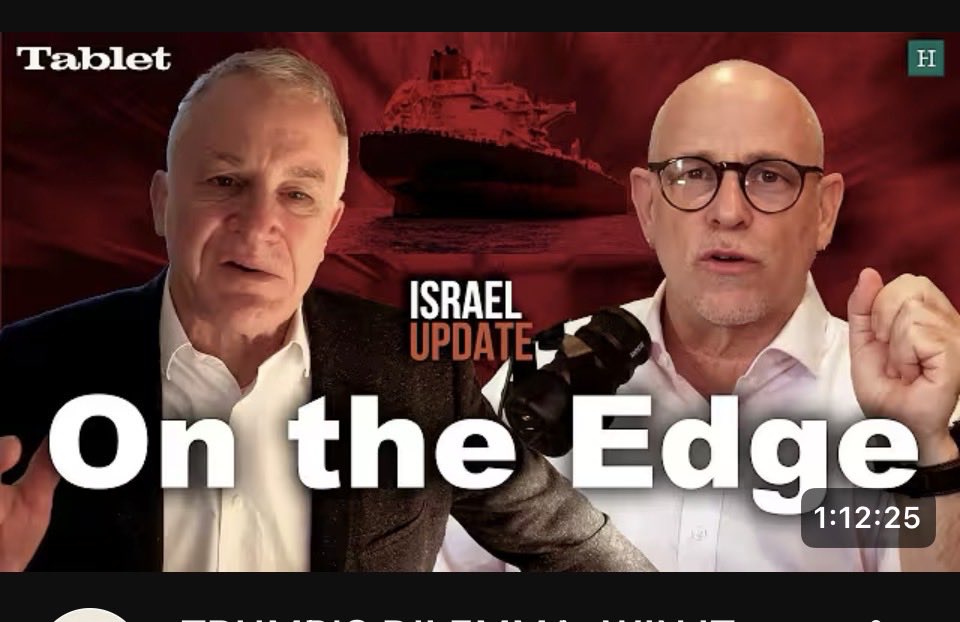
We promised — @GadiTaub1 and I — to put out one video per week, and we are sticking to it! The latest episode of Israel Update is out!
English
@McFaul After 47 years of terror and unrelenting drive toward asymmetric weapons and threshold nuclear capability with the goal of annihilating Israel and blackmailing the world (while supplying Russia w drones to use against Ukraine), what “alternative” do your propose?
English
No war is ever easy.
No war ever goes as planned.
That's why war should always be a last resort, after all other instruments of American power for achieving our security interests have been exhausted.
NewsWire@NewsWire_US
TRUMP ADMINISTRATION CONSIDERING DEPLOYING THOUSANDS OF ADDITIONAL US TROOPS TO MIDDLE EAST: REUTERS
English
@steve_hanke Question: in any confrontation between a democracy and a totalitarian government, has Prof Sachs ever sided with the democracy ( or of the people oppressed by said totalitarian regime)? I cannot think of one - at least in the past 30 years. Maybe I missed an outlier where he did.
English
Distinguished Columbia Univ. Prof. Jeff Sachs on the US-Israeli war on Iran:
“This is not even a preemptive attack because Iran wasn't attacking anybody. This is just brazen, naked aggression, and it's the essence of the violation of international law.”
English
@EuroBriefing It is difficult to imagine that any country would stake its security on assurances from Europe. More likely that Qatar is keeping its options open (to the extent it has agency) pending the outcome of the war.
English

Even if the US and Israel end up defeating the Iranian regime militarily, they could still lose the political battle. Qatar is now beginning to question its existing security arrangements, as Israel and the US pursue their own agendas. Qatar’s foreign minister sees a role for Europe in the future security architecture in the region. We think this may overestimate Europe’s capabilities, and its politics.
eurointelligence.com
English
@GadiTaub1 He’s telling us not to believe our lying eyes (of an historically unprecedented military partnership that is redrawing the map of power and influence in the ME in favor of an alliance btw the US and Israel).
English

האיש הזה היה פעם סגן ראש המל"ל. ולא זכור לי עניין אחד שהוא לא טעה בו מתחילת המלחמה.
עד שלא יתחלף דור אוסלו בכל מערכות הביטחון שלנו, ביטחון לא יהיה פה.
Eran Etzion ערן עציון@eranetzion
הכותב, המוכר לי היטב, היה שגריר צרפת בישראל, ואח"כ בוושינגטון, ו-באו"ם. כתב ספר על קיסינג'ר, ועוד ספרים ומאמרים מקצועיים בתחומי האסטרטגיה ומדיניות החוץ. אחד הדיפלומטים המוערכים ביותר בעולם. והוא מתאר נכוחה את המצב - נתניהו חולל את השבר הגדול ביותר בהיסטוריה של יחסי ישראל ארה"ב. שבר שיקח הרבה מאוד שנים לתקן, אם בכלל.
עברית
@McFaul How can [the British] help us? They cannot and they will not. They will free-ride on our efforts to remove the Iranian threat to Western civilization.
English
If they are a “rust bucket”, how can they help us?
And why does Senator Sheehy think that insulting allies is a way to get them to help us?
I grew up in Butte Montana. From that experience I can report that no one likes bullies.
Acyn@Acyn
Sheehy: The Royal Navy used to be a great force for good in the world. Now, they are a rust bucket. They should be showing up to support this.
English
@RNicholasBurns The US has an unprecedented alliance in this war - with Israel and the Gulf Arab states. They are the directly affected parties. Israel is now our most effective military ally. W Europe, by contrast, has limited capabilities and will to fight. We are forming beneficial alliances
English

The most important lesson I learned since my start in government four decades ago? America needs its allies. They came to our defense on 9/11 and are critical now in limiting China on Taiwan and Russia in Ukraine. Listen to them. Respect them.
Daniel Fried@AmbDanFried
Building a coalition for military action takes time and effort. The US had military help from allies in Iraq and Afghanistan, help that grew over time. In earlier statements, European allies left the door open to military support in defense of Gulf countries. This angry @realDonaldTrump post doesn't help achieve it. 1/2
English