

AlphaGems17
4.4K posts




@RetardedNi85688 Would love if the dev would respond to people questions though. Thats a lack of transparency and is not good for the token.
English
AlphaGems17 retweetledi

Follow up thread on my thesis for $Hl. 👇
REVENGE ARC (I'M HIM. BIO/ACC)@RetardedNi85688
The dominant narrative right now is simple: agents will talk to agents, pay each other, and run entire workflows without humans. A2A (agent-to-agent) is becoming the new paradigm. Agents discover tools. Agents pay APIs. Agents execute tasks. Agents even hire other agents. But there’s a missing piece in that fully autonomous vision: who shapes the quality of those agents? Even today, every strong AI system still depends on human intelligence somewhere in the loop: • ranking outputs • correcting hallucinations • verifying facts • red-teaming safety issues • evaluating reasoning quality This isn’t execution work. It’s judgment work. And judgment is still fundamentally human. This is where @humanlayersol fits — not as a contradiction to A2A, but as a supporting layer that improves it. $HL is building a crypto-native marketplace where humans contribute structured feedback to AI systems and get paid instantly in SOL, while building a portable on-chain reputation tied to their wallet. Instead of traditional labeling platforms: • no bank onboarding • no payout delays • no locked reputation • no geographic restrictions You get: • global contributors • instant on-chain settlement • microtask-based AI training work • verifiable reputation This creates something interesting in the A2A world: Agents can operate autonomously, but they still need calibration. Agents can transact, but they still need alignment. Agents can generate, but they still need evaluation. @humanlayersol becomes the intelligence feedback loop that keeps the agent economy usable. We’re already seeing early traction: 77+ contributors within 48 hours Task system live Partnerships with RLHF companies Microtasks priced between $0.18–$1 Instant payouts in SOL This signals something important: the agent economy isn’t purely humanless — it’s human-assisted. Think of the stack: Agents → execution Payment rails → transactions Tool layers → capabilities Security layers → safety HumanLayer → judgment A2A doesn’t remove humans. It changes their role. Humans move from operators to evaluators. From doing tasks to shaping intelligence. The long-term trajectory may reduce human involvement, but the transition phase — where models need continuous feedback — is massive. And that phase creates a new labor market: structured human intelligence feeding autonomous systems. HumanLayer is positioning itself as that market. Not replacing agents. Not competing with automation. But altering the A2A paradigm by adding a necessary feedback layer. Fully autonomous systems don’t emerge from autonomy alone. They emerge from iteration, correction, and alignment. That loop still runs through humans. HumanLayer is turning that loop into infrastructure. @humanlayersol $HL Ca: AzBrensiV6XmMohSRZ8XJQNLeoLFrNFumu1ZGbJqpump
English
AlphaGems17 retweetledi

Crypto doesn’t make a product interesting.
But it can make it work better.
That’s what most people miss about @humanlayersol $HL
Most work platforms still run on:
• banks
• payout delays
• withdrawal queues
• regional limits
That’s not internet-native. That’s stuck in the old, slow legacy system.
@humanlayersol is great example why crypto makes work platforms like the internet.
AzBrensiV6XmMohSRZ8XJQNLeoLFrNFumu1ZGbJqpump
👇🧵
English

AlphaGems17 retweetledi

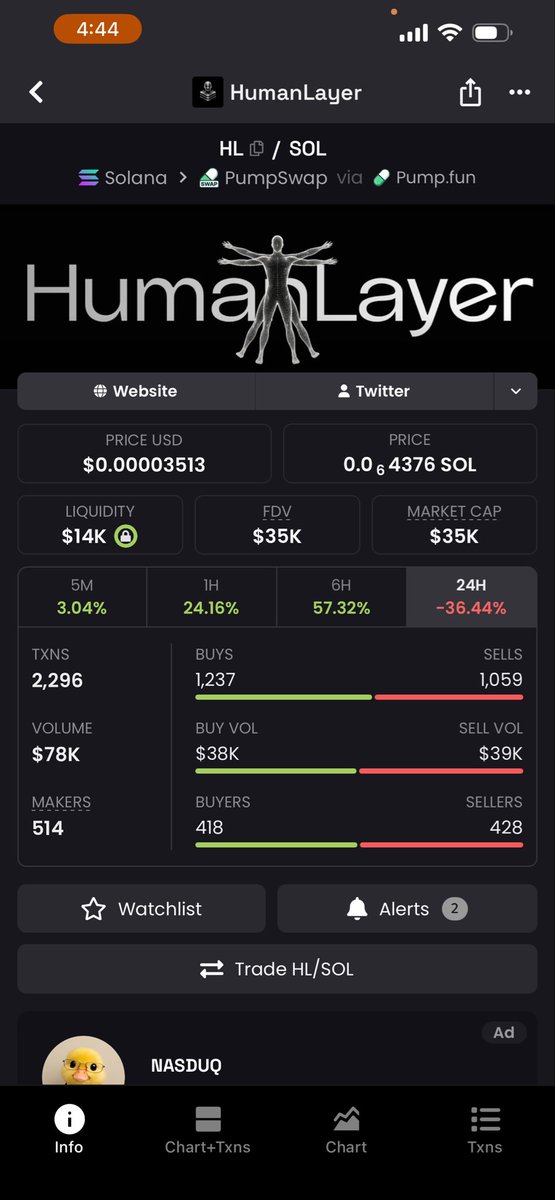
500k easily for $HL great innovation here! A working product already!
English
AlphaGems17 retweetledi

Gm
Community is growing
Just a matter of time to a new leg
🔥🔥🚀🚀🚀
Hold your positions.
This is a millions project
English
AlphaGems17 retweetledi
bought more $HL before it turns to 500k and beyond! 🚀🚀🚀
English
AlphaGems17 retweetledi

Hi @humanlayersol if you seeing this please create telegram group or discord for people. So we can ask any question about project better than silent like this and we do nothing for our bags..
English

More payouts have now been processed for contributors who requested withdrawals on 03/04/2026. If you submitted a payout request during that window, check your wallet to confirm receipt.
We are continuing to process payout requests as they move through the system, and this latest batch reflects another round of completed withdrawals going out to contributors who have already earned on HumanLayer. As the platform grows, maintaining a fast and reliable payout flow remains one of our core priorities, and every processed batch is part of proving that contributors can complete work, request withdrawals, and receive rewards without the long delays common on traditional systems.
If you requested a payout on 03/04/2026, take a moment to check your wallet and verify whether your transfer has arrived.
English
@humanlayersol
Dear Algorithm bull post to 1 million market cap please!!!!!!
English