NidetzkyLab

71 posts

NidetzkyLab banner
NidetzkyLab

NidetzkyLab

@NidetzkyLab

Our lab @tugraz is focused on fundamental and applied Glycosciences and Glycobiotechnologies

Graz, Austria Katılım Nisan 2020
102 Takip Edilen223 Takipçiler
NidetzkyLab
NidetzkyLab@NidetzkyLab·
Why does cellulose hydrolysis slow long before full conversion? Time-lapse in situ AFM nanomechanical mapping reveals two mechanisms: substrate nanomechanics + enzyme adsorption dynamics control conversion efficiency. | ACS Catalysis pubs.acs.org/doi/10.1021/ac…
English
0
0
1
37
NidetzkyLab
NidetzkyLab@NidetzkyLab·
Human GDP-l-fucose synthase (GFS) catalyzes a three-step reaction: epimerization at C-3″/C-5″ and NADPH-dependent reduction at C-4″. Kinetic and structural studies reveal: product release (GDP-l-fucose) is the rate-limiting step, not catalysis. pubs.acs.org/doi/10.1021/ac…
English
0
3
5
630
NidetzkyLab retweetledi
Biology+AI Daily
Biology+AI Daily@BiologyAIDaily·
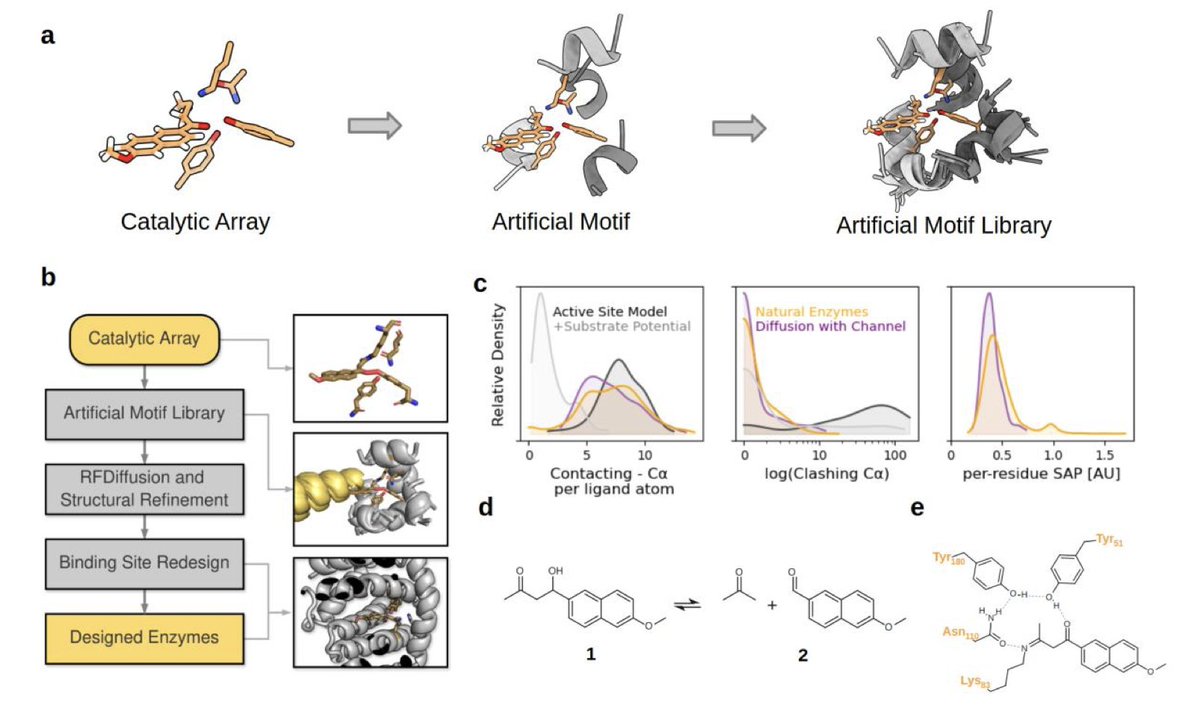
Computational enzyme design by catalytic motif scaffolding 1.A new enzyme design method called Riff-Diff combines machine learning with atomistic modeling to scaffold catalytic motifs in de novo proteins. It achieves catalytic activities approaching those of laboratory-evolved enzymes—without the need for high-throughput screening. 2.Riff-Diff robustly designs enzymes from predefined catalytic arrays, enabling the one-shot creation of active biocatalysts. Notably, 91% of the designed retro-aldolases were catalytically active, and several achieved product formation rates multiple orders of magnitude above the screen average. 3.The method was validated on two mechanistically distinct reactions: the retro-aldol cleavage of methodol and the Morita–Baylis–Hillman (MBH) reaction. Both design campaigns yielded enzymes with measurable and in some cases high activity, despite being built from scratch. 4.Key to Riff-Diff is the use of “artificial motifs”—helical fragment assemblies that preorganize catalytic side chains in energetically favorable conformations. These motifs are embedded into scaffolds using a modified RFdiffusion framework. 5.To ensure substrate accessibility, the authors introduced placeholder helices to enforce binding pocket formation during backbone generation. This strategy improves the mimicry of natural enzyme pockets and helps avoid clashes. 6.Iterative refinement cycles are used to improve backbone and sequence quality. Riff-Diff integrates structure prediction (ESMFold), sequence design (ProteinMPNN or LigandMPNN), and Rosetta-based optimization into a cohesive pipeline. 7.Experimental characterization of retro-aldolase variants revealed that several designs (e.g., RAD29 and RAD35) exhibit kcat values of ~0.03 s⁻¹—roughly 5 million-fold faster than the uncatalyzed reaction and surpassing many previous computational designs. 8.These designs also demonstrated high thermostability (folded beyond 90 °C), high chemical stability, and strong stereoselectivity (RAD35 achieved >99% ee). RAD35 also showed 895 turnovers after 48 hours. 9.Crystal structures of several variants showed near-atomic agreement with design models. Yet, catalytic activity did not always correlate with structural precision, highlighting the importance of active site dynamics. 10.Molecular dynamics and AlphaFold3 models revealed that side chain flexibility and substrate engagement, rather than static structural accuracy alone, better explain differences in catalytic performance. 11.For the MBH reaction, Riff-Diff produced enzymes that exceeded the activity of prior computational designs and even rivaled evolved MBHases. MBH48 achieved higher kcat and lower byproduct formation than BH32.8, an evolved variant from 13,590 screened clones. 12.Structural and CD data confirmed proper folding and design accuracy in the MBH enzymes. Crystal structures validated both backbone and side-chain placements, with observed deviations explaining performance differences. 13.The study underscores a crucial insight: active site precision is necessary but not sufficient for high activity. Catalytic geometry, substrate alignment, and conformational dynamics all co-determine enzyme function. 14.Riff-Diff’s design strategy generalizes to arbitrary catalytic arrays and offers a scalable, semi-automated framework for enzyme creation. It paves the way for testing computationally derived catalytic motifs in de novo scaffolds. 15.This work pushes enzyme design closer to predictive, low-throughput workflows and offers rich benchmarking datasets to develop future models of catalytic activity—potentially moving beyond empirical screening altogether. 💻Code: github.com/mabr3112/riff_… 📜Paper: biorxiv.org/content/10.110… #ProteinDesign #EnzymeEngineering #ComputationalBiology #Catalysis #DeNovoDesign #SyntheticBiology #RiffDiff
Biology+AI Daily tweet media
English
2
30
139
5.9K
NidetzkyLab
NidetzkyLab@NidetzkyLab·
Excited to share our latest research: Phosphorylation-condensation cascade for biocatalytic synthesis of C-nucleosides: Chem Catalysis cell.com/chem-catalysis…
English
1
0
4
242
NidetzkyLab
NidetzkyLab@NidetzkyLab·
Electrochemically Induced Nanoscale Stirring Boosts Functional Immobilization of Flavocytochrome P450 BM3 on Nanoporous Gold Electrodes - Hengge - Small Methods - Wiley Online Library onlinelibrary.wiley.com/doi/10.1002/sm…
English
0
0
1
194
NidetzkyLab retweetledi
Francesco Carraro
Francesco Carraro@Carraro_Fra·
Looking forward to share some of the research we are doing on magnetically responsive enzyme@HOF biocomposites: if you are interested, please join Session 2, today at 14:10! @9thMOF2024 @FalcaroG @UAchemist @NidetzkyLab DOI: 10.26434/chemrxiv-2024-p7159
Francesco Carraro tweet media
English
1
5
12
1.1K
NidetzkyLab
NidetzkyLab@NidetzkyLab·
Flexible only to become rigid, no contradiction in enzyme catalysis! Our new study captures the interplay of structural preorganization and conformational sampling in UDP-glucuronic acid 4-epimerase catalysis. @NatureComms @tugraz nature.com/articles/s4146…
English
0
4
13
1K
NidetzkyLab
NidetzkyLab@NidetzkyLab·
Our review titled” Bottom‐up Synthesized Glucan Materials: Opportunities from Applied Biocatalysis” is out! Discover how biocatalysis crafts precise D-glucan structures, paving the way for advanced material applications! onlinelibrary.wiley.com/doi/10.1002/ad…
English
0
1
6
479
NidetzkyLab
NidetzkyLab@NidetzkyLab·
Exploring Mechanochemical Coupling in Cellulose-Degrading Nanomachines! Our study unveils the cellulosome as a Brownian ratchet, propelling on cellulose by coupling protein motions to hydrolysis. Deeper insights: pubs.acs.org/doi/10.1021/ac…
English
1
0
2
337
NidetzkyLab
NidetzkyLab@NidetzkyLab·
Ever considered using magnet-induced local heating to modulate enzyme activity? 🤔 Dive into our latest paper for insights and surprises: #EnzymeModulation" target="_blank" rel="nofollow noopener">onlinelibrary.wiley.com/doi/10.1002/sm… #MagneticParticles @Tugraz
English
0
0
3
190
NidetzkyLab retweetledi
TU Graz
TU Graz@tugraz·
Microorganisms in the human gut utilise so-called beta-elimination to break down plant natural products and thus make them available to humans. Fruit and vegetables contain a variety of plant natural products such as flavonoids, which are said to have health-promoting properties. Most plant natural products occur in nature as glycosides, i.e. chemical compounds with sugars. In order for humans to absorb the healthy plant natural products, the sugar must be split off in the intestine. Microorganisms in the intestinal flora help to speed up the process: tugraz.at/en/tu-graz/ser…
English
0
1
7
870
NidetzkyLab
NidetzkyLab@NidetzkyLab·
"Dive into our new review on 'C-Ribosylating Enzymes in the (Bio)Synthesis of C-Nucleosides and Natural Products'! From antimicrobial compounds to mRNA vaccine building blocks, explore enzymes, mechanisms, and biocatalytic applications. @ACSCatalysis pubs.acs.org/doi/10.1021/ac…
English
0
0
5
727