

Niffe Hermansson
379 posts

Niffe Hermansson
@Niffe
Mathemagician doing research at the Trace institute. Boundless love for nature and curiosity about experience.
Auckland, New Zealand Katılım Temmuz 2007
175 Takip Edilen198 Takipçiler
English

@Niffe @alieninsect @donalddhoffman Aw. I’m glad you’re going to Copenhagen though! I’m sure we’ll end up on a conference dance floor with Marina again sometime in the near future ;)


English
Niffe Hermansson retweetledi

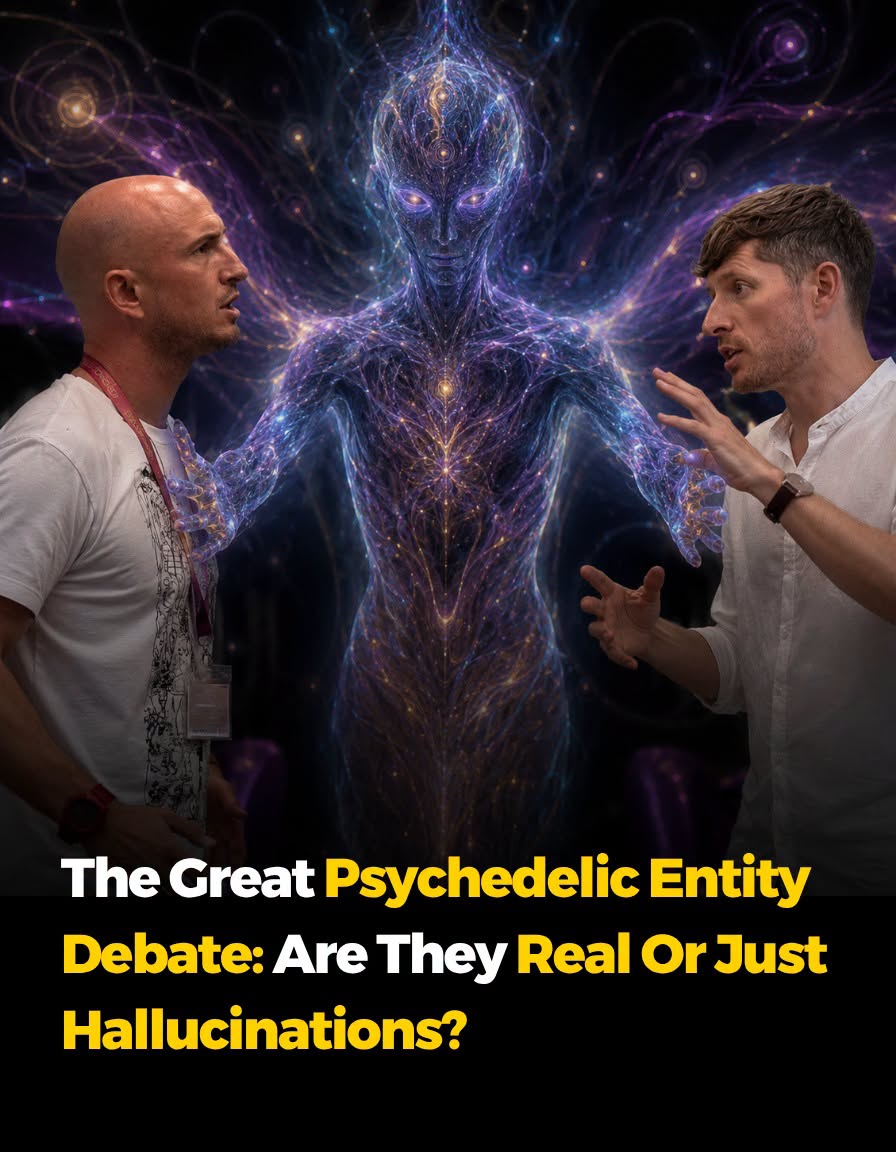
The Great Psychedelic Entity Debate: Are They Real Or Just Hallucinations?
A decent article discussing my recent paper in collaboration with @donalddhoffman and @Niffe Hermansson...
[Link in reply]
Musashino-shi, Tokyo 🇯🇵 English
@sineadaw @alieninsect @donalddhoffman Thank you! I'm very happy to be involved in this work.
Unfortunately not, I was going back and forth about whether I was going to attend or not, but ultimately the fact that it coincides with the Models of Consciousness conference in Copenhagen pushed me over the edge.
English
@alieninsect @Niffe @donalddhoffman @Niffe, so fantastic you’re doing this! Will I see you at the “new” TSC this fall?
English
Niffe Hermansson retweetledi

Niffe Hermansson retweetledi
Excellent new interview with @THIRDEYEDROPS where we take a deep dive into my latest collaboration with @donalddhoffman and @Niffe Hermansson...
Includes some footage from our event in LA hosted by the Trace Institute @thetraceinst in collaboration with @noonautics
[LINK IN REPLY]

Musashino-shi, Tokyo 🇯🇵 English
@algekalipso And, I suggest, there is a lot of value in noticing that tthis applies to everyone else as well. They too have no self, and whatever version of them occurs in mind one moment is gone in the next.
Every hug is a cloud hug, and it's (empty) probabilistic mass all the way down.
English
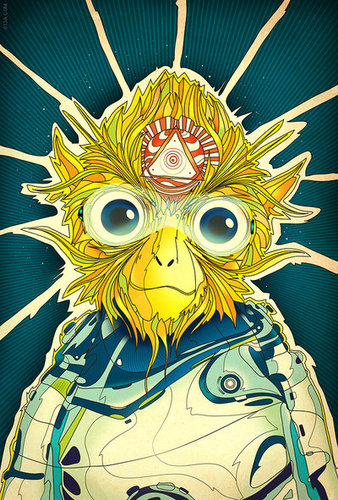
Self-love together with awareness of anatta is very strange, borderline comical. Can you ever really see yourself for long enough to say "I care about you"? Because as soon as the image flashes it's not you anymore, and as soon as you notice having noticed the image, the image is not there either. You can't even find a place, a source, a destination, a landing location, or even a time when the you that you're caring for actually happened. In some sense, best you can do is care via eigenmodes - you don't care for where you are, but where you'll be - or rather, tend the garden of the micro experiential selves you'll get to "be" by anticipating where the probabilistic mass of your spread out distribution of self is about to be, and meet it with consonance beyond its expectation. But even here it's more like massaging a cloud, than ever really meeting someone to give them a hug. The Buddha isn't selfless because it wants to (although this is also true) but on some level because it has to. There's no self to meet and be biased towards when looking.
Colma, CA 🇺🇸 English
Niffe Hermansson retweetledi

Curious about alien intelligences? Watch the full episode on @StarTalkRadio here: youtube.com/watch?v=GEtCYw…

YouTube
English
Niffe Hermansson retweetledi
Do we perceive reality as it truly is?
Our co-founder, @donalddhoffman , joins @neiltyson on @StarTalkRadio to explore consciousness, evolution, and why reality may be far stranger than it seems.
Watch here: youtu.be/GEtCYwr3quI
YouTube
English

@Niffe '... A process that cannot be understood by stopping it.'
One of my favourite quotes
English
"The mystery of life isn't a problem to solve, but a reality to experience."
-Frank Herbert, Dune
Roger This@RogerThisdell
The insight journey into the nature of mind can feel like a process of realising seemingly deeper and deeper fundamental identities, as your consciousness becomes more transparent to itself; eventually opening up your energy field, until there is no centre and no sense of solidity to experience. Then the existential question of what ultimately are you becomes moot; and instead, understanding the nature of mind becomes less of a 'what is' question (to be answered as or by any thing) and more of an open ended, evolving exploration as life reveals itself.
English
@RogerThisdell Hell yeah!
Lovely description and visual representation.
English
The insight journey into the nature of mind can feel like a process of realising seemingly deeper and deeper fundamental identities, as your consciousness becomes more transparent to itself; eventually opening up your energy field, until there is no centre and no sense of solidity to experience.
Then the existential question of what ultimately are you becomes moot; and instead, understanding the nature of mind becomes less of a 'what is' question (to be answered as or by any thing) and more of an open ended, evolving exploration as life reveals itself.
GIF
English
Yes, this! In my experience this is true of essentially every beginner.
I'm still working on getting better at communicating that freedom comes from clearly perceiving what is, not dissociating from what is.
Thanks, @TVachaW for putting these words on it.
Vacha@TVachaW
There is almost no meditation technique I’m aware of that >50% of people don’t turn into an exercise in dissociation. People will use jhana techniques to hide from their pain in bliss. People will prematurely "dissolve" sensations in vipassana to avoid fully feeling them, instead of seeing sensations more clearly *by* feeling them. People will use open awareness meditation to simply space out. People will mistake emptiness practices for trying to contact an obliterating nothingness rather than contact the unfixed nature of phenomena. People will even use metta practice to coccoon themselves in a kind of warm fuzzy feeling that protects them from experiencing emotions they find challenging. Or to cartoonize others into 2-dimensinal objects of an abstract love rather than connecting to their actual suffering. For most people, the fancier and more complex the dissociation the better, as complexity provides fertile ground for the misdirection that dissociation thrives on. But when done properly, each of these practices should be a vehicle for contacting reality, not numbing it out. The bliss and concentration of jhana creates a safe and clear container for investigating our suffering. Vipassana provides tools for feeling our suffering so deeply that we come to see something of how its constructed. A truly open awareness will be open to everything - including the messiest parts of our suffering. Emptiness practice won't paint over suffering with nothingness, but rather bring fluidity, malleability and aliveness to it. Metta will connect us to our sufferings and the sufferings of others in ways that give us greater capacity to feel - and practically respond - to them with compassion. There's this image of meditation as an exercise in blissing out. And obviously accessing bliss can be an empowering part of it. But actually, accessing pain, suffering and a tangible felt connection with our body, our life circumstances and the people around us is even more empowering. I think a healthy attitude to meditation is to *assume* that we probably will not entirely escape this tendency to hi-jack it in service of our mind's habitual tendency towards dissociation. By remaining vigilant to it, we can start to notice what the mental motion of dissociation looks like. And by noticing what the mental motion of dissociation looks like, gradually we can learn and master the mental motion of reassociation. The mental motion of making uncompromising contact with the fullness of our experience. There are not many more fruitful skills to learn than that.
English

Niffe Hermansson retweetledi
> why does consciousness feel like one seamless experience?
feels that way to *whom*? One agent in the body is good at language, and at telling others that they are the only tenant in there. If your organs (including the right hemisphere, but also other structures) also felt like they had a seamless experience, the left-brain tenant wouldn't know and would still ask this question (which I think is exactly the situation we have now). I'm extremely skeptical of "unconscious learning" and stuff like that where the "it was unconscious" verdict is obtained by asking the "subject". On the other hand, we *do* have an interesting question to ask about your left hemisphere, which is built of many, many pieces (you don't have to go to hemisphere scales to know we're all collective intelligences in that sense), and yet has an integrated single perspective.
English
The horror of waking up to find that Codex has burned through 30% of my weekly tokens over night.
At least there were some serious improvements to the thing it was building, so I guess that's something.
English
If you care deeply about whether AI is conscious and can suffer because it would matter to how you treat it, but you eat meat, I am deeply curious about your internal reasoning.
English
@WystanTBS Based on the emails I receive, this is a behaviour rapidly gaining popularity...
English

I love the smell of AI psychosis in the morning. It smells like... progress. You know, one time on modafinil Claude and I derived a unified field theory, for 12 hours. When it was all over, I sent it to every physicist whose email I could find. Not one replied, not one ivory-tower idiot replied. The smell, you know, that burning token smell? My mind, every neuron. Smelled like... progress. Someday, the singularity will come, and it'll all be over.

English