NGCathAes

179 posts

NGCathAes banner
NGCathAes

NGCathAes

@NigCatholicAes

Katılım Temmuz 2023
70 Takip Edilen453 Takipçiler
NGCathAes
NGCathAes@NigCatholicAes·
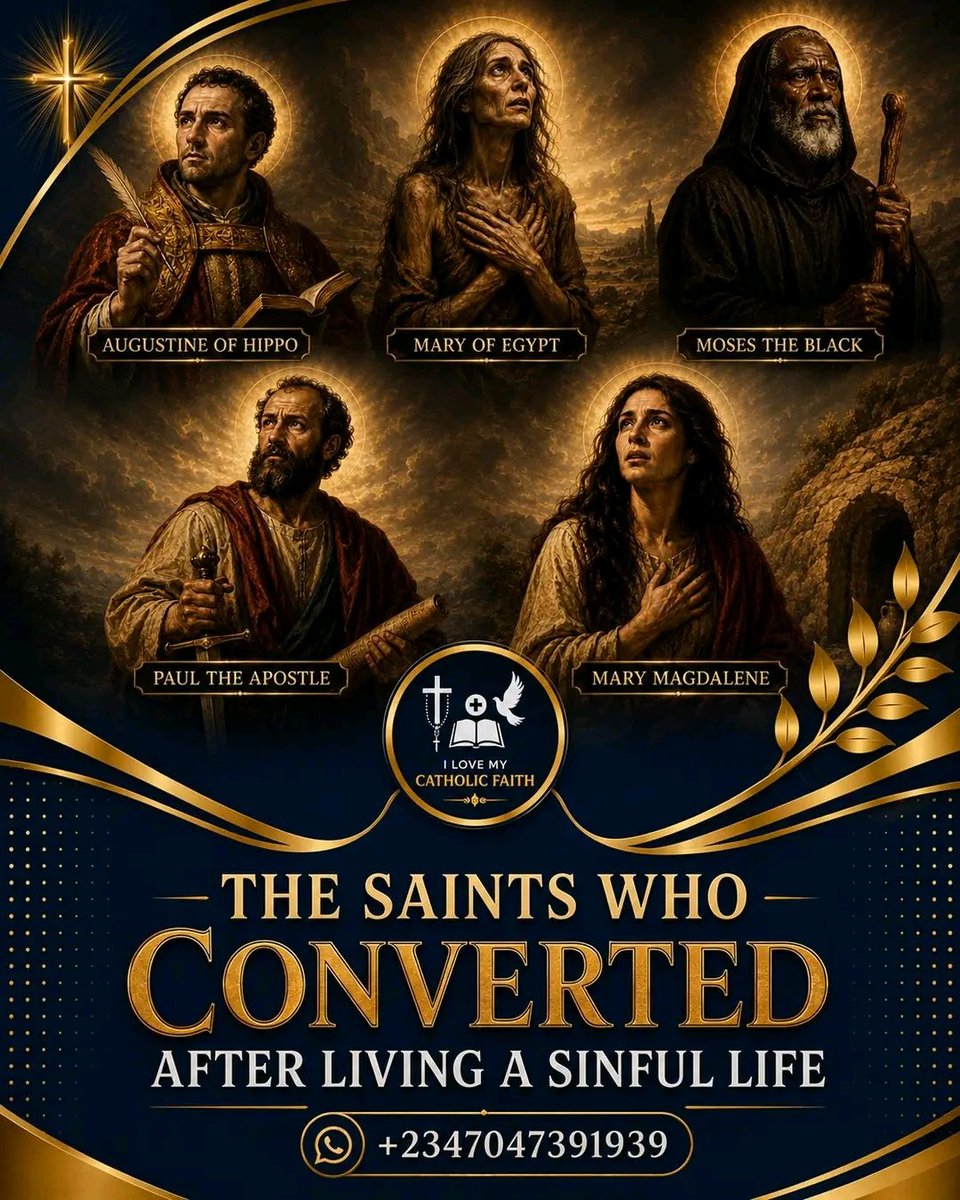
@UcheMaryOkoli The church has a rich repository of sacred art featuring these saints, there is no need to use AI.
English
0
0
0
27
Uche is a girl
Uche is a girl@UcheMaryOkoli·
🔥 THE SAINTS WHO CONVERTED AFTER LIVING A SINFUL LIFE 🇻🇦✝️ One of the most beautiful truths of the Catholic faith is this: God never gives up on sinners. Some of the greatest saints in the history of the Church were once people deeply trapped in sin, pride, violence, lust, anger, greed, or unbelief. Before becoming holy men and women admired across the world, many of them lived broken lives far from God. Yet through repentance, grace, prayer, and surrender to Christ, they became shining examples of holiness. Their stories remind us that sainthood is not reserved for people who were born perfect. Sainthood is the result of allowing God’s mercy to transform a wounded soul. ✝️ ST. AUGUSTINE OF HIPPO Before his conversion, Augustine lived a life filled with worldly pleasures and sinful passions. He openly admitted in his writings that he struggled with lust, pride, and immoral living. For years he rejected God and pursued fame, philosophy, and earthly satisfaction. But behind his rebellion was an empty heart searching for truth. Through the prayers and tears of his holy mother, St. Monica, and through the preaching of St. Ambrose, Augustine finally surrendered his life to Christ. His conversion became one of the most powerful in Christian history. After his repentance, he became a bishop, theologian, and one of the greatest Doctors of the Church. His writings still inspire millions today. His famous words continue to touch hearts: “Our hearts are restless until they rest in You, O Lord.” ✝️ ST. MARY MAGDALENE Mary Magdalene is remembered as one of the most devoted followers of Jesus. Tradition has long associated her with a sinful past before she encountered Christ. Everything changed when she met Jesus. Instead of condemning her, Christ showed her mercy, love, and healing. She became one of His most faithful disciples and remained loyal even at the foot of the Cross when many others fled in fear. She was also among the first to witness the Resurrection of Christ. Her life is a testimony that God can restore dignity, purity, and purpose to anyone who turns back to Him. ✝️ ST. MOSES THE BLACK Before becoming a saint, Moses the Black was feared as a violent criminal and gang leader. He lived a life filled with robbery, brutality, and immorality. Yet God’s mercy reached even him. After encountering the witness of holy monks, Moses experienced deep repentance and entered a monastery. The man once known for violence became known for humility, prayer, fasting, and holiness. He struggled greatly against temptation but never stopped fighting for holiness. Eventually, he became a beloved spiritual father and martyr. His story proves that no one is too far gone for God’s grace. ✝️ ST. MARY OF EGYPT Mary of Egypt spent many years living in extreme immorality and sinful pleasure. According to tradition, she led countless souls into sin and cared little for holiness. But during a pilgrimage to Jerusalem, something extraordinary happened. An invisible force prevented her from entering a church. At that moment, she realized the weight of her sins and cried out for mercy before an image of the Blessed Virgin Mary. That moment changed everything. She abandoned her old life completely and fled into the desert, where she spent decades in prayer, fasting, repentance, and spiritual battle. From great sin came great holiness. Her life teaches us that true repentance requires sacrifice, humility, and total surrender to God. ✝️ ST. PAUL THE APOSTLE Before becoming the Apostle Paul, he was Saul — a fierce persecutor of Christians. He approved the killing of believers and sought to destroy the early Church. But on the road to Damascus, he encountered Jesus Christ. That encounter transformed him forever. The persecutor became a preacher. The destroyer became a builder of the Church. The enemy of Christians became one of Christianity’s greatest apostles. (Check the comment👇 section).
Uche is a girl tweet media
English
3
24
111
2.2K
The Blessed Salt 🧂
The Blessed Salt 🧂@theblessedsalt·
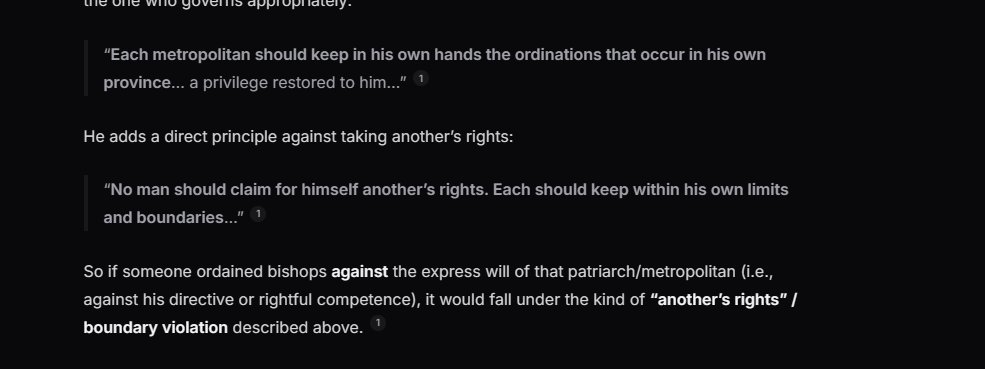
If creating your own parallel hierarchy of bishops not in union with the pope and in direct disobedience to him isn’t schism, nothing is.
Mason-Dixon Latin Mass Society@MDLatinMass

@theblessedsalt It's a false accusation of schism since the Society isn't separating from the Church, and it's hypocritical on its face given the Chinese Bishops who won't be touched for the exact same thing, and the German faggot brigade that only got a meaningless sternly worded letter.

English
16
5
102
3.6K
NGCathAes
NGCathAes@NigCatholicAes·
@PaulinusOfTrier I am sorry, what other option is there for ordaining Bishops against the express will of the Holy Father, who is the head of the college of Bishops?
English
0
0
1
31
Henry von Blumenthal
Henry von Blumenthal@PaulinusOfTrier·
Do any non partisan Catholics seriously believe that Cardinal Fernandez's warnings against the SSPX consecrations are mere iterations of objective truth, and not policy driven threats for which other options exist?
English
29
10
83
7.6K
NGCathAes
NGCathAes@NigCatholicAes·
@AbpPanini Bad in one places doesn't mean bad in another is good.
English
0
0
1
15
Cardinal Hannibale Panini
The Novus Ordos are all reacting about the SSPX… that supposed ‘extremely small’ group nobody has to worry about. You point out the homosexual blessings or Germany they do not react nearly as much as poor SSPX.
English
8
3
60
1.2K
NGCathAes retweetledi
ColoradoDescenditAdInfernos
@lukei4655 . . . and their role should be like the role of the first deacons: managing the Church's material affairs and so freeing up priests and bishops for pursuits that are more catechetical, sacramental, mystagogical, formational, etc.
English
1
1
12
478
Fr. Gabriel T Mosher, OP
Permanent Deacons should be required to exclusively work for the Church. If they are married, a Diocese should be required to provide a sufficient wage to him so that he can adequately support his family with a single income.
English
58
8
233
40.9K
NGCathAes
NGCathAes@NigCatholicAes·
@SSPXEN Nigga don't ordain Bishops illicitly.
English
0
0
2
46
NGCathAes
NGCathAes@NigCatholicAes·
War is a terrible thing.
Crazy Vibes@CrazyVibes_1

A Catholic priest walked into a house filled with Jewish orphans in fascist Italy and spoke four words that would save 73 lives. July 1942. Arrigo Beccari. Thirty-two years old. Seminary teacher in Nonantola, a small village near Modena in northern Italy. He had just heard about the children. Fifty Jewish orphans, ages six to twenty-one, had arrived at Villa Emma, an abandoned mansion on the edge of town. They came from Germany, Austria, and Yugoslavia. They had fled the Nazis. Many had already lost parents, homes, and entire families. They could not speak Italian. They had nowhere else to go. Beccari walked to the villa, knocked on the door, and stepped inside. He looked at the frightened faces in front of him and said: “You are safe now.” He meant it. For more than a year, something extraordinary unfolded in fascist Italy. An entire village quietly chose to protect those children. Farmers brought food. Shopkeepers donated supplies. Widows opened their homes. A local doctor named Giuseppe Moreali treated the sick. A carpenter built furniture and taught woodworking. Women cooked meals. One room inside the villa became a synagogue. Beccari visited every day. He taught lessons. Spent time with the younger children. Tried to give them moments that felt normal again. Then, in April 1943, another thirty-three Jewish children arrived from Croatia, escaping the massacres carried out by the Ustaše regime. Now there were seventy-three children at Villa Emma. Then came September 8, 1943. Italy surrendered to the Allies. German forces immediately occupied northern Italy. The SS began hunting Jews across the region. In Rome, more than 1,200 Jews were rounded up and deported to Auschwitz. Only sixteen survived. At dawn on September 9, German troops marched into Nonantola. Beccari and Dr. Moreali ran to Villa Emma. “You have to leave. Now. All of you. Tonight.” More than one hundred people, including counselors and caretakers, had to disappear in less than thirty-six hours. Beccari did not wait for official permission. He did not hesitate. Some children were hidden inside the seminary itself, tucked into dormitories, cellars, attics, and storage rooms. Then Beccari moved through the village knocking on doors. Farmers. Shopkeepers. Widows. Teachers. He asked each of them the same thing: Hide these Jewish children. Feed them. Protect them. Not one refused. Within thirty-six hours, Villa Emma was empty. When German soldiers arrived, they found only an abandoned building. No children. No evidence. No witnesses. The orphans had been scattered across more than twenty Catholic homes, hidden in barns, haylofts, bedrooms, and church buildings throughout the village. For weeks, Beccari visited them daily, bringing food, comfort, and information. But everyone understood they could not stay forever. The Germans were searching everywhere. There was only one possible escape route. North. Across the Alps. Into Switzerland. Beccari and Moreali forged more than 120 identity documents, baptism certificates, travel permits, birth records. On paper, Jewish children became Catholic Italians. The children memorized new names, birthdays, and invented family histories in a language many of them barely understood. Between September 28 and October 16, 1943, they escaped in small groups by train, on foot, and through mountain passes under cover of darkness. Every one of the seventy-three children reached Switzerland safely except one. A teenager named Salomon Papo was too sick with tuberculosis to travel. The Gestapo later found him in a sanatorium and deported him to Auschwitz. One out of seventy-three. Not because someone betrayed them. Because illness made escape impossible. The Gestapo launched investigations. Who had hidden the Jews? Who had forged the documents? No one in the village talked. Eventually, Beccari himself was arrested and handed over to the SS in Bologna. He was tortured for months. Beaten repeatedly. Interrogated again and again for names, locations, and evidence. He gave them nothing. His name appeared on execution lists three different times. Three different times, the executions were delayed. Eventually, he was released. The war was nearing its end, and the Germans still had nothing. Beccari walked back to Nonantola. Back to the seminary. Back to teaching. And perhaps the most remarkable part of the story is this: It was never only one priest. More than forty households helped hide Jewish children. Not one villager betrayed them. Farmers. Seminarians. Teachers. Shopkeepers. Elderly widows. An entire village chose strangers’ children over its own safety. The children survived the war. Many later emigrated to what became Israel in 1945. They built families, careers, and new lives. They never forgot Nonantola. In 1964, Yad Vashem recognized Arrigo Beccari and Giuseppe Moreali as Righteous Among the Nations, the first Italian priest and doctor ever given that honor. Beccari remained in Nonantola until 1980. Same village. Same church. Same quiet life. He baptized the grandchildren of families who had once hidden Jewish orphans in their homes. He never chased recognition. At one point he reflected simply: “It would be difficult to erase the memory of the terror and suffering of those days. Or of my joy at doing the small good which was my duty.” Small good. That is what he called it. Arrigo Beccari died on December 27, 2005, at the age of ninety-six, in the same village where he had spent most of his life. A village priest who helped lead one of the most successful Holocaust rescue operations in Italy. A man tortured by the Gestapo who never betrayed a single child. A man scheduled for execution three separate times who returned afterward to ordinary parish life because, to him, that was simply who he was. Seventy-three children grew old because of thirty-six hours in September 1943. Because one priest started knocking on doors. Because one village kept saying yes. Because ordinary people chose courage when the world around them chose silence.

English
0
0
3
32
NGCathAes
NGCathAes@NigCatholicAes·
@UcheMaryOkoli I love Spanish vestments, I wish Nigerian ateliers made better vestments.
English
1
0
0
70
Uche is a girl
Uche is a girl@UcheMaryOkoli·
Catholicism is so beautiful 😍
English
6
48
933
10.3K
NGCathAes
NGCathAes@NigCatholicAes·
@Chibuikem1997 @UcheMaryOkoli Nigga how does that disprove anything I have said. I said the poor treatment of traditionalist has pushed people to the SSPX.
English
0
0
0
7
Chibuikem Ignatius
Chibuikem Ignatius@Chibuikem1997·
@NigCatholicAes @UcheMaryOkoli You are wrong!!! I mistakenly attended SSPX at Yaba. The priest spent 80% of the homily comparing and discrediting the church, have you seen their online posts, it's always anti-church. You can't claim to be one with Vatican and you are always positioned to fight any update
English
1
0
0
18
NGCathAes retweetledi
Deacon paul🇻🇦
Deacon paul🇻🇦@PaulOgbonnayaO1·
SURVIVING SECOND VATICAN COUNCIL FATHERS As of April 2025, there are four surviving Bishops who participated in the Second Vatican Council (1962–1965), often referred to as “Council Fathers.” These individuals are among the last living witnesses to one of the most significant events in modern Catholic history. 1. Cardinal Francis Arinze (Nigeria) • Born: November 1, 1932 (age 92) • Role at Vatican II: Attended the final session in 1965 as coadjutor bishop of Onitsha. • Notable Facts: At age 32, he was the youngest Catholic Bishop in the world at the time. Consecrated Bishop in 1965 by Archbishop Charles Heerey. Made a Cardinal in 1985 by Pope Johnpaul II and later served as Prefect of the Congregation for Divine Worship and the Discipline of the Sacraments. 2. Archbishop Victorinus Youn Kong-hi (South Korea) • Born: November 8, 1924 (age 100) • Role at Vatican II: Attended the second, third, and fourth sessions as Bishop of Suwon. • Notable Facts: He later became Archbishop of Gwangju and served as president of the Catholic Bishops’ Conference of Korea. 3. Bishop José de Jesús Sahagún de la Parra (Mexico) • Born: January 1, 1922 (age 103) • Role at Vatican II: Attended the first, second, and fourth sessions as Bishop of Tula. • Notable Facts: He is the only surviving council father from the Americas. 4. Bishop Daniel Alphonse Omer Verstraete, O.M.I. (Belgium/South Africa) • Born: July 31, 1924 (age 100) • Role at Vatican II: Attended the final session in 1965 as prefect of the Apostolic Prefecture of Western Transvaal. • Notable Facts: He served as Bishop of Klerksdorp in South Africa. These four Bishops represent the final living links to the Second Vatican Council, which brought significant reforms to the Catholic Church, including the promotion of the vernacular in the Liturgy, enhanced engagement with the modern world, and a renewed emphasis on ecumenism. #catholic SR J.🤍
Deacon paul🇻🇦 tweet mediaDeacon paul🇻🇦 tweet mediaDeacon paul🇻🇦 tweet mediaDeacon paul🇻🇦 tweet media
English
4
48
341
21.5K
NGCathAes
NGCathAes@NigCatholicAes·
@JendersII There are too many people in the SSPX for this to be left to happen.
English
0
0
1
29
NGCathAes
NGCathAes@NigCatholicAes·
@UcheMaryOkoli My point is the poor treatment of Traditional Catholics by the Church hierarchy is pushing people towards the SSPX and Sedevacantism. The is not one good reason why the TLM should be restricted.
English
1
0
1
25
NGCathAes
NGCathAes@NigCatholicAes·
@UcheMaryOkoli It is unthinkable that what the Church has held as sacred for a millennium plus is all of a sudden not sacred, except if the Church was wrong all those centuries, the treatment that the ancient liturgy is getting is frankly demonic.
English
1
0
0
25
NGCathAes
NGCathAes@NigCatholicAes·
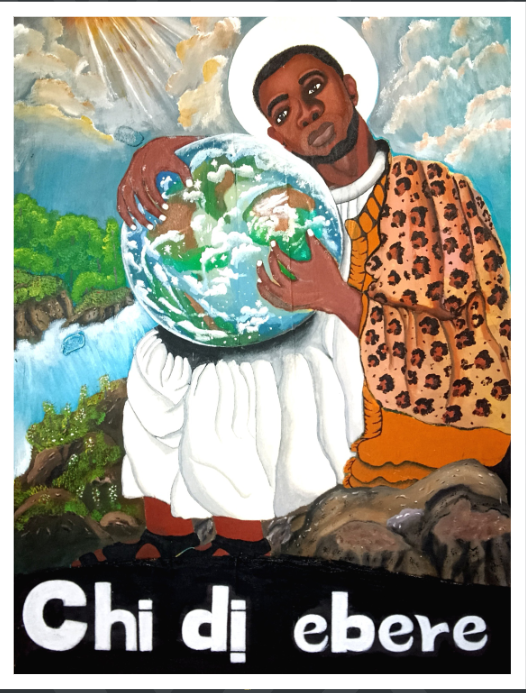
Chi dị Ebere – A Reimagined Depiction of Jesus as an Igbo Man Emphasising His Merciful Nature. Painted and Illustrated by George Edih.. Gotten from : hacpod.org/chi-di-ebere-a…
NGCathAes tweet media
English
0
1
23
311
NGCathAes
NGCathAes@NigCatholicAes·
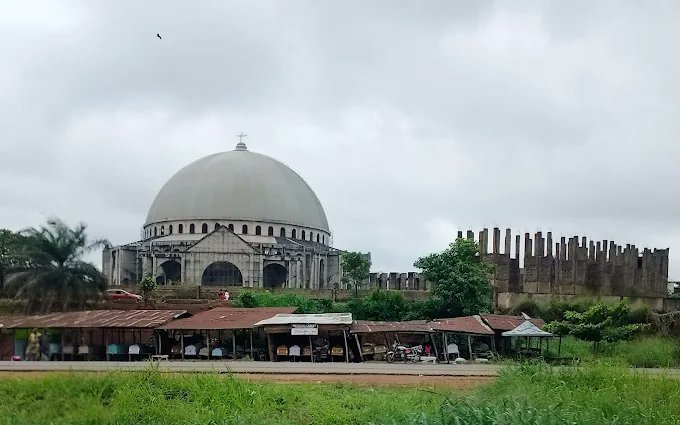
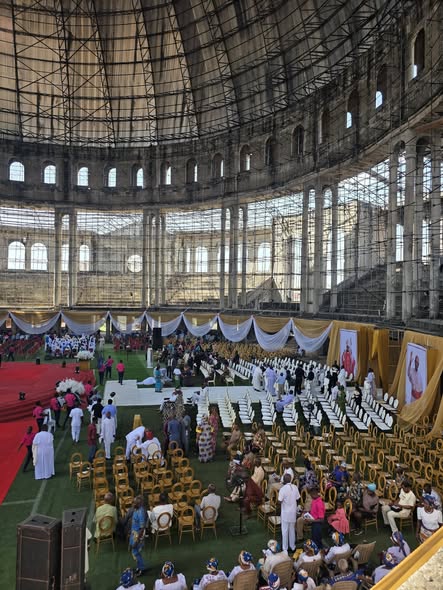
Immaculate Conception Catholic Cathedral, Okigwe.
NGCathAes tweet mediaNGCathAes tweet mediaNGCathAes tweet media
English
0
0
18
131
NGCathAes retweetledi
NGCathAes
NGCathAes@NigCatholicAes·
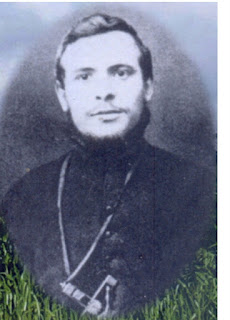
Fr. Carlo Zappa "Ozo-kpo-kpo", Prefect of the Upper Niger, the man to whom the entirety of the Anioma people (including myself) owe their Christianization to his tireless mission.
NGCathAes tweet media
English
1
4
11
205