NimwegenLab

4.7K posts

NimwegenLab

NimwegenLab

@NimwegenLab

Gene regulatory networks and genome evolution. How do single cells make up their minds? @[email protected]

Basel City, Switzerland Katılım Şubat 2014
179 Takip Edilen3.5K Takipçiler
NimwegenLab
NimwegenLab@NimwegenLab·
Remember KC complexity is only defined up to an additive constant that depends on the choice of the Turing machine. For LLMs the size of this machine is huge in comparison to the size of both inputs and outputs.
English
0
1
0
114
NimwegenLab
NimwegenLab@NimwegenLab·
No. LLMs have essentially memorized the internet in their weights. For LLMs the KC complexity is not in the prompts but in the size of the ‘Turing machine’ generating the output. If anything is surprising is that the internet can be compressed into an LLM.
Jonathan Gorard@getjonwithit

I think one of the conclusions we should draw from the tremendous success of LLMs is how much of human knowledge and society exists at very low levels of Kolmogorov complexity. We are entering an era where the minimal representation of a human cultural artifact... (1/12)

English
1
1
5
725
NimwegenLab retweetledi

Shashi Thutupalli
Shashi Thutupalli@stpalli·
Protocells from three inorganic salts, some formaldehyde and water? They grow? They synthesise organic molecules of core biomolecular classes: amino acids, sugars, lipid-like motifs? And, there are similar structures in today's oceans? Yes! Read on. arxiv.org/abs/2601.11013
English
2
36
154
33.7K
NimwegenLab
NimwegenLab@NimwegenLab·
@lpachter I think this is just mathematician trolling (although I admit even this physicist had to wince reading that).
English
0
0
1
478
NimwegenLab
NimwegenLab@NimwegenLab·
@mbeisen But they allow Americans to see some of BBC's greatest hits, no? And things like Inspector Montalbano. At least that's what I remember from when I still lived in the US.
English
0
0
0
553
NimwegenLab
NimwegenLab@NimwegenLab·
New paper! Concentrations of active transcription factors (TFs) can fluctuate on the same time scale as individual TF binding and unbinding events, causing 'non-equilibrium' regulatory responses in their targets. We believe this may be pervasive in bacterial gene regulation.
PRX Life@PRX_Life

Different target genes controlled by the same regulator respond to DNA damage with highly distinct expression responses when fluctuations in transcription factor levels match the timescale of their binding and unbindingfrom DNA. Read the paper: go.aps.org/3Iu2SnU

English
1
0
7
719
NimwegenLab
NimwegenLab@NimwegenLab·
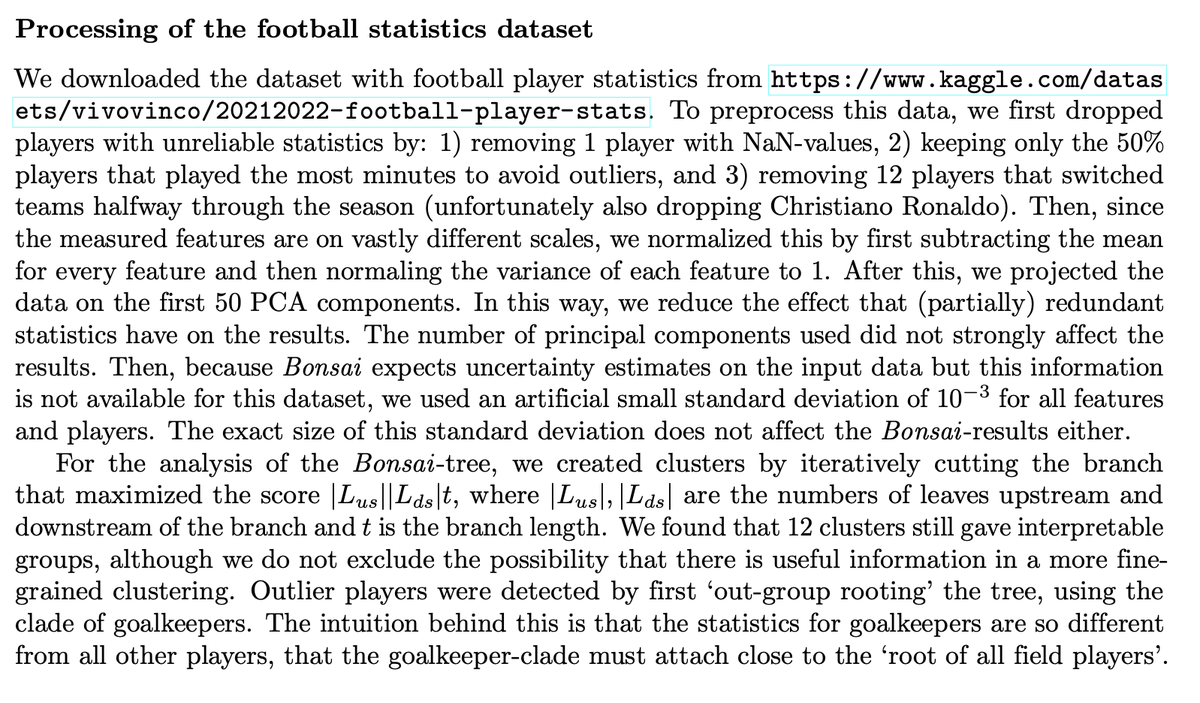
@chemetrian @DucheneJohan For what it is worth, below is the ad hoc thing we did for the football player statistics. Even with that rather dumb processing, the results still look reasonable and informative to us.
NimwegenLab tweet media
English
0
0
2
95
NimwegenLab
NimwegenLab@NimwegenLab·
@chemetrian @DucheneJohan a good measure of their similarity. So it will depend on whether you can map small molecule structures to such a representation.
English
1
0
2
80
NimwegenLab retweetledi
ᒍOᕼᗩᑎ ᗪᑌᑕᕼEᑎE
Popular methods like UMAP & t-SNE are stochastic and distort data structure. Bonsai - a novel method - builds trees to relate high-dimensional objects, accounting for measurement noise. biorxiv.org/content/10.110…
ᒍOᕼᗩᑎ ᗪᑌᑕᕼEᑎE tweet media
English
16
301
1.7K
133.1K
NimwegenLab retweetledi
antisense.
antisense.@razoralign·
Bonsai: Tree representations for distortion-free visualization and exploratory analysis of single-cell omics data biorxiv.org/content/10.110…
antisense. tweet media
English
2
16
87
7K
NimwegenLab
NimwegenLab@NimwegenLab·
@MozarellaPesto @DucheneJohan The distances between cells along the branches in the Bonsai tree accurately approximate the true distances between the cells in the high-dimensional space. See my tweetorial: x.com/NimwegenLab/st… or, even better, read the paper.
NimwegenLab@NimwegenLab

Here it is! Bonsai. No more excuse to use t-SNE/UMAP. Bonsai not only makes cool pictures of your data. It actually rigorously preserves its structure. No tunable parameters. Absolutely incredible work of @dhdegroot.bsky.social. I'm so excited about this. biorxiv.org/content/10.110…

English
0
0
4
121
Matteo
Matteo@MozarellaPesto·
@DucheneJohan How meaningful are the 2D projections compared to umap?
English
2
0
5
2.2K
NimwegenLab
NimwegenLab@NimwegenLab·
@willmacnair Hi Will. Have you read our paper? Cause I think it answers wgat we mean with rigour. I’d be happy to discuss if it’s still unclear to you after reading.
English
0
0
0
55
Will Macnair
Will Macnair@willmacnair·
@NimwegenLab What does “rigour” mean in the context of biology? Is biology rigorous? Less provocatively, this reminds me a little bit of some work by a friend of mine using hyperbolic spaces for embedding single cell data, which naturally allow branching data: nature.com/articles/s4146…
English
1
0
0
73
NimwegenLab
NimwegenLab@NimwegenLab·
Here it is! Bonsai. No more excuse to use t-SNE/UMAP. Bonsai not only makes cool pictures of your data. It actually rigorously preserves its structure. No tunable parameters. Absolutely incredible work of @dhdegroot.bsky.social. I'm so excited about this. biorxiv.org/content/10.110…
English
2
6
23
942
Ryan Hill
Ryan Hill@zndx·
@DucheneJohan Is there source available? I don't immediately see a repo link in the paper. Great work regardless!
Colorado, USA 🇺🇸 English
2
0
7
2.3K
NimwegenLab
NimwegenLab@NimwegenLab·
Or play with the visualizations of example datasets. A full Bonsai-scout tutorial is available at: youtube.com/watch?v=JDHZ... Single-cell omics data are amazing and deserve more reliable tools for visualization and exploratory analysis. We hope to have made a difference here!
English
0
0
0
286
NimwegenLab
NimwegenLab@NimwegenLab·
Remarkably, famous players show up as outliers on the Bonsai tree, e.g. Messi is on the longest branch! Try it on your own data! Our webserver allows you to upload UMI count tables after which all analysis is performed automatically. youtube.com/watch?v=9h7GUk…
YouTube video
YouTube
English
1
0
0
457