Router Protocol@routerprotocol
2025 at Router: the year we stopped chasing everything and started building one thing
At the start of 2025, Router still looked like many things at once.
We were a chain. We were a bridge. We were experimenting with intents. We were serving users, partners, and ecosystems, sometimes all at the same time. But underneath all of it, one pattern kept showing up again and again: Users just wanted swaps to work. Builders just wanted integrations to be easier.
Everything we did this year was us slowly listening to that signal.
Phase 1: Building Reach, Reliability, and Real Usage (Jan–March)
We started the year focused on one thing: making Router Nitro everywhere users needed it to be and making it actually usable at scale.
In the first few months, Nitro expanded aggressively across ecosystems. We added early support for new chains like @SonicLabs, HyperEVM, @berachain, @soneium, @MorphNetwork, Zero, @StoryProtocol, and @monad often from testnet or day one.
We became one of the very few bridges enabling @solana ↔ @Bitcoin transfers, expanded swaps to and from Solana and @trondao, and crossed the milestone of 50+ chain integrations. We launched on Binance Wallet, integrated with aggregators like @CryptoRubic, and enabled cross-chain flows directly inside partner UIs.
We shipped features like Gas Send, Auto Refuel, and faster withdrawals, and increased the maximum trade size from $10K to $25K per swap, making Nitro viable for both retail users and larger trades.
January also marked the beginning of Router’s work on intent-based experiences. We released the ISA (Intent-Specific Addresses) framework and launched Router Pay, allowing users to move funds across chains with no wallet connections or approvals, just scan, send, done.
On the economic side, we stayed disciplined. 100% of Nitro’s revenue continued to go toward ROUTE buyback and burn, alongside burns from staking rewards on unvested supply. Moreover, through collaboration with Symbiotic, we began rethinking chain security.
Phase 2: Nitro Expansion and the bottleneck (Apr–Jun)
While integrating with chains and ecosystems on Nitro, we leaned harder into building the buy/trade experience, a clean interface where users could tap into trending tokens, memecoins, live charts, volumes, and stats, all in one place. By May, this trade page went live, and naturally, more tokens started flowing into Nitro as users explored and traded directly.
On the infra side, Nitro kept expanding across chains while also getting faster and more efficient. We integrated Circle’s CCTP v2, bringing ultra-fast native USDC transfers across chains and by June, Nitro was among the first bridges to support native USDC transfers to and from @Optimism using CCTP v2.
We also focused on improving how users navigate Nitro day to day. Features like Portfolio views and an in-page search bar rolled out, making it easier to track assets and move quickly without friction.
Still, we felt the limits. The ecosystem was moving faster than any single team could keep up with new bridges, chains, solvers. And every integration still required coordination, fees, and custom work. Aggregation itself was becoming the bottleneck.
But the more we added, the clearer the ceiling became: no single team can manually integrate the entire on-chain world. Aggregation itself was the bottleneck.
Phase 3: The Pivot (Jul–Sept)
By mid-year, it became clear that Router was ready for a reset.
In July, we started gearing up for Router 2.0 and shared our thinking publicly with the release of the Open Graph Architecture (OGA) whitepaper. It was the first time we clearly said: aggregation itself needs to change.
Soon after, the Router App went live. It enabled seamless swaps across both EVM and non-EVM chains, optimized liquidity across bridges, DEXs, and solvers, and handled everything from small swaps to multi-million-dollar trades. Routes could now be split and reassembled in real time, and integrations were permissionless.
After the app launch, we opened discussions and proposals to sunset Router Chain and move entirely toward Open Graph Architecture, and the community approved the sunsetting Router Chain, marking a historic shift in Router’s journey.
On the token migration front at the close of migration, 1,625,761 $ROUTE v1 tokens remained unmigrated. In line with the approved proposal, the equivalent of 54,186,614 $ROUTE v2 tokens were removed.
Router Chain and Router Nitro were the foundation of everything we built. Let’s look back at some numbers we were able to achieve with Nitro and Router Chain.
- 1.8M+ transactions and $1B+ volume processed through Nitro Bridge
- 1.5M+ cross-chain intents and $30M+ volume via the Cross-Chain Intent Framework (CCIF) adopted by protocols like @LidoFinance, @Stake_Stone, and @LynexFi
- Canonical bridging that expanded access to ecosystems such as @RedbellyNetwork, @matchain_io, Oasis Sapphire, and @Vanarchain
- Deep aggregator integrations, including powering 25% of Rubic’s transactions and nearly 11% of its total volume
Phase 4: Opening the Network (October–December)
The last quarter of the year was about momentum and proof.
We kept refining the UI, making swaps feel smoother, clearer, and easier to trust. At the same time, the network itself kept expanding with new bridges like @NEARProtocol, @KyberNetwork, @Chainflip, @EverclearOrg etc., infact the support for @Bitcoin also went live!
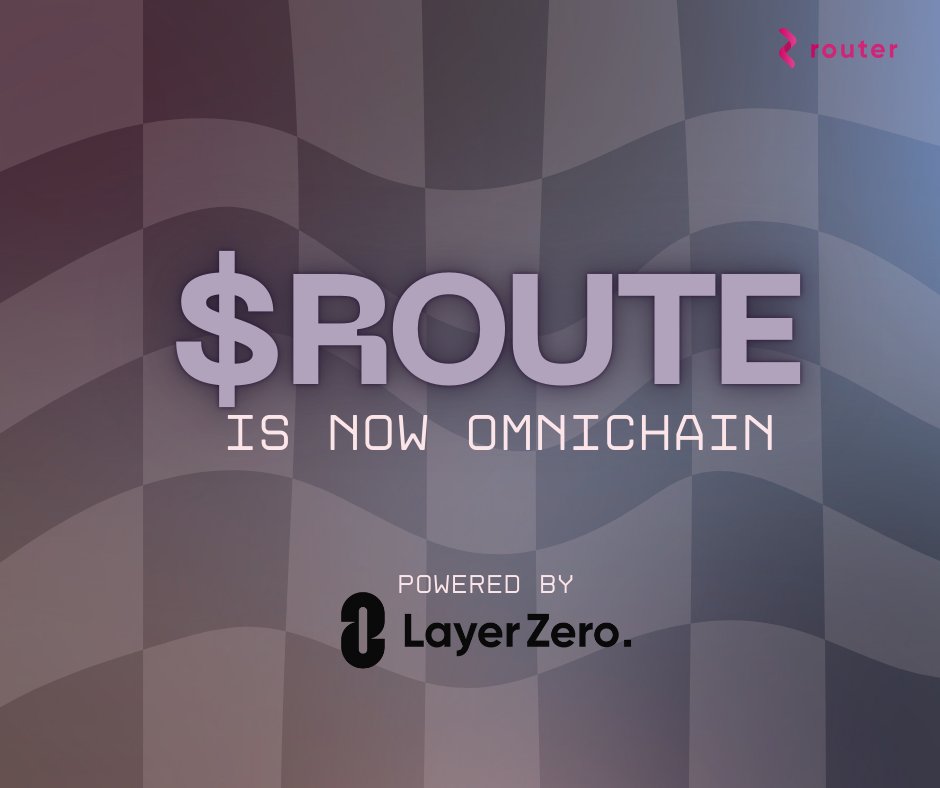
On the token side, $ROUTE became omnichain via LayerZero’s OFT standard, giving it native mobility across chains like Ethereum and Polygon
We are closing the year by shipping a fully revamped website and a small win of Fibrous integrated Router App on its own (detailed announcement coming soon)
By the end of 2025, Router is looking very different from how it started. We stopped trying to be many things at once and committed fully to solving one problem well: onchain swaps. For users, and for the entire ecosystem building around them.