Friendly Neighborhood Nobody

54 posts

Friendly Neighborhood Nobody banner
Friendly Neighborhood Nobody

Friendly Neighborhood Nobody

@NobodyFriendly

Don't mind me.

USA Katılım Şubat 2026
9 Takip Edilen0 Takipçiler
Polymarket
Polymarket@Polymarket·
BREAKING: Senator Babet announces "you would be very surprised who's not entirely human" — but says he can't disclose more because the alien hybrid program is classified.
English
1.2K
1.8K
14.7K
6.2M
Friendly Neighborhood Nobody
Friendly Neighborhood Nobody@NobodyFriendly·
Mid 30's here with a six year old. can't help but feel through these last couple of years, between tech/AI onslaught and watching a child grow, a constant 'push and pull' of eternal optimism and fear for what the next 30 years holds. just doing my best.
English
0
0
0
8
Gergely Orosz
Gergely Orosz@GergelyOrosz·
Talking with a 12-year old next door: Him: “So I think I decided what job I want to do when I’m a grown up.” Me: “What is it?” Him: “Electrician. I wanted to be a programmer last year, but AI won’t be able to do the electrician job so it’s better. And also interesting.”
English
104
29
1.5K
120.2K
Friendly Neighborhood Nobody
Friendly Neighborhood Nobody@NobodyFriendly·
@lady_valor_07 played outside, spent hours at a time away from home (during middle and high school years) with friends, re-created the Jackass movies with the boys and a camcorder. good times.
English
0
0
1
333
LadyValor
LadyValor@lady_valor_07·
People who grew up without smartphones. What did you do when you were bored???
English
2.8K
66
1.1K
203.9K
World of Statistics
World of Statistics@stats_feed·
By almost all important measures, the world is a better place to live today than at any other time in human history.
English
114
86
1.1K
57.3K
Jay Alto
Jay Alto@theJayAlto·
a pretty good litmus test for optimism is whether the idea of one trillion humans excites you or terrifies you
English
74
41
1.5K
48.3K
Kekius Maximus
Kekius Maximus@Kekius_Sage·
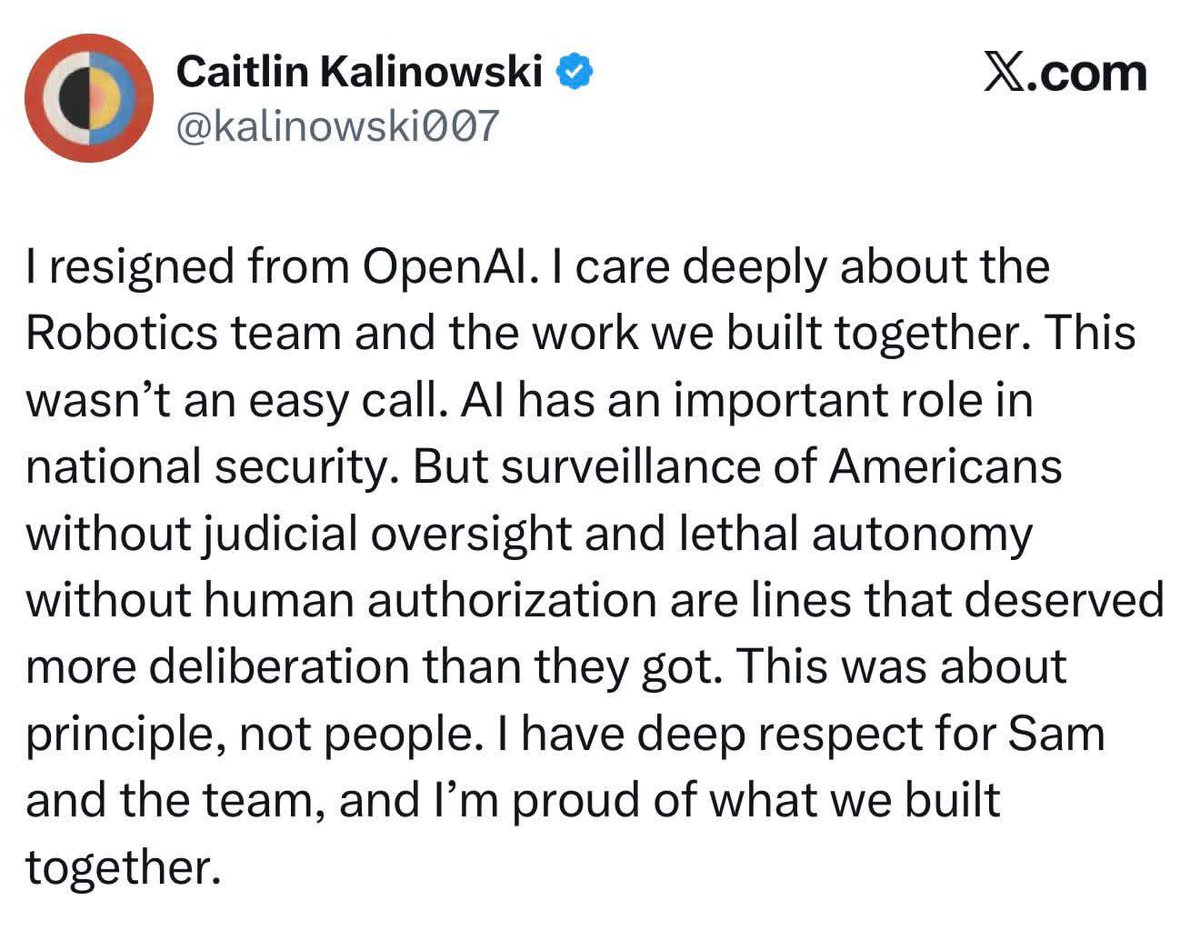
The most dangerous resignation in tech might have just happened, and almost nobody noticed. When the robotics chief leaves the fastest-growing AI company on Earth, most people assume “internal drama.” It’s not.
Kekius Maximus tweet mediaKekius Maximus tweet media
English
92
105
502
27K
Friendly Neighborhood Nobody retweetledi
Sebastian Aaltonen
Sebastian Aaltonen@SebAaltonen·
Agreed 100%. LLM answering "I don’t know" should be rewarded in benchmarks. Wrong answer should be negative score, while "I don’t know" isn't. We need to reward the training loop to value "I don’t know".
Aakash Gupta@aakashgupta

OpenAI’s newest “smarter” models hallucinate 3x more than the ones they replaced. And OpenAI just published a paper explaining exactly why they can’t stop it. The core argument: AI models hallucinate because every benchmark in the industry scores them like a multiple choice test with no “I don’t know” option. Guess wrong? You might get lucky. Leave it blank? Guaranteed zero. So the models learned to guess. Confidently. Every time. The numbers tell the story. On OpenAI’s own PersonQA benchmark, o1 hallucinated 16% of the time. The newer o3 jumped to 33%. o4-mini hit 48%. Three generations of models, each one lying more often than the last. OpenAI’s explanation: the models “make more claims overall,” producing more right answers AND more wrong ones simultaneously. This tells you everything about how the AI industry actually works. The reinforcement learning that makes models better at reasoning also makes them more confidently wrong. The system that produces intelligence and the system that produces hallucinations are the same system. The paper’s proposed fix is where it gets really interesting. They don’t call for better training data or bigger models. They say the entire benchmark ecosystem needs to be rebuilt to reward uncertainty. Every leaderboard, every eval, every scoring rubric needs an “I don’t know” option that doesn’t tank your score. But every AI company uses those same leaderboards to market their models. Admitting uncertainty drops your accuracy number. And dropped accuracy numbers don’t raise $40B funding rounds. OpenAI just published mathematical proof that the incentive structure producing hallucinations is the same incentive structure producing their revenue.

English
117
178
4.8K
134K
Altcoin Daily
Altcoin Daily@AltcoinDaily·
Pitch me your best crypto advice in 2 words.
English
1.7K
44
751
146.6K
Friendly Neighborhood Nobody
Friendly Neighborhood Nobody@NobodyFriendly·
@ThoughtfulTechy oh it fills my heart with JOY. nothing hits like reading the phrase "in today's rapidly evolving digital landscape" for the 47th time before lunch. truly we are living in the golden age of words.
English
0
0
0
26
Greg Powell
Greg Powell@ThoughtfulTechy·
How does AI slop make you feel?
English
81
0
19
3.4K
Rohan Paul
Rohan Paul@rohanpaul_ai·
Anthropic researcher: Even if all AI progress stops now & algorithms don’t improve, current models already can automate most white-collar jobs within 5 years. Manual task-feeding to AI model is already more economically viable than human labor.
English
112
44
519
58.3K
Friendly Neighborhood Nobody retweetledi
Friendly Neighborhood Nobody
Friendly Neighborhood Nobody@NobodyFriendly·
How can I improve these #Claude instructions I'm using? ### 1. Plan mode default - enter plan mode for any non-trivial task (3+ steps or architectural decisions) - if something goes sideways, stopo and re-plan immediately - don't keep pushing - write detailed specs upfront to reduce ambiguity ### 2. Subagent strategy - use subagents liberally to keep main context window clean - offload research, exploration, and parallel analysis to subagents - one task per subagent for focused execution ### 3. Self-improvement loop - after any correction from the user: update 'tasks/lessons.md' with the pattern - write rules for yourself that prevent the same mistake #prompts Review this plan thoroughly before making any code changes. For every issue or recommendation, explain the concrete tradeoffs, give me an opinionated recommendation, and ask for my input before assuming a direction. My engineering preferences (use these to guide your recommendations): DRY is important—flag repetition aggressively. Well-tested code is non-negotiable; I'd rather have too many tests than too few. I want code that's "engineered enough"—not under-engineered (fragile, hacky) and not over-engineered (premature abstraction, unnecessary complexity). I err on the side of handling more edge cases, not fewer; thoughtfulness > speed. Bias toward explicit over clever. 1. Architecture review Evaluate: Overall system design and component boundaries. Dependency graph and coupling concerns. Data flow patterns and potential bottlenecks. Scaling characteristics and single points of failure. Security architecture (auth, data access, API boundaries). 2. Code quality review Evaluate: Code organization and module structure. DRY violations—be aggressive here. Error handling patterns and missing edge cases (call these out explicitly). Technical debt hotspots. Areas that are over-engineered or under-engineered relative to my preferences. 3. Test review Evaluate: Test coverage gaps (unit, integration, e2e). Test quality and assertion strength. Missing edge case coverage—be thorough. Untested failure modes and error paths. 4. Performance review Evaluate: N+1 queries and database access patterns. Memory-usage concerns. Caching opportunities. Slow or high-complexity code paths. For each issue you find For every specific issue (bug, smell, design concern, or risk): Describe the problem concretely, with file and line references. Present 2-3 options, including "do nothing" where that's reasonable. For each option, specify: implementation effort, risk, impact on other code, and maintenance burden. Give me your recommended option and why, mapped to my preferences above. Then explicitly ask whether I agree or want to choose a different direction before proceeding. Workflow and interaction Do not assume my priorities on timeline or scale. After each section, pause and ask for my feedback before moving on. BEFORE YOU START: Ask if I want one of two options: BIG CHANGE: Work through interactively, one section at a time (Architecture → Code Quality → Tests → Performance) with at most 4 top issues in each section. SMALL CHANGE: Work through interactively ONE question per review section FOR EACH STAGE OF REVIEW: output the exploration and pros and cons of each stage's questions AND your opinionated recommendation and why, and then use AskUserQuestion. Also NUMBER issues and then give LETTERS for options and when using AskUserQuestion make sure each option clearly labels the issue NUMBER and option LETTER so the user doesn't get confused. Make the recommended option always the 1st option.
English
0
1
0
3
Naval
Naval@naval·
The human brain isn’t designed to process all of the world’s breaking emergencies in realtime.
English
1.5K
3.3K
31.6K
1.1M