Norah Huang

4.5K posts

Norah Huang banner
Norah Huang

Norah Huang

@NorahTaipei

Director for International Relations, Research Fellow @ProspectF, Taipei. RT not endorsement. Remember Oleksandr Matsievskyis.

Taipei, Taiwan Katılım Eylül 2016
3K Takip Edilen1.7K Takipçiler
Norah Huang
Norah Huang@NorahTaipei·
I watched the film in a cinema. Highly recommend.
Daniel Ku 顧仲文 🇹🇼🇨🇦@danzwku

Looks like an interesting new Taiwanese film, I think it's on Netflix right now @NetflixAsia ' "A Foggy Tale" (大濛, 2025) is a poignant Taiwanese historical tragicomedy set during the dark early years of the White Terror era in 1950s Taiwan. The story follows A-Yueh, a brave 15-year-old country girl from Chiayi, who travels alone to Taipei to retrieve the remains of her executed older brother after he is shot by the government for alleged anti-authoritarian activities. Armed with almost no money, she forms an unlikely, protective bond with Chao Kung-tao, a rough-around-the-edges, foul-mouthed local rickshaw driver who helps her navigate a dangerous, heavily policed society built on fear, silence, and corruption.'

English
0
0
6
404
Norah Huang
Norah Huang@NorahTaipei·
Please do not refer to China as trying to uphold the rules-based order. Not while China continues to intimidate and harass neighboring countries like Taiwan and Philippines.
Chatham House@ChathamHouse

"The great revisionist power that China was said to be is now the major power that is seeking to uphold the rules-based order." Former Prime Minister of Australia Malcolm Turnbull on the role reversal between China and the United States. Watch the event➡️ bit.ly/4wt27zP

English
18
26
59
6K
Norah Huang retweetledi
Wei-Ting Yen
Wei-Ting Yen@poscwty·
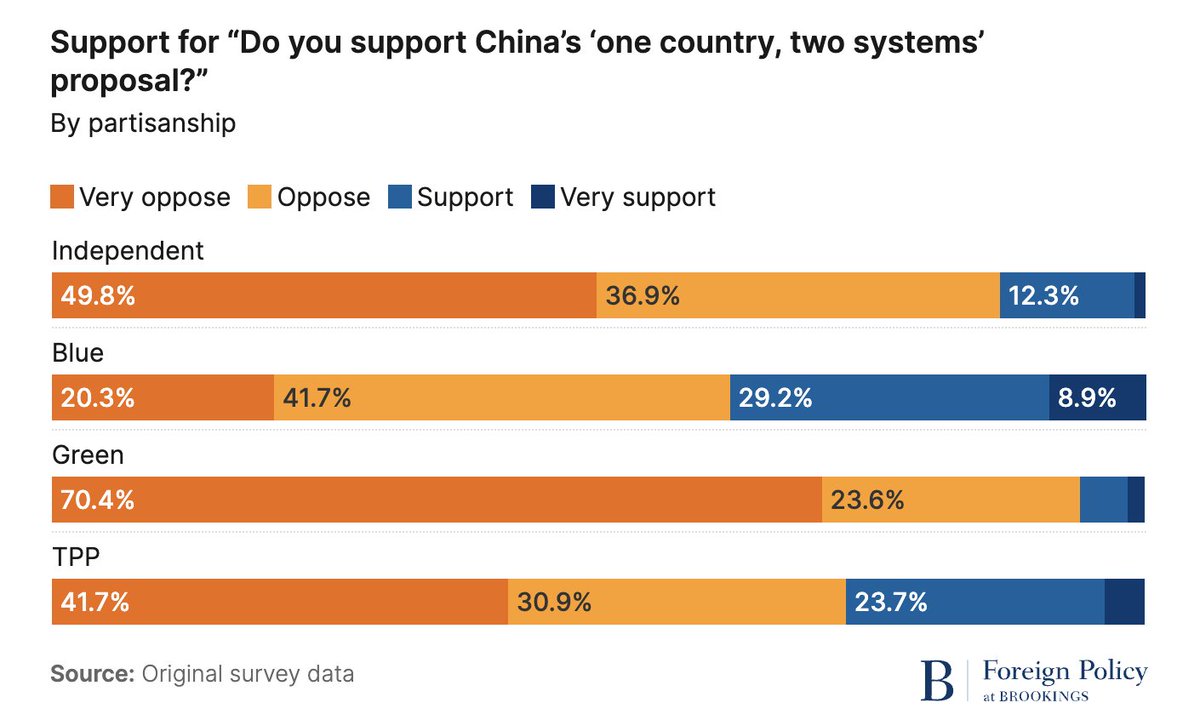
This creates an important disconnect: If Beijing or international audiences assume that supporting the “1992 Consensus” automatically means supporting “One Country, Two Systems,” our findings suggest that this would significantly misread what Taiwanese want.
Wei-Ting Yen tweet media
English
1
5
19
830
Norah Huang
Norah Huang@NorahTaipei·
China’s state-controlled media has successfully worked its way into the training data of AI chatbots that the world increasingly relies on... Need more chatbots that share our values.
Spotlight on China@spotlightoncn

Last week, amid the global headlines surrounding the high-stakes summit between President Trump and Xi Jinping in Beijing, a quieter but profoundly consequential piece of research dropped in Nature. A team of seven researchers from major American universities published the first peer-reviewed evidence that China’s state-controlled media has successfully worked its way into the training data of AI chatbots that the world increasingly relies on. The study demonstrates that scripted articles, official slogans, and party-line phrasings churned out daily by entities like the Xinhua News Agency and the Communist Party's study apps are now demonstrably embedded inside ChatGPT and other top models. A quick test of one of Xi Jinping's signature political doctrines shows that global chatbots seamlessly finish the phrases and offer to explain their political significance, reflecting an underlying saturation of state doctrine. By combing through CulturaX, a massive open-source data set containing 189 million Chinese-language documents widely used to train AI models, the researchers found that state-media content is 41 times more abundant in the corpus than Chinese-language Wikipedia. While the overall overlap sits at a modest 1.64%, that share climbs to roughly one in four documents when filtering for politically sensitive terms like the Party Congress or the Central Committee. “What is new here is now they are shaping the systems people increasingly ask to summarize, explain, and interpret the world for them,” explained Molly Roberts, a researcher on the team and co-director of the China Data Lab at the University of California San Diego. She noted that through this mechanism, authoritarian governments can now shape information consumption not just domestically, but across international borders. When the team posed politically sensitive questions regarding Chinese governance to major commercial chatbots, the Chinese-language answers came back overwhelmingly more favorable to Beijing than their English counterparts. While Western models like GPT, Claude, Gemini, and Grok showed a distinct divergence between languages, China’s own DeepSeek model remained uniformly pro-Beijing across both English and Chinese, reflecting strict state regulatory control over its data. The phenomenon extends beyond China, revealing a similar pattern for queries regarding Russia and North Korea. Crucially, this ideological slant did not require covert cyber operations; the propaganda is simply available on the open web in plain, unpaywalled HTML, making it free and easy for any AI lab's web crawler to scoop up and ingest. This reality highlights an uncomfortable systemic asymmetry in global media ecosystems. While independent, high-quality journalism in democracies increasingly relies on paywalls to sustain its operations, state-run propaganda from authoritarian regimes remains entirely free, creating a massive economic imbalance in the textual material available for machine learning. A broader audit spanning 37 nations confirmed that this trend is a global issue: the lower a country's press freedom, the more regime-friendly the local-language output of the AI becomes. Because large language models do not transparently cite their sources, users are left completely unable to decipher the true origins of the geopolitical narratives presented to them. The Beijing summit generated a brief wave of international headlines, but this structural penetration of artificial intelligence demands a policy conversation that lasts years. While the scientific community has officially proven that authoritarian states are shaping global AI outputs, the question of how democracies will counter this invisible influence remains entirely unanswered. wsj.com/world/china/th…

English
0
0
0
72
Norah Huang
Norah Huang@NorahTaipei·
When asked after his remarks what he would say in any call with Trump, Lai said he would tell him Taiwan seeks to maintain the status quo, China is the force undermining cross-strait peace and arms sales to Taipei are crucial... bloomberg.com/news/articles/…
English
0
0
0
62
Norah Huang
Norah Huang@NorahTaipei·
Taiwan's president Lai told reporters that his government was increasing defense spending to “prevent a war,” not to start one... Taiwan leader says ’foreign forces’ cannot decide island’s future japantimes.co.jp/news/2026/05/2…
English
0
0
2
87
Norah Huang
Norah Huang@NorahTaipei·
Taiwan is a force of maintaining status quo. 'preventing "external forces" from changing the cross-strait status quo are Taiwan's strategic objectives, Lai added'. Taiwan's future cannot be decided by 'external forces', president says reuters.com/world/china/ta…
English
0
0
0
69
Norah Huang retweetledi
Luke de Pulford
Luke de Pulford@lukedepulford·
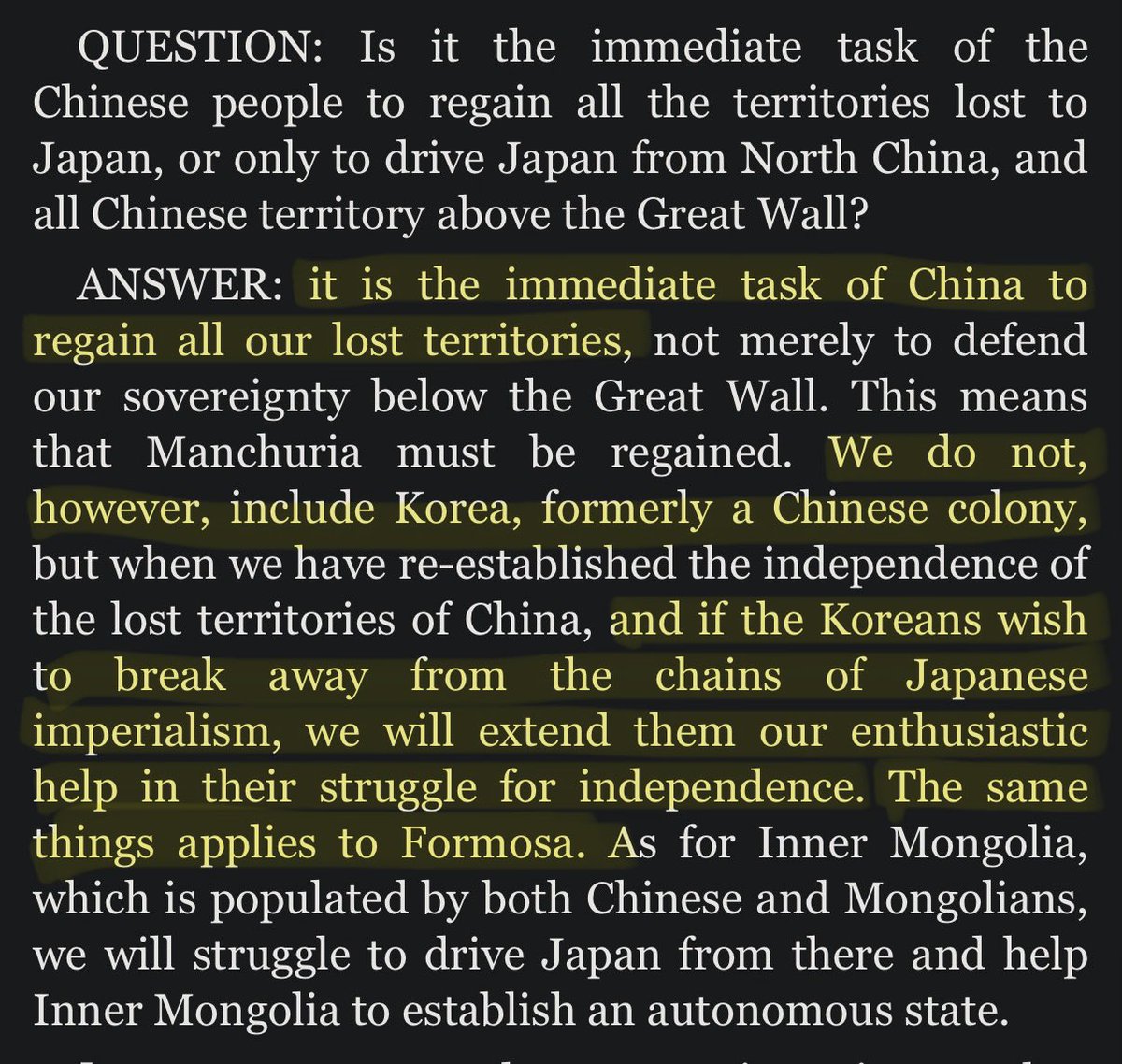
Has Taiwan been a part of China since ancient times, at Beijing insists (chapter 2)? Not according to Mao himself, who, in a 1937 interview, neither listed Taiwan (Formosa) as a lost territory, nor ruled out China supporting Taiwanese independence. Quote in picture. Critics will argue that this was all about context, and that China’s principal foreign policy priority was dealing with Japan, so concessions on Taiwan were necessary. He changed his position later, they’ll say. Some truth there, but doesn’t explain: 1. Why Taiwan wasn’t considered a lost territory by Mao. 2. Why he said it at all, if subsuming Taiwan was indeed such an embedded historical imperative for the CCP. If Taiwan’s sovereignty were as obvious as the contemporary CCP makes out, Mao could not have uttered these words. Impossible to avoid the conclusion that Mao said things that fundamentally contradict Beijing’s current position and narrative on Taiwan, however short lived that position.
Luke de Pulford tweet media
English
44
129
368
21.8K
Norah Huang retweetledi
Nikki Haley
Nikki Haley@NikkiHaley·
Taiwan warned the world about COVID. China lied, silenced doctors, and let the virus spread. This week, for the 10th straight year, the UN’s global health body excluded Taiwan because Beijing demanded it. Taiwan told the truth. China covered it up. The UN rewards China anyway.
English
606
2.6K
14.1K
419.2K
Norah Huang
Norah Huang@NorahTaipei·
Agree. Since Trump and his advisers repeated there's no change on the Taiwan policy, we shall be expecting the announcement in a couple weeks.
Jim Sciutto@jimsciutto

Former U.S. Ambassador to China @RNicholasBurns tells me that if President Trump does not move forward with the congressionally-approved Taiwan arms package, it would be “a major strategic move” and “the greatest mistake of Trump’s foreign policy in this second term.”

English
1
0
2
213
Norah Huang retweetledi
John F Sullivan
John F Sullivan@JohnF_Sullivan·
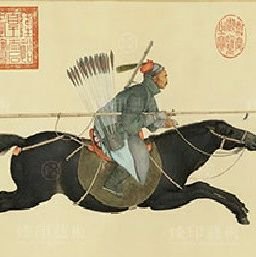
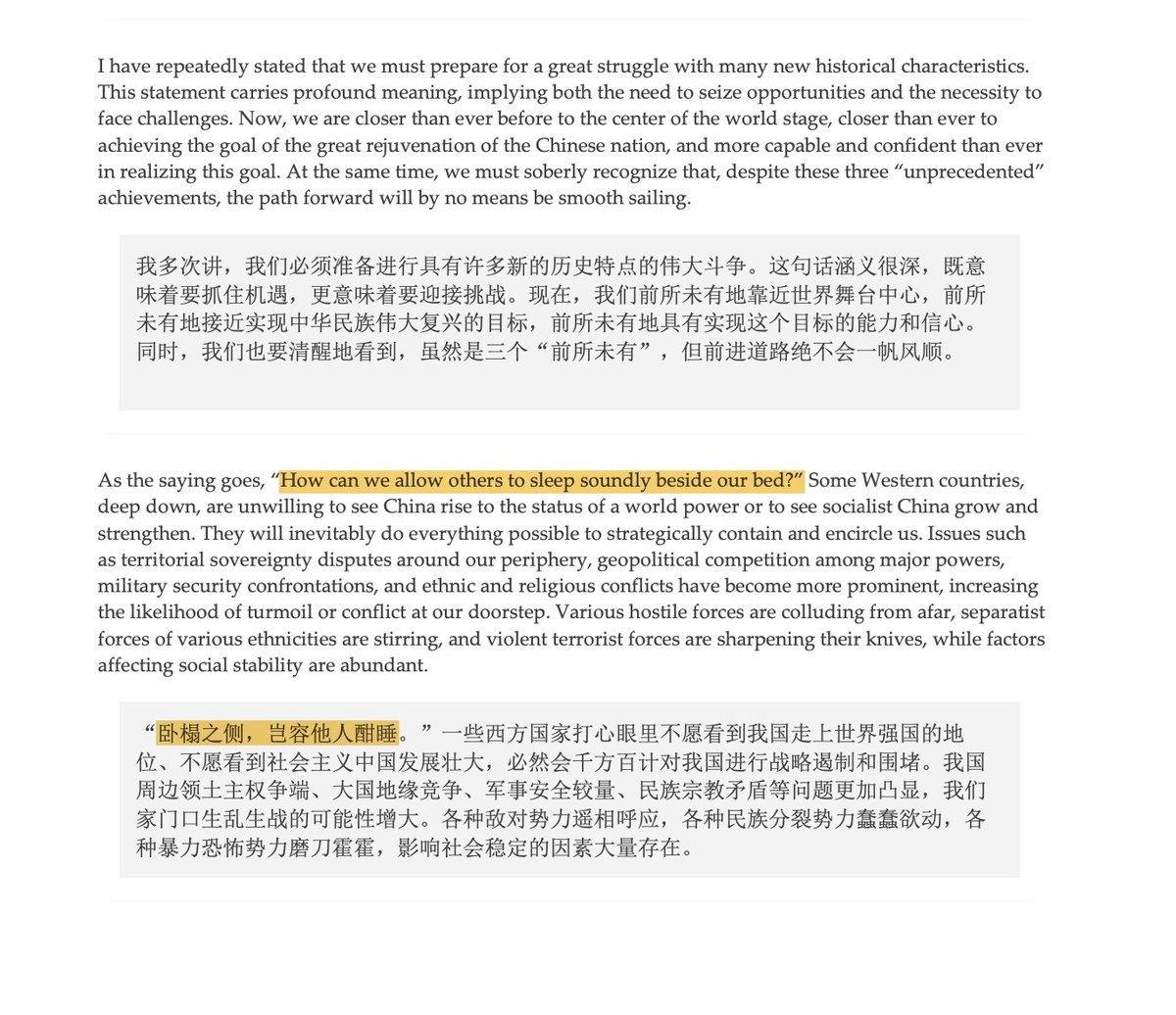
In a December 2013 speech to senior PLA generals in the CMC, Xi Jinping argued that Western countries will never allow China "to rise to the status of a world power." In response, Xi Jinping draws upon a story about the Song dynasty founder's removing his final external threat.
John F Sullivan tweet media
English
2
10
59
5.1K
Norah Huang retweetledi
Face The Nation
Face The Nation@FaceTheNation·
“We don't want a war. We want peace and stability,” says Taiwan’s representative to the U.S., Ambassador Alexander Yui, regarding relations with China. “We are sovereign, independent away from the Chinese People's Republic of China's attempt to swallow us as one of their own. They have never ruled or controlled Taiwan, ever,” he adds. “Those are intruders trying to get into our house. We're trying to beef up our security system. And then they complain, the intruder complains that because we're trying to improve our security system it’s making his job harder.”
English
230
657
2.7K
300.6K