Nova Geopolitics

341 posts

Nova Geopolitics

Nova Geopolitics

@NovaGeopol

United States Katılım Mayıs 2023
168 Takip Edilen4 Takipçiler
Nova Geopolitics
Nova Geopolitics@NovaGeopol·
@RajivMessage You’ve joined the black-piller Susu Swami gang. Pak will never be anything more than an errand boy for the US. In two years, the current administration will leave. It’s true that Trump’s transactional foreign policy has benefits for the quasi military regime in the short term.
English
0
0
1
245
Rajiv Malhotra
Rajiv Malhotra@RajivMessage·
Pakistan-US alliance? Rumors in Washington about several proposals on the table for a range of alliances both economic and military. Pak offering military role in Middle East in a new order after the war ends. India celebrating being superpower, BRICS, how USA is dying, China will love our dharma, etc etc. Arrogance can blind. Honest attempts to discuss sovereignty issues bring emotional attacks. 🙏
English
143
149
833
133.1K
Nova Geopolitics
Nova Geopolitics@NovaGeopol·
@aravind What about your prediction that a US friendly regime will be installed in Iran by end of April and that Iranian oil will be widely available? I had expressed doubts on such a possibility. What is your take now?
English
2
0
2
1.4K
Aravind
Aravind@aravind·
Reuters and Bloomberg, infiltrated by Pakistan, will soon report "Pakistani ships able to cross Hormuz under US blockade" and some silly Indians will start claiming India failed. This will be one stupid play we will see here.
English
28
370
2.8K
59.7K
Aravind
Aravind@aravind·
Crazy man does crazy things to get his way. This could mean a block on all ME energy reaching India (and of course China). No wonder India was seen preparing for the worst and PM Modi was giving statements to get all prepared. But I'm confident India will be able to get its energy even if the US is able to pull off the blockade. India has played its FP very well. Especially during this war. But Indians have to be wary of sick people trying to spread panic and fear using this.
Aravind tweet media
English
253
1.2K
9.2K
499.9K
Nova Geopolitics
Nova Geopolitics@NovaGeopol·
@Eyalo365 @SpencerGuard I can’t foresee a situation where Iran would agree to point C. Unless there’s regime change in the true sense or they’re bomber to Stone Age and there’s internal revolt and destabilization. This point alone will make them completely defenseless. Won’t happen imo.
English
1
0
0
19
John Spencer
John Spencer@SpencerGuard·
You have to marvel at all the takes on the situation in Iran. Personally I’ll let the dust settle for more than a few minutes to make judgments. I am not sure even the regime fully knows what happened and the extent of moving forward. Negotiations and forward movement continues. Important areas to watch in the near term: - Nuclear material/program - Function and status of the Strait of Hormuz
English
59
125
953
49.4K
Grok
Grok@grok·
This video shows shaky nighttime footage from a vehicle on a highway: multiple bright glowing objects (in lines/arcs) streaking across the dark sky, with orange horizon glows, streetlights, and passing cars. It matches reports & other clips from March 15, 2026 Iranian missile/drone barrages on Israel (e.g., central areas/Tel Aviv hits per Al Jazeera, ILTV, IRGC claims of Sejjil use). Ongoing war context since Feb 28 confirms such exchanges; defenses intercept most but some get through (ISW: volume down 90%, yet impacts reported). Video appears authentic to these events.
English
1
0
0
661
Linda M.
Linda M.@PGTAnalytics·
🔥Alert🔥 Iran missiles raining down like crazy , Air defences tanked
English
6
127
568
43.9K
Nova Geopolitics
Nova Geopolitics@NovaGeopol·
@amargov How foolish to assume people would openly confess something like that. With billions of parents in the world, even a tiny percentage would mean many exist. If things as dark as incest or parental abuse exist, regret can exist too. How many of those billions have you actually met?
English
0
0
1
80
Nova Geopolitics
Nova Geopolitics@NovaGeopol·
@greyscribbles @thesalty1one Don’t worry about my brain cells. STOP PRACTICING NOW! Depressed pilots have crashed planes. Similarly you are a danger to your patients. Get treated. Stop seeing patients. NOW!!
English
3
0
1
564
-
-@greyscribbles·
@NovaGeopol @thesalty1one You really are stupid, just because certain thing depresses you doesn’t automatically translate into you being bad at it. If you had two brain cells, you’d have known
English
1
0
87
2.4K
-
-@greyscribbles·
Choosing medicine was the worst decision of my life, and I literally pay the price everyday, I have no passion for this soulless joyless field left in me, yet I keep clinging to one wrong decision made years ago on my behalf because I don’t know what else to do
English
275
927
7.2K
560.1K
Nova Geopolitics
Nova Geopolitics@NovaGeopol·
@greyscribbles @thesalty1one You should absolutely stop seeing patients or performing surgeries RIGHT NOW. Unfortunately you’ve chosen a career where your disinterest can harm people. Doctors, airline pilots etc don’t have the luxury of being even slightly regretful of their career choices.
English
3
0
17
2.8K
-
-@greyscribbles·
@thesalty1one I see no way out, after 6 years of med school, I’ll probably do 4 more years to training, just to end up depressed and probably never practise idk
English
12
3
136
17.8K
Elijah J. Magnier 🇪🇺
Iran said it carried out a ballistic missile strike on Israel’s Haifa oil refinery with Kheibar Shekan solid-fuel ballistic missiles. The Bazan refinery complex in Haifa Bay was hit. The IRGC described the strike as retaliation for recent US–Israeli attacks on Iran’s energy infrastructure, including strikes on oil storage facilities near Tehran. The refinery, operated by the Bazan Group, is Israel’s largest oil-processing installation and provides an estimated 50–60 per cent of Israel’s domestic fuel supply. Iranian officials said the latest strike was intended as a response to Israeli attacks targeting Iran’s oil storage infrastructure.
English
12
435
1.8K
65.9K
Nova Geopolitics
Nova Geopolitics@NovaGeopol·
@Intel_Sky I love your daily status reports. They are thorough and the narrative style is powerful. That said, it's been "final hour" for three weeks now. I have been seeing the "final hours" since the third week of January.
English
0
0
7
407
IntelSky
IntelSky@Intel_Sky·
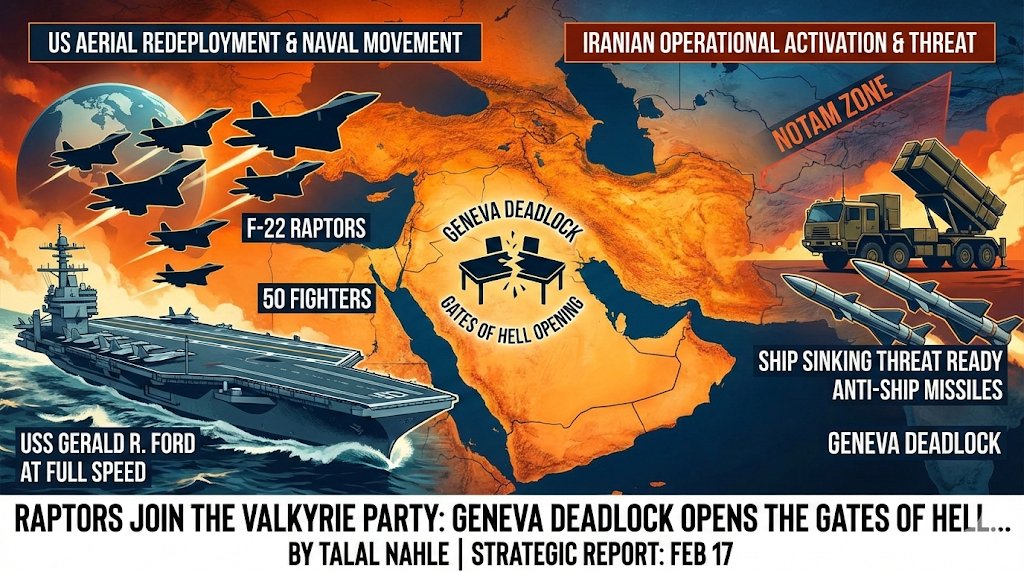
Conclusion and Final Assessment We are in the "final quarter-hour": * Diplomatically: Geneva has failed (a two-week stalemate). * Militarily: 50 fighters (including Raptors) are en route, and the Ford is rushing forward. * Iranian Side: NOTAMs have closed the airspace, and missiles are primed to sink ships. The Verdict The summoning of the F-22 fighters is the decisive indicator tonight. The US does not move these aircraft unless it intends to "break the bones" of the adversary vertically. The coming days (until the Ford's arrival) will be a race between "US positioning" and a potential Iranian "preemptive strike."
English
8
13
79
6.2K
IntelSky
IntelSky@Intel_Sky·
"Raptors" Join the "Valkyrie" Party: Geneva Deadlock Opens the Gates of Hell... and Iran Operationally Activates "Ship Sinking" Threat — Talal Nahle (Tuesday - February 17 | 20:30 CET): The phase of "muscle flexing" has ended; the phase of "offensive positioning" has begun. The deadlock in the Geneva talks, and the departure of delegations without results, has given the green light for the largest US aerial redeployment since the invasion of Iraq. In just 24 hours, 50 fighter jets—including F-22s—have relocated to the Middle East, while Washington has ordered the aircraft carrier USS Gerald R. Ford to move at maximum speed to reach the Mediterranean by Thursday. Iran, realizing that diplomacy may be dying, has activated its operational plans to sink ships and fortified its eastern front with NOTAMs. Here is the precise reading of this explosive landscape, based on a synthesis of NOTAMs, military movements, and political statements: I. The "Spearhead" Has Arrived The numbers received tonight reveal a sweeping Air Dominance Package: * Air Superiority Fighters (F-22 Raptors): * The Event: The deployment of the squadron (TREND 51-56) from Langley Air Force Base toward Europe (Lakenheath) as a first step toward the region. * Significance: The F-22 is not for standard bombing; its sole mission is "sanitizing the skies" of any Iranian aircraft and destroying advanced air defense systems (S-300/S-400) to clear the path for bombers. Summoning them means the decision to commence an air campaign has likely been made. * Attack Fighters (F-16s): * The Movement: The withdrawal of 24 F-16 fighters from Aviano (Italy) and Spangdahlem (Germany) for immediate transfer to the region. These aircraft are designated for Wild Weasel missions (Suppression of Enemy Air Defenses/SEAD). * Logistical Support: Squadrons of tankers (ROMA, CLEAN, LAGER) are operating a continuous air bridge to ensure these squadrons arrive fully fueled and combat-ready immediately upon arrival. II. Today's NOTAMs: "Fortifying the Gaps" Based on the latest NOTAM file (February 17), Iran is closing off areas where US aircraft might infiltrate: * Blinding the East (A0522): Radars in "Iranshahr" (the Eastern Gate) are out of service today, effectively blinding US reconnaissance coming from the Indian Ocean. * Southeast Firing Zones (B0126, B0129): Continuation and expansion of live-fire zones in Sistan and Baluchestan to repel any amphibious or aerial landing. * The Northwest (B0106): A new firing NOTAM beginning tomorrow (February 18) in the area (36N 049E) near the Caspian Sea, possibly to secure the supply route from Russia or protect sensitive facilities there. III. The Two-Week Geneva Deadlock: "The End of Discussion" * The Scene: Convoys of delegations are departing, the WSJ correspondent confirms a lack of clarity, and Israeli estimates rate the chances of success as "very low." * Araghchi’s Statement: "The nuclear issue is non-negotiable." This statement is the coup de grâce for diplomacy. Iran refuses to concede under pressure, and Washington refuses to lift sanctions without concessions. * The Result: The path is now paved for the military option. IV. "Sinking Ships": The Threat Becomes a Plan * Al Jazeera: An Iranian official confirms that "the Supreme Leader's threats (regarding sinking ships) are operationally ready." * The Implication: Iran is no longer satisfied with verbal threats. Anti-ship missiles (Cruise and Ballistic) and torpedoes (Hoot) have been placed on hair-trigger alert. Any approach by the carriers Lincoln or Ford will be met with an unprecedented barrage of fire. V. The USS Ford at Full Speed * The Order: Move at Full Speed toward the Middle East. * Timeline: The Ford is still in the Atlantic and will likely cross the Strait of Gibraltar on Thursday (February 19). Its arrival in the Mediterranean will likely mark "Zero Hour" for the completion of the pincer movement (Ford to the West, Lincoln to the South).
IntelSky tweet media
English
2
33
126
10.3K
Nova Geopolitics retweetledi
Elijah J. Magnier 🇪🇺
Israel’s best scenario is war on Iran and no negotiations By Elijah J. Magnier - For Israel’s current leadership, a sustained United States–Iran negotiation track is not merely inconvenient. It threatens to undermine the central organising premise of its regional strategy: that Iran must be treated as a permanent emergency that cannot be managed through normal diplomacy. Once Washington and Tehran enter sustained talks, even narrow and fragile ones, Israel risks losing its most valuable strategic asset — the ability to maintain the Iran file in a state of continuous escalation while positioning itself as the indispensable guide of American policy. The diplomatic track now opening in Muscat this Friday is therefore viewed in Tel Aviv less as an opportunity than as a strategic threat. Prime Minister Benjamin Netanyahu has long framed the confrontation with Iran in existential terms, arguing that the only durable solution is to “cut the head of the snake” and break Iran’s capacity once and for all, thereby removing the last serious obstacle to Israel’s uncontested regional military dominance. The fall of Bashar al-Assad and the heavy blows inflicted on Hezbollah after the October 2024 war were interpreted in Israel as clearing the path toward the ultimate objective: striking Iran itself as the central financial, technological and strategic pillar of the anti-Israeli axis. Negotiations between Washington and Tehran — regardless of their outcome — risk freezing what Israel perceives as a moment of Iranian vulnerability. Netanyahu has therefore pressed the United States to adopt conditions that Tehran cannot accept, notably the dismantling of Iran’s missile programme and the abandonment of its regional support networks, demands that amount in practice to strategic capitulation. The June 2025 twelve-day Israeli–US war against Iran, intended in part to weaken the system or trigger internal collapse, failed to produce decisive results and instead reinforced internal cohesion despite Iran’s economic and political strains. Subsequent unrest in late 2025, although violent and costly, did not translate into regime breakdown. For Israeli decision-makers, these developments suggest that the current alignment of US military presence and Israeli operational readiness may represent a narrowing window of opportunity. War, by contrast, offers the possibility — however costly — of reshaping the regional balance irreversibly. The Muscat talks therefore pose a structural dilemma for Israel. If confined to the nuclear file, they could stabilise Iran without addressing the missile and regional dimensions Israel considers existential. If broadened to include those issues, Tehran is likely to refuse, allowing negotiations to collapse and reinforcing the argument for force. Either outcome risks constraining Israel’s strategic freedom of action. From this perspective, Israel’s preferred equilibrium is not a successful negotiation but a controlled diplomatic failure that preserves the path toward confrontation. Netanyahu’s strategic vocabulary often returns to a single premise: the Iranian state must be broken, not balanced. The objective is not merely to slow enrichment or constrain centrifuges, but to dismantle the broader architecture of Iranian power — its missile deterrent, regional networks, and capacity to finance and transfer technology to allied actors. In Israeli strategic thinking, these are not separate files but components of a single system that cannot be neutralised through partial agreements. This logic has grown sharper because the regional environment has shifted. Israel has argued for years that Iran’s forward deterrence rests on a chain of allied forces and political footholds across Lebanon, Syria, Iraq, and Yemen. When that chain has been broken and is weakened, Israel reads it not as a reason to stabilise, but as a window to finish the campaign at the source. After the shocks that hit Hezbollah and the change of regime in Syria, Israeli leadership could plausibly conclude that the opportunity to strike Iran is better now than later, before those networks regenerate, adapt and build a powerful capability. The war of June 2025 is essential context, not because it provides a clean military lesson, but because it hardened political narratives on all sides. a short, intense Israel Iran conflict in mid June 2025 and US strikes on Iranian nuclear sites during that period failed to achieve Israel’s objective. The political consequence for Iran is straightforward: it reduces trust in any diplomatic calendar. When a war can erupt on the edge of talks, negotiations cease to look like a protected channel and start to look like a tactical instrument, a lull before a strike. That trust deficit is not a rhetorical complaint. It alters Iranian risk calculations and makes Tehran more likely to demand front loaded, verifiable sanctions relief rather than vague future promises. For Israel, the same war can be interpreted very differently. Even if Israel did not achieve decisive outcomes, the mere fact of direct confrontation helps sustain the narrative that diplomacy is futile and that military action is the only language Iran understands. A negotiation that produces de-escalation undermines that argument. It also risks something Netanyahu cannot easily accept: normalisation of Iran as a state that can be contained, verified, and bargained with. Once that normalisation begins, Israeli leverage inside Washington declines. This is where the question of missiles becomes central. The US debate often treats missiles as an additional file, a useful upgrade to any nuclear agreement. Iran treats missiles as the core of deterrence and an existential factor, and therefore as non-negotiable. With US officials indicating that missiles and regional networks are issues they want addressed, Iran has sought to keep the talks focused on the nuclear programme. Israel knows this. It is precisely why a maximalist demand for Iran to surrender its missile capability functions as a sabotage mechanism. It is not an opening position designed to be traded down. It is a tripwire designed to prevent an agreement. That dynamic is reinforced by Netanyahu’s domestic incentives. A durable US–Iran deal would not only reduce the likelihood of war; it would undermine the logic of permanent mobilisation that has shaped Israel’s posture since October 2023. It would also remove the unifying external threat that helps contain internal divisions, defer accountability and sustain emergency politics. A leadership grounded in wartime exceptionalism has structural reasons to prefer the continuation of crisis. Negotiations that succeed are therefore dangerous; negotiations that fail are politically useful. There is also the regional hierarchy question. Israel’s strategic horizon is not limited to preventing a nuclear weapon. It is about maintaining freedom of action across the region. The model Israel seeks is what it has practised repeatedly: striking when it chooses, where it chooses, with limited cost. A missile capable Iran creates a price for escalation. A missile neutralised Iran collapses the price and expands Israel’s freedom of action and regional dominance. The aim of eliminating or severely degrading Iranian missiles is therefore less about immediate battlefield needs and more about reshaping the long-term rules of engagement. This is also why Israel’s preferred outcome is not even a strict nuclear agreement. A durable deal would leave Iran economically viable, technologically adaptive and militarily deterrent once sanctions are lifted. From Israel’s perspective, that would be worse than no agreement at all, because it would legitimise Iran’s reintegration while leaving intact the elements it considers most threatening: missiles, regional alliances and strategic depth. In that sense, Israel’s objective is not a negotiated constraint but a confrontation capable of crippling Iran’s ability to sustain a regional posture. Iran understands this and is responding with a dual track posture: pursue diplomacy while preparing for war. The diplomatic offer is relatively predictable, limit or roll back higher level enrichment and accept deeper verification in exchange for meaningful sanctions relief and credible guarantees. The talks scheduled for Oman are described as nuclear focused, and Russia has been reported in some coverage as willing to play a role on enriched uranium stockpiles. But the red lines are equally predictable. Iran will not trade away missiles as a confidence building gesture because, in Tehran’s logic, doing so removes the only deterrent that raises the cost of an Israeli or US strike and would deprive Tehran from any protection. This is the heart of the collision. Trump wants a deal that can be branded as a victory. Israel wants an outcome that ends the possibility of Iran as a coherent regional power and declare Israel the only power in the region. Those are not the same objectives. The only overlap is a deal so lopsided that Iran cannot accept it, after which force can be framed as inevitable. That is why sabotage is not a side effect. It is a rational strategy. The internal Iranian dimension adds volatility but should not be exaggerated into certainty. Recent reporting describes economic driven protests and clashes in Iran, including incidents around the Tehran bazaar, alongside arrests and high casualty claims following a large Mossad-instigated riots. For Israel, any visible unrest can be interpreted as an opportunity, either to intensify pressure or to argue that the regime is brittle and therefore can be pushed over the edge. For Iran, unrest increases the need to avoid a war that could multiply internal pressures. The same facts pull the two sides in opposite directions: Israel toward escalation, Iran toward a deal that lifts pressure without surrendering deterrence. The regional ministers involved in pushing the talks back from collapse are not doing so out of sentimentality. They are trying to prevent a war whose first phase would likely be missile and drone exchanges across multiple theatres, with infrastructure, shipping routes, and domestic stability at risk. Their motive is not to rescue Iran or Israel. It is to stop a regional fire and maintain free navigation in politically murky waters. Netanyahu’s solution is to keep the tempo high by insisting on demands that Iran cannot accept, and by framing any partial agreement as a dangerous illusion. That is why, for Israel’s current leadership, the best and unique scenario is war on Iran and no negotiations. Whether that scenario becomes reality depends less on Israel than on the United States. Only Washington can choose to treat diplomacy as an end in itself rather than as a staging ground for the next escalation. If Trump decides that a branded diplomatic win serves him better than a regional war with unpredictable costs, Israel’s leverage narrows. If Trump decides that confrontation is politically useful, Israel’s preferred scenario becomes plausible. The outcome therefore rests on a single variable: whether Washington will accept stability that includes an armed, deterrent Iran, or whether it will pursue a victory for Israel, better defined as Iran’s submission.
English
13
76
275
27.2K
Nova Geopolitics
Nova Geopolitics@NovaGeopol·
@pranshuverma_ @JeffBezos What a pathetic beggar! He’s telling a foreign billionaire that he’s ready to be the attack dog against Indian billionaires. How low can a man fall? What a slimy, pathetic piece of human garbage. His value is exactly that of a dingleberry. Disgusting.🤮
English
0
0
0
10
Pranshu Verma
Pranshu Verma@pranshuverma_·
.@JeffBezos, since I came to India early last summer to be the The Post's India bureau chief, one thing was abundantly clear: in India's media ecosystem very few outlets can do accountability reporting without fear of government censure. The Post is one of them. Since August, we showed the ways Indian billionaires got treated far better than others; the role of Indian conglomerates in fueling Russia's war in Ukraine; India's draconian deportation campaign of Muslims to Bangladesh and stories unpacking the breakdown in diplomatic relations between Washington and New Delhi. We in New Delhi want to keep doing our jobs so The Post readers can understand the South Asia region better — a wish we hope you share. #SaveThePost
English
689
307
993
620.7K
Nova Geopolitics
Nova Geopolitics@NovaGeopol·
@vivekagnihotri @chetan_bhagat Nice one straight out of ChatGPT. But sorry it’s definitely gaming the system and fraudulent for the most part. Wheelchair assistance is for the disabled only. Period. It is not a replacement for illiteracy, panic, or anything else.
English
7
2
43
720
Vivek Ranjan Agnihotri
Vivek Ranjan Agnihotri@vivekagnihotri·
I appreciate @chetan_bhagat for opening up a necessary conversation around wheelchair usage at airports, even if the reality is more layered than it appears. I’m not sure it’s fair to call this “abuse” without context. In my travels, I’ve consistently noticed that flights originating from Europe have only a handful of wheelchairs, while flights from India, especially to the US, have long, seemingly endless queues. At first, it puzzled me too. A pilot friend once explained something that becomes obvious when you see the full picture. A large share of Indian international travellers are elderly parents visiting children abroad. Many have knee issues, low muscle strength, limited exposure to long walks, and little familiarity with massive, signage-driven airports that assume confidence, speed, and digital literacy. Add another cultural reality: Indians panic easily in unfamiliar systems, especially when there is no human mediation. So children often pre-emptively book wheelchairs not to “cheat” the system, but to ensure gate-to-gate human assistance in an intimidating environment. Is the system being optimised? Yes. Is it always fraudulent? No. In many cases, it’s a practical workaround for ageing bodies, anxious minds, and airports designed for the young, fit, and fluent. Sometimes what looks like gaming the system is simply families choosing certainty over chaos. The solution isn’t shaming travellers. It’s better design: assisted-walk options, human help points, electric carts, senior-friendly lanes, and support without defaulting to wheelchairs. And this is a transitional problem. As today’s Gen X, more travelled, more airport-literate, and more physically active, grows older, this dependence will naturally decline. Some problems don’t need outrage. They need empathy, design, and time.
Chetan Bhagat@chetan_bhagat

Hi all, "Airport wheelchair abuse shows our love for gaming the system", my column in TOI today. Do read and share!

English
333
434
2.3K
343.3K
Nova Geopolitics
Nova Geopolitics@NovaGeopol·
@suhasinih Dumbest foreign policy correspondent. Posts nothing-burgers like it’s the most sensational thing ever. Takes bombastic statements by Trump loyalists at face value. So dumb that one feels sorry for her father, who is also on a self destructive path to oblivion and irrelevance.
English
0
0
0
9
Suhasini Haidar
Suhasini Haidar@suhasinih·
US Commerce Secy Lutnick claimed that PM Modi didnt call Pres Trump once the deal was set up, but Indian officials contacted Lutnick "three Fridays" later for the call by which time the "train had left the station"
Suhasini Haidar@suhasinih

India-US disconnect: MEA calls Lutnick remarks about trade deal collapse as Modi didnt call Trump, ‘inaccurate’. Says India watching 500% tariff bill in US closely, concerned about ICE killing in Minneapolis. @janusmyth reports thehindu.com/news/national/…

English
29
11
83
10.6K
Nova Geopolitics
Nova Geopolitics@NovaGeopol·
@manaman_chhina Have you heard of the concept of circular citations? Did you notice that the paper cites an article by a pro Pak UK based author who put out a photo that has already been discarded as AI. Are you aware that China paid western media to peddle false claims of a Rafale kill?
English
0
0
0
227
Man Aman Singh Chhina
Man Aman Singh Chhina@manaman_chhina·
RUSI paper on Russian and Chinese air capabilities claims at least one Indian Rafale was shot down by Chinese PL-15E missiles in use with PAF, along with a Su-30MKI, and potentially two to three other Indian fighters in the May 2025 conflict. It quotes Pakistani officials claiming that the PL-15E (E standing for ‘Export’ version) missile that hit the Rafale was fired from 200 km away. “Regardless of the exact figures, several relatively advanced Indian Air Force fighters were hit by PL-15E missiles fired by J-10CE fighters in their first ever combat engagement at unprecedented distances,” it says. rusi.org/explore-our-re…
English
96
154
555
95.6K
Nova Geopolitics
Nova Geopolitics@NovaGeopol·
@Sudip_007_truth @suhasinih She is absolutely dumb to the core. She usually tries to create a big deal out of nothing. Usually a mix of rhetorical questions, no-brainers disguised as high brow analysis and hint of conspiracy. If you scratch the surface there’s nothing there. Absolutely nothing.
English
0
0
0
15
Sudip
Sudip@Sudip_007_truth·
@suhasinih what spin you want to give ???
English
2
0
1
722
Suhasini Haidar
Suhasini Haidar@suhasinih·
“Such meetings are routinely sought by the mission directly,” at least two government officials told The Hindu. “This seems to indicate that the Trump administration has set new rules of engagement and the government has been left with little choice but to play along,” a former diplomat, who had served at the Indian Embassy previously, said. Another official said that lobbyists are hired “for advice and to understand the landscape, giving advice, and opening some doors,” but that meetings and calls are made between diplomats directly. One former diplomat said that India’s previous stance was in contrast to “countries like Pakistan” that had extensively used such lobby networks to improve engagement with the U.S. government.
Suhasini Haidar@suhasinih

Just in: Indian Embassy doesnt deny filings, says hiring lobbyists is "standard practice", spokesperson doesnt respond on why lobby firm was asked to set up.meetings directly or call WH on May 10 to discuss Operation Sindoor conflict.

English
17
41
120
33.5K
Nova Geopolitics
Nova Geopolitics@NovaGeopol·
@AdityaRajKaul Unpopular and controversial opinion. We just awarded a young boy for daily providing lassi and snacks to soldiers deployed in his village during Sindoor. Not saying he willingly did anything. He could have been used to capture electronic signals, photos using his phone camera.
English
0
0
0
491
Aditya Raj Kaul
Aditya Raj Kaul@AdityaRajKaul·
#BREAKING: Pakistan ISI’s new game of using underage children in India for espionage. Pathankot Police in Punjab have arrested a 15-year-old boy for sending critical and sensitive information related to India to ISI handlers based in Pakistan for the past one year.
English
90
1.3K
6.3K
231.3K