Obieda Ananbeh

369 posts

Obieda Ananbeh banner
Obieda Ananbeh

Obieda Ananbeh

@ObiedaAnanbeh

Jordan | USA Katılım Ağustos 2011
452 Takip Edilen46 Takipçiler
Obieda Ananbeh
Obieda Ananbeh@ObiedaAnanbeh·
A recent paper from OpenAI (“Why Language Models Hallucinate”) shows that LLMs are rewarded for being too confident instead of saying “I don’t know.” 👉 Fixing this means teaching models to value uncertainty when the answer isn’t clear. 🔗 cdn.openai.com/pdf/d04913be-3…
English
0
0
0
34
Obieda Ananbeh
Obieda Ananbeh@ObiedaAnanbeh·
In Large Language Models (LLMs), everything is built on next-word prediction. The model picks the word with the highest probability — not necessarily the truth. That’s why we get hallucinations: confident but wrong answers. 🤯
English
1
0
0
38
Obieda Ananbeh
Obieda Ananbeh@ObiedaAnanbeh·
ChatGPT Plus users can send up to 160 messages with GPT-5 every 3 hours. After reaching this limit, chats will switch to the mini version of the model until the limit resets. This is a temporary increase and will revert to the previous limit in the near future.
English
0
0
1
139
Obieda Ananbeh
Obieda Ananbeh@ObiedaAnanbeh·
@sama ChatGPT Plus users can send up to 160 messages with GPT-5 every 3 hours. After reaching this limit, chats will switch to the mini version of the model until the limit resets.
English
0
0
0
129
Sam Altman
Sam Altman@sama·
GPT-5 rollout updates: *We are going to double GPT-5 rate limits for ChatGPT Plus users as we finish rollout. *We will let Plus users choose to continue to use 4o. We will watch usage as we think about how long to offer legacy models for. *GPT-5 will seem smarter starting today. Yesterday, the autoswitcher broke and was out of commission for a chunk of the day, and the result was GPT-5 seemed way dumber. Also, we are making some interventions to how the decision boundary works that should help you get the right model more often. *We will make it more transparent about which model is answering a given query. *We will change the UI to make it easier to manually trigger thinking. *Rolling out to everyone is taking a bit longer. It’s a massive change at big scale. For example, our API traffic has about doubled over the past 24 hours… We will continue to work to get things stable and will keep listening to feedback. As we mentioned, we expected some bumpiness as we roll out so many things at once. But it was a little more bumpy than we hoped for!
English
2.7K
1.4K
15.6K
2M
Obieda Ananbeh
Obieda Ananbeh@ObiedaAnanbeh·
I would like him to do more AI education videos, and launch Eureka Labs.
Obieda Ananbeh tweet media
English
0
0
0
33
Obieda Ananbeh
Obieda Ananbeh@ObiedaAnanbeh·
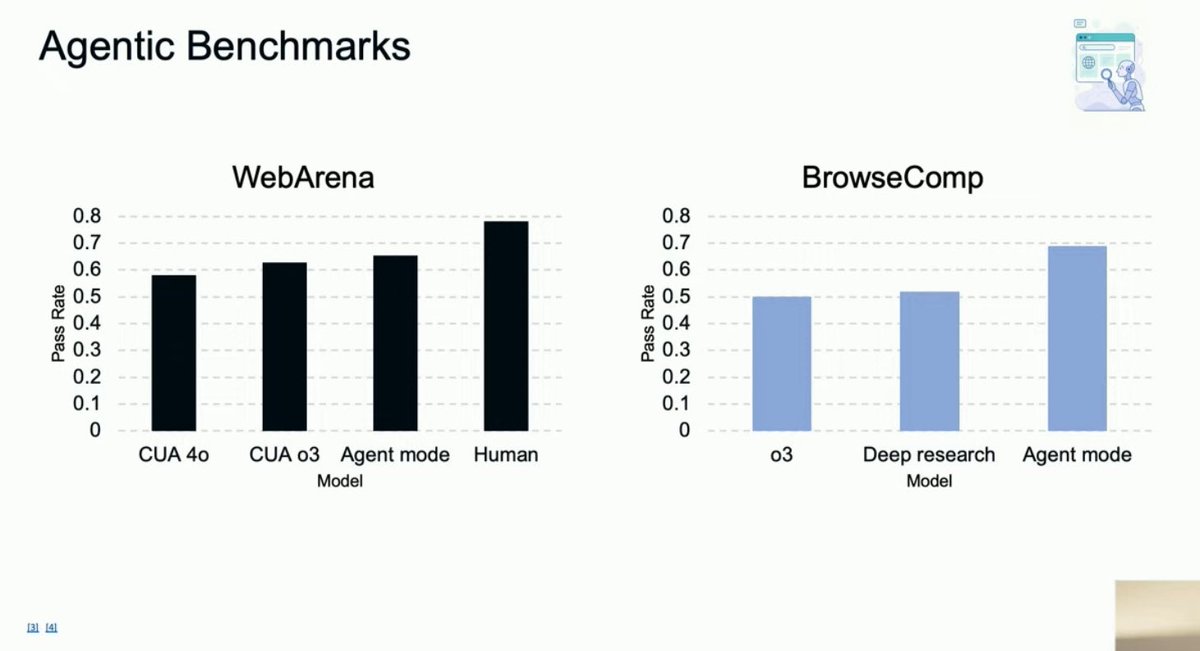
@OpenAI Agent Mode and its tools have achieved over 40% on HLE, and we’re closing in on a normal human in WebArena.
Obieda Ananbeh tweet mediaObieda Ananbeh tweet media
English
0
0
0
40
OpenAI
OpenAI@OpenAI·
ZXX
637
700
7.6K
2.9M
Obieda Ananbeh
Obieda Ananbeh@ObiedaAnanbeh·
@sundarpichai Big Sleep sounds like a big step forward for cybersecurity teams everywhere.
English
0
0
1
28
Sundar Pichai
Sundar Pichai@sundarpichai·
New from our security teams: Our AI agent Big Sleep helped us detect and foil an imminent exploit. We believe this is a first for an AI agent - definitely not the last - giving cybersecurity defenders new tools to stop threats before they’re widespread.
English
248
806
9.6K
745.9K
Obieda Ananbeh
Obieda Ananbeh@ObiedaAnanbeh·
Love this take. Scalar rewards are cheap but information-poor, once horizons hit minutes were wasting bits. Melding RL with structured in context retrospection auto generated “lessons” that later distill to weights, could multiply sample efficiency and feel more human like.
Andrej Karpathy@karpathy

Scaling up RL is all the rage right now, I had a chat with a friend about it yesterday. I'm fairly certain RL will continue to yield more intermediate gains, but I also don't expect it to be the full story. RL is basically "hey this happened to go well (/poorly), let me slightly increase (/decrease) the probability of every action I took for the future". You get a lot more leverage from verifier functions than explicit supervision, this is great. But first, it looks suspicious asymptotically - once the tasks grow to be minutes/hours of interaction long, you're really going to do all that work just to learn a single scalar outcome at the very end, to directly weight the gradient? Beyond asymptotics and second, this doesn't feel like the human mechanism of improvement for majority of intelligence tasks. There's significantly more bits of supervision we extract per rollout via a review/reflect stage along the lines of "what went well? what didn't go so well? what should I try next time?" etc. and the lessons from this stage feel explicit, like a new string to be added to the system prompt for the future, optionally to be distilled into weights (/intuition) later a bit like sleep. In English, we say something becomes "second nature" via this process, and we're missing learning paradigms like this. The new Memory feature is maybe a primordial version of this in ChatGPT, though it is only used for customization not problem solving. Notice that there is no equivalent of this for e.g. Atari RL because there are no LLMs and no in-context learning in those domains. Example algorithm: given a task, do a few rollouts, stuff them all into one context window (along with the reward in each case), use a meta-prompt to review/reflect on what went well or not to obtain string "lesson", to be added to system prompt (or more generally modify the current lessons database). Many blanks to fill in, many tweaks possible, not obvious. Example of lesson: we know LLMs can't super easily see letters due to tokenization and can't super easily count inside the residual stream, hence 'r' in 'strawberry' being famously difficult. Claude system prompt had a "quick fix" patch - a string was added along the lines of "If the user asks you to count letters, first separate them by commas and increment an explicit counter each time and do the task like that". This string is the "lesson", explicitly instructing the model how to complete the counting task, except the question is how this might fall out from agentic practice, instead of it being hard-coded by an engineer, how can this be generalized, and how lessons can be distilled over time to not bloat context windows indefinitely. TLDR: RL will lead to more gains because when done well, it is a lot more leveraged, bitter-lesson-pilled, and superior to SFT. It doesn't feel like the full story, especially as rollout lengths continue to expand. There are more S curves to find beyond, possibly specific to LLMs and without analogues in game/robotics-like environments, which is exciting.

English
0
0
0
37