Padma T

177 posts

Padma T

Padma T

@Observer_doubt

Observer

Katılım Mayıs 2022
117 Takip Edilen94 Takipçiler
TheBigBerbowski
TheBigBerbowski@TheBigBerbowski·
New follower? Thank you for joining me on my journey! Here's a quick intro: I'm focused on small and mid caps, and occasional swings of any cap. I share my deep dives and research on my substack. thebigberbowski.substack.com Any questions? Just ask, I usually respond to everyone.
English
3
0
14
2K
HeidingOut
HeidingOut@HeidingOut·
Discharged - well as soon as they bring the paperwork! now i just wanna go home and sleep. not sure why hospitals keep coming in your room all night long. how are sick people supposed to get better with zero sleep Should have just been out all night at a party.
English
3
0
18
587
HeidingOut
HeidingOut@HeidingOut·
Sry I'm heidingout lol. Spent night in hospital all good now just unexpected Heidi chaos from being sick last week. Thx for pumping $MU in my absence.
English
23
0
44
3.5K
Luc
Luc@investingluc·
How I build my largest positions: I get a lot of questions about how I size my highest conviction ideas. But before I say anything else..."high conviction" does NOT mean the idea can't/won't fail miserably. I never put myself in a position to lose big. I ask myself before every single trade: is there a chance I can take a big loss here? The answer should NEVER be yes. Putting yourself in a position to "lose big" could be oversizing, playing short term options, excessive leverage, no risk mgmt, etc. With that being said, I have no problem putting 30% of my account into a position if the stars really are aligning (technicals, fundies, catalyst). But you're prob thinking: "seems like if you're putting 30% of your account in something, you could take a loss pretty easily, no?!" Well, I've become obsessed with safe scaling...and I have a very unique four phase style for SWING trading. Phase 1: Initial Entry - size ~25% of full position - you're very early here - ideally entering on a big base or when stock is quiet - price can be volatile, choppy - be quick to cut...then re-assess + possibly re-enter Phase 2: Bulking Phase - stock starts to make an initial move - want to see confirmation (higher lows, holding levels) - strong trend, adding on weakness within uptrend - move stops to break even - another ~30% of full position added here (brings position to 50–70%) Phase 3: Fake Out + Second Wind Phase - where most get shaken out - pullbacks, fake breakdowns, undercuts - sentiment flips bearish short-term (huge!!) - if structure + thesis still intact…this is a buy - adding another ~20% here (position now ~85% full) Phase 4: Final Adds - trade is working - these are momentum adds - clean breakout + expansion move - pressing the winner - reach full position size (can be 30%+ of port) Big wins are built through: > strong trends > longer timeframes > solid catalysts > building conviction + size > pressing winners $INTC example below. Luc
English
8
6
100
6.9K
KaizenInvestor
KaizenInvestor@Kaizen_Investor·
I checked the complete supply chain of this space revolution and I decided to open a new position tomorrow. This company trades purely on its replacement value and net cash position with 0 premium for its IP. They are heavily pushing into new industries and recently introduced a new product which puts them miles ahead of competition. This new product will be a long-term game changer for space, but it’s also a game changer for AI. So, I think space will have to wait a bit. Product will be bought away for AI purposes first. Unlike Filtronic, my American friends will be able to trade this stock as well. I have busy day tomorrow but will release more info as soon as I can.
KaizenInvestor@Kaizen_Investor

I spent two weeks researching the space communications evolution. The real bottleneck in the LEO mega-constellation race? Whoever can push 50–100W of GaN power at V-band and E-band frequencies wins. In the article: → The difference between Ka-band and V- or E-band → Why GaN-on-SiC is a non-reversible shift → Who holds the moat in V-band and E-band SSPAs
English
21
1
104
21.1K
Padma T
Padma T@Observer_doubt·
@investingluc Luc as a rule what % of $, u allocate for 1 swing trade
English
0
0
1
804
Luc
Luc@investingluc·
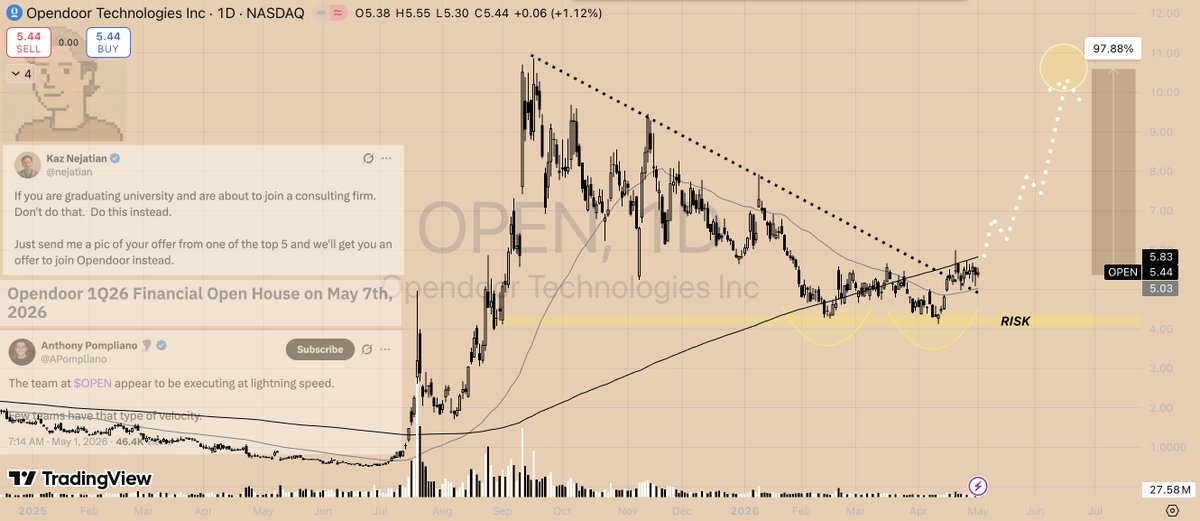
$OPEN...holy guacamole. My top setup right now. - financial "open house" on may 7th - chart = basing + curling - s tier leadership + team - other former "meme stocks" ripping - asymmetric r/r ...you're betting on the team + tam here. Swinging $OPEN shares @ ~$5.44.
Luc tweet media
English
20
31
402
34.7K
Luc
Luc@investingluc·
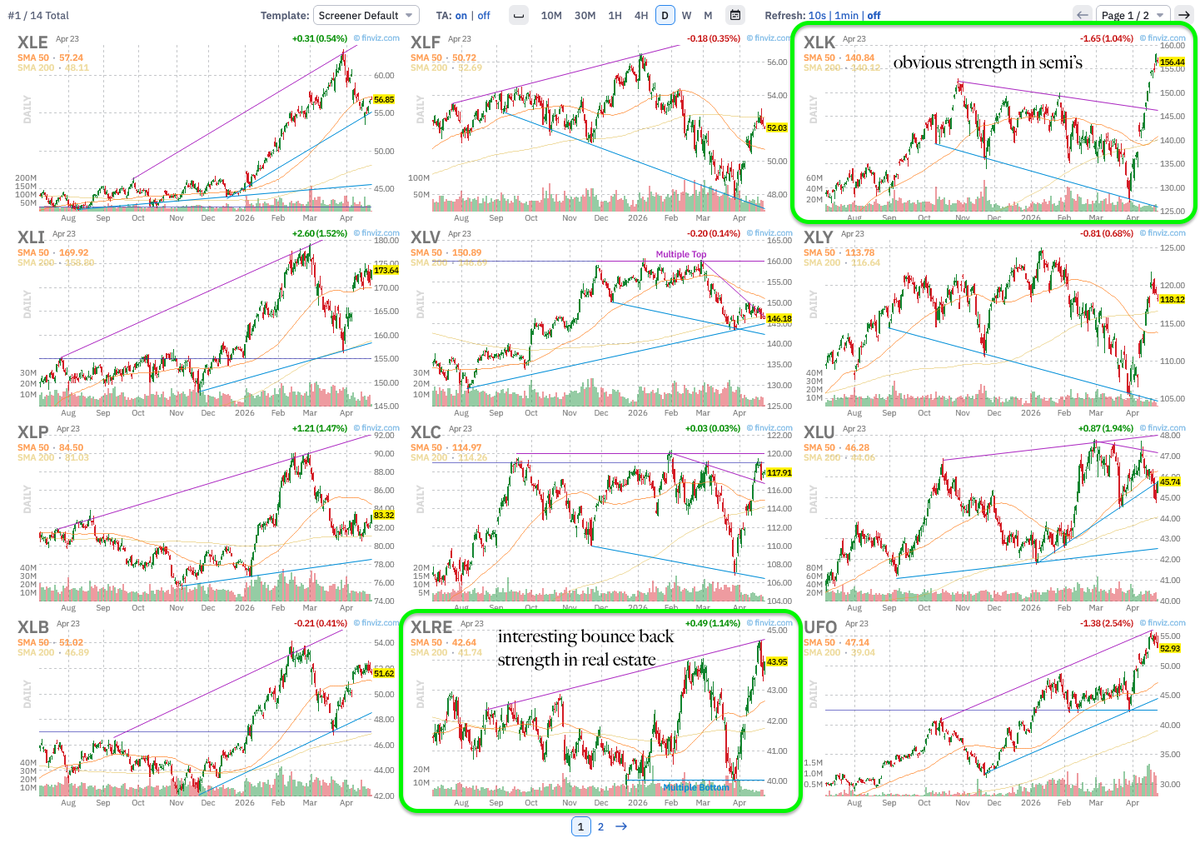
List of ETFs I monitor for sector strength...my first step in finding more concentrated thematic strength. Basically a top down approach. Putting all of their charts side-by-side gives you an interesting perspective. Energy, $XLE * oil, gas, energy production * exxon, chevron type names * moves with oil prices + macro supply/demand Financials, $XLF * banks, insurance, asset managers * jpmorgan, goldman, berkshire * sensitive to interest rates + credit cycles Technology, $XLK * software, semiconductors, hardware * apple, microsoft, nvidia * growth engine of the market Healthcare, $XLV * pharma, biotech, medical devices * jnj, unitedhealth * defensive with innovation upside Industrials, $XLI * aerospace, defense, machinery * boeing, caterpillar * tied to economic cycles + infrastructure Consumer Discretionary, $XLY * “wants” not needs * amazon, tesla, nike * strong in booming economies Consumer Staples, $XLP * everyday essentials * coca cola, walmart, p&g * stable, defensive demand Communication Services, $XLC * social media, telecom, streaming * meta, google, netflix * blend of tech + media Utilities, $XLU * electricity, water, gas providers * duke, nextera type names * slow growth, rate sensitive, dividend heavy Materials, $XLB * chemicals, metals, raw materials * dow, freeport * early cycle economic exposure Real Estate, $XLRE * reits, property companies * commercial + residential exposure * highly sensitive to interest rates Newer / More Speculative ETF's: Space / Defense Innovation, $ARKX * space, satellites, defense tech * spacex-adjacent ecosystem, rocket lab type names * future infrastructure + frontier tech Space Industry, $UFO * satellites, communications, space infrastructure * more pure-play space exposure * moves with space hype cycles AI / Robotics, $BOTZ * robotics, automation, ai hardware * nvidia-adjacent ecosystem * levered to global automation trend Disruptive Innovation, $ARKK * high-growth, disruptive companies * tesla, genomics, fintech, ai * high beta, narrative-driven Semiconductors, $SOXX * chipmakers + supply chain * nvidia, amd, broadcom * backbone of ai + compute Cybersecurity, $CIBR * digital security, data protection * crowdstrike, palo alto * benefits from rising cyber threats I highlighted 2 charts below. First is semiconductors having obvious strength...one I will be looking at on any weakness. The second is real estate. This one is really interesting and I will be watching for subsector strength (companies, building in ai, data centers, etc). Anyways, feel free to bookmark this. I use this view to gauge the bounce back strength in relation to local highs + as a visual of thematic leadership. Luc
Luc tweet media
English
6
16
130
9.2K
Singularity Research
Singularity Research@SingularityRes·
🚨 Want to know exactly WHEN to sell your memory/NAND stocks ( $SNDK $MU $WDC $SKHYNIX etc.) at the absolute top? I just dropped article on how to use AI to timing the exit perfectly. 📅 Drops TOMORROW morning at 9AM EST Don’t miss the biggest wealth transfer in memory stocks this cycle 👀 Follow + link in bio to catch it the second it drops 🔥
Singularity Research tweet media
English
7
0
20
9.4K
Padma T
Padma T@Observer_doubt·
@FiveBaggers @HeidingOut Yes i follow her , thanks. i was talking about amd / mu . I dont intend to own poet , its too volatile for me.
English
1
0
3
37
Brother Vallentius Faber
Brother Vallentius Faber@FiveBaggers·
@Observer_doubt @HeidingOut Follow @HeidingOut and wait on her next trade opportunity. She’s terrific. Absolutely brilliant. As for $POET it’s a small cap company and very speculative. I took a small position which I wouldn’t lose sleep over losing entirely.
English
3
1
6
509
Brother Vallentius Faber
Brother Vallentius Faber@FiveBaggers·
What do you think about $POEL launching - a 2X ETF on a small cap? WTH? I bought some $POET after the shakeout. Wondering if we could see a big comeback on this one.
English
1
0
2
229
HeidingOut
HeidingOut@HeidingOut·
I only ever buy the 2x 3x ETF when I see an immediate breakout (super short tf) OR the breakout is on a super high tf like it was on $AMD and $MU in March. Otherwise, you'll be bled dry on the daily slippage. Most pay 2x or 3x on the long side. But, on the short side it's actually a slightly higher loss. Position sizing is key. I had to avg down a 2-3 times on both of those positions bc the breakout was huge but those are harder to predict price and timing wise in a $400/$500 stock etc.
English
2
2
3
350
Peter DiCarlo
Peter DiCarlo@pdicarlotrader·
You’ve seen my new bull‑cycle indicators in videos for months. I finally released the full system + both indicators in a free masterclass THT Bull Cycle Trading Blueprint 🧭 One rules‑based swing system. Two free indicators. capitalist-academy1.teachable.com/p/blueprint
English
47
16
303
187.8K
Padma T
Padma T@Observer_doubt·
Thank you so much for ur response. I donot do options as i have still not understood the concept well. I did Mu & Muu stock & leverage. With the same amount of money invested i made almost 50% more profits on Muu . I had these stocks over a month. Was wondering if there was any doen side in holding for couple of months.
English
2
0
1
32
HeidingOut
HeidingOut@HeidingOut·
It depends on the trading strategy and the specific stock (particularly the timeframe of the breakout). Leveraged ETFs suffer from daily slippage: you capture roughly 2x or 3x the gains, but you lose slightly more than that on the downside. They're not ideal for long-term holding.I day trade, swing trade, and invest. On very short timeframes with strong breakouts, leveraged ETFs are fantastic for short holds. You can trade them in pre-market and after-hours (a huge advantage in micro/small caps, unlike options), especially when my conviction is 80%+.Options work very well too when spreads are inefficient. See my $PYPL trade from a couple weeks ago, or my $RIVN and $SOXL trades from last April/May. Those stocks were depressed with option spreads heavily biased in the buyer’s favor. On $RIVN, the stock dropped 4-5% from my entry and I still sold the options for a large profit due to the imbalance.I tend to enter a little early and exit a little early, so I scaled into $AMDL and $MUU with 2-3 purchases (position sizing was critical). That breakout was on the 2-week sto, signaling a major move that would last longer than a typical short trade. I used options on $SOXL but not the others due to IV and spreads. Sorry if this doesn’t perfectly answer your question—it really depends on a few key details.
English
1
1
3
49
HeidingOut
HeidingOut@HeidingOut·
Everyone crashing out over small caps and you mostly hold semis/photonics. 😝 $AAOI - 230% calls or 40% on shares $AMDL - 183% shares $MUU - 121% shares $IONQ - 60% calls $CIEN - 40% shares $ARM - 34% shares $LWLG - 22% shares
English
7
3
36
2.9K
Padma T
Padma T@Observer_doubt·
@pdicarlotrader Whats the time window you choose on mondays to rebalance, generally it is very volatile on open
English
0
0
3
417
Peter DiCarlo
Peter DiCarlo@pdicarlotrader·
@Observer_doubt I do all of my rebalancing in the portfolio Monday morning You could definitely go in today, but I just do everything on Monday with my team
English
1
0
9
2.2K
Peter DiCarlo
Peter DiCarlo@pdicarlotrader·
$NVDA Bull Cycle Alert 🚨 67% of the time this signal hits, $NVDA is +50% to +150% higher 6–12 months later. In this video I break down today’s setup, why I sold last month, and why I’m buying back this week. Watch Now ⬇️
English
62
69
912
97.9K
Padma T
Padma T@Observer_doubt·
@pdicarlotrader Thank you Peter for your response, appreciate you sharing knowledge.
English
0
0
2
61
Padma T
Padma T@Observer_doubt·
@pdicarlotrader Why not buy today , why wait till monday ? Want to understand if there us a reason?
English
2
0
7
2.3K
Padma T
Padma T@Observer_doubt·
@Kaizen_Investor Thank you for sharing , can you also update your entry price for these stocks, particularly rescent ones FTC, SK hynix
English
1
0
2
264
KaizenInvestor
KaizenInvestor@Kaizen_Investor·
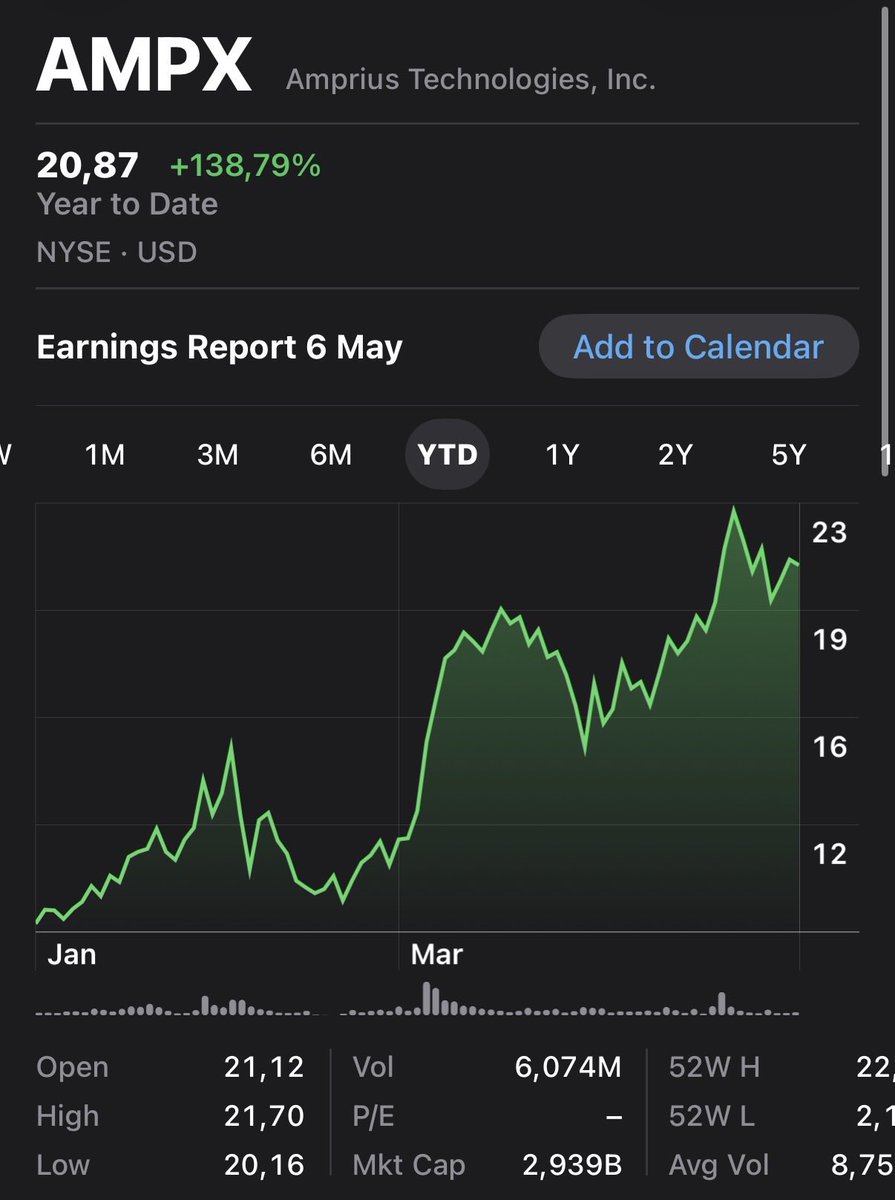
The rating of my current holdings according to this framework. $GOOGL: 97/100 Alphabet’s management operates with relentless execution and immense capital discipline. While the sheer, absolute dollar magnitude of their stock-based compensation remains staggering, their aggressive share repurchases, strict strategic focus on monetizing AI infrastructure, and transparent, data-backed communications make them elite operators who are successfully defending one of the largest economic moats in existence. $FTC: 96/100 Filtronic’s management team under CEO Nat Edington demonstrates an exceptional, almost robotic level of operational execution and capital discipline. By leveraging their core RF and mmWave competencies to secure and execute massive, binding contracts in the LEO space and defence sectors, management has consistently over-delivered on guidance without diluting shareholders, reflecting the highest tier of corporate integrity and competence. SK Hynix: 93/100 SK Hynix’s management team operates with absolute, ruthless operational efficiency, cementing a near-monopoly in the highest-margin sectors of the AI hardware supply chain. While their corporate governance reflects a traditional Korean chaebol structure—meaning individual executives hold virtually zero personal equity—their technical execution, capital discipline, and balance sheet mastery currently represent the gold standard in the global semiconductor space. $ASM.AS: 92/100 ASM International’s management team demonstrates exceptional execution, operational visibility, and capital discipline. While lacking the high insider ownership typical of aggressive, founder-led companies, their pristine balance sheet, brutally accurate multi-year financial forecasting, and active share buyback programs firmly establish them as highly trustworthy stewards of shareholder capital. $OUST: 90/100 Ouster, Inc. (OUST) presents a rare profile in the pre-profit / early-commercialization hardware space: a management team that actually executes on its roadmaps. Led by CEO Angus Pacala, the company has demonstrated strict operational discipline, successfully commercializing its digital lidar technology while maintaining a fortress balance sheet. While historical share dilution from strategic M&A requires monitoring, management’s transparency regarding one-time revenue events and their consistent delivery of hardware margins earn them an elite rating. $PL: 89/100 Planet Labs (PL) is a rare anomaly in the high-growth space: a former SPAC that actually survived its cash-burn phase and successfully transitioned into a free-cash-flow-generating enterprise. While management's equity compensation remains slightly elevated, their exceptional track record of launching highly complex hardware on schedule and their disciplined, jargon-free focus on securing massive government contracts demonstrates supreme execution and integrity. $MRVL: 88/100 Marvell’s management team operates with high technical competence and ruthless strategic clarity, successfully transforming the company from a broad-based silicon provider into a highly focused AI data center powerhouse. While management has faced cyclical headwinds in legacy segments that triggered some guidance volatility, their ability to aggressively hit engineering milestones for custom AI silicon and responsibly manage capital allocation reflects elite, tier-one execution. $PLTR: 87/100 Palantir Technologies (PLTR) features a visionary, high-conviction management team that consistently executes on commercial expansion and product delivery at a scale few enterprise software companies can match. While their aggressive stock-based compensation and slight equity dilution trigger mechanical deductions, their ability to drastically over-deliver on forward guidance and perfectly align capital deployment with their core Artificial Intelligence Platform (AIP) establishes them as elite operators. $TMDX: 87/100 TransMedics Group (TMDX) possesses an elite, execution-focused management team that has successfully transformed the company from a capital-intensive med-tech startup into a vertically integrated, cash-flowing logistics and clinical powerhouse. While minor deductions are warranted for recent share dilution and stock-based compensation levels, management’s flawless delivery on ambitious infrastructural timelines and mathematically transparent communication earn them near-maximum trust. $HIMS: 85/100 Hims & Hers Health, Inc. (HIMS) is operated by an aggressively competent management team that has successfully transitioned from a cash-burning SPAC into a highly profitable, cash-flowing entity. While historical share count expansion requires ongoing scrutiny, their ability to execute against stated timelines, beat forward guidance, and seamlessly expand their core direct-to-consumer moat into highly lucrative verticals borders on clinical precision. $RKLB: 79/100 Rocket Lab (RKLB) boasts a highly accountable, founder-led management team that excels in strategic focus and transparent communication, successfully transitioning the company into a space systems and defense prime contractor. While the persistent delays of their heavy-lift Neutron rocket require notable deductions, the company’s ability to consistently meet financial guidance and maintain technical integrity makes them a standout in the capital-intensive aerospace sector. $AMPX: 75/100 Amprius Technologies’ management team exhibits high-level execution regarding product iteration and revenue growth, but this comes at a severe cost to retail equity holders. While the team successfully transitioned the company toward profitability by ruthlessly pivoting to a fabless contract-manufacturing model, their aggressive share dilution and the quiet abandonment of their flagship domestic manufacturing plans reveal a management team that prioritizes survival and top-line growth over pristine shareholder alignment. $FLNC: 73/100 Fluence Energy (FLNC) presents a complex profile of elite financial backing and strong insider alignment, severely undercut by chronic project execution issues and lumpy guidance misses. While management operates with a fortress balance sheet and refuses to artificially pump the stock with trending AI buzzwords, their inability to consistently defend gross margins and deliver predictable quarterly revenues makes them a volatile, high-risk operator in the utility-scale energy storage sector. $IREN: 35/100 IREN (formerly Iris Energy) presents as a highly promotional, capital-intensive infrastructure play that relies heavily on retail shareholder dilution to fund its shifting ambitions. While management has successfully secured impressive debt financing and massive power capacities, their chronic inability to hit original timelines, massive expansion of the share count, and blatant narrative pivot from Bitcoin to Artificial Intelligence reflect a team that prioritizes growth at the direct expense of shareholder equity.
KaizenInvestor@Kaizen_Investor

So, in the past couple of months management has led investors down in some FinX favorites. I can recall $EOSE, $TE, and $POET stocks plunged after management heavily missed revenue guidance or just management mistakes. For an individual investor it is not always easy to digest the whole management team, let alone rate them. I've done a lot of research last night to management frameworks. McKinsey, Morgan Stanley, BCG, Morningstar,... all have papers on rating management. The problem? Most of them are focusing on established companies. They focus on ROI, Free Cash flow, and dividends. If I build a framework like this, the management of high growth companies always have a bad score. So, I wanted to create something different. An honest and objective framework on management. As I don't want to include too much financial figures, a bit will always be subjective. The 5 categories: Category 1: The Say-Do Ratio (Maximum 30 Points): The Say-Do Ratio tracks the historical reliability of management's public promises versus their actual execution. In pre-profit companies, trust is the only currency; if management cannot accurately forecast their own engineering and sales timelines, their financial projections are entirely worthless. Category 2: Communication & Transparency (Maximum 20 Points): This category measures the integrity, clarity, and psychological tone of executive communication. It assesses whether management treats investors as intelligent partners or as targets for manipulation. Category 3: Capital & Dilution Discipline (Maximum 25 Points): For pre-profit companies, managing the share structure is just as important as managing the product. A brilliant technology will still result in zero shareholder returns if the equity is diluted into oblivion before commercialization. Category 4: Founder-Led & Insider Alignment (Maximum 15 Points): This category assesses whether management shares the same financial fate as retail and institutional investors, embodying the skin in the game philosophy. Category 5: Strategic Focus (Maximum 10 Points): This measures the company's ability to stay on course, defending its economic moat rather than chasing the latest technological fad to generate short-term retail interest. Does it work? It looks like it. Some examples: $POET: 19/100 $EOSE: 35/100 $TE: 28/100 $PL: 88/100 $RKLB: 79/100 To make it easy, I did put my framework in a Gem. If you want to do the same, please copy paste the framework and instruction that I have put in the comments. It should be possible in every LLM, not just Gemini. If you don't have a paid subscription on any model, just ask me. I will put in in my model and give you the score with the major red and green flags.

English
18
3
63
18.4K