Fellow Nigerians, good morning.
I woke up this morning after my church service with a deeply reflective heart, and despite every constraint, I felt compelled to share these thoughts with you.
Many people do not truly understand the silent pains some of us carry daily—the private struggles, emotional burdens, and quiet battles we face while trying to survive and serve sincerely in difficult circumstances.
We now live in an environment that has become increasingly toxic, where the very system that should protect and create opportunities for decent living often works against the people—a society where intimidation, insecurity, endless scrutiny, and discouragement have become normal.
More painful is when some of those you associate with, believing you would find understanding and solidarity among them, become part of the pressure you face. Some who publicly identify with you privately distance themselves or join in unfair criticism.
We live in a society where humility is mistaken for weakness, respect is seen as a lack of courage, and compassion is treated as foolishness—a system where treating people equally is questioned simply because you refuse to worship status, tribe, class, or power.
Personally, I have never looked down on anyone except to uplift them. I have never used privilege, position, or resources to oppress others, intimidate the weak, or make people feel small. To me, leadership has always been about service, sacrifice, and helping others rise.
Let me state clearly: my decision to leave the ADC is not because our highly respected Chairman, Senator David Mark, treated me badly, nor because my leader and elder brother, Alhaji Atiku Abubakar, or any other respected leaders did anything personally wrong to me. I will continue to respect them.
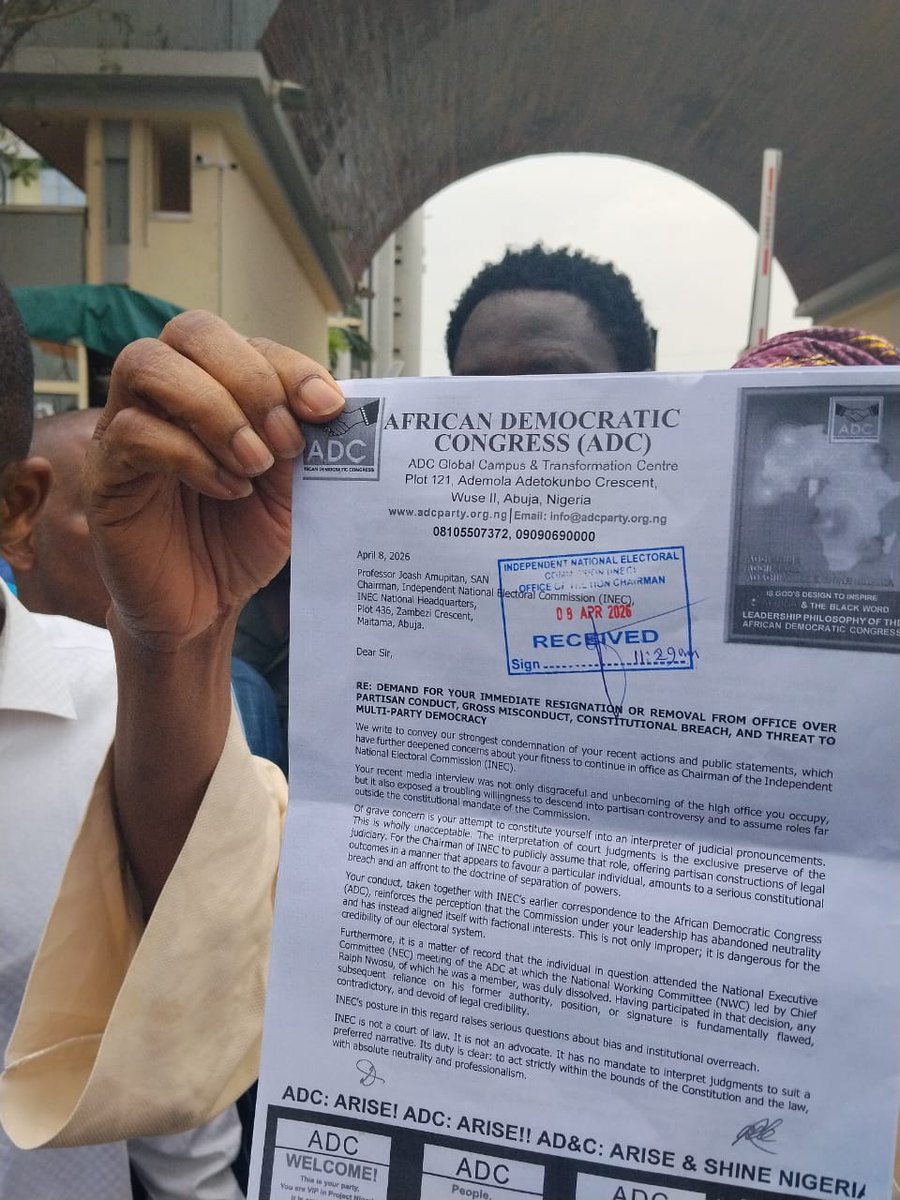
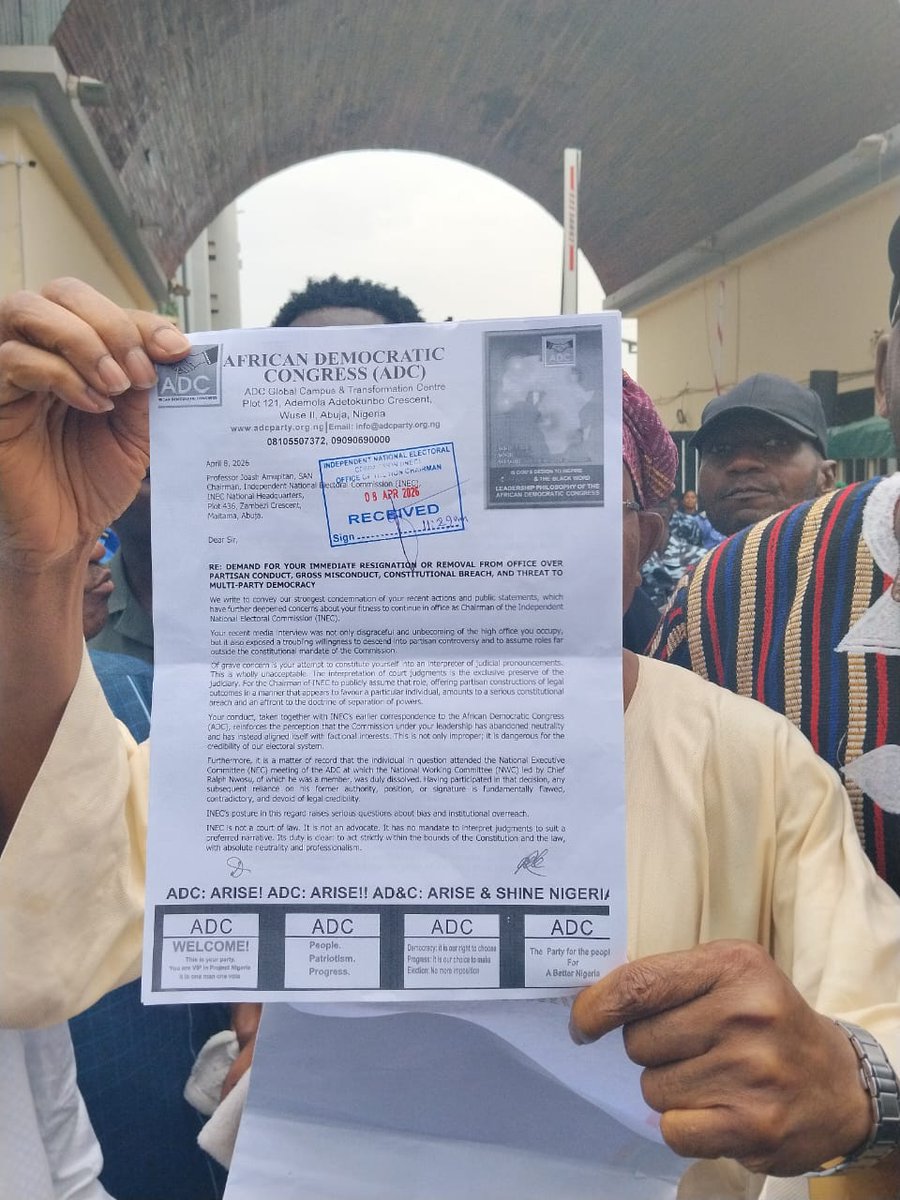
However, the same Nigerian state and its agents that created unnecessary crises and hostility within the Labour Party that forced me to leave now appear to be finding their way into the ADC, with endless court cases, internal battles, suspicion, and division, instead of focusing on deeper national problems and playing politics built more on control and exclusion than on service and nation-building.
Even within spaces where one labours sincerely, one is sometimes treated like an outsider in one’s own home. You and your team become easy targets for every failure, frustration, or misunderstanding, as though honest contribution has become a favour being tolerated rather than appreciated.
And when you choose to leave so that those you are leaving can have peace, and you step out into the cold, you are still maligned and your character is questioned. Despite all your efforts to continue working for a better Nigeria and engaging people with sincerity and goodwill, those who do not wish you well continue to attack your character and question your intentions.
There are moments I ask God in prayer: Why is doing the right thing often misconstrued as wrongdoing in our country? Why is integrity not valued? Why is the prudent management of resources, especially when invested in critical areas like education and healthcare, wrongly labelled as stinginess? Why are humility and obedience to the rule of law often taken to be weakness rather than discipline?
Let me assure all that I am not desperate to be President, Vice President, or Senate President. I am desperate to see a society that can console a mother whose child has been kidnapped or killed while going to school or work. I am desperate to see a Nigeria where people will not live in IDP camps but in their homes. I am desperate for a country where Nigerian citizens do not go to bed hungry, not knowing where their next meal will come from.
Yet, despite everything, I remain resolute. I firmly believe that Nigeria can still become a country with competent leadership based on justice, compassion, and equal opportunity for all.
A new Nigeria is POssible. -PO
When Borrowing is Leprosy and cancerous.
Mr. President, borrowing is not only a leprosy, but a killer cancer when it is borrowed for consumption and not production as it is in Nigeria today.
Borrowing for consumption slowly eats away at the health, reputation, and autonomy of a nation. One of the major “leprosy” afflicting Nigeria today is not just debt, but debt without productivity. Debt that is not tied to measurable economic value. Debt that does not translate into jobs, growth, or improved living standards for the Nigerian people.
No serious economy borrows recklessly. Nations borrow with discipline, with purpose, and with a clear plan for repayment through productive investment.
Fiscal Responsibility Act 2007 provides that “Any government in the Federation or its agencies and corporations desirous of borrowing shall, specify the purpose for which the borrowing is intended and present a cost-benefit analysis, detailing the economic and social benefits of the purpose to which the intended borrowing is to be applied”
Cost-benefit analysis must show how the loan would be applied, how it will impact economic growth and improve the welfare of Nigerian citizens in measurable ways.
Most of the borrowings by this government do not satisfy the requirements of law or the requirements of economic common sense. The humongous borrowing so far does not show how the projects for the loans enhance the productive capacity of the nation and the welfare of Nigerian citizens.
These loans are also dangerous because they burden the capacity of the Nigerian state to improve the economy in the future, as we have one of the world’s highest debt servicing ratios. What matters is not debt-GDP as much as debt-debt servicing ratio because the latter constrains our capacity to finance the sectors that drive human development and economic growth.
If the money is wrongly spent as we do in Nigeria currently, it becomes double jeopardy because you are using current revenue to service debts that did not add to revenue or improve capacity for more production in the future.
A responsible government does not merely defend borrowing; it explains it, justifies it, and most importantly, ensures it works for the people.
A new Nigeria is POssible. -PO
A decaying Nation Crying for Leadership.
What we have witnessed across our country in just the past 48 hours is not only tragic, it is utterly unacceptable and a damning indictment of our collective failure of leadership.
From the reported killings in Katsina, Adamawa, Kaduna and Benue States, to the gruesome murder of an entire family in Plateau State, and the heartbreaking abduction of innocent children in Kogi State, one of the incidents involves children conveying their mother's dead body for burial. Nigeria is bleeding. We are fast becoming a nation where human life is treated as expendable, where citizens live in fear, and where the basic duty of government, to protect lives and property, is repeatedly neglected.
11 innocent Nigerians were killed in Katsina State. 7 more in Benue State. 23 in Adamawa State in just one day. An entire family was brutally murdered in Plateau State. 24 children were abducted from an orphanage in Kogi State, and 10 more children were taken in Kaduna State, all within 48 hours.
These are not mere statistics; they are our fellow Nigerians, fathers, mothers, sons, daughters, whose lives have been brutally cut short or violently disrupted.
This cannot continue. A nation cannot develop under the weight of such persistent insecurity and human tragedy. The normalisation of these horrors is itself a crisis. We must ask, with all sense of urgency and responsibility: where is the leadership? Where is the coordination, the competence, and the compassion required to confront this menace decisively?
My heart goes out to all the grieving families across these states. I pray for divine comfort for those who have lost loved ones and for the safe and immediate return of all abducted children.
A New Nigeria is not just a slogan; it has become an urgent necessity.
A New Nigeria is Possible. -PO
Nigeria Is Bleeding From Within
It is deeply troubling to read recent World Bank reports indicating that, while Nigeria’s Federation Revenue surged to ₦84 trillion in just three years, a staggering 41% —amounting to ₦34.44 trillion —never reached the Federation Account. This sum exceeds the combined ₦34 trillion earmarked for capital projects in the 2024 and 2025 Appropriation Bills, a comparison that underscores the gravity of the situation and signals that something is fundamentally wrong.
This is not a mere oversight; it points to institutionalised corruption on a massive scale. In 1994, when the Okigbo Panel reported about $12.4 billion from the Gulf War oil windfall as unaccounted for, Nigerians were outraged and the nation shook with indignation. Today, an even more troubling situation appears to be unfolding, yet it is met with a disquietening silence.
We are trapped in a lethal paradox: Earning more as a nation, yet having less to invest in healthcare, education, and infrastructure. From 2025, systemic “deductions” have allowed agencies to capture more resources than entire states and even critical ministries.
These leakages explain why countries with fewer resources are out-performing us across key development indices. With such a broken system, how can we fix power, strengthen our schools, build resilient healthcare, or develop critical infrastructure?
Nigeria has no business being poor. We must stop these leakages through disciplined, transparent leadership driven by character. It is time to redirect our hijacked resources back to the people and move Nigeria into the league of developed nations.
With our collective resolve to change this corruption-infested system, a New Nigeria is POssible. -PO
“Before the current government came in to be, Nigerian rank in t£rr0r!sm was number 8, today, we’re at number 4. if you give them another 4 years, we’ll be number 1. When this government also came in to be, our p0verty rate was 41.6 percent, 10 million people, today we’re 63 percent, 140 million people living in p0verty”
- Peter obi says as he gives a powerful speech at the ongoing ADC convention
From Pharisee to Tax Collector: Rethinking Tinubu’s Kenyan Comparison
In a recent remark in Yenagoa, Bola Ahmed Tinubu suggested that Nigerians should find solace in being “better off than Kenya and other African countries.” While this may have been intended to soften the impact of economic hardship and rising fuel prices, the comment risks downplaying the severity of the current crisis. It echoes the biblical parable of the Pharisee and the Tax Collector in the Gospel of Luke (18:9–14). A similar warning is found in the Qur’an (53:32), which cautions against self-righteousness.
Like the Pharisee who boasted of his superiority over others to mask his own spiritual void, such downward comparisons serve more as a refuge than a remedy. This validated an earlier dismissive remark by President Ahmed Bola Tinubu during electioneering: “Na statistics we go shop?” Yet statistics remain indispensable - they are the language through which nations understand their condition and chart progress. No country can develop in isolation from measurable realities or without comparing itself with peers. Comparisons, when properly grounded, are not instruments of escapism but tools of accountability. What is objectionable is not comparison itself, but comparison stripped of credible, verifiable data—mere tax collector comparisons that soothe rather than solve.
On key development indicators such as security, the Human Development Index, life expectancy, GDP per capita, literacy levels, and electricity access, Kenya consistently outperforms Nigeria. Nigeria is the fourth most terrorised nation in the world, while Kenya is not among the ten worst. Kenya’s HDI ranking is 143 out of 180 countries, with a coefficient of about 0.630, compared to Nigeria’s ranking of 164 out of 180, with a coefficient of about 0.530. Its GDP per capita is roughly $2,200–$2,300, compared to Nigeria’s $807–$835. Kenya’s poverty rate is about 43% of the population (approximately 23 million people), while Nigeria’s is about 63% (around 150 million people), over six times that of Kenya. Kenya’s life expectancy is about 67 years, while Nigeria’s is about 54 years. The literacy rate in Kenya is approximately 81–85%, compared to Nigeria’s 62–65%.
Kenya’s electricity access is higher, while Nigeria has one of the lowest levels of electricity access in the world. Kenya has about 3.5 million out-of-school children, while Nigeria has about 20 million. Kenya’s inflation rate has been about 4.5% or lower over the past three years, while Nigeria’s has remained above 15% within the same period. Kenya’s exchange rate has been around USD 1 to KES 130 over the past three years, whereas Nigeria’s exchange rate rose from below ₦500/$1 to above ₦1,250/$1 within the same period. Even with developments in the Middle East and rising oil prices, Kenyans have not experienced the sharp increases in petroleum product prices seen in Nigeria.
Across other key indicators, Kenya also performs better. In the end, these indices clearly show that Kenya ranks higher than Nigeria on several development metrics. The standard of living of Kenyans is better than that of Nigerians. If the President considers Kenyans to be suffering despite these stronger figures, then Nigerians are in a far more difficult situation. He should therefore refrain from self-consolation and, in honest reflection, take responsibility for the situation and make a determined effort to drive improvement. This requires a posture of humility, accountability, and commitment to addressing the factors that have slowed Nigeria’s development.
A new Nigeria is POssible. -PO