opsek
154 posts

opsek
@opsek_io
Operational security audits and training for web3 organizations and HNWIs. We train your team and harden your stack, so you don't get hacked.
127.0.0.1 Katılım Eylül 2024
43 Takip Edilen786 Takipçiler
Our founder, @PabloSabbatella is joining the Review Committee for the Defi Security Summit 2026.
Expect the operational side of security to be a lot harder to ignore this year.
👇 Why this matters to us, and what we'll be pushing for
Defi Security Summit@summit_defi
Welcome @PabloSabbatella to the DSS 2026 Review Committee. Thank you for helping shape this year's technical program. DSS 2026 | Mumbai, India
English
opsek retweetledi
opsek retweetledi

At @opsek_io we're hiring a Head of Security to build and lead the security function for one of the most established protocols in DeFi.
Onchain is already strong. The work is everything around it. 👇
English
Shai-Hulud 2.0 cleanup, step by step: how to check if you're hit, what to rotate, and why ignore-scripts is the single biggest guardrail going forward
souilos@theSouilos
English
We built a social engineering game.
A "verified" account slides into your DMs with a job opportunity. You follow the steps.
At the end, you have to report every red flag you caught.
The more you catch, the higher your score. Can you get them all?
game.opsek.io

English
opsek retweetledi
Opsek's @PabloSabbatella is in NYC for ETHConf!
Your opsec has no excuses now. Come find him before the scammers find you.

English
Google Fi is harder to SIM swap than a standard carrier but requires personal data and US-based activation. AT&T is the worst option here: personal data required, high SIM swap exposure.
Hushed is the only virtual number on the list. Useful in specific contexts, but most services flag it immediately.
English
Efani and Silent SIM sit at opposite ends. Efani is non-virtual with strong protections but expensive and US/Canada/Mexico only.
Silent SIM requires no personal data and accepts crypto, but some of its stealth features are illegal in certain jurisdictions.
If you're outside North America, Silentlink is the cleanest option: no KYC, crypto payments, worldwide coverage. Limitation: data and inbound SMS only.
English
Not all phone numbers are created equal.
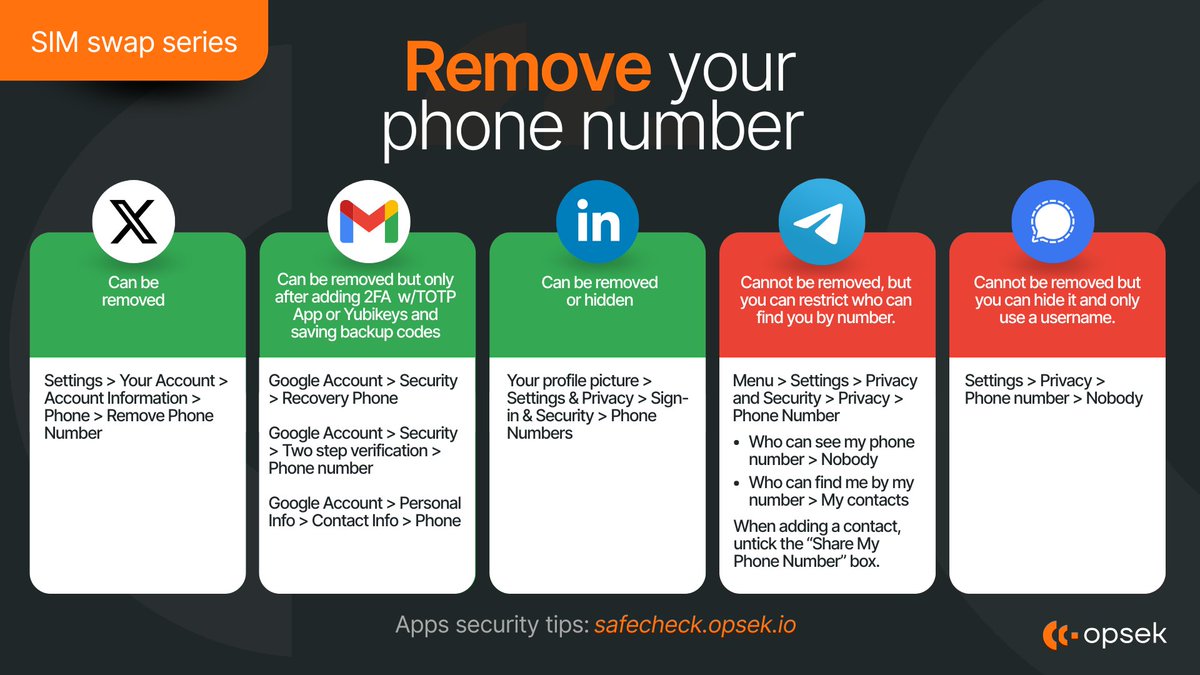
A SIM swap attacker doesn't care how strong your password is. They need one thing: your number. Which provider you're on determines how easy that is.
We compared six options across coverage, privacy requirements, and SIM swap resistance.

English
opsek retweetledi

Just updated our open-source YubiKey cheatsheet with a new section: encrypting files with GPG so they can only be opened when your YubiKey is physically present and touched.
Infostealers grab files off disk and brute-force them offline. A touch-gated key kills that: the stolen copy is just inert ciphertext. 🔑🧵
English


Update or not? What's safer ?
Pablo Sabbatella@PabloSabbatella
Update or not? That's the question. Here's the answer 👇 - Update everything the second it drops? → You risk pulling in a compromised library or dependency (a supply chain attack). - Never update? → You leave hundreds of known vulnerabilities sitting unpatched and getting exploited in the wild. The way out: it depends on WHAT you're updating. I split it into two groups: - 🟢 Group 1: Software from large orgs with real review processes and release pipelines. Treat their updates as safe by default, so patch FAST: macOS, Windows, Android, iOS, and browsers (Chrome, Safari, Firefox, Brave, etc). - 🟡 Group 2: Packages, libraries and tools with deep dependency trees, often maintained by tiny teams with little to no OpSec or release controls. Here you slow down and verify before bumping. For Group 2 I like the approach Dan Guido (@dguido, co-founder & CEO of Trail of Bits) shared in a recent talk: on top of disabling install scripts in NPM, they enforce a mandatory package cooldown: nobody installs a package version less than 7 days old, across any package manager, company-wide, enforced through MDM (Jamf). This works because most npm/PyPI compromises get caught and pulled within hours to a few days. A 7-day cooldown closes that window before the bad version ever lands on your machine. Summary: patch trusted vendors fast, pin untrusted dependencies and review before you bump.
English
Operational security audits and training for Web3 Organizations (DeFi, L1s, L2s, VCs, Centralized exchanges, service providers) and HNWIs.
We perform Threat modeling, Security training, OSINT investigations, Company infra hardening, Team full setup hardening, Treasury and multisig audits, Physical security, and Red teaming. After the initial assessment, we become the Security lead for the organization until they hire a CISO.
English


You choose it or not, your organization is gonna be OpSec audited either way.
Choose wisely

English
One is 100x cheaper than the other.
Pablo Sabbatella@PabloSabbatella
You choose it or not, your organization is gonna be OpSec audited either way. Choose wisely
English
Threat actors move fast.
Your updates need to move faster.
br1@brunotorossi
Apple’s 2026 patch cadence looks unusual. By May 21, Apple had already shipped 7 iOS/iPadOS 26 updates and 6 macOS 26/Tahoe updates, plus a new category: Background Security Improvements. This isn’t just “bug fixes.” It may be a sign of a structural change in delivering updates.
English