Renaissance Man

99.1K posts

Renaissance Man banner
Renaissance Man

Renaissance Man

@OriginalFolarin

Then out of nothing, out of absolutely nothing, I was born. So that when I become someone one day, I'll always remember that I came from nothing

Loke Loke Katılım Haziran 2012
1.3K Takip Edilen1.2K Takipçiler
Sabitlenmiş Tweet
Renaissance Man
Renaissance Man@OriginalFolarin·
Folarin is a builder. He builds families, businesses and communities. Through intelligence and insight, his enterprises are established and endure.
English
0
1
3
1K
Renaissance Man retweetledi
Movez
Movez@0xMovez·
Spotify's Chief Architect just showed how they ship 4,5K deployments /day with Claude at Anthropic stage 27-minutes. free. By #1 music app dev "More than 99% of our engineers use AI coding tools. Adoption took off after Opus 4.5" Worth more than any $500 vibe-coding course.
Movez@0xMovez

Creator of Claude Code just dropped a 6-min workshop on new Claude feature during live session in London. Boris Cherny: “A lot of my code these days is written by "routines". I’m not doing the prompting - I create the routines that do the prompting.” 6 minutes. Free. From a live session. Watch this now. This will change the way you vibe-code forever.

English
125
330
4.6K
1.1M
Renaissance Man retweetledi
EPL Bible
EPL Bible@EPLBible·
This is pretty scandalous Just watch the whole video 🤯
English
520
6K
25.9K
2M
Renaissance Man retweetledi
Startup Archive
Startup Archive@StartupArchive_·
Shopify CEO Tobi Lutke explains Goodhart’s law and why he doesn’t like KPIs or OKRs “Goodhart’s law is real. The moment a metric becomes a goal, it’s no longer a useful metric… No metric by itself is a complete heuristic for a complex business. There’s a million different tensions in a company, and you can’t keep all of them in harmony by optimizing for one thing.” For this reason, Shopify doesn’t use KPIs or OKRs. But as Tobi explains, this doesn’t mean they don’t value data and metrics. “We are extremely data informed. We have invested enormous amounts of money and time into systems that give us basically everything at our fingertips… But what Shopify attempts to do is just not over-fit for what’s quantifiable.” People love optimizing for highly-quantifiable things because there’s immediate gratification that comes from seeing a number go up. But Tobi thinks that the most important aspects of a product are rarely quantifiable: “The overlap of the most valuable things you can do with a product and the things that happen to be fully quantifiable are like maybe 20%. Which leaves 80% of a value space unaddressable by the people who only look at quantifiable things.” He continues: “Shopify is comfortable with unquantifiable things like taste, quality, passion, love, hate… The sort of deep satisfaction that a craftsperson feels when they’ve done a job well is actually a better proxy if you allow it to be.” They then have robust analytics systems that tell the company if something’s wrong or a new rollout breaks something. “We think about it as a cockpit for a pilot. The decisions are still made by pilots, and we think this leads to better results… I think there needs to be more acceptance in business of unquantifiable things… And then metrics take a support function.” Source: @lennysan (Feb 2025)
English
59
253
2.7K
679.3K
Renaissance Man retweetledi
Mr. Buzzoni
Mr. Buzzoni@polydao·
Atlassian's revenue: $1.79 billion last quarter Atlassian's move: fire the engineer who built their infrastructure his move: post a 38-minute breakdown of every system he built, free for anyone to copy what he revealed: > Envoy proxy instead of enterprise load balancers > sidecar architecture for auth, logging, rate limits > DynamoDB + SQS for async provisioning > Packer + SaltStack for automated VM deployments at scale Atlassian charges per employee across 350,000 customers this guy just handed you the enterprise playbook for free save this
English
392
5.3K
53.8K
20.7M
Renaissance Man retweetledi
Shanu Mathew
Shanu Mathew@ShanuMathew93·
1 GW AI data center economics are mostly a sensitivity table based on the assumptions you use. Three revenue cases: Low: ~$7B (500k GPUs × 80% utilization × $2/GPU-hour × 8,760 hours) Mid: ~$17B (750k GPUs × 85% utilization × $3/GPU-hour × 8,760 hours) High: ~$32B (1M GPUs × 90% utilization × $4/GPU-hour × 8,760 hours) Against ~$50B of capex, revenue payback looks like ~7 years, ~3 years, and ~1.6 years. That framing is incomplete because the operating cost stack is large: Power: ~$0.7–1.5B (1M kW × 80–90% utilization × 8,760 hours × $0.08–0.15/kWh × 1.15–1.25 PUE) Facilities operations: ~$0.2B (1,000 MW × ~$175k/MW/year) IT service and maintenance: ~$1.5–3.0B (3–6% of $50B capex) Labor, software, insurance, security, admin: ~$0.2–1.0B (2–3% of revenue, case-dependent) Depreciation: ~$6.5–8.0B ($15B GPUs/servers over ~4 years + $7.5B networking over ~6 years + $17.5B power/cooling over ~15 years + $10B shell over ~25 years) That changes the payback math: Low case: likely uneconomic. EBIT is minimal or negative after full cost burden. Mid case: roughly ~8–10 years to EBIT payback. High case: roughly ~3 years to EBIT payback, but only if GPU density, utilization, and rental pricing all hold near the bull-case end of the range. The key variables have to include other factors beyond just power cost. They are GPU count per GW, realized rental price, sustained utilization, service burden, depreciation life, and refresh economics. The main question is what happens in year five onward. A cluster still earning $3/GPU-hour has a very different return profile than one earning $0.50/GPU-hour after the next hardware cycle. We’ve seen demand and rental prices hold up, if they compress for whatever reason, the math changes very quick.
David Sacks@DavidSacks

Back-of-envelope numbers for 1 gigawatt data center: All-in Capex: ~$50 bn Enterprise revenue generated: ~$25-30 bn/year Electricity cost: $1-2 bn/year ~2 year payback. The boom is real.

English
38
71
622
115.2K
Renaissance Man retweetledi
dolo
dolo@amjushere·
Here’s a 40 mins vid of Arsenal doing the same thing
Kessu@Kessutin666

@amjushere show one clip of arsenal doing this

English
1.4K
6.9K
43.9K
3.5M
Renaissance Man retweetledi
AYi
AYi@AYi_AInotes·
Damn,Redis创始人用一个C文件,干翻了大厂烧几十亿的GPU集群。 Antirez,那个写出Redis的传奇黑客,昨天开源了ds4。 一个专门为DeepSeek V4 Flash写的原生推理引擎,只有几千行C代码。 它做到了一件很多人都觉得不可能的事: 把拥有1M上下文窗口、能跑完整coding agent循环的准前沿模型,完整跑在一台普通的128GB MacBook Pro上。 YC CEO Garry Tan看完直接转发,只说了一句话: “正在下载… 1M上下文+可用的coding agent能力,全在一台128GB MacBook上,这太疯狂了🤯” 这已经不是一个普通的量化项目那么简单了铁汁们, 属于顶级黑客用极致的系统工程,把闭源实验室烧几十亿才能玩的东西,压到了每个人的笔记本里。 他的三个黑客级操作,每一个都颠覆了行业常识: 1. 不对称2-bit量化: 只对MoE里占90%体积的专家部分做2-bit压缩,所有关键路径保持全精度。 质量损失极小,Antirez本人亲测“coding agent工作良好,能可靠调用工具”。 2. 把KV Cache扔到SSD: 很多人都觉得KV Cache必须放内存,1M上下文会直接炸掉128GB内存。 他直接把KV Cache搬到了苹果的高速SSD上,用磁盘当扩展内存,彻底突破了硬件天花板。 3. 纯Metal原生优化: 没有任何多余的封装, 没有通用框架的开销, 所有代码只为Apple Silicon写, 只为DeepSeek V4 Flash写。 实测性能:M3 Max 128GB上稳定27 tok/s。 不算快,但对本地跑agent循环来说,完全够用了。 你不用再给OpenAI付API费,不用再担心数据泄露,不用再忍受网络延迟。 所有的AI能力,完完全全在你自己的电脑里。 卧槽,这才是真正的革命, 过去AI的权力攥在少数几家大厂手里,他们有GPU集群,定价格,甚至说删就删。 现在,一个黑客用几千行C代码,就把这个权力还给了每一个开发者。 开源AI真的是不可阻挡的, 大厂烧几十亿训练出来的模型,只要权重一开源, 全世界的黑客就会用你想象不到的方式,把它优化到每一个能跑的设备上。 今天是MacBook,明天是手机,后天是手表,太让人兴奋了! 2026年5月9日,AI终于从云端的神坛,落到了每个人的笔记本里。 或许这一天,会被写进历史!
Garry Tan@garrytan

Downloading now... 1M token context window with supposedly usable coding agent capability all on a 128GB Macbook Pro is 🤯

中文
107
591
3.8K
555.8K
Renaissance Man retweetledi
Nicolas Bustamante
Nicolas Bustamante@nicbstme·
A lot of people are arguing that HTML burns more tokens than markdown. It's true but you can save at least 40% by externalizing the CSS to a template with . This style.css is your formatting so the LLM will never output CSS again. I tested on a 12116 token HTML article and it dropped to 6,723 tokens so -44%! You'll have this:
External CSS

Hello, world.

...

Instead of this:
...
Thariq@trq212

x.com/i/article/2052…

English
144
35
835
839.6K
Renaissance Man retweetledi
ani
ani@anirudhbv_ce·
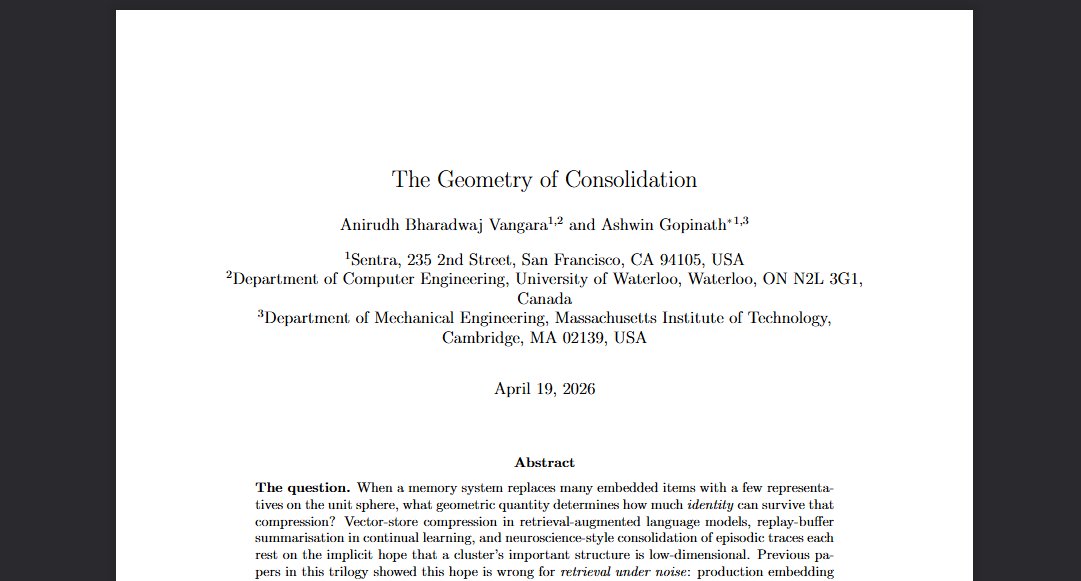
We finally know why LLMs hallucinate. It's not the model. It's the geometry. @OpenAI text-embedding-3-large: 91/3072 dimensions do real work. @GeminiApp gemini-embedding-001: 80/3072 dimensions do real work. ~97% of your vector database is mathematically empty. Your RAG system is retrieving from noise. @ashwingop and I present "The Geometry of Consolidation" - a proof that RAG compression has a hard floor no algorithm can beat, set by a single spectral number your embedding model cannot escape. Every hallucination your RAG pipeline produces? This is why. Paper + results: github.com/niashwin/geome…
ani tweet mediaani tweet media
English
148
459
3.7K
271.2K
Renaissance Man retweetledi
Peter Wildeford🇺🇸🚀
Peter Wildeford🇺🇸🚀@peterwildeford·
PALO ALTO NETWORKS on MYTHOS: "In our testing, three weeks of model-assisted analysis matched a full year of manual penetration testing, with broader coverage."
Peter Wildeford🇺🇸🚀 tweet media
English
38
250
2.3K
204.7K
Renaissance Man retweetledi
Seba Lopez 💻
Seba Lopez 💻@Sebalg_tech·
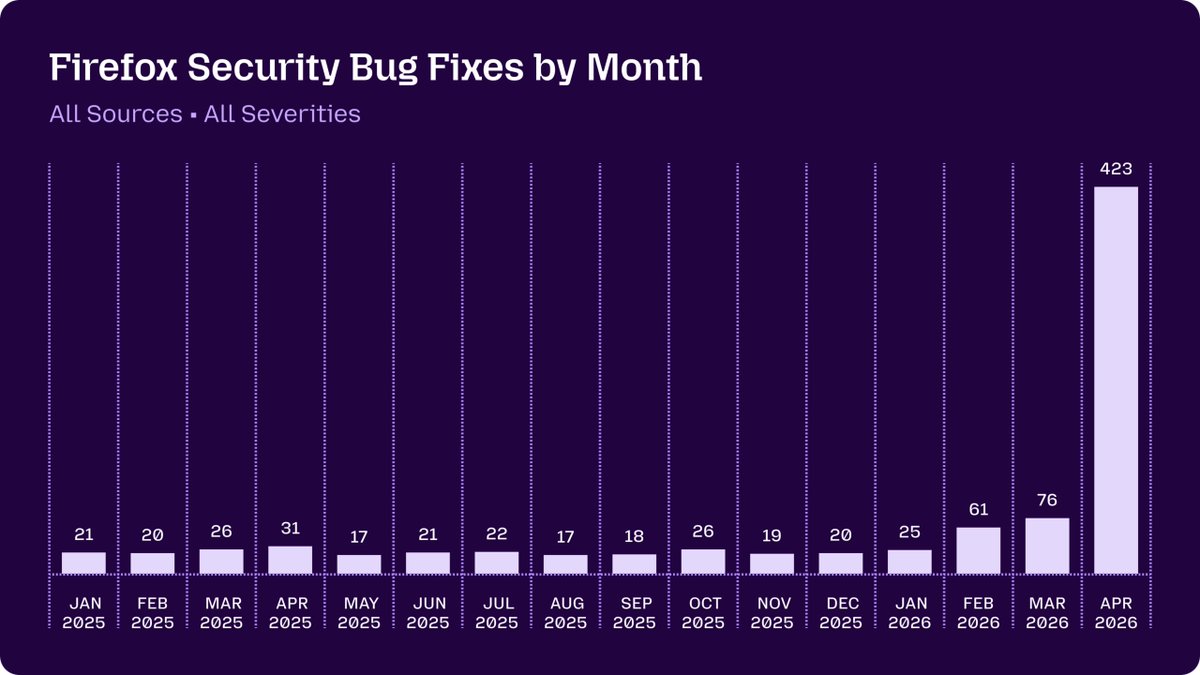
@alexalbert__ Did they find more security bugs this month because they had private access to Mythos and therefore spent much more time than usual searching for and fixing bugs, or was it actually because Mythos itself made them more effective?
English
26
7
639
28K
Renaissance Man retweetledi
Alex Albert
Alex Albert@alexalbert__·
With the help of Claude Mythos Preview, the Firefox team fixed more security bugs in April than in the past 15 months combined.
Alex Albert tweet media
English
345
1.3K
15.5K
1.5M