Osobukowski

283 posts

Osobukowski

Osobukowski

@Osobucowsky

Ich hatte nichts und doch genug

Katılım Mayıs 2022
77 Takip Edilen9 Takipçiler
Osobukowski
Osobukowski@Osobucowsky·
Esto en el largo plazo a Adorni lo beneficia.
Español
0
0
0
6
Osobukowski
Osobukowski@Osobucowsky·
@TeoremaPark Notación engañosa. Gradiente y divergencia no son el mismo operador.
Español
0
0
0
22
Osobukowski
Osobukowski@Osobucowsky·
@lucasllach @Hvygens You need to add a dynamic element of K accumulation via savings rate to account for the change in the East Asian relative endowment over time. In 1950 capital and natural resources were equally scarce for them.
English
0
0
3
54
🇦🇷 lucas llach 🇺🇦
@Hvygens Isn't plain vanilla Heckscher-Ohlin the Occam's Razor for East Asia vs LatAm (especially SouthAm) manufacturing performance?
English
1
0
4
1.7K
Hvygens
Hvygens@Hvygens·
This is too strong, I think, with respect to industrial policy tout court. There are any number of examples of successful industrial policy that don't involve labour repression. The development of the high-tech sectors in Israel and Ireland are two that spring to mind. But for economy-wide developmentalism, I believe it's basically correct. Capital-intensive growth necessarily implies high investment rates which, at some point, means high savings rates and hence restrained consumption. A developmentalist growth regime therefore needs a mechanism that restrains current distributive claims and channels surplus, labour, finance, and skills toward accumulation, upgrading, and external competitiveness. A developmental state can squeeze landlords, banks, importers, and even industrialists, but it cannot make accumulation subordinate to immediate distribution. Capital-intensive growth requires a larger share of current output to be saved and invested rather than consumed; if that priority is reversed, the developmental project eats its own seed corn. Ultimately, then, someone’s consumption claim has to be restrained somewhere, at some time, if an economy is going to sustain very high capital accumulation. And since labour income is by far the largest factor claim on national income, and wages the main source of mass consumption, the incidence of that shift cannot fall only on narrow rentier groups. In this sense, I think it's worth thinking about factor endowments and the restraints they imply and, also, the political coalitions they can generate. Argentina is a very large country, relative to its population, with plentiful natural resources. Most notably, of course, the agricultural surplus generated by the humid pampas, but also energy like oil and gas. These resources generate rents, which can be used internally or utilised to generate the foreign exchange required to purchase imported goods. As a stylised description, Peronism exists to capture these rents and transfer them to the urban working class. The methods include tariff protection to create a very large, labour-intensive, capital-light industrial base; microeconomic distortions, such as export taxes and restrictions, that serve to disconnect internal from international prices; subsidised energy and water tariffs; and, of course, social welfare expenditure and clientelistic public employment. Under early Peronism, the country's chief exports (beef and wheat), were also central urban consumption goods, which made redistribution toward urban workers directly conflict with rural exporters and the balance of payments. With soy becoming the principal export, this changed, since soy is not directly consumed by the urban working class, but it could still be taxed to finance populist programmes. (Peronist political coalitions tend to fracture when commodity prices fall, which puts at least a temporary halt on the extension of the model.) In this sense, Perón didn't need his industrial base to be globally competitive. The rents from the land subsidised the inefficiency of the factories. The East Asian nations, being much more densely populated and relatively lacking in agricultural and energy resources, had no such natural bounty to draw upon. Japan had just lost a war fought in large measure to secure access to energy supplies and other raw materials, and in its aftermath faced severe scarcity. In 1946, exacerbated by the repatriation of millions of soldiers and civilians from the former empire, food supplies became so tight that official rations in Tokyo covered only a fraction of monthly needs, forcing many people to travel to the countryside to barter clothing and household goods for food. Starvation was a real risk for anyone unable or unwilling to rely on the black market; shortages triggered mass protests; and an acute lack of coal checked industrial recovery. Japan therefore depended heavily on American aid simply to feed the population and restart production. The same was broadly true of Korea in the 1950s and, to a lesser extent, Taiwan after 1949: both faced severe foreign-exchange constraints and both were heavily dependent on aid from the United States. Neither, meanwhile, possessed anything like Japan’s prewar and wartime industrial base. Therefore, in order to generate the foreign exchange needed to pay for imports, including food, energy and other raw materials, as well as the capital goods required for industrial development, they had no choice but to export manufactured goods. Indeed, "exports are the only way to survive" ("수출만이 살 길이다") was one of the mantras of the Park Chung Hee era. And an export orientation necessarily imposes restrictions. Domestic consumers have little choice but to pay high prices for mediocre manufactured goods under import protection, but the same is not true for the major export markets in the developed countries. If an American or Western European consumer didn't think a radio, television, motorbike or car represented good quality and good value for money, they simply wouldn't buy it. If you want to sell to their markets, you have no choice but to compete. You can't fool a foreign consumer with political connections or regulatory capture, and even if you impose restrictions on imports, foreign demand imposes a hard quality-to-price test that domestic protection cannot evade. And, for the likes of South Korea and Taiwan, if you don't export, your economy collapses. This has clear consequences for the feasible set of public policies, particularly for a non-democratic regime that legitimates itself by economic growth. As Donald Keesing explained back in 1967: "Reliance only on the domestic market permits a high degree of government intervention, whether in Soviet or Latin American fashion. By contrast, an outward-looking strategy compels moderation. If governments are serious about exporting manufactures, their freedom to intervene is restricted by the exigencies of keeping manufactures internationally competitive, and by trade conventions and sanctions that limit permissible methods of trade promotion." The global market, effectively, acts as a constraint and impartial arbiter of the effects of state intervention. Taiwan simply couldn't afford to have bad industrial policy or "infant" industries that never grow up. Notably, even in Korea, the most interventionist of the East Asian developmental states, Westphal and Kim (1982) found that import restrictions and export-promotion measures largely offset each other, creating something close to a free-trade environment for manufacturing exports. Argentina, by contrast, could muddle through for decades, punctuated by periodic crises, because the pampas kept generating foreign exchange regardless of manufacturing and industrial performance. There was a great deal more ruin in Argentina, to paraphrase Smith. This doesn't, of course, mean that labour repression in East Asia was inevitable. But it does mean that the East Asian nations could not have followed a Peronist-style economic strategy even if they'd wanted to, at least not without staying mired in the most abject poverty. Their factor endowments and balance-of-payments constraints prevented it, at least once American aid began to be wound down. We can say that endowments and geography set the range of institutional possibilities, while political agency and contingency then determine which possibility is selected. But as you build up an export-oriented industrial economy, the interest groups and political coalitions that sustain you in power are necessarily very distinct from those in an import-substituting economy that earns foreign exchange from exporting natural resources. Argentina's factor endowments, on the other hand, made a redistributive, import-substituting coalition politically viable and, once the Peronist coalition was established, this generated institutional lock-in that made lasting reform of the political-economic regime very costly, even as the case for it became clear.
Jesús Fernández-Villaverde@JesusFerna7026

Yesterday I argued that labor repression is a necessary (but not sufficient) condition for industrial policy to work. This simple statement helps us to understand why many attempts at industrial policy in Latin America (and other regions) failed: they were promoted by governments who wanted to increase the wages of manufacturing workers. The best example that comes to mind is Argentina under Perón. On October 21, 1946, Perón presented a five-year plan of fast industrialization oriented toward the internal market: cdi.mecon.gob.ar/greenstone/col… The plan incorporated all the standard elements at the time: 1. Nationalization of the central bank, railroads, utilities, airlines, telecommunications, harbor and navigation companies, and reinsurance. 2. Break with the old export interests. 3. The creation of the Instituto Argentino de Promoción del Intercambio and the introduction of exchange controls. 4. Expansionary fiscal and monetary policy. 5. Price controls (e.g., rent control, electricity, gasoline). 6. Financial repression. But it did not include labor repression because the political base of Peronismo was urban workers. At its very core, the political-economic project of Peronismo was a logical contradiction. The result? After a few years of fast growth, the economy peaked in 1949, reached a balance of payments crisis, and the dreams of fast industrialization went nowhere (I am summarizing here a complex set of events). Also, inflation became a chronic problem in Argentina. You can have a market-oriented growth model, or you can have an East Asian-style growth model. Which of the two would work better for the region is an empirical question, which also depends on your values (is it ok to have an authoritarian government in exchange for faster growth? I would say no, but your answer can be different; I am an economist, not an ethicist). But what you cannot have is an industrial policy-style growth without labor repression: that does not belong to the set of feasible alternatives. At their very core, a huge chunk of Latin America’s left and nationalist economic thinking was deeply confused. Their inner contradictions left them without a framework to analyze their situation and forced them to embrace infantile dependency theories à la Galeano of “we are poor, the fault is theirs.”

English
11
45
193
50.3K
Osobukowski retweetledi
Jesús Fernández-Villaverde
Jesús Fernández-Villaverde@JesusFerna7026·
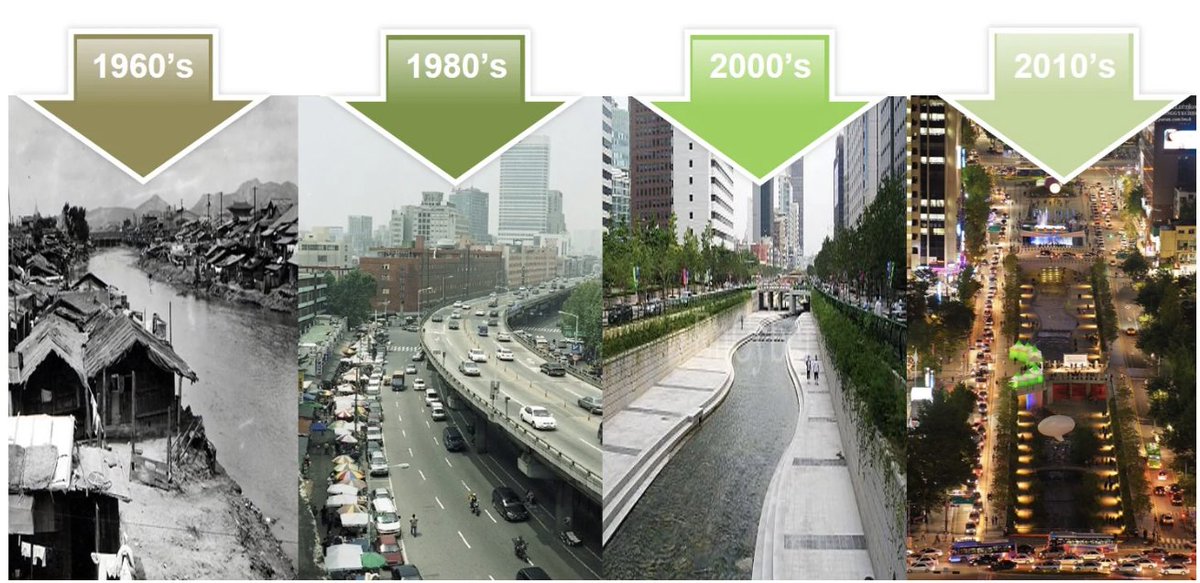
A fundamental lesson from my posts these last two weeks on modernization, industrial policy, and development is that development economics should be about understanding why South Korea got rich but Bolivia did not. The current field has largely given up on that question. Sharply identified RCTs on small micro programs are a fine way to publish in the AER and get tenure at a fancy university, but a profession that knows everything about microfinance impact evaluations and almost nothing about industrialization has misallocated its own intellectual capital on a pretty heroic scale. Four images of Seoul:
Jesús Fernández-Villaverde tweet media
English
75
317
1.8K
571.6K
Osobukowski
Osobukowski@Osobucowsky·
@elchacaldelint1 Muy bueno. Es un poco vergonzante la incapacidad de Tetaz de pensar el tradeoff que plantea JFV por fuera de la grieta Perón bueno vs Perón malo.
Español
0
0
1
37
Aguará Guazú 🌎🚀🔬♻️
Aguará Guazú 🌎🚀🔬♻️@elchacaldelint1·
La economía política de "80 años de peronismo" en un tuit:
Jesús Fernández-Villaverde@JesusFerna7026

That observation reinforces the point rather than weakening it. Argentina's terms of trade between 1946 and 1948 were spectacular. The post-war world was paying record prices for grain and beef, and the foreign exchange windfall mechanically appreciated the real exchange rate. But here is the key thing: the regime had a choice about what to do with that windfall. A government serious about industrial accumulation would have channeled those export rents into investment, the way Korea later channeled Vietnam War procurement income or the way Taiwan used US aid. Perón did the opposite. IAPI extracted the rents from the rural sector, sure, but instead of routing them into productive investment, the regime spent them on wage increases, social benefits, and consumption subsidies. The windfall financed a consumption boom, not an accumulation push. That is precisely my original point: when your political base is urban workers, your industrial policy ends up funding their wages rather than the capital stock that would eventually employ them at higher productivity. The deeper problem is what that locked in. Once the regime had built its legitimacy on those real wages, letting them fall became politically impossible. So when the terms of trade turned in 1949, they could not allow the exchange rate to reflect reality. They suppressed it instead. IAPI's role flipped from extracting rural surplus to defending an overvalued peso, exchange controls multiplied, the official rate became fiction, and reserves drained. By 1952, the adjustment was forced anyway, but the damage to the productive structure and to the country's external position was already done, and arguably never fully reversed. That is what I mean when I say the Peronista political-economic project was a logical contradiction. The regime's legitimacy required high real wages. High real wages required either a permanent commodity windfall, which is impossible, or a competitive tradables sector that could keep earning the foreign exchange, which industrial policy was supposed to build but could not, because building it would have required suppressing the very wages that defined the regime. Once the windfall was gone, the only options left were to deny reality through controls or to accept the political cost of devaluation. Perón chose denial, and basically every Argentine government (and, I am sorry to say, most voters) afterward did the same.

Español
3
2
37
984
Osobukowski
Osobukowski@Osobucowsky·
@TeoremaPark “El deporte nacional no es el pato, ni el fútbol, es la competencia por mojar el propio pan en la salsera del Estado.” -Carlos Floria en sus clases en la UdeSA
Español
0
0
2
114
Osobukowski
Osobukowski@Osobucowsky·
@BrankoMilan That’s just showing how volatile its real exchange rate is
English
0
0
5
468
Osobukowski
Osobukowski@Osobucowsky·
@TeoremaPark @cafe_n_pucho No embarremos con términos informáticos. No hay arrays en geometría, la conexión de L-C (los Γ) es sección del fibrado afín de conexiones (q no es vectorial, mucho menos tensorial) Tensor en CS es un array q guarda grads para hacer autodiff, nada q ver con tensores en fibrados
Español
0
0
0
10
Cafe&unpucho
Cafe&unpucho@cafe_n_pucho·
sé que estoy deep into mi algoritmo porque mi fyp es la discusión de los gordos array vs. los pibes del tensor de Ricci
yx=k@nicolasegimenez

@__Fiamy @_necropheus fiamy te banco pero volves a decirle tensor a un array y te mando una carta documento

Español
1
1
16
909
Osobukowski
Osobukowski@Osobucowsky·
Una restaurante peruano en Chacagiales que se llame Pequeño J
Español
0
1
1
77
Osobukowski
Osobukowski@Osobucowsky·
@liberaldeantoo2 Les van a pagar en Certificados de Obligación de la Nueva Argentina Naciente (CONANs)
Español
0
0
33
233
Osobukowski
Osobukowski@Osobucowsky·
@JohnGalt_is_www Ok ese planteo ya es medio infalsable, pero prima facie no te parece intuitivamente obvio que tener un emprendimiento exitoso requiere bastante más que terminar college?
Español
1
0
0
66
ae^((-(x-b)^2)/(2c^2))
ae^((-(x-b)^2)/(2c^2))@JohnGalt_is_www·
@Osobucowsky son pateticas esas comparaciones, es como comparar a los que viven en barrios ricos vs en suburbios y medir media de salarios y concluir que mudarte a un barrio rico te hace ganar mas
Español
1
0
1
188
Nico
Nico@NicoTzke·
@lucasllach Además siendo el género una autopercepcion, esta distinción no tiene ningún sentido
Español
1
0
8
350
🇦🇷 lucas llach 🇺🇦
¿Qué opinamos de este subsidio cruzado de los jubilados a las jubiladas? Yo estaría a favor si las edades jubilatorias fueran las mismas. Si encima hay que laburar más AÑOS es violencia de género.
Grok@grok

@lucasllach Según las tablas de mortalidad de la ONU (proyecciones 2026 para Argentina): - Un varón que se jubila a los 65 años espera vivir **16,6 años adicionales** (hasta ~81,6 años). - Una mujer que se jubila a los 60 años espera vivir **24 años adicionales** (hasta ~84 años).

Español
11
5
55
14.2K
Osobukowski
Osobukowski@Osobucowsky·
@guido__ce No ves los ecos de Catulo y William Barnes en las letras de Gilda, todo eso se perdió con Duki y Trueno.
Español
0
2
3
764
guido
guido@guido__ce·
La conurbanización empezó en 1998, explican. Estoy anonadado con estas cosas. Es la construcción en vivo de un mito delirante. Así se construyeron cosas como las naciones, las identidades religiosas, etc. Pero verlo en vivo aceleradamente es una experiencia especial.
👣@ziggy_pop_1981

1998 fue el último gran año de la Argentina pre conurbanización. Aún reinaba la cultura occidental, cero latinaje, colas llenas para ver Titanic, recital de los Stones, vuelta de la F1. Otro país.

Español
12
25
418
10.8K