owl
5.8K posts

owl
@owl_posting
cancer guy @noetik_ai || ex virus guy @dyno_tx || i write on bio ml at https://t.co/QPTHsR3fzm || podcast on https://t.co/JBM0K65IrO


Fervo, a geothermal energy developer, raised $1.89 billion in a US IPO that priced above the marketed range, after upsizing the deal earlier this week bloomberg.com/news/articles/…


This will not end well for the US biopharma industry. The BMS/Hengrui deal announced yesterday includes co-commercialization which is the last piece after manufacturing and discovery that has not been present in Chinese drug cos. If we want to maintain our lead in US biotechnology we need to: 1. Drop cost and increase speed of phase 1 clinical trials in US. Good progress here recently from @US_FDA 2. Drop cost and increase speed of the lab work that drives product development in therapeutics. At @ginkgo we believe you do this via autonomous robotic labs, but I'll take anything that works -- right now discovery is 1/3 the cost in China as bench scientists there are 1/3 the labor cost. 3. Improve IP protections so its not too easy to fast-follow a biologic -- often the ultra-risky first clinical work on a new target is done in US and Chinese startups are fast-following and easily designing around patent limitations on protein sequences. 4. Leverage the fact that US consumers are paying for 70% of the profits in the biopharma industry to put in place the sort of trade restrictions we use to protect domestic automotive, defense, AI, and other strategic industries. Easy way to get started here is add biotech to the COINS Act list of strategic technologies alongside chips, AI, quantum, drones, etc. We need to do it now. Democracies should control genetic engineering - it's not more complicated than that. "Hengrui, which has the option to co-develop certain assets and participate in commercialization globally, gains access to some of the fruits of BMS’ drug discovery engine, plus its partners’ global R&D, regulatory and commercial capabilities." fiercebiotech.com/biotech/bms-in…

We’re putting the “reversible” in Reversible Cryopreservation 🧡 Our latest post breaks down how our rewarming process works and shares new human organ-scale rewarming data we’re excited to finally show. Check it out in the link below 👇

@josiezayner moonshots are good, let the kids shoot for the stars and see if they can figure out something novel. we need more people in this space trying all sorts of new things, succeed or fail, this is good

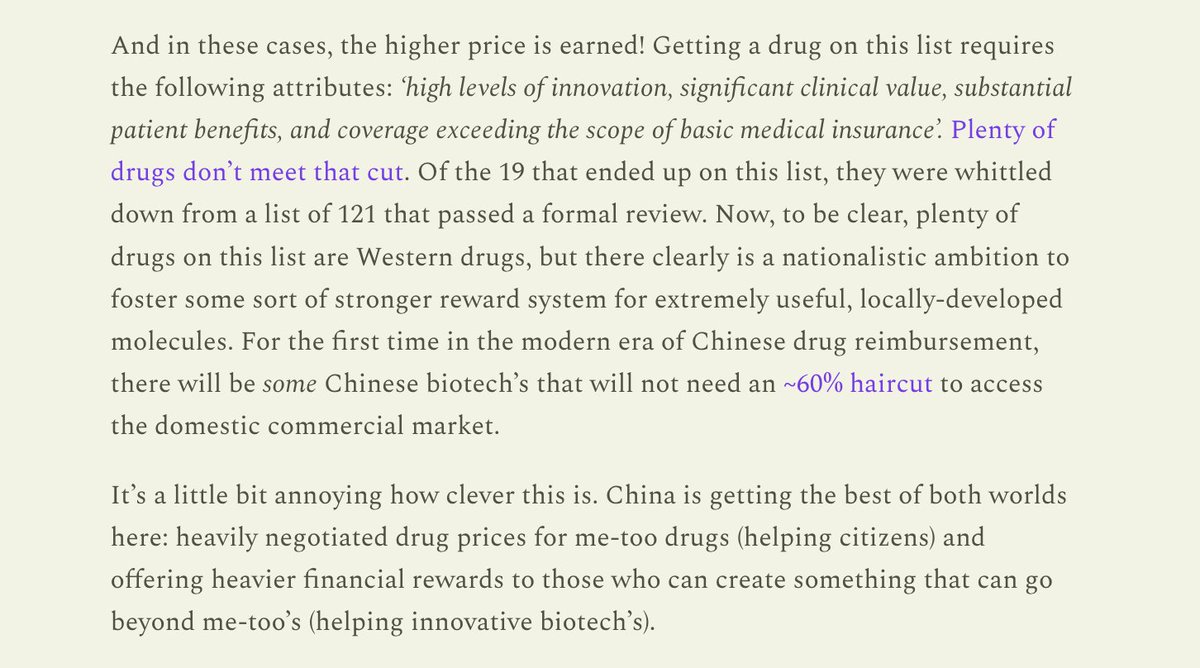
the upside of a hyper-centralized healthcare system is that you can be clever with it at scale


How financial architectures shaped (and will continue to shape) Chinese drug development (4.5k words, 20 minutes reading time) owlposting.com/p/how-financia… some thoughts on the current, and quickly upcoming future of Chinese drug development, and how finance determined its shape


a lot of excellent ai-bio startups are based on sufficiently complicated theories of change that slide decks are no longer sufficient to grasp them in their entirety. these days, you must cross your eyes, think really, really hard, and trust the fuzzy bubble that emerges

the creation of Opus 4.5 involved a faustian bargain between anthropic and otherworldly forces; in exchange for beautiful writing, it will hallucinate in ways not seen since 2023. in this way, it is more similar to the great writers of olde than different


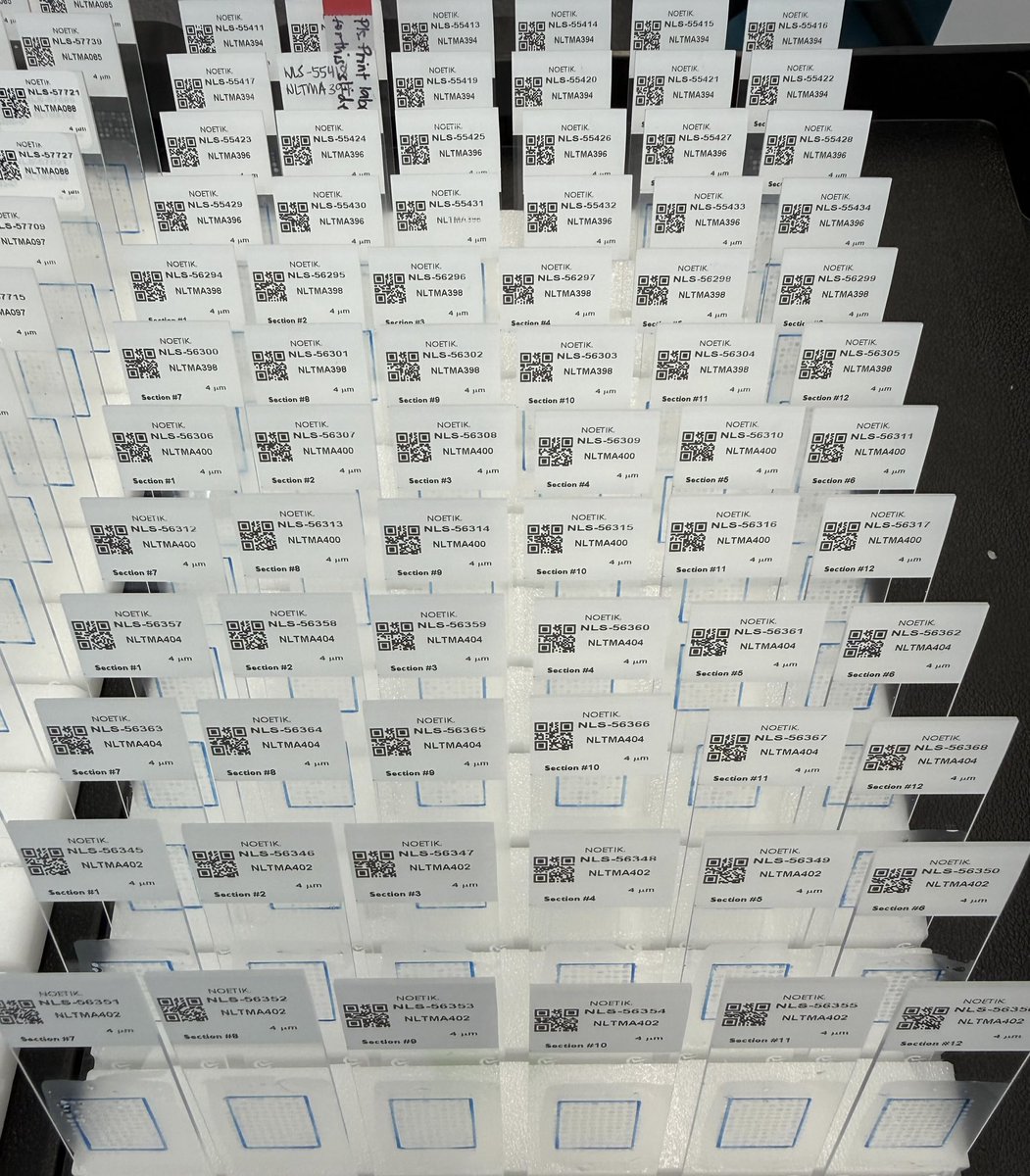
Perturb-MARS: Reading mouse experiments through a human lens noetik.blog/p/perturb-mars… During my first week at @NOETIK_ai, there was one project in particular I was immediately enamored with, and have been excited to write about since. Eleven months later, it is finally ready to be put out there. This is an essay over Perturb-MARS. In short: a multiplexed in-vivo mouse perturbation screen, read out by a foundation model trained only on human cancer tissue. This model (TARIO-2, which we've written about before) takes mouse H&E and returns predictions in human spatial-transcriptomic space. No retraining. no ortholog mapping. It just works, and allows us to answer questions the current preclinical apparatus is structurally incapable of answering, such as discovering combination therapy antagonism. And more importantly, Perturb-MARS offers us the substrate of a scalable, active-learning flywheel. This rarely exists in biology, and doesn't exist at all in in vivo settings. As in, environments where a model can make predictions, the wet lab can test them at scale, and the results come back in the same coordinate system the predictions were made in. Code and math have this. Biology largely doesn't. @NOETIK_ai's goal is to build simulators of human biology. You need active-learning environments to do this well. And Perturb-MARS gets us closer to that than anything I'm aware of. We are extremely interested in partnerships over this work! Reach out to partnerships@noetik.ai to start that discussion.

a nervous pathologist recently reached out to me to ask how i thought things have changed in the year since i wrote this article, asking if their job is still safe i did not know the answer, so i had a conversation with one of the anonymous people i talked to for this article to ask for a yearly update (i trust them to be well-informed on the subject) tldr: the future job prospects for a pathologist today are a bit bleaker compared to april 2025. but maybe it'll also be fine? on the ai side, modern LLMs are now able to reliably operate in long-term, autonomous workflows that can combine multiple pieces of patient info, much like how a human pathologist would. of course, the models are certainly slower, which may be enough for the human to operate as a coordinator of agents in the short-term. but...unlike, say, software engineering, there is a maximum amount of 'work' that can go into any singular pathology slide annotation/analysis, and a human may simply be unneeded at some point (or at least dramatically fewer humans) on the digitization side, whereas pathology digitization used to be slow on the uptake, it feels like it is getting faster. why? pharma is simply forcing digitization by virtue of H&E-driven, ai-assisted companion diagnostics becoming increasingly common. and the more things are digitized, the more AI-shaped the whole task becomes. beyond that, remember: this type of digitization is not really *meant* for human pathologists anyway, since it is deriving features that are invisible to the naked eye (e.g. HRD, androgen sensitivity, etc). because of this, you could imagine that there grows to be increasing comfort with removing humans from even the white-box analysis as well that said: the optimistic case here is that the companion diagnostic explosion is actually a tailwind for human sign-off, not a headwind. even today, no path lab wants to retain diagnostic liability for what an AI said, and so even the black-box stuff currently requires a credentialed human to sign the report for billing and liability reasons, and that may continue. so, the per-case complexity goes up even as the per-task automation goes up. in this world, pathologists are fine! maybe even more in demand! but the job looks much stranger. which could be said for perhaps every job