Owner 1win

389 posts

Owner 1win banner
Owner 1win

Owner 1win

@Owner1win

Founder of @1winPRO, @1winToken, @1winesports, @1winModels and a lot more projects to come 🚀 🔗 TG: https://t.co/TWzuuo60JV 🔗 My life: https://t.co/EhSinDoHJe

Katılım Ekim 2024
9 Takip Edilen77K Takipçiler
Owner 1win retweetledi
Ihtesham Ali
Ihtesham Ali@ihtesham2005·
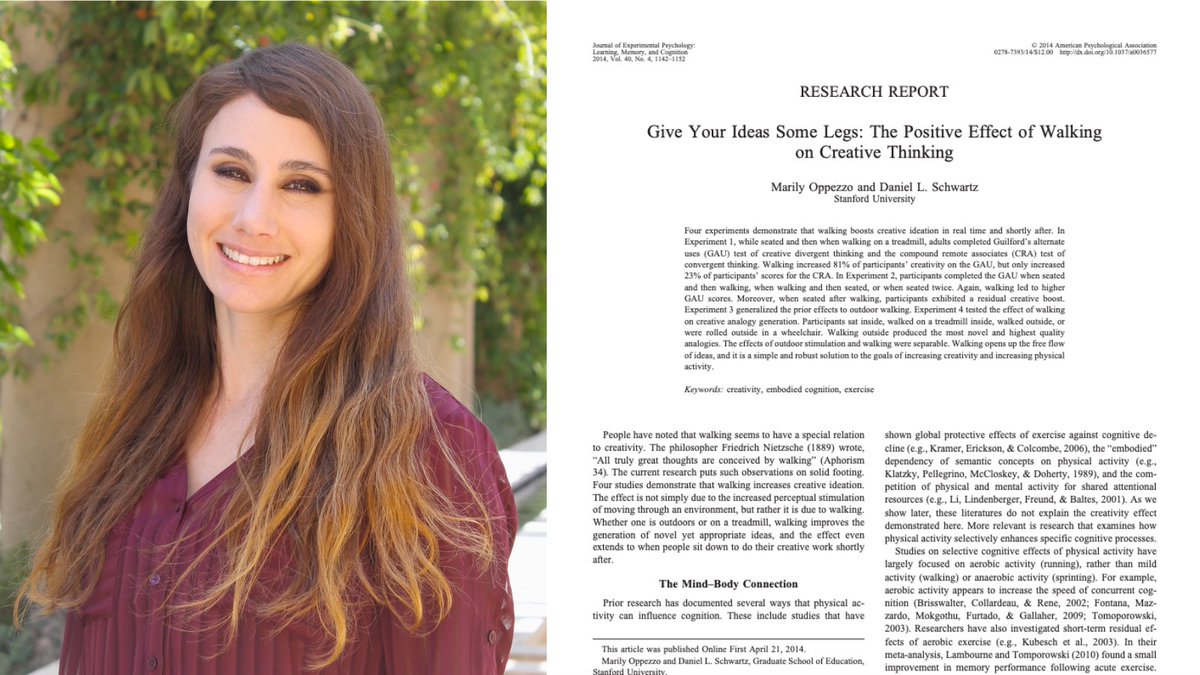
A Stanford psychologist spent 4 years proving that the simple act of walking generates 60% more creative ideas than sitting, and the experiment she designed to kill every alternative explanation is one of the most decisive findings in modern psychology. Her name is Marily Oppezzo. She got the idea for the study while walking with her advisor at Stanford to discuss her thesis topic, and the paper she eventually published in the Journal of Experimental Psychology in 2014 is sharp enough that it should have ended the seated meeting on the day it came out. She ran 4 experiments on 176 people. Same person tested twice. Once sitting, once walking. The creativity tasks were the standard ones psychologists have used for decades to measure how good a brain is at generating novel useful ideas. The result was almost too clean to publish. 81% of participants in the first experiment produced more creative ideas while walking than while sitting. In the second experiment, 88%. In the third, 100%. Every single person walked into a more creative version of themselves. On average, people generated 60% more novel useful ideas the moment their legs started moving. The skeptical question is the obvious one. Maybe it was the fresh air. Maybe it was the scenery passing by. Maybe it was the change of environment doing the work, not the walking itself. Oppezzo killed every one of those explanations with one experimental decision. She put people on a treadmill facing a blank wall. No scenery. No fresh air. No environmental change. Just legs moving in place while staring at white drywall. The 60% boost held. Then she ran the experiment that closed the case completely. She took participants outside in two conditions. Half of them walked through a Stanford courtyard. The other half were pushed through the exact same courtyard in a wheelchair. Same outdoor stimulation. Same scenery passing at the same speed. The only difference was whether the legs were moving. The walkers produced dramatically more novel high-quality ideas than the wheelchair group. The outdoors did almost nothing on its own. The walking did everything. This is the part of the study that hit hardest when I read it the first time. She also tested the opposite kind of thinking. Convergent thinking. The kind where there is one right answer and you have to narrow down to it. Word puzzles where 3 words share a hidden fourth word that connects them. The seated participants did slightly better on these. Walkers got slightly worse. Walking is not a general intelligence enhancer. It does one specific thing. It opens up the divergent search inside your brain. The part that generates options. The part that produces unexpected connections. The part that takes a problem and finds five ways into it instead of one. When you need to converge on the single right answer, sit down. When you need to find the answer in the first place, get up. The mechanism is now well understood. Walking selectively activates what neuroscientists call the default mode network, the system inside your brain that runs when you are not consciously focused on anything. The DMN is where mind-wandering happens. Where memories cross-reference each other. Where ideas that have been sitting in separate folders inside your head finally bump into each other. When you sit at a desk and force yourself to concentrate, you suppress the DMN. When you walk at a natural pace, the executive part of your brain gets just busy enough handling the walking that the DMN comes online and starts doing the work that focus was blocking. The most useful finding in the entire paper is the one almost nobody quotes. The boost did not turn off the moment people stopped walking. Participants who walked first and then sat back down stayed elevated. Their next round of seated creativity work was still significantly better than people who had been sitting the whole time. The rest lingered for at least several minutes after the legs stopped moving. You do not need to do creative work while walking. You need to walk before the creative work. The brain holds the state. The history of this is the part that should haunt anyone who still does meetings in chairs. Charles Darwin built a gravel loop behind his house in Kent called the Sandwalk and walked it 3 times a day for the rest of his life. The theory of evolution was developed one lap at a time on that path. Nietzsche walked up to 10 hours a day during the years he wrote his most important books and openly said the work was conceived on his feet. Beethoven composed for the morning and walked for 5 hours every afternoon with a pencil in his pocket for when something landed. Kahneman said the best thinking of his Nobel Prize-winning career happened on leisurely walks with Amos Tversky. Steve Jobs refused to take important conversations sitting down. He held them on foot. Every one of them was using the system Oppezzo would not measure until 2014. They just did not know what to call it. The question worth sitting with is the one almost nobody asks. Every meeting you have ever attended sitting around a table was a meeting held at a fraction of the brain power that was actually available to the people in the room. Every brainstorm that got stuck inside a conference room. Every problem you tried to solve at a desk and gave up on. Every idea you could not quite get to. The intervention is the easiest one in modern science. No supplement. No app. No subscription. No training program. Just a pair of legs and 15 minutes. The Stanford lab proved it. The philosophers knew it. The neuroscience explains it. And almost everyone reading this is still trying to think their way out of problems sitting completely still.
Ihtesham Ali tweet media
English
233
2.5K
9.6K
1.1M
Camus
Camus@newstart_2024·
Gordon Ramsay was burning out hard at 40. Overweight, exhausted, Michelin stars flying everywhere, but zero time for himself. So he forced 90 minutes, 5 days a week back into his schedule. Started triathlons. Did an Ironman. Now he says training is his reset — where he processes life and gets his best ideas. This one hit me. The world’s most intense chef protects his training time like it’s sacred. Real success isn’t just grinding at work. It’s protecting the time that keeps you sharp and sane. Do you protect a non-negotiable block of time for yourself each week?
English
42
85
1.7K
955.5K
Jon Erlichman
Jon Erlichman@JonErlichman·
Odds of making money: 1 year in stock market: 74% Blackjack: 42% Slot machine: 5-10% Lottery ticket: 5%
English
109
199
3.8K
280.8K
Owner 1win
Owner 1win@Owner1win·
Boredom isn't a problem - it's a resource. We live in a world where boredom is basically impossible - notifications, podcasts, Netflix. Any pause can be filled with content in seconds. And we do it automatically, without even thinking. I dug deeper into this topic and even found out there was an experiment where participants were asked to sit alone with their thoughts for 6 to 15 minutes. No phone, no books, nothing. The only alternative was a button that gave them an electric shock. Surprisingly, 67% of men pressed it. People literally chose pain over silence. Everything has an explanation, of course. The brain treats boredom as a threat and looks for any stimulus it can find. That's why we reach for our phones - not because there's something interesting there, but just because there's something. And yet during boredom, the brain shifts into a special mode. Neuroscientists call this the default mode network. This is when the brain stops processing external information and turns inward - connecting unrelated ideas, making sense of experiences, building long-term plans. This is exactly where unexpected solutions and insights come from that never surface when you're busy. But here's the problem - we never let our brains get there. The default mode network never gets to switch on. Every pause - in the elevator, between tasks, the first minutes after waking up - gets filled with a phone. The brain is constantly processing other people's content and never gets a chance to think for itself. My advice is simple - give your brain 10 minutes of boredom a day. Not meditation, not a walk with a podcast - just nothing. That's the only time it's actually working for you, not for someone else's algorithm. Archimedes in the bath, Newton under the apple tree, Einstein on his bicycle - all these stories about moments of insight during idleness are no coincidence. The default mode network works precisely when you're doing nothing. Give your best ideas a chance to come out.
English
6
1
21
1K
Owner 1win retweetledi
Zack D. Films
Zack D. Films@zackdfilms1·
Spinning Mt Fuji Like A Beyblade 🤯
English
1.8K
4.2K
74.7K
22.8M
Interesting AF
Interesting AF@interesting_aIl·
Meta officially layoffs 8,000 jobs, or 10% of its workforce He warns “success isn’t a given” in the AI race
Interesting AF tweet mediaInteresting AF tweet media
English
205
132
2.2K
478.6K
Owner 1win retweetledi
1win Token
1win Token@1winToken·
Guide: How to become a 1win Token ambassador As part of our ambassador program, we are creating a whitelist within our community. First stage rewards: unique contests with real prizes! To become part of it, you need to: 1. Join the 1win Discord: discord.gg/Cmq4yVySq 2. Send any message in the general chat 3. Create your referral link and invite 100 people We showed how to do it in the images under this post.
1win Token tweet media
English
20
5
79
23.9K
Owner 1win
Owner 1win@Owner1win·
Got hungry Our olive from the new LD giveaway
Owner 1win tweet media
English
10
4
43
2K
Owner 1win
Owner 1win@Owner1win·
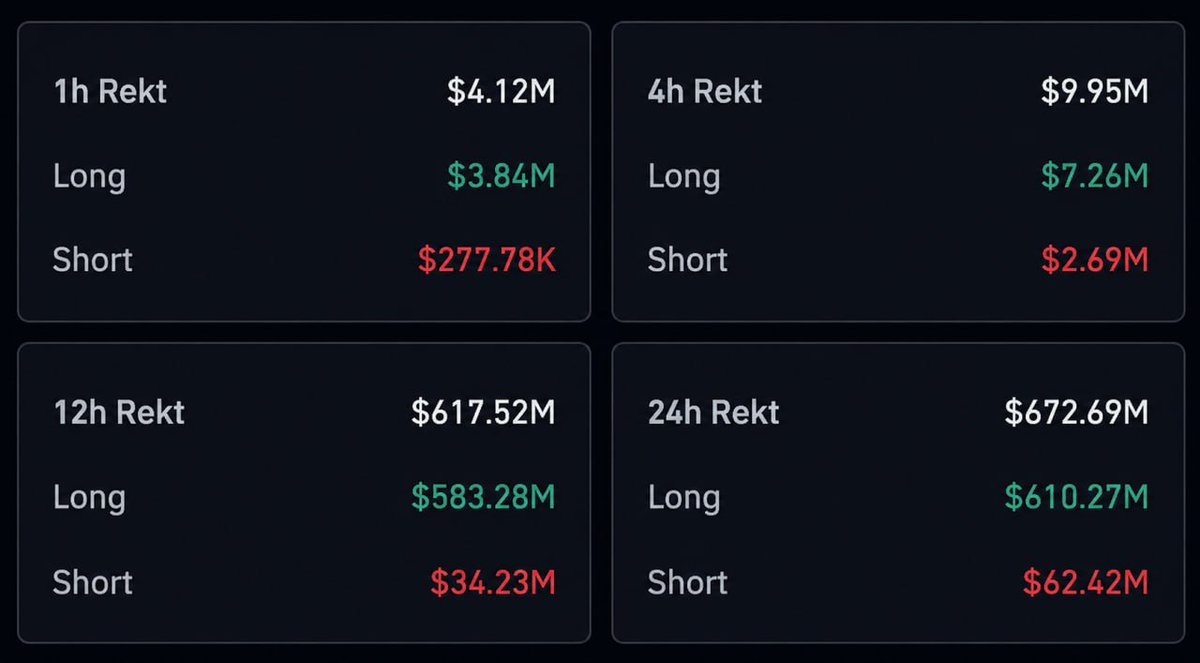
If someone tells you exactly where the market is going… 99% of the time, it’s nonsense I’m used to analyzing information as clearly and accurately as possible. But many people miss one simple thing: looking back. Write down your thoughts, then check later if your logic actually worked. If you don’t understand the current market, look at the data: real numbers, where liquidity came from, where it went, what actually happened. Since last Friday, traders have been liquidated for $1.5B, and 90% of that was longs. That means 90% of people were wrong - or managed risk badly. And out of the 10% who were right, half were probably just lucky. Tomorrow, they may be in the first group losing money. When you analyze the market, charts, or news, always leave room for risk. That’s the only correct way to avoid losing - at least not everything at once. At 1win, we always follow the logic of safe risk management. When a company has 7,000 employees, Tier-1 artists, fighters, and influencers as faces of the brand, and has grown far beyond a simple “online casino” into multiple large independent directions… (Yes, for example, some @1winToken users don’t even know that @1winModels exists, and conversely) When you’re building something big and want the whole system to work, ignoring the scale of your idea and the risks for other directions is an obvious path to failure. Winning today doesn’t mean you won’t lose tomorrow. That’s how a post about “the market is hard to read” turned into a post about risk and the long-term perspective of your ideas. And yes, this is not financial advice, DYOR. It’s a post about why financial advice theoretically can’t exist.
Owner 1win tweet media
English
9
3
43
2.8K