Dr Patrick Morris O'Connor

1.6K posts

Dr Patrick Morris O'Connor banner
Dr Patrick Morris O'Connor

Dr Patrick Morris O'Connor

@PaddyHistoricus

"Pueri in vicinia" ・ Historian of Ancient & Medieval times, with an interest in Psychology and the longue durée ・ Most views provisional and/or ironic ・

London Katılım Mart 2020
365 Takip Edilen159 Takipçiler
Dr Patrick Morris O'Connor
Dr Patrick Morris O'Connor@PaddyHistoricus·
@HausdorffMedia The concept-creep of the term "blood libel" is truly a wonder to behold. Why can't you just accept that non-racists are capable of disagreeing with you, and argue the case on its merits, rather than conflating Jewishness with the activities of the state of Israel?
English
0
0
0
5
Natasha Hausdorff
Natasha Hausdorff@HausdorffMedia·
If only the British communal leadership had the stomach to say we will not platform spreaders of the genocide blood libel, like Ed Davey, at a national rally against Antisemitism, things might look at bit different in the UK.
English
86
242
1.5K
36.4K
Dr Patrick Morris O'Connor
Dr Patrick Morris O'Connor@PaddyHistoricus·
@MarkHug52861536 @labourlewis Yeah some good ideas, to which you could add many more. In general Labour have been induced to respect conventions that in many cases were only established in recent history as if they are laws of physics.
English
0
0
0
5
Mark Hughes
Mark Hughes@MarkHug52861536·
@PaddyHistoricus @labourlewis 5.Politicians have become obsessed with the household analogy yet when applying they ignore the fact that no household balances its books in the years they buy a house or a car or have an extension. They borrow in these years and yet it seems a Government is unable to do the same
English
1
0
1
11
Clive Lewis MP
Clive Lewis MP@labourlewis·
Westminster may finally be about to have the argument it has spent 40 years avoiding. If Andy Burnham returns to Parliament, the political class will know how to cover it. A leadership drama. Who is up, who is down, whether Keir Starmer can survive, whether Labour is once again turning inward. The familiar machinery of Westminster psychodrama will whirr into life. That framing misses the larger point. Burnham’s possible return matters not because of what it says about Labour’s leadership, but because of what it reveals about the British state: what it can still do, what it has forgotten how to do, and what kind of country it must become if it is serious about resilience. Britain is finally having a more serious conversation about national security. The Strategic Defence Review, the pivot back towards Europe, the recognition that hybrid warfare turns citizens, infrastructure and civic institutions into part of the front line: all of it marks a real shift in how the state thinks about its own survival. But at the centre of that conversation lies a question that the defence establishment, and most of Westminster, still does not want to answer. What kind of society do you need to be before resilience is possible? Finland is now the model everyone cites. Comprehensive security. Whole-of-society defence. Civilian preparedness woven into military planning. British strategists admire the Finnish system and ask how it might be copied. But the admiration stops short of the uncomfortable question: why does it work there? The answer is not geography or history or some mysterious quality of Finnish national character. It is structural. Nearly 80% of Finns say they would defend their country if attacked. In Britain, the figure is closer to 33%. That gap is not an accident. It exists because Finland has spent decades building a society in which people have a genuine stake in what they are being asked to defend. Energy is affordable. Housing is available. Public services function. Institutions command trust. The Nordic welfare state is not a sentimental add-on to Finnish security policy. It is the foundation of it. You cannot ask people to defend a country that does not work for them. Britain has spent 40 years building the opposite. The privatisation of essentials – energy, water, transport, housing – transferred wealth upwards from households to shareholders while making the basics of everyday life more expensive. The state, stripped of the tools to control costs at source, has been reduced to compensating after the fact. Out of every pound the Government spends on housing, 88p goes to subsidising private rents. Just 12p goes to building homes. When energy prices spiked in 2022, the Government spent £40bn in a single winter cushioning the blow, not because it had a resilient energy system but because it lacked one. Debt interest now consumes more than £100bn a year. Britain has the highest debt servicing costs in the G7: the compounding price of financing failure rather than eliminating it at source. This is what bond market dependency actually looks like. It is not an abstract fiscal condition. It is the consequence of a state that has been stripped of the supply-side tools that would let it cure the problems it now pays, indefinitely, to manage. And here is the paradox the Treasury refuses to confront. The countries that borrow most cheaply are often those that have retained the public investment model Britain abandoned. The spread between UK and Dutch borrowing costs has widened sharply not because markets fear public investment, but because they have lost confidence in a model that borrows to subsidise private failure while never addressing its causes. This is the connection Britain’s defence debate is missing. The familiar framing, that social spending is what must be sacrificed to meet the NATO target, is not merely politically toxic. It is strategically illiterate. Cutting the foundations of social cohesion to fund the hardware of national defence is self-defeating. You end up with planes and no pilots, submarines and no crew, an army that cannot recruit because the society it is meant to protect has stopped believing in itself. I think Burnham understands this. That is why his programme is more interesting than the leadership gossip suggests. What he has been building in Greater Manchester – public control of transport, expanded social housing, investment in the productive foundations of the city economy – is not a nostalgic rerun of postwar nationalisation. It is a proof of concept for a different kind of state. The Bee Network is the most visible example, but the argument behind it travels. A state that can shape markets is not condemned to subsidise their failures. A state that produces affordable energy through public generation does not need to spend tens of billions cushioning every price shock. A state with a serious public housebuilding programme does not need housing benefit to rise endlessly in line with private rents. A state that builds institutions people can see, use and trust begins to restore the civic confidence on which resilience depends. The real constraint on Britain is not money. It is capacity: the workers, institutions, supply chains and public purpose needed to turn national will into national renewal. Britain’s tragedy is not that it has run out of money. It is that after 40 years of hollowing out the state, it has made itself less able to act. Burnham’s critics will reach for the familiar warning. Borrow more, spend more, spook the gilt markets, repeat the Truss disaster. But this misunderstands both the problem and the opportunity. Bond markets do not have ideological preferences. They have functional ones. They prefer clarity, credible revenue streams, productive investment, and a state with a plan. What they punish is not public ambition but incoherence. A properly designed productive state programme would not be a leap into fiscal fantasy. It would be an attempt to end the much costlier fantasy that Britain can keep borrowing to compensate for broken markets while refusing to repair them. The defence conversation and the economic conversation need to become the same conversation. Finland did not build national resilience by choosing between welfare and security. It built resilience by understanding that they are inseparable: that a country in which the basics work, where people trust one another and the institutions around them, is one that can face danger with something more than anxiety. That is the deeper argument Burnham represents. Westminster will be tempted to treat him as a leadership story. It should resist the temptation. The question is not whether Burnham can return to parliament. It is whether Britain can return to the idea that the state should make life work. Because a country that cannot command the confidence of its people cannot truly defend itself.
English
551
811
3.6K
783.6K
Dr Patrick Morris O'Connor
Dr Patrick Morris O'Connor@PaddyHistoricus·
@OwenPaintbrush Anders Breivik quoted an article by Phillips - in full - in his manifesto before killing dozens of teenagers in Norway. If the government was consistent in its attitude to words deemed to inspire terrorism, the kind of statements that characterise her invective would be banned.
English
0
0
1
141
Frank Owen's Legendary Paintbrush🥀🇵🇸🇾🇪🇸🇩
If anyone on the left talked about Jews and Israel the way Melanie Phillips talks about Palestinians and Palestine, they would be investigated by the police for hate speech and would never see the inside of a television or radio studio ever again.
English
383
3.3K
8.4K
142.1K
Dr Patrick Morris O'Connor
Dr Patrick Morris O'Connor@PaddyHistoricus·
@BareLeft They apparently were so afraid of the contents of the backback that one of the officers actually stamps on the backpack toward the end of the clip 🤔
English
0
0
0
8
Marl Karx
Marl Karx@BareLeft·
Having watched this back a few times today now the initial shock is over, it's clear the Met are extremely sensitive to even the suggestion of excessive force being used, because they know how bad this footage is going to look when properly scrutinised.
Osita Mba@DrOsitaMba

We must stand with @ZackPolanski at this critical moment. The Establishment and their minions are telling us to reject the evidence of our eyes and ears.

English
435
1.4K
7.2K
179.9K
Dr Patrick Morris O'Connor
Dr Patrick Morris O'Connor@PaddyHistoricus·
@SkyNews "Does not align with our values". Funny thing to say about something you clearly ordered to happen.
English
0
0
1
33
Sky News
Sky News@SkyNews·
The solar panels destroyed by Israel's army are used to provide the Lebanese town of Debl with electricity, as well as supply power to its water station. The IDF says the actions seen in the video do not align with their values. 🔗 trib.al/PCHqQAT
English
1.9K
5K
10K
1.3M
Dr Patrick Morris O'Connor
Dr Patrick Morris O'Connor@PaddyHistoricus·
@timothy_stanley Novelty. The crucifix thing is new, so it is news. The war crimes, by this point, have become little more that the ambient background noise. Nobody is shocked by them, and all have well-developed conceptual boxes for them - "typical israel" / "paliwood" / "war is hell" etc.
English
0
0
1
162
Tim Stanley
Tim Stanley@timothy_stanley·
I, too, was distressed to see a crucifix being destroyed, but far more troubled by the accounts of alleged abuses against living people - as described in the Israeli press. I'm unsure why this isn't drawing equal comment. haaretz.com/israel-news/is…
English
19
113
408
22.3K
Dr Patrick Morris O'Connor
Dr Patrick Morris O'Connor@PaddyHistoricus·
It is extraordinary how many nations have framed laws in the last few years, which are designed to curtail free speech, and that specifically mention Israel. The craziest part is that the enactment of these laws has an inverse relationship with the prevelance of antisemitism.
Arnaud Bertrand@RnaudBertrand

France is on the eve of voting one of the most shameful laws in its history: it would effectively outlaw criticism of Israel and criminalize any speech seen as even remotely sympathetic to whoever the French government chooses to designate a "terrorist group." In effect this law would turn France's foreign policy into unchallengeable dogma backed by prison time. You could literally be sent for 5 years in prison if you, for instance, call what France says are "terrorists" a "resistance group." Think for instance Nelson Mandela during the apartheid (the ANC was on every Western terrorist list) or, heck, France's own Résistance against Nazi Germany - designated as "terrorists" by the Vichy regime and the Nazi occupation. It's frankly absolutely insane. The new law is called "loi Yadan" after its author Caroline Yadan, a MP who represents French expatriates living in Israel. The U.S. has congressmen paid by AIPAC: France has cut out the middleman entirely, we have MPs whose constituency is literally in Israel. The law has already passed committee and heads to a full parliamentary vote on April 16th - 3 days from now - under a very unusual fast-track procedure. Seven of eleven parliamentary groups have said they'll vote yes and the law is expected to pass. What does the law say? Let me quote from it directly (full text here: assemblee-nationale.fr/dyn/17/textes/…): 1) Article 1 introduces the concept of "implicit" provocation to terrorism and punishes it with five years imprisonment and a fine of €75,000 That's the one I was speaking about. Under this provision, describing anyone France designates as terrorist as a "resistance movement" - the way France describes its own Résistance against Nazi occupation - could effectively become a crime. The key concept is what does "implicit provocation to terrorism" mean? Nobody knows. And that's the point. It means whatever a prosecutor wants it to mean: a perfectly good case could be made that, for instance, quoting international law on the right of occupied peoples to resist with respect to Hamas is, in fact, "implicit provocation to terrorism." France's most famous anti-terrorism judge, Marc Trévidic, says he has never seen anything like it in his entire career (x.com/CharliesIngall…): "Implicit provocation to terrorism: do you realize what that means? Becoming a censor of other people's thoughts, trying to guess what a person really meant." 2) The same article also expands the terrorism apology offense to include "minimizing or trivializing acts of terrorism in an outrageous manner." This is even crazier: until now, "apology of terrorism" meant actually expressing a favorable judgment of "terrorist acts" (which is already insane because, as we all know, one person's terrorist is another's freedom fighter). Well, under this new provision, a judge could decide that providing context, explaining root causes, or insufficiently condemning an act amounts to "trivializing" terrorism - and that would now be punishable with 5 years in prison. So, for instance, a history teacher explaining the origins of Hamas or Hezbollah is providing context - but a prosecutor could argue that contextualization is trivialization. The same reasoning could apply to a journalist, a researcher, or anyone on social media who says "yes, it was terrible, but here's why it happened." The "but" becomes a crime, as it is trivialization. 3) Article 4 expands Holocaust denial law Under current French law, denying the Holocaust is already a crime. This provision extends that crime by specifying that contestation of crimes against humanity now includes, "whatever its formulation, a negation, minimization, or outrageous trivialization" of those crimes. Again with "outrageous trivialization"! In this instance the very authors of the text - Caroline Yadan and her colleagues - explain their reasoning explicitly in the law's preamble (assemblee-nationale.fr/dyn/17/textes/…): "Comparing the State of Israel to the Nazi regime would thereby be punishable as an outrageous trivialization of the Shoah." So while the provision is written in general terms, its architects are openly saying what it's for: making it a crime to draw any parallel between Israel's actions and those of the Nazis. 4) Article 2 creates a brand new crime: calling for the destruction of a state. The law adds to an existing 1881 press law a provision punishing anyone who "publicly, in disregard of the right of peoples to self-determination and the purposes and principles of the UN Charter, calls for the destruction of a state recognized by the French Republic." Five years imprisonment, €75,000 fine. The qualifiers about self-determination and the UN Charter are meant to sound reassuring. But what does "destruction" mean? In practice, if you advocate for a one-state solution where Israelis and Palestinians live as equals, you are de-facto calling for the "destruction" of the state of Israel. Well, that would now be punishable by 5 years in prison 🤷 There you go. Absolutely insane: if this new law passes, and it unfortunately very much looks like it will, France - the country that gave the world the Declaration of the Rights of Man, the country whose national identity is built on the Résistance - will have made it illegal to use the word 'resistance' about anyone the government doesn't like. Jean Moulin would be prosecuted. De Gaulle would be prosecuted. The only people who wouldn't be prosecuted are those who stay silent. Which, of course, is the whole point.

English
0
0
0
16
Dr Patrick Morris O'Connor
Dr Patrick Morris O'Connor@PaddyHistoricus·
@RnaudBertrand It is extraordinary how many nations have framed laws in the last few years, which are designed to curtail free speech, and that specifically mention Israel. The craziest part is that the enactment of these laws has an inverse relationship with the prevelance of antisemitism.
English
0
0
0
138
Arnaud Bertrand
Arnaud Bertrand@RnaudBertrand·
France is on the eve of voting one of the most shameful laws in its history: it would effectively outlaw criticism of Israel and criminalize any speech seen as even remotely sympathetic to whoever the French government chooses to designate a "terrorist group." In effect this law would turn France's foreign policy into unchallengeable dogma backed by prison time. You could literally be sent for 5 years in prison if you, for instance, call what France says are "terrorists" a "resistance group." Think for instance Nelson Mandela during the apartheid (the ANC was on every Western terrorist list) or, heck, France's own Résistance against Nazi Germany - designated as "terrorists" by the Vichy regime and the Nazi occupation. It's frankly absolutely insane. The new law is called "loi Yadan" after its author Caroline Yadan, a MP who represents French expatriates living in Israel. The U.S. has congressmen paid by AIPAC: France has cut out the middleman entirely, we have MPs whose constituency is literally in Israel. The law has already passed committee and heads to a full parliamentary vote on April 16th - 3 days from now - under a very unusual fast-track procedure. Seven of eleven parliamentary groups have said they'll vote yes and the law is expected to pass. What does the law say? Let me quote from it directly (full text here: assemblee-nationale.fr/dyn/17/textes/…): 1) Article 1 introduces the concept of "implicit" provocation to terrorism and punishes it with five years imprisonment and a fine of €75,000 That's the one I was speaking about. Under this provision, describing anyone France designates as terrorist as a "resistance movement" - the way France describes its own Résistance against Nazi occupation - could effectively become a crime. The key concept is what does "implicit provocation to terrorism" mean? Nobody knows. And that's the point. It means whatever a prosecutor wants it to mean: a perfectly good case could be made that, for instance, quoting international law on the right of occupied peoples to resist with respect to Hamas is, in fact, "implicit provocation to terrorism." France's most famous anti-terrorism judge, Marc Trévidic, says he has never seen anything like it in his entire career (x.com/CharliesIngall…): "Implicit provocation to terrorism: do you realize what that means? Becoming a censor of other people's thoughts, trying to guess what a person really meant." 2) The same article also expands the terrorism apology offense to include "minimizing or trivializing acts of terrorism in an outrageous manner." This is even crazier: until now, "apology of terrorism" meant actually expressing a favorable judgment of "terrorist acts" (which is already insane because, as we all know, one person's terrorist is another's freedom fighter). Well, under this new provision, a judge could decide that providing context, explaining root causes, or insufficiently condemning an act amounts to "trivializing" terrorism - and that would now be punishable with 5 years in prison. So, for instance, a history teacher explaining the origins of Hamas or Hezbollah is providing context - but a prosecutor could argue that contextualization is trivialization. The same reasoning could apply to a journalist, a researcher, or anyone on social media who says "yes, it was terrible, but here's why it happened." The "but" becomes a crime, as it is trivialization. 3) Article 4 expands Holocaust denial law Under current French law, denying the Holocaust is already a crime. This provision extends that crime by specifying that contestation of crimes against humanity now includes, "whatever its formulation, a negation, minimization, or outrageous trivialization" of those crimes. Again with "outrageous trivialization"! In this instance the very authors of the text - Caroline Yadan and her colleagues - explain their reasoning explicitly in the law's preamble (assemblee-nationale.fr/dyn/17/textes/…): "Comparing the State of Israel to the Nazi regime would thereby be punishable as an outrageous trivialization of the Shoah." So while the provision is written in general terms, its architects are openly saying what it's for: making it a crime to draw any parallel between Israel's actions and those of the Nazis. 4) Article 2 creates a brand new crime: calling for the destruction of a state. The law adds to an existing 1881 press law a provision punishing anyone who "publicly, in disregard of the right of peoples to self-determination and the purposes and principles of the UN Charter, calls for the destruction of a state recognized by the French Republic." Five years imprisonment, €75,000 fine. The qualifiers about self-determination and the UN Charter are meant to sound reassuring. But what does "destruction" mean? In practice, if you advocate for a one-state solution where Israelis and Palestinians live as equals, you are de-facto calling for the "destruction" of the state of Israel. Well, that would now be punishable by 5 years in prison 🤷 There you go. Absolutely insane: if this new law passes, and it unfortunately very much looks like it will, France - the country that gave the world the Declaration of the Rights of Man, the country whose national identity is built on the Résistance - will have made it illegal to use the word 'resistance' about anyone the government doesn't like. Jean Moulin would be prosecuted. De Gaulle would be prosecuted. The only people who wouldn't be prosecuted are those who stay silent. Which, of course, is the whole point.
English
466
5.3K
10.4K
721.7K
War Monitor
War Monitor@WarMonitors·
The greatest free advert in history
English
235
2.9K
40.2K
2.7M
Paul Mortimer-Lee
Paul Mortimer-Lee@MortimerleePaul·
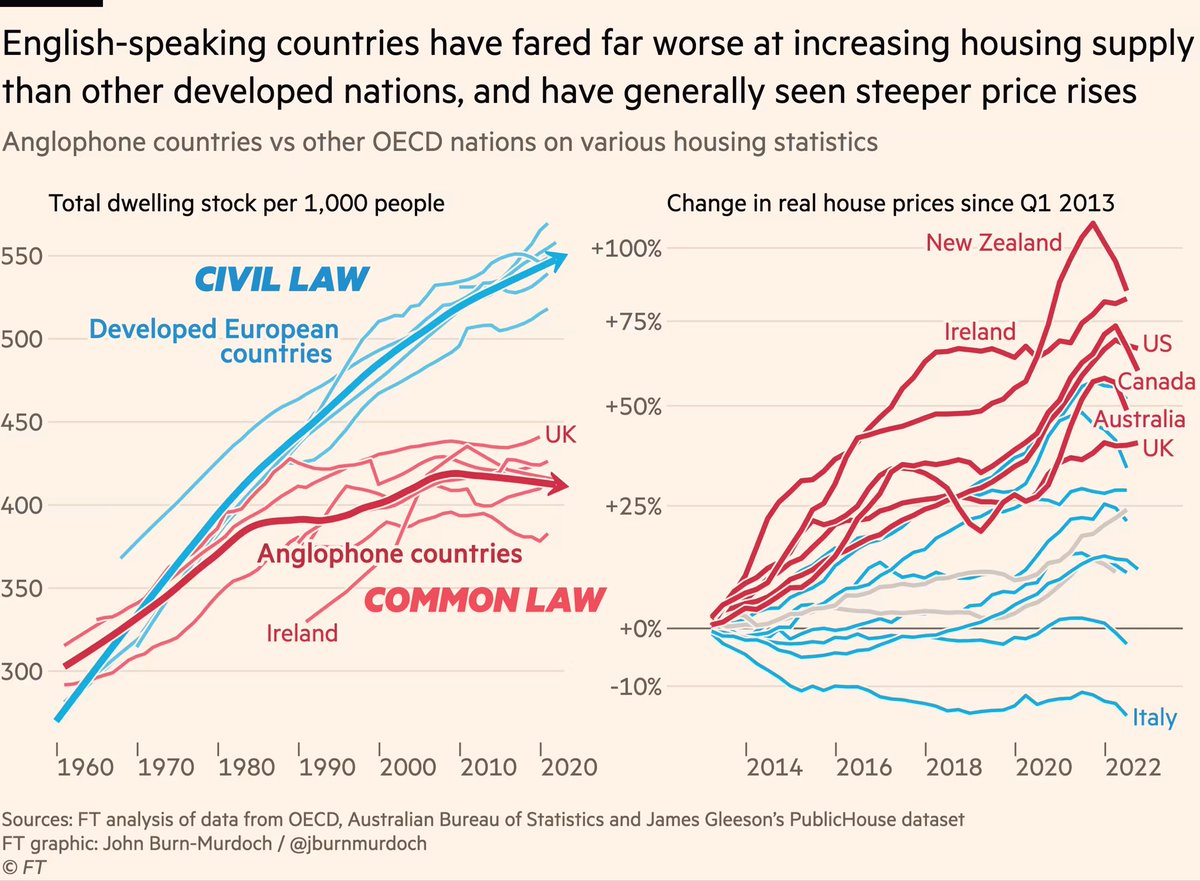
@jburnmurdoch Producing one chart when there are many competing explanations oversimplifies. I would want to see the impact after controlling for other explanatory variables. Did they do that?
English
1
0
6
450
John Burn-Murdoch
John Burn-Murdoch@jburnmurdoch·
Underrated factor in why English-speaking countries have especially bad housing crises is their common law systems (adversarial and litigious) vs judge-led civil law systems elsewhere. Makes Anglo planning/permitting systems especially vulnerable to NIMBYs and other objections.
John Burn-Murdoch tweet media
English
247
1K
6.8K
752.4K
Dr Patrick Morris O'Connor
Dr Patrick Morris O'Connor@PaddyHistoricus·
@jburnmurdoch Not exactly a clear relationship Stock is falling, but prices have plateaued When stock increased in the 90s, prices were surging Why do the graphs cover different periods? Where are the 60s-90s? Why is "25%" so big?? The presentation of these stats is almost satirically bad
English
0
0
0
18
Dr Patrick Morris O'Connor retweetledi
Wagie Capital
Wagie Capital@WagieCapital·
“AI wiLL RePlAcE eVeRy WhItE cOllAr JoB”
Wagie Capital tweet media
English
1.1K
8.5K
109.7K
4M
Dr Patrick Morris O'Connor
Dr Patrick Morris O'Connor@PaddyHistoricus·
@esjesjesj How could he fail them when he'd made such a good job of similar projects in Ogdenville, North Haverbrook and Brockway?
English
0
0
2
78
Dr Patrick Morris O'Connor
Dr Patrick Morris O'Connor@PaddyHistoricus·
When the terrorism legislation was framed under Blair, critics said the definition was too broad. The gov insisted that only bombers and kidnappers would be labelled as terrorists Channel 4 have now confirmed that people are now being defined as terrorists for damaging property.
Saul Staniforth@SaulStaniforth

Channel 4's 'Palestine Action, The Truth behind the ban' reveals that despite all the things the govt claimed & implied about PA (Iranian backed, violent, secret intel etc), the real reason they proscribed the group as terrorists was because PA was damaging property. Thats it.

English
0
0
0
20
Dr Patrick Morris O'Connor
Dr Patrick Morris O'Connor@PaddyHistoricus·
@mehdirhasan He is a technocrat with a thin veneer of left-ish rhetoric. The right hate him because of the rhetoric. The left hate him because the rhetoric is transparently negotiable and insincere. And nearly everyone hates him because technocracy has gone right out of fashion since 2008.
English
0
0
0
14
Mehdi Hasan
Mehdi Hasan@mehdirhasan·
I happen to think Starmer is useless and lacking in charisma, but I am still baffled at just how unpopular is. What is that makes him more unpopular than Liz Truss? Or Jim Callaghan?
English
1.4K
214
4.4K
792.1K
Elon Musk
Elon Musk@elonmusk·
Whoever said “money can’t buy happiness” really knew what they were talking about 😔
English
126.6K
59.7K
601.5K
111.7M
Dr Patrick Morris O'Connor
Dr Patrick Morris O'Connor@PaddyHistoricus·
@SophyRidgeSky Very astute point Sorry to be critical but I think your colleagues are far too willing to be cultivated, and even resentful when politicians fail to treat them like friends and confidents This was a big reason the Labour left could not get sympathetic coverage, schmooze deficit
English
0
0
0
85
Sophy Ridge
Sophy Ridge@SophyRidgeSky·
Peter Mandelson is obviously a very charming man. Funny, well connected, gossipy, you hear a lot of people talk about him with affection in Westminster. My own stand out memory of him is a little different. The first time I met him was at my first ever Labour Party conference, I was a trainee reporter in my early twenties.  In other words, I had no status or any connections really at all. And I guess the best way to put it, is that Peter Mandelson was dismissive rather than charming. The reason I'm saying this is because I think it goes to the heart of Westminster's problem, a problem that I believe is deeply connected to the Epstein scandal (in Epstein’s world status - connections - and money - was everything.) Because people who look at Westminster - in the same way as they might look at Washington - and think, this is a closed group of elites, who all know each other, who go to the same parties, and share the same in jokes... well, to a large extent, they are right. There are too many people in Westminster who look over the shoulder of the person they're talking to see if there's someone more important in the room. Status is everything... what stories can they give me... how can they further my career? The personal and the professional become blurred.  And Peter Mandelson is the embodiment of that. Charming, well connected, gossipy. In the inner circle.  If we're honest with ourselves, that's the reason he's been allowed to fail and then be rehabilitated so many times. It's the reason he was given the best job in politics - US Ambassador - despite being friends with a paedophile. And it's the reason he's had a softer landing than many others would have in his position.  A softer landing... until now. Because after the latest dump of Epstein emails, there really is no coming back. Not even for the most charming man in Westminster.
English
1.2K
1.2K
8.7K
1.1M
Dr Patrick Morris O'Connor
Dr Patrick Morris O'Connor@PaddyHistoricus·
@Mr_Andrew_Fox Just read your document. Just two mentions of under-counting, both in relation to combatant fatalities. You simply ignore the factors that might result in under-count of total fatalities, you don't even attempt to address them in any way. Your work is rank propaganda. Ironic.
English
0
0
0
47
Andrew Fox
Andrew Fox@Mr_Andrew_Fox·
This would be “news” if I hadn’t published a paper in *December 2024* pointing out that: 1) the list at the time was probably full of errors (Hamas agreed and deleted thousands of entries a few months later) and “70% women and children” was drivel; 2) Hamas overall totals were historically about right; 3) IDF killed combatant estimates were historically about right, and Hamas always hides combatant deaths during conflict and acknowledges them weeks/months later. I was right about everything, over a year ago. Shame on the world’s media for their abysmal reporting standards on deaths in Gaza. You can read the paper, here: henryjacksonsociety.org/wp-content/upl…
Andrew Fox tweet media
English
55
314
1.6K
105.5K