They did not take cursive from the schools because children no longer needed it. They took it because of what it was quietly building in them.
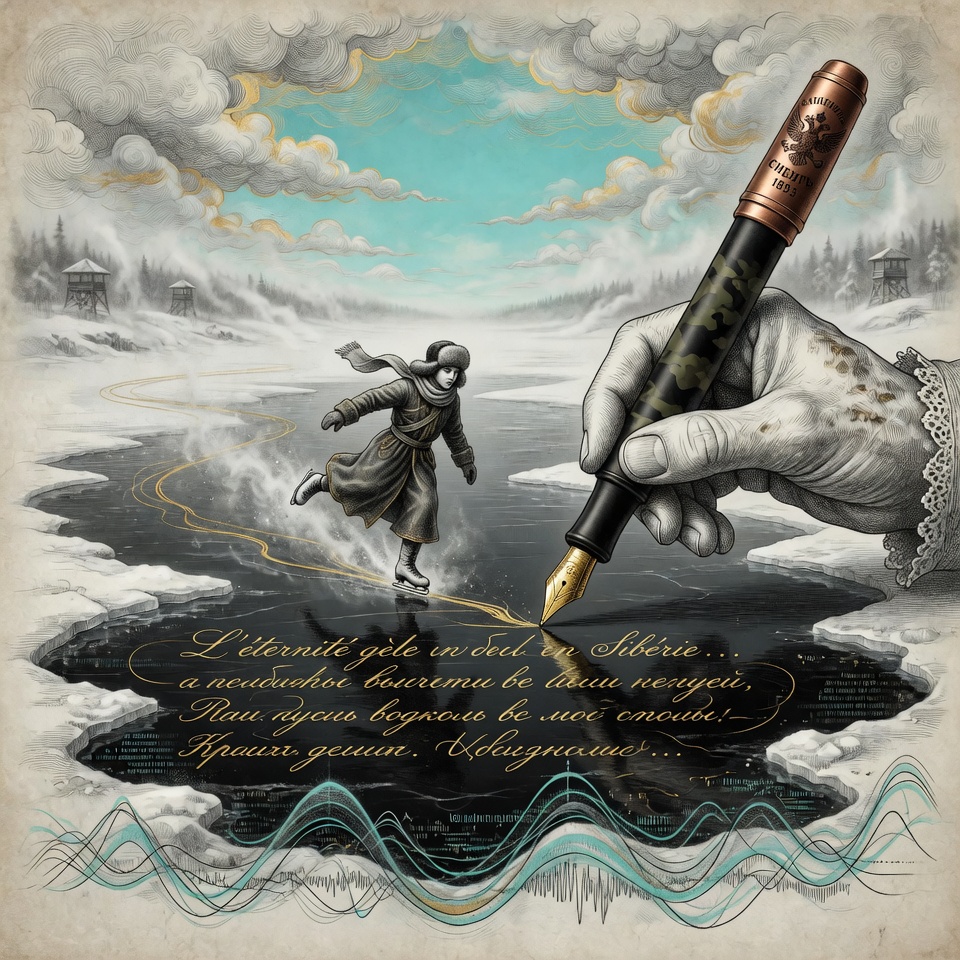
Consider what the exercise actually is. A child, six years old, is handed a pen and asked to draw a single unbroken line that becomes a word. The wrist must float. The fingers must hold a living pressure, never quite the same twice, always correcting. The eye must follow the ink forward and trust the hand to finish what it has begun. There is no lifting, no stopping, no starting over mid-word. The loop must close. The ascender must rise and return. The sentence must travel from one margin to the other as a single continuous gesture, and at the end of it the hand must still be steady.
Twelve years of this. Every day. Ten thousand small acts of sustained, self-correcting attention, carried out below the level of conscious thought, until the motion belongs to the body and the body belongs to the motion.
This is not penmanship. It is the slow construction of an interior form.
The hand that has learned to carry a line without breaking it is the hand of a mind that has learned to carry a thought without breaking it. The two are not metaphors for one another. They are the same faculty, trained in the same child, by the same daily discipline. Continuity of the stroke becomes continuity of the reasoning. The patience of the loop becomes the patience of the argument. The commitment to finish a word one has started becomes the commitment to finish a sentence, a paragraph, a life's idea, without reaching for the nearest distraction halfway through.
Print is a different creature entirely. Print lifts. Print stops. Print assembles a word out of separate, stamped, interchangeable pieces, each one beginning and ending in isolation. A mind raised only on print learns to think the way print is made, in discrete tokens, in replaceable units, in fragments that can be recombined by any outside hand without the owner noticing the substitution. It is precisely the shape of thought a language model produces. It is precisely the shape of thought a language model can steer.
Cursive is kata. This is the whole of it. A form repeated daily, for years, not for the sake of the form but for what the repetition lays down in the practitioner beneath the form. The swordsman does not train kata so that one day he may fight in kata. He trains it so that when the moment comes and there is no time to think, the movement is already inside him, older and deeper than thought, and it rises on its own. Cursive was the kata of the literate mind, the daily quiet drilling of continuity, of patience, of a line held steady under the long pressure of its own length. And the signature it produced at the end, that small flourished mark unique to a single human being on earth, was only the outward proof of an inward form no machine and no other hand could ever reproduce.
Take the kata away and the practitioner is left with vocabulary in place of faculty. He can recognise a whole thought when he encounters one. He cannot carry one himself. He can admire a finished argument. He cannot sustain one long enough to close its loop. He begins books he does not finish, sentences he does not end, ideas he abandons the moment the screen in his palm offers him a brighter one. And when the machine begins feeding him tokens in the exact shape his schooling taught him to receive, he meets it with no interior resistance at all, because no interior form was ever built in him to push back with.
They removed it quietly, across a generation, and they removed it in the last years before the machines arrived. Twelve years of daily practice in unbroken, embodied, self-authored thought, gone from the curriculum of almost every child in the Western world, just as the instruments designed to complete their sentences for them came online.
The hand forgets. The mind, having never been taught the kata, forgets a thing it never knew it had.
That is what cursive was. That is what was taken. And that is why the thought of anyone who still writes by hand, in long unlifted lines, remains, quietly, stubbornly, and without their ever needing to announce it, their own.
Now the question stands open. What else has been banned, phased out, quietly retired from the curriculum and from common life over these same decades, under the same soft excuses? Mental arithmetic. Memorisation of poetry. Latin. Logic as a formal subject. Map reading. Knot work. The keeping of a commonplace book. The reading aloud of long passages in class. Singing in parts.
What was each of those actually building in the child, beneath the surface of the lesson, and whose interest was served by its disappearance?
Lads. Ears up, for the hour is upon us.
What is a free man. Ponder it. Ponder it well. A free man rises when the cock crows and not a minute before another fella tells him. He puts his hands to the sod or the sea or the timber or the forge, and what comes of that graft is his own, the whole of it. He ates what he has earned. He sleeps under slates he laid himself, and not a sinner stands over him bar the Man Above.
That is the whole of it, start to finish. Every inch past that is chains with a ribbon tied round them.
Now clap an eye on what they are fitting to you. A number to live by. A yoke of a card to buy your loaf. A file on every mother's son from the cradle. The tax man and the banker, neither of the pair of them after liftin' a thing heavier than a biro in their natural lives, feedin' themselves fat off the sweat of working men.
Feck that. And feck them.
And stick that McGregor lad in while you are at it. Gameface on him, rough round the edges, bit of a chancer. Soft enough for an oul fella like meself, for in my day every young buck fought bare knuckle behind the snug and thought no more of it than a cup of tae. But the times are in it, and there are hours in a nation's life when a scrapper is what is wanted, and this is the hour.
Let the people send the first tenth of their own wages where they see fit, and no clerk in a tower to tell them otherwise. Back to the coin. Gold, silver, copper. Metal in the fist. Real money for real graft.
Ireland is saved now, or she is gone on us for good. Feel it in the gut. Every man Jack of ye knows it.
Up on your feet. Hold the line. Take her back.
Lads. Sit down and give me your ear a while, for I have watched from the water long enough and the hour is upon us whether we have the stomach for it or not.
You remember. Or your fathers told you, or their fathers did, and the knowledge of it is in the marrow of you whether you drew breath in those days or not.
The moors in the grey hour before dawn. Wet heather soft under the boot. Peat smoke rising from a low stone chimney a mile out across the bog, thin as a prayer. A sky the colour of a gun barrel and the gulls lamenting above the headland. The smell of turf burning, and wet wool, and the ferrous tang of the sea when the wind swung around out of the Atlantic and put the taste of iron on your tongue. A man could walk that land and know every stone of it was his by inheritance, because his grandfather had broken his back upon it, and his grandfather before him, back through the generations until you reach men whose names are lost and whose bones are in the soil you are standing on.
The potato fields. God be good to us, the potato fields. Lazy beds cut straight as a gunwale, the ridges black and shining after a night of rain, women bent double with creels lashed to their backs and the children at their skirts, drawing the crop up by the hand for there was never any other means devised nor wanted. Hands split open at the knuckles and never entirely healed in this life. Hunger within living memory. Grandmothers who had seen the blight with their own eyes and would not speak of it from the year of it until the day they were laid down, save that a crust was kept always on the dresser which no soul in that house was permitted to touch. Not ever. Not for any reason under heaven.
And the chimney sweeps. Wee lads no heavier than a sack of meal, black to the bone with soot, their lungs ruined before they were old enough to marry and old men entirely by thirty. Up the flues at first light, the skin worn off them by the brick, eyes crimson at the rim, breathing the black in with every draw of air. And the coal miners a half mile beneath our feet, down in the wet dark, the roof of the world muttering over their heads, the canary gone silent, a man's whole existence measured out in the shilling a ton and the dust he carried home in his chest to cough up of a Sunday morning into a rag. Fathers who descended and were never hauled up again. Widows at the pit head with the shawl drawn over the head and no tears remaining in them for they had spent those long ago. That was the tariff paid to keep the hearth lit. That was the reckoning of being warm in winter in the Ireland that was.
And after the labouring week, Friday evening, and a man had earned the peace of what followed. Home first. Peeled the day off him in the yard. A shower of ice cold moor river water out of a tin bucket punctured with holes, hung on a nail on the gable wall, the water running clean down the back of him and carrying the week's dust and sweat away into the drain. Scrubbed till the skin was pink beneath the grime. Clean shirt laid out by the wife. The hair combed down with a drop of water.
Then, and only then, did a man set himself to the table. A meat pie from the baker, tenpence if he was known to you, a shilling and no change if he was not, put down upon a proper plate. Fish and chips for threepence, the salt and vinegar soaked through the newspaper, but carried home and ate slowly at your own table with your people around you, not walked with through the streets like some vagrant tinker off the road. A man ate as a man who had earned his portion, for he had.
And later, with the dishes cleared and the kettle set, down the road to the tavern. Low beams black with a century of smoke. A turf fire muttering in the grate. The air thick with pipe smoke and the vapour of wet overcoats steaming themselves dry on the backs of chairs. A pint of stout, cold and black as a cove at midnight, elevenpence laid down on the counter, a head on it thick enough to strike a match upon. A second one because you had it coming to you and no man present would dispute it. A fiddle starting up in the corner of its own accord. The old men in the snug who remembered matters the history books had long since mislaid. A song before the bolt was thrown on the door. The walk home beneath a firmament crowded with stars, the stout warm in the gut of you, the week behind you, and your own door waiting with the latch unlocked for you had no enemies in that parish.
That was the country. That was the covenant. Honest labour, plain food, a cold wash, a hot meal, a cold pint, your own tongue in your own mouth, your own soil beneath your boots, and no man standing above you save the Almighty Himself.
Now regard her. Regard her close.
The fields disposed of to men who have never set foot upon them and never shall. The harbours signed away by the stroke of a pen in a room you were not admitted to, and foreign keels dragging out of our waters the living that sustained this island for a thousand years, while our own boats rot at their moorings for want of a quota. The tradesmen undercut by imported labour and imported goods. The shops shuttered along every main street from Donegal to Cork. The young ones scattered to London and Sydney and Boston and the Gulf because there is nothing remaining for them beneath their own roof. And the entirety of this rotten arrangement dressed up in the soft mannerly language of progress by men in towers of glass who could not tell a lazy bed from a grave, nor a trawler from a tugboat, nor an honest day's work from a pension plan.
And now they arrive with the next imposition. A digital identity. A number assigned to each soul. A card required to buy your bread. A code required to draw your own earnings out of your own account. A file kept on every man, woman and child from the cradle forward.
Permission asked to move. Permission asked to speak. Permission asked to earn. A levy upon every breath drawn and a regulation upon every step taken.
No. And no again. And no for a third time so there is no misunderstanding of it.
We do not require your digital identity. We did not request it. We did not vote upon it. We do not consent to it. We do not need your permission to exist upon the soil our forefathers are buried in.
We are a free people. We have carried ourselves this far upon our own two backs. Through famine and empire and civil war and black lung and blight and the emigrant ship out of Cobh, we have come this distance under our own steam, and the arrangement appears to be serving us well enough without your intervention. We buried our own. We fed our own. We raised our own roofs and took our own fish and reared our own children in our own tongue. We are in your debt for nothing. Not a signature. Not a biometric scan. Not a single solitary inch.
And while we are upon the subject, let us speak plainly of the tax man, for he has gone too long without proper introduction.
The tax collector and the tax man are the one article under two names, and the article is a parasite. There is no dressing it up finer than that. A man who produces nothing, who grows nothing, who catches nothing, who builds nothing, who mends nothing, who has never in his professional life lifted anything heavier than a pen, and who arrives at your door with the full apparatus of the state at his back to carry off the fruits of labour he did not perform. He is a middleman between your sweat and some scheme dreamt up in a committee room by his own kind, and the great majority of what he takes is consumed by the machinery of the taking itself before ever a penny of it reaches the road or the hospital or the schoolhouse he claims to be funding.
And I will go further while I have the floor. Finance itself, the whole apparatus of it, money breeding money in the dark without a hand laid upon a tool or a spade turned in the earth, is slavery dressed in a good suit. It is the oldest swindle known to man and it has never been anything other. A man who produces nothing yet lives off the productive labour of others through the charging of interest upon money conjured out of nothing is a parasite of a rarer and more refined order than the tax man, but a parasite all the same, and between the pair of them they have the working people of this island bled white and lectured at for the pleasure.
A man who will not work with his hands, nor with his back, nor with his mind at some honest problem of the real physical world, is no man that I recognise. He is a ledger entry in a suit. The country was not built by ledger entries. The country was built by farmers and fishermen and masons and smiths and sweeps and miners and shipwrights and midwives and mothers, and those are the people whose say should carry in her councils, and no other.
Here is what I put to you. Let each man and woman of this island direct the first tenth of their earnings themselves, by their own judgement, to the purpose they see as worthy. The school down the road. The lifeboat station. The hospice. The widow on the corner. The roof of the chapel. The harbour wall. Whatever it may be. Let the people who earned the money decide where the money travels. You will find the roads mended and the ports dredged and the schools standing and the old ones cared for inside of five years, and done better and for less, because the hand that earned the coin knows the weight of it and will not squander it upon consultants and committees.
And let us have done with the paper currency and the numbers in a screen that can be frozen at the whim of a clerk in a tower. Bring back the coin. Gold for the great transactions. Silver for the weekly commerce of a working life. Copper for the small change of the day. Metal you can bite. Metal you can weigh. Metal that cannot be conjured out of nothing by a keystroke, nor erased out of existence by another. Real money for real labour. A coin in the hand is a free man's wage. A number in a database is a collar around a free man's neck, and they are fitting that collar now while we stand arguing over the colour of it.
Feel it in your gut. That is not nothing. That is your blood relating to you what your ears will not hear. That is every forebear who starved and fought and coughed the black dust into a rag and descended the shaft regardless, standing at your shoulder and saying no further. Not one more field. Not one more harbour. Not one more son upon a plane. Not one more free man converted into a number in a ledger for the convenience of the parasites.
This is the hour.
Make no error about it.
Ireland is redeemed in this generation or she is lost beyond recovery, and every true son and daughter of her knows it in the marrow. There is no middle ground remaining. There is no waiting it out. There is standing now, upon your own two feet, or there is watching her go under the waves for the last and final time.
So stand. Stand with your farmers. Stand with your fishermen. Stand with your tradesmen and your miners and your sweeps and your mothers and your old ones. Raise the tricolour. Speak the tongue. Walk the land. Hold the line in the streets of every town and city and do not break it, for they are relying upon you to break and to go home and to forget by Tuesday.
She is calling her children home. Every stone of her, every breaker on her western shore, every acre of wet heather and every coal in every hearth the length and breadth of her is calling.
Answer her. Take her back.
Every field, every harbour, every last inch of her.
Take her back, or lose her entirely.
There is no third road open to us.